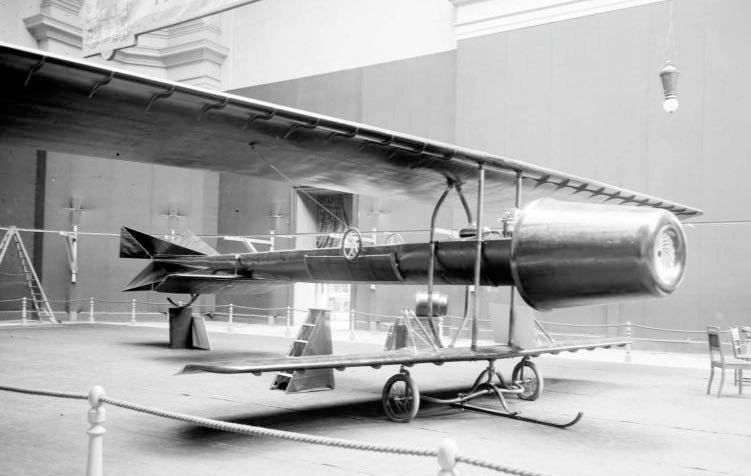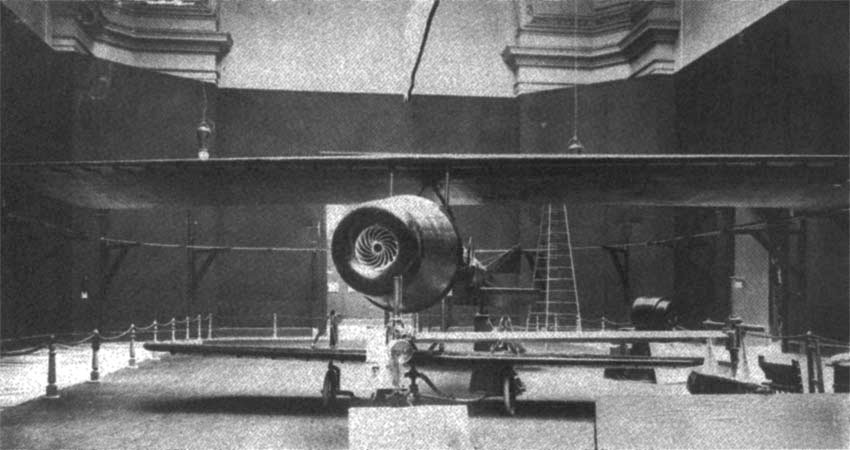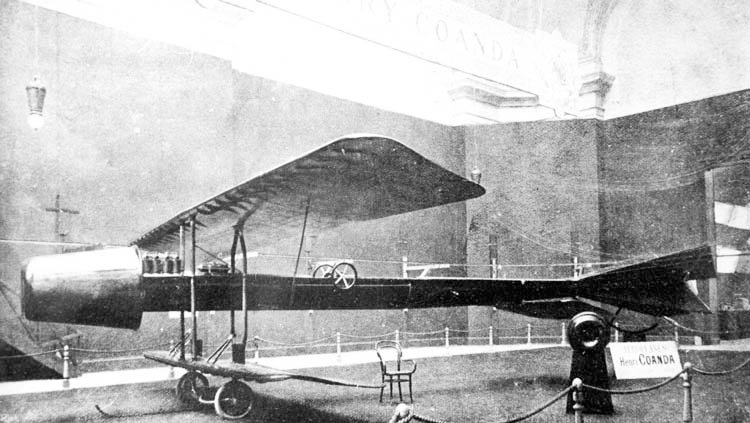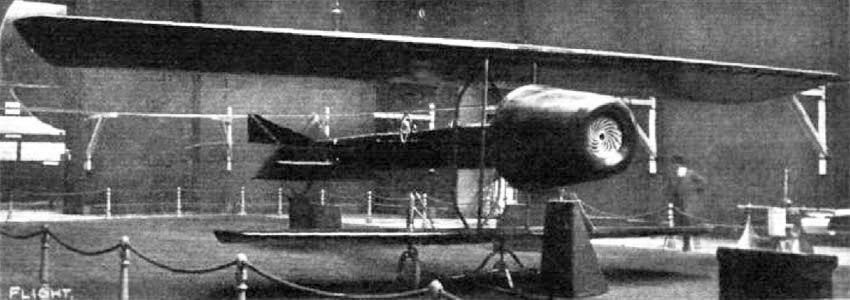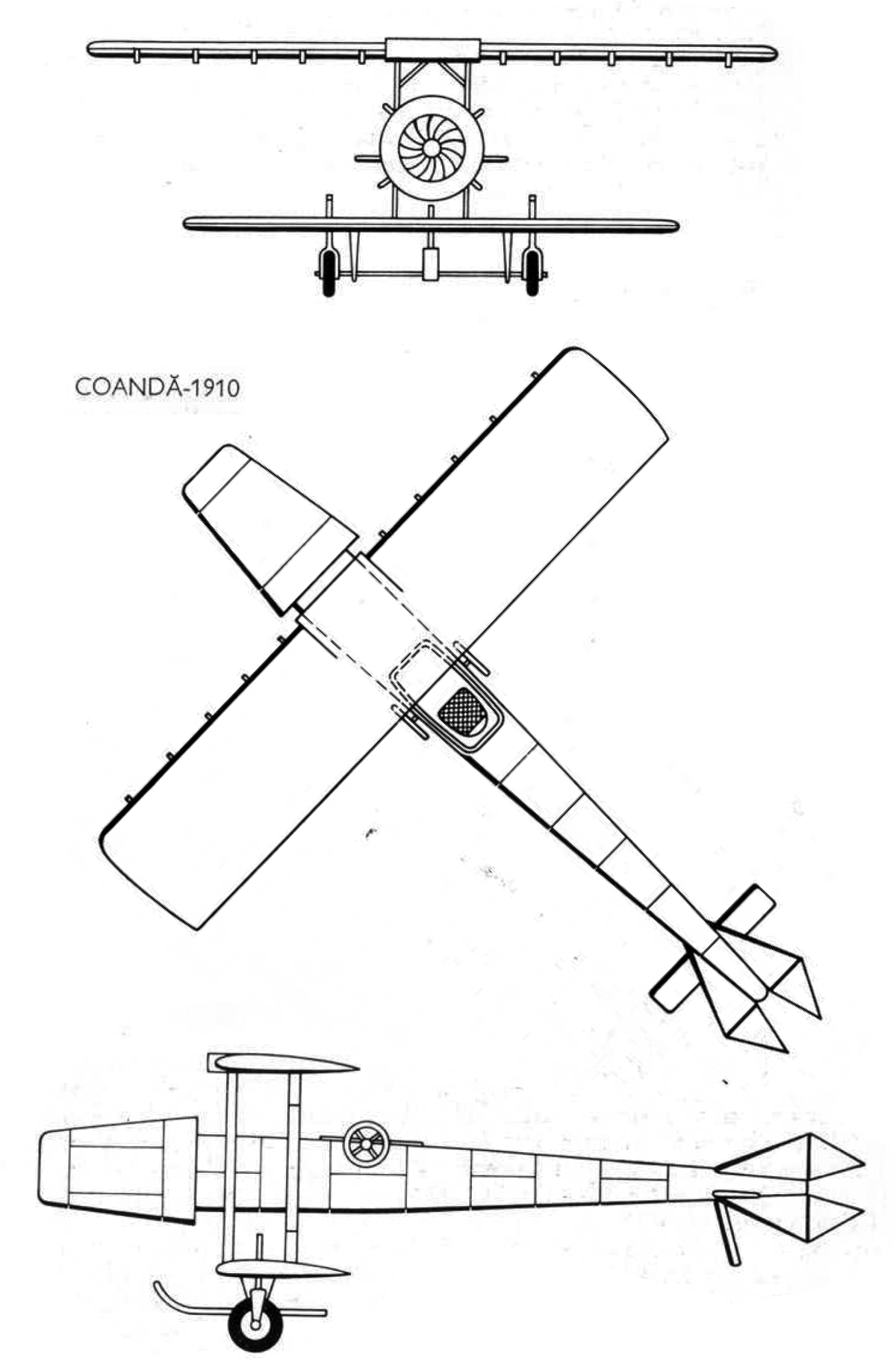
In 1910, the Romanian-born aircraft designer Henri Coandă built this peculiar apparatus in the Caproni workshops. What was most remarkable about it was its engine: a compressor, powered by a 4-cylinder, 50 hp Clerget gasoline engine, forced air into two combustion chambers located on the sides of the fuselage, where it mixed with fuel and burned. The fuel tanks were housed in the upper pair of wings, which was larger in area and slightly extended forward compared to the lower one.
An Innovative Propulsion Design
In October 1910, the aircraft was exhibited at the second international aeronautical exhibition in Paris, where the photo above was taken. The apparatus lifted into the air only once: on December 16, 1910.
On that day, Coandă was testing his brainchild at the Issy-les-Moulineaux airfield near Paris. According to his recollections, he did not intend to fly, but only wanted to check the propulsion system’s operation; however, an unexpectedly large and hot jet stream forced him to concentrate entirely on engine adjustment. Although the skin near the nozzles was metallic, there was a fear of fire. Moreover, according to legend, at that time the effect of a jet clinging to a surface, also known as the Coandă effect, could be observed.
The Involuntary Flight and the “Coandă Effect”
Meanwhile, the aircraft moved and gained considerable speed. When Coandă looked forward and realized he was rapidly approaching a wall, there was no time left to brake or turn. He had no experience flying an aircraft, so after the plane sharply pitched upwards, it flew a short distance and crashed onto its left wing. The “freshly minted” aviator did not become one in the literal sense: he was thrown clear upon impact with the ground, but the machine itself burned.
A Forgotten Pioneer, Yet with a Lasting Legacy
The project received no further development due to a lack of public attention and support from the scientific community and sponsors. Coandă later switched to propeller-driven aircraft and successfully continued his research in aerodynamics.
Technical Specifications
| Modification | Coanda 1910 |
| Wingspan, m | 10.30 |
| Length, m | 12.50 |
| Wing area, m2 | 32.70 |
| Maximum takeoff weight | 420 |
| Engine type | 1 Piston engine Clerget |
| Power, hp | 1 x 50 |
| Crew | 1 |
Image gallery of the Coanda 1910