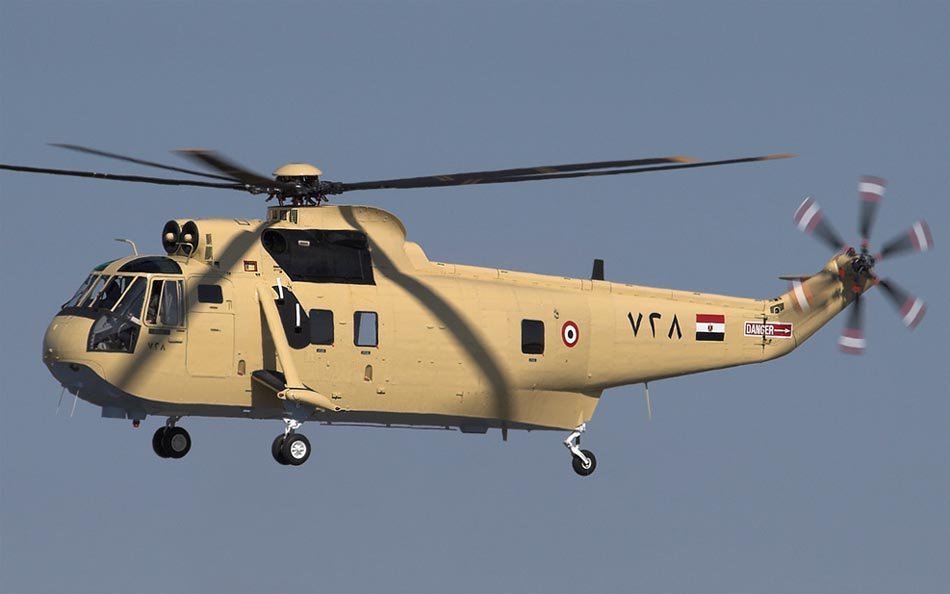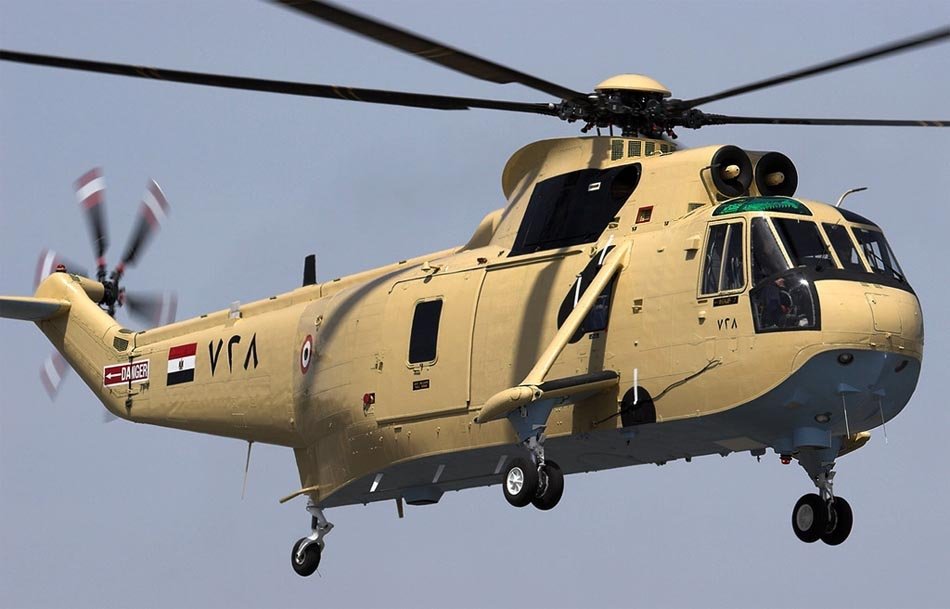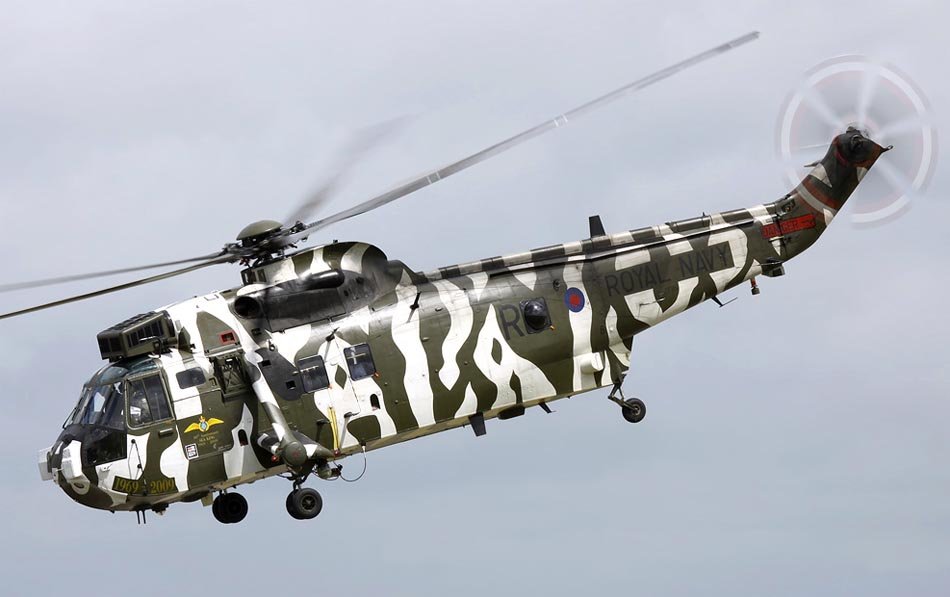
The Commando is a multi-purpose helicopter created by the British firm Westland, based on the Sea King naval helicopter (the British version of the Sikorsky S-61, designated SH-3 Sea King in the US Navy). The British Army, during negotiations to license produce the Sea King, showed definite interest in developing a transport modification.
However, generals later decided to adopt the Franco-British developed Puma medium transport helicopter and purchase heavy Chinooks from the USA. Nevertheless, Westland privately developed the ‘Commando’ variant (named by analogy with the Wessex Commando transport helicopter), intended for troop transport. The firm’s management hoped to convince the army command; the first helicopter even featured traditional green-brown camouflage. Simultaneously, the British Royal Navy also required a transport helicopter.
Development and Early Sales (Mk1)
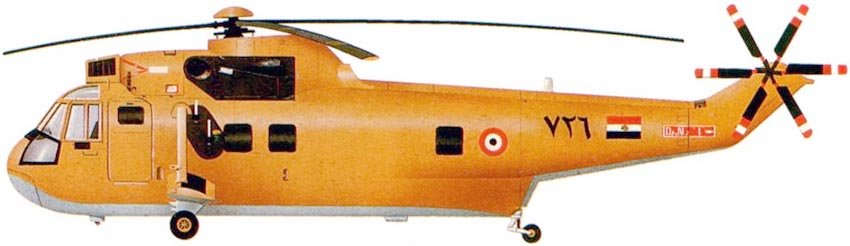
Work on the project began in 1972. The first buyers of the new aircraft were not the British, but the Egyptians. The Commando Mk1 model itself (Egyptian designation Mk70) was not yet the definitive ‘Commando.’ The Mk1 was a minimally converted HAS.Mk1 transport.
The helicopter had its radar, sonar, and some other electronic equipment dismantled, which increased cargo cabin volume and fuel capacity. However, the folding mechanism for the main rotor blades and tail boom was retained. The first British transport based on the Sea King flew on September 12, 1973, with deliveries to Egypt beginning in January 1973.
The Commando Mk2 and its Expansion
After successfully selling the Commando to Egypt, Westland’s managers completely reoriented their marketing strategy for the transport variant, focusing on its export to countries in the Middle and Far East. The subsequent Mk2 model incorporated structural solutions that improved flight characteristics in hot and high-altitude conditions.
These solutions had already been tested on the Mk50 anti-submarine helicopter, intended for Australia: more powerful H1400-1 engines and a six-blade tail rotor. Considering future operations in desert conditions, the helicopter was equipped with filters at the air intake.
The Commando Mk2 largely shed its ‘marine’ past and became a full-fledged transport helicopter. The rotor blades and tail boom were no longer foldable. The design of the main landing gear changed: transverse struts with floats at the ends were replaced with small wings, and the floats were removed. The landing gear was non-retractable.
As a result, the weight of the landing gear decreased, and it became possible to suspend armament or additional fuel tanks under the wings. However, in real conditions, these hardpoints were never used. The helicopter was used for transporting people and goods, not for fire support of ground troops. An attempt to adapt the Sea King for this purpose also failed across the Atlantic.
The cargo cabin had 28 seats, and in overload, the helicopter could carry 34 soldiers. In 1974, Saudi Arabia signed a contract for the supply of 42 Commando Mk2s. Mk2s also entered service with the armies of Egypt and Qatar, with both states purchasing two ‘Luxury’ variant helicopters for VIP transport, in addition to their military transport Commandos.
For Egypt, four Commando Mk2E electronic warfare (EW) variants were built, equipped with Selenia IHS-6, RQH-5(V), and TQN-2 apparatus. Externally, this variant was easily distinguished by its antennas protruding in different directions. The first Mk2E flight took place in September 1978. After two years of refinement and testing of the electronic equipment at the English proving ground in Aberporth, the helicopters were delivered to Egypt in 1980.
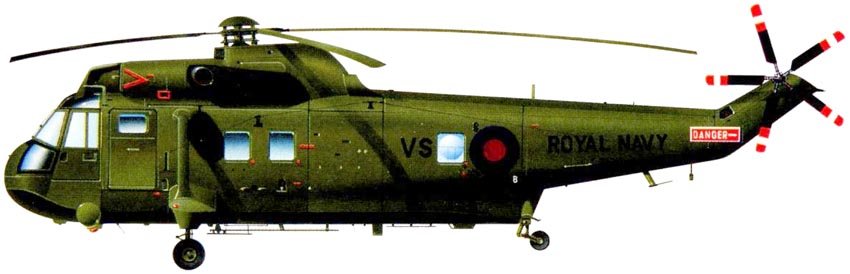
In 1978, Britain also decided to acquire some ‘Commandos’. The Royal Navy required 42 helicopters to replace its Wessex transports.
In terms of design and equipment, the Sea King HC Mk4 variant was analogous to the Commando Mk2, with only the radio communication equipment borrowed from the Sea King Mk5 helicopter. The first batch of nine helicopters was delivered to the fleet in September 1981.
The Commando Mk3 and its Naval Role
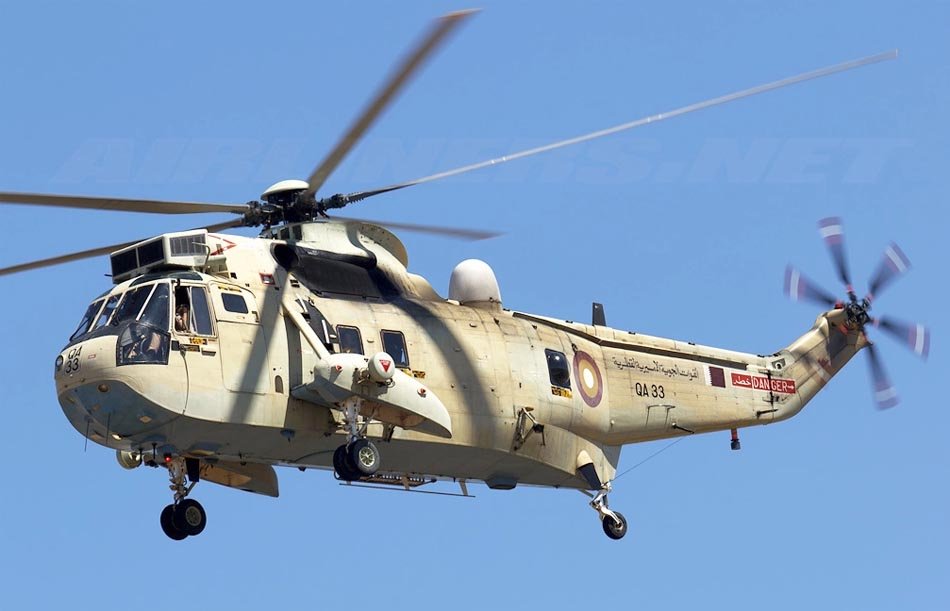
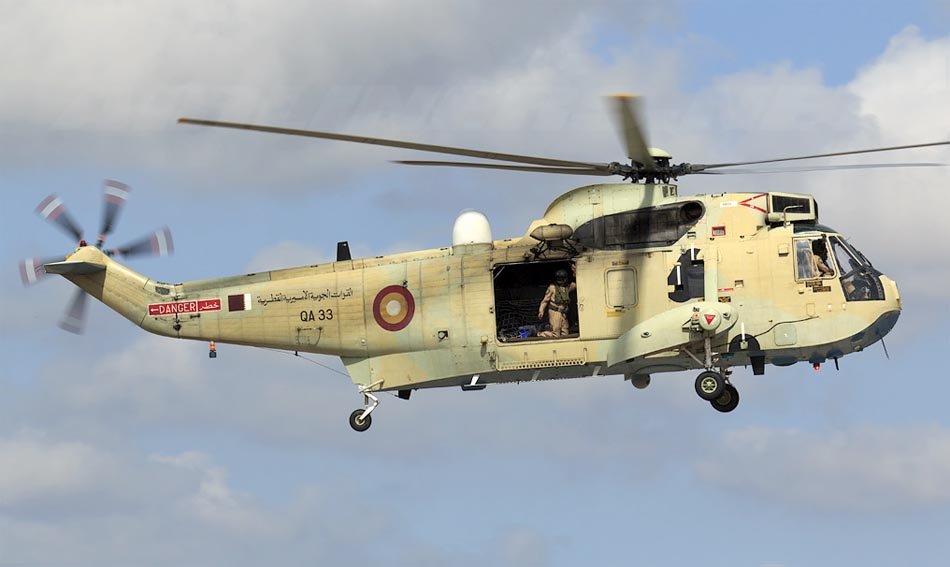
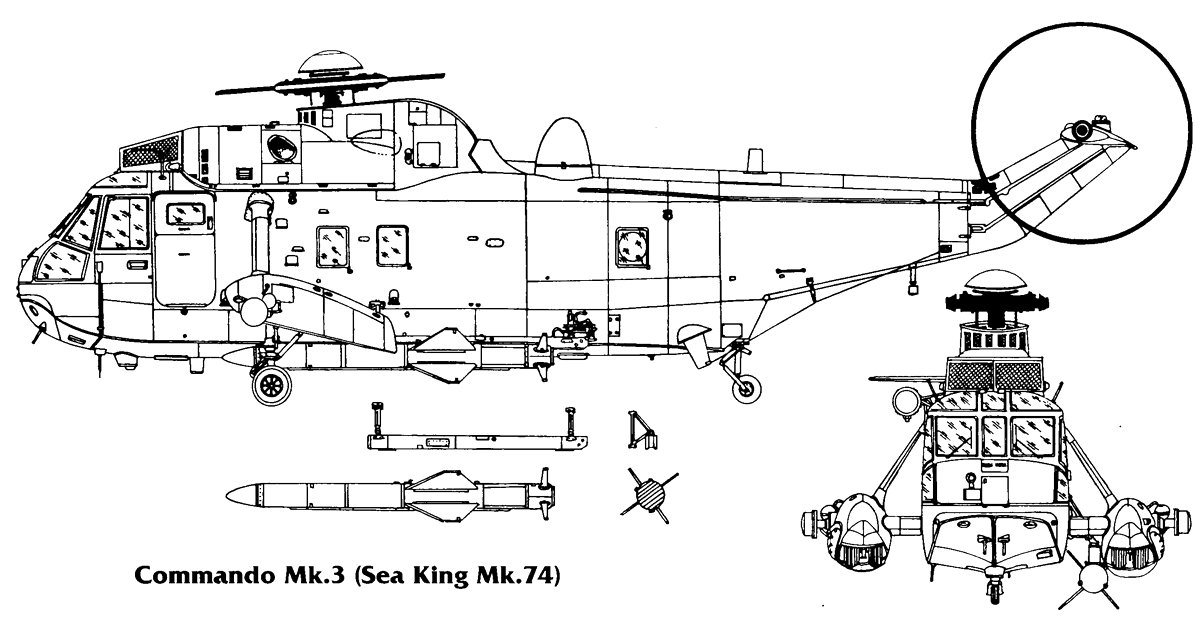
The last Commando variant, the Mk3, was created specifically for Qatar. The Mk3 reintroduced design details characteristic of naval Sea Kings: retractable landing gear with floats and a folding tail boom. The circle had closed. This was due to the helicopter’s primary role in the Qatari army: anti-surface warfare.
Typical combat missions involved extended flights over the sea, hence the need to ‘marinize’ the semi-land-based Commando. In the early eighties, the Persian Gulf was the hottest spot on Earth. Iran and Iraq waged the ‘Tanker War,’ and all major world powers observed it from their battle fleets.
Commando Mk3s, armed with French AM.39 Exocet anti-ship missiles (or ATGMs in principle), could, if necessary, reliably blockade the Strait of Hormuz. While other types of missiles could theoretically be used, the Exocet was the most popular at the time, having been successfully employed by Argentina against Britain and Iraq against Iran. This publicity influenced Qatar, which demanded its helicopters be equipped with this specific weapon system.
The first of eight Commando Mk3s (Mk74) was delivered in 1982, with the last arriving in 1984.
Technical Specifications
| Modification | Commando Mk.2 |
| Main rotor diameter, m | 18.90 |
| Tail rotor diameter, m | 3.16 |
| Length, m | 22.15 |
| Height, m | 5.13 |
| Empty weight | 5620 |
| Normal takeoff weight | 9025 |
| Maximum takeoff weight | 9525 |
| Internal fuel, l | 3714 + optionally 864 |
| Engine type | 2 Rolls-Royce Gnome H.1400-1T turboshaft engines |
| Takeoff power | 2 x 1238 |
| In-flight power | 2 x 1092 |
| Maximum speed, km/h | 222 |
| Cruising speed, km/h | 200 |
| Practical range, km | 1240 |
| Combat radius, km | 396 |
| Rate of climb, m/min | 619 |
| Service ceiling, m | 3900 |
| Static ceiling, m | 1525 |
| Crew, crew members | 2 |
| Payload | 28 soldiers standard (45 soldiers maximum) or 9 stretchers and 2 attendants or 2722 kg of cargo in cabin or 3629 kg of sling load. |
| Armament (optional) | one 20-mm cannon or 12.7-mm or 7.62-mm machine gun. Combat load – 1134 kg on 2 hardpoints: 2 pods with 20-mm cannon or 12.7-mm machine gun, or 2 launchers for 68-mm, 70-mm, 80-mm, or 81-mm unguided rockets (НУР). |
Image gallery of the Westland Commando