Alexander Vasilyevich Belyakov
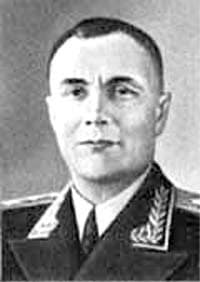
Born December 9 (21), 1897, in Bezzubovo village, now Noginsk District, Moscow Oblast. He spent his childhood and youth in Ryazan. From 1915-1916, he studied at the Petrograd Forestry Institute.
Belyakov joined the army in 1916. In 1917, he graduated from the Alexandrovsky Infantry School in Moscow and participated in the Civil War as part of the 25th Rifle Division (Eastern Front). In 1921, he graduated from the Moscow Aerophotogrammetric School, where he subsequently worked as a teacher.
From 1930-1935, he served as a lecturer and head of the Department of Aeronavigation at the N.E. Zhukovsky Air Force Academy. In 1936, he successfully completed the Kachin Military Aviation School for Pilots as an external student.
Pioneering Transcontinental Flights
From July 20-22, 1936, Belyakov served as the navigator on an ANT-25 aircraft (with V.P. Chkalov as commander and G.F. Baidukov as co-pilot) for a non-stop flight. The journey stretched from Moscow across the Arctic Ocean and Petropavlovsk-Kamchatsky to Udd Island (now Chkalov Island, at the Amur estuary), covering 9374 km in 56 hours and 20 minutes.
For his successful execution of this demanding flight and the extraordinary courage and heroism demonstrated, he was awarded the title of Hero of the Soviet Union on July 24, 1936.
On June 18-20, 1937, he again served as navigator on the ANT-25 aircraft (with Chkalov and Baidukov) for another historic non-stop flight. This journey took them from Moscow, over the North Pole, to Vancouver, USA, covering 8504 km in a straight line over 63 hours and 16 minutes.
Military Service and Post-War Contributions
Between 1936 and 1939, Belyakov held the position of flag-navigator for Special Purpose Aviation (AON), and from 1939-1940, he was flag-navigator of the RKKA Air Force. Starting in 1940, he became Deputy Head of the Air Force Academy in Monino, later serving as Head of the Ryazan Higher School for Air Force Navigators.
He actively participated in the Great Patriotic War, notably taking part in the Battle of Berlin in 1945 as the chief navigator of the 16th Air Army. His expertise proved crucial during this pivotal operation.
From 1945-1960, he led the navigation faculty of the Air Force Academy (now named after Yu.A. Gagarin), shaping future generations of navigators. He retired from military service in 1960.
Academic Legacy and Honors
Following his retirement, Belyakov became a professor at the Moscow Institute of Physics and Technology in 1960, where he headed the military department. He was a prolific author of scientific works focusing on aeronavigation.
Alexander Belyakov resided in Moscow until his death on November 28, 1982. He is interred in Moscow’s prestigious Novodevichy Cemetery. He achieved the rank of Lieutenant General of Aviation in 1943 and earned a Doctor of Geographical Sciences degree in 1938.
His numerous accolades include two Orders of Lenin, three Orders of the Red Banner, the Order of the Patriotic War 1st degree, two Orders of the Red Banner of Labor, and three Orders of the Red Star, alongside various medals. An island in the Sea of Okhotsk and streets in Moscow and other cities bear his name, commemorating his indelible contributions.
ArchivoAéreo Editorial Team
A group of aviation researchers and enthusiasts dedicated to documenting and preserving global aeronautical history. All articles are reviewed to ensure historical accuracy.
Sources & Accuracy
The information presented in this technical sheet has been compiled from declassified flight manuals, historical archives, and specialized literature. While we strive for maximum accuracy, some performance data may vary depending on the specific variant or operational conditions.