Be-210
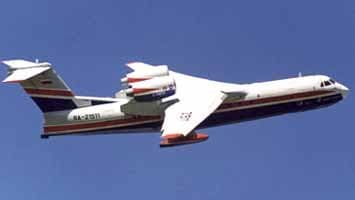
The Be-210 is a passenger amphibian aircraft designed for local airlines, developed by the TANTK G.M. Beriev Aircraft Company. This aircraft is a passenger modification of the multi-purpose Be-200 amphibian, offering an efficient solution for regional transportation needs.
Cabin Design and Capacity
The Be-210’s cabin was equipped in collaboration with the British firm AIM AVIATION (FLITEFORM). Its spacious passenger cabin, with a volume of 84 cubic meters (17×2.6×1.9 m), can accommodate 72 passengers with seats pitched at 0.75 meters.
This aircraft has been designed in accordance with AP-25 airworthiness standards, which are equivalent to the FAR-25 regulations of the U.S. Federal Aviation Administration (FAA). This ensures high standards of safety and performance for the aircraft.
Advanced Avionics and Propulsion
The Be-210 features the new “ARIA-200” flight-navigation complex, a joint development and production of the Russian-American enterprise ARIA (Scientific Research Institute of Aviation Equipment and AlliedSignal Aerospace). This advanced system ensures precise navigation and flight control at all stages and in any meteorological conditions.
It is powered by two D-436T-1P turbofan engines, each with 7500 kgf of thrust, manufactured by the Ukrainian Motor-Sich enterprise from Zaporizhzhia. Additionally, there is an option to install BR-715 type engines (BMW-Rolls Royce) at the customer’s request, providing flexibility and robust performance.
Technical Specifications
| Modification | Be-210 |
| Wingspan, m | 32.70 |
| Aircraft length, m | 32.50 |
| Aircraft height, m | 8.90 |
| Wing area, m2 | 117.44 |
| Empty weight | 22340 |
| Maximum takeoff weight | 42000 |
| Engine type | 2 Turbofan D-436T-1P |
| Thrust, kgf | 2 x 7500 |
| Maximum speed, km/h | 790 |
| Cruising speed, km/h | 750 |
| Ferry range, km | 3600 |
| Practical range, km | 2000 |
| Service ceiling, m | 10000 |
| Crew | 2+2 |
| Payload | 72 passengers or 8000 kg of cargo |
ArchivoAéreo Editorial Team
A group of aviation researchers and enthusiasts dedicated to documenting and preserving global aeronautical history. All articles are reviewed to ensure historical accuracy.
Sources & Accuracy
The information presented in this technical sheet has been compiled from declassified flight manuals, historical archives, and specialized literature. While we strive for maximum accuracy, some performance data may vary depending on the specific variant or operational conditions.