Be-8
Development and Early Flights
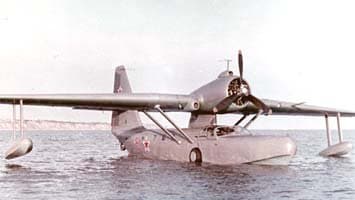
The Be-8 amphibious aircraft completed the family of seaplanes that began in 1941 with the KOR-2 (Be-4) reconnaissance aircraft. Despite being highly rated by specialists, the Be-8 did not enter serial production for various reasons and was mostly used as a flying laboratory. Work on it began in 1946, based on the technical design of the KL-145 shipborne reconnaissance aircraft.
Unlike its prototype and other predecessors, which were catapult-launched reconnaissance aircraft, the new single-engine amphibian was designed primarily as a civil multi-purpose aircraft. It could be used as a liaison, passenger, ambulance, training, and aerial survey aircraft, as well as an ice and fishing reconnaissance aircraft. On March 11, 1947, USSR Council of Ministers Resolution No. 493-192 was issued for the construction of aircraft “A” (the OKB called this amphibian “Annushka”).
The pace of work was quite high even for that time; on July 8, 1947, the mock-up commission met, and on November 22 of the same year, even before the official presentation of the aircraft for factory flight tests, the first high-speed water taxi run was conducted. It was repeated a day later, and it turned out not to be in vain — the tail section between frames №23 and №29 had to be urgently strengthened, and anti-flutter weights were installed on the wing consoles. On December 3, 1947, the Be-8 made its first 25-minute flight from water.
The crew that lifted the amphibian into the air consisted of test pilot M.V. Tsepilov and flight engineer D.Y. Chernetsky. Two weeks later, on December 15, Lieutenant Colonel S.B. Reidel, Deputy Head of the Naval Aviation Flight Service Department, and Major N.F. Piskarev flew the aircraft “A”. In his flight report, S.B. Reidel wrote: “The aircraft is simple to fly and accessible even to a pilot of less than average qualification, i.e., a pilot flying a Po-2 or UT-2. It can be fully utilized as a liaison and training aircraft.”
On the last day of 1947, taxiing and runs began on the dirt runway of the factory airfield in Taganrog. Test pilot M.V. Tsepilov’s conclusion was quite positive, though he noted that the raised nose of the hull obstructed the pilot’s “forward-right” view, requiring him to taxi “in a snake-like manner,” like a fighter. On February 11, 1948, Tsepilov and Chernetsky first took the aircraft off from land and performed a 20-minute flight.
Test flights from land and water continued throughout the winter and spring. On March 18, 1948, the testers reported full completion of the program. In his report, M.V. Tsepilov noted that the amphibian could be submitted for state tests, and “the high seaworthiness qualities achieved by the Be-8 amphibian, its excellent flying characteristics, and the permissibility of carrying additional passengers and cargo under overload provide grounds to consider it expedient to develop a number of Be-8 amphibian modifications: a patrol variant, a training variant, and a transport variant.”
On May 5, 7, and 9, control and acceptance flights from land and water were carried out by a crew from the Navy Aviation Research Institute, consisting of test pilot Lieutenant Colonel F.S. Leshchenko and flight engineer Captain S.I. Ponomarev. In the act based on the results of the control state tests, test pilot Lieutenant Colonel Ivanov of the Navy Aviation Research Institute made the following conclusions: “The aircraft is simple to fly and accessible to a pilot of average qualification. The aircraft can be successfully used in all recommended variants. When using the aircraft in the training variant, it is necessary to install duplicated control of the propeller-engine group for the right pilot.”
The same act noted: “The Be-8 aircraft is simple to operate and can be serviced by one mechanic and one engine technician. Access to the engine group components and their inspection are convenient, with the exception of the generator.” Despite successfully passing tests and receiving positive feedback from testers, “marrying off ‘Annushka’,” as Georgy Mikhailovich Beriev sadly joked, did not succeed. Neither military nor civilian customers were interested in the aircraft.
In addition to the first aircraft, another amphibian specimen was built, which first flew in January 1949. The second Be-8 had some differences from the first prototype. In particular, the electromechanical landing gear retraction and extension system was replaced with a hydraulic one. Instead of the AV-29E-81A propeller, an experimental AV-29V-81A propeller equipped with an anti-icing system was installed, along with trimmers on the ailerons and pneumatically controlled frontal engine cowl flaps.
Quest for Bases and Experimentation
Both Be-8s remained at the factory parking lot for some time. In 1949, on one of these machines, piloted by M.V. Tsepilov and S.I. Kondratenko, chief designer G.M. Beriev, accompanied by I.G. Kozelsky, made several flights over the Black Sea coast of the Caucasus in search of an ice-free water area for a test base. Until then, all OKB aircraft were tested only in Taganrog, and when the bay froze, a “dead season” began for seaplanes. However, the volume of work grew, and the need for a branch of the flight test station in a year-round ice-free water area became acutely apparent.
Beriev chose Gelendzhik Bay. It met all the main requirements, and moreover, naval aviation units had been stationed on its western shore during the war, leaving behind a concrete slipway. Soon, buildings for the flight test base services were constructed in Gelendzhik, and testing proceeded without seasonal interruptions.
But the Be-8 entered aviation history not only thanks to the “discovery” made from its board. On it, within the framework of the scientific research topic “Radium,” the installation of hydro-skis (NIR “Radium-L”) and hydrofoils (NIR “Radium-K”) was tested. The project for a take-off and landing device with hydro-skis for the Be-8 was developed at NII No. 15 of the Navy. The preliminary design was approved on April 6, 1955. The layout of hydrofoils for the amphibian was developed by laboratory 12 of TsAGI, specializing in high-speed hydrodynamics issues.
The aircraft was fitted with “KS” type hydrofoils, consisting of two V-shaped front nose units and a T-shaped stern unit. All foils had a supercavitating profile, developed in the TsAGI hydro channel. Hydro-skis and hydrofoils were attached to the aircraft using mounting points from the removed land landing gear. In this configuration, the Be-8 naturally ceased to be an amphibious machine, and therefore, a special roll-out chassis, consisting of two main bogies and a tail device, was used for launching and retrieving the seaplane.
Flight tests of the Be-8 with hydro-skis were conducted in June-July, and with hydrofoils in July-September 1956, in the eastern part of the Gulf of Finland, with wind speeds from 0 to 9.2 m/s and wind waves from 0 to 0.7 m high. The first flight of a domestic seaplane equipped with hydrofoils, with take-off and landing speeds exceeding 100 km/h, took place on July 20, 1956. In total, during the tests, 29 runs at various engine operating modes and 22 flights were performed. The seaplane was piloted by leading test pilot Colonel F.S. Leshchenko.
Based on the test results, it was concluded that hydrofoils ensure normal take-off and landing of the seaplane and can be recommended as take-off and landing devices on new machines. The piloting technique of the Be-8 with hydrofoils proved to be simpler than in the conventional boat variant. Although the flight experiments yielded interesting results, it was not possible to implement them on production machines due to the significant complication of the seaplane’s design and increased drag in both air and water.
While improving take-off characteristics, hydro-skis and hydrofoils consumed a significant portion of power, delaying the hull’s exit onto the step. For an aircraft of this mass, these devices proved to be ineffective.
Detailed Technical Description
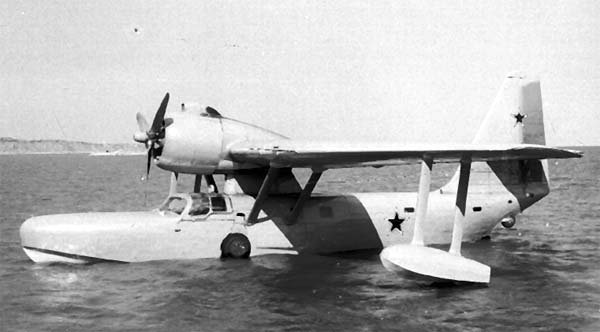
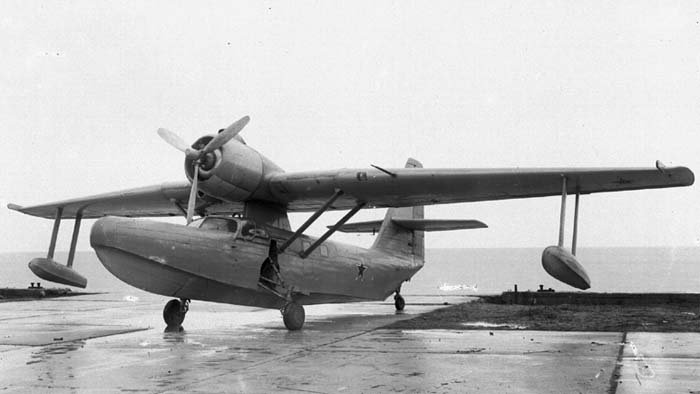
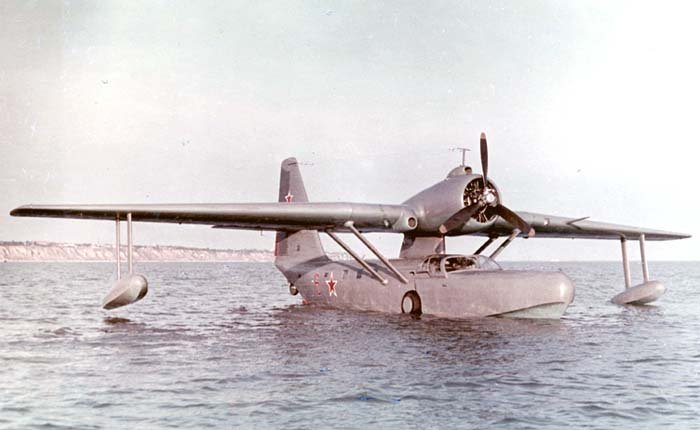
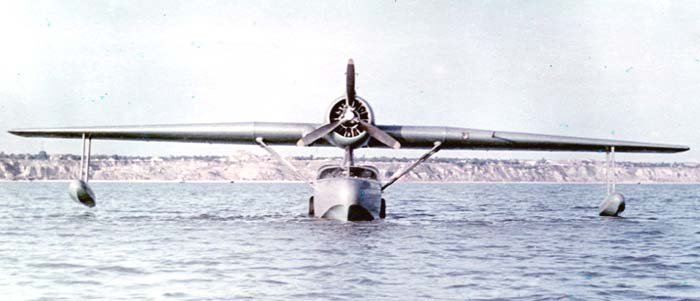
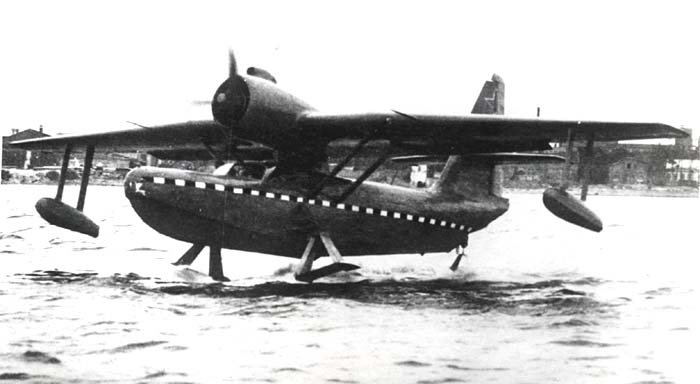
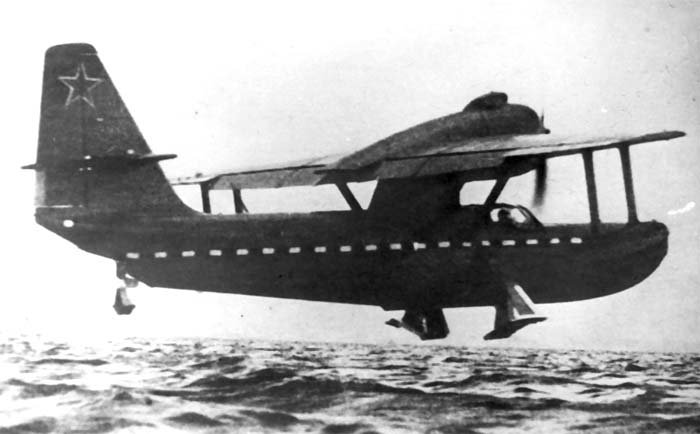
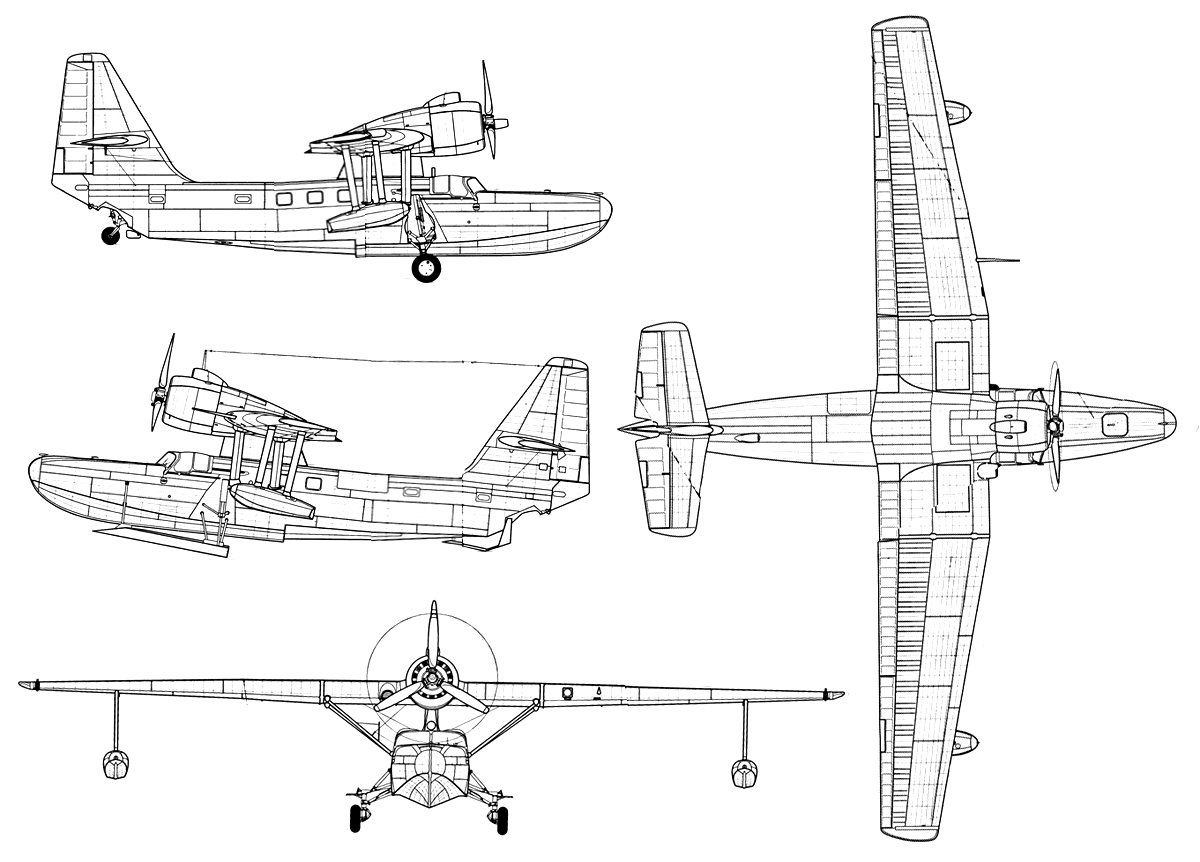
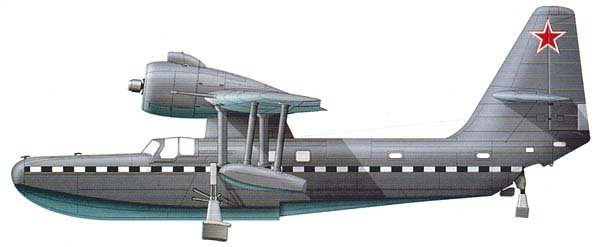
General Information about the Aircraft: The Be-8 amphibious aircraft is a flying boat with a high-mounted braced wing on a pylon. It is intended for use in rugged terrain, rich in lakes and rivers, or in coastal marine areas, in military and civil variants, as a liaison, passenger, ambulance, initial training, ice and fishing reconnaissance aircraft, and aerial photographer. The crew consists of one or two pilots. The passenger cabin can accommodate six passengers, while in the ambulance variant, it can carry two stretcher patients and two sitting patients.
Fuselage: The hull is a two-step design, with a V-bottom in the nose and inter-step sections. The hull’s construction is all-metal; the riveting of the bottom skin up to the first step is done with flush rivets, while the rest of the skin uses dome-head rivets. The hull is divided by four watertight bulkheads into five compartments: nose, pilot, middle, passenger cabin, and tail compartment. The crew is located in the cockpit in the forward part of the hull. The passenger cabin is in the middle section and has five portholes. Access is through an entry hatch measuring 1010×650 mm. It is equipped with sofa-type seats, heating, and ventilation.
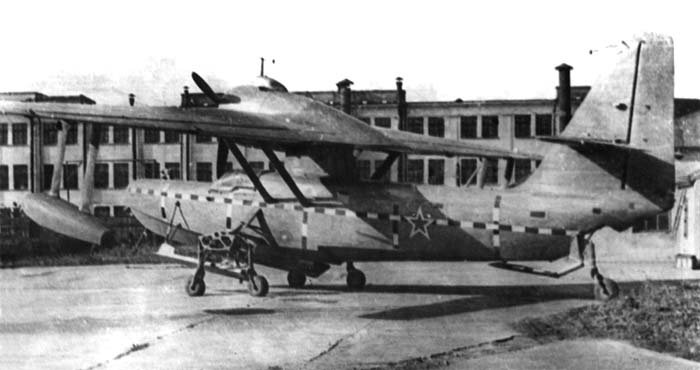
In the middle part of the hull, niches are made for landing gear retraction, and there is also a pylon, structurally connected to hull frames №12 and №14. The nose and tail parts of the pylon are removable, housing electrical wiring and controls for the propeller-engine group and ailerons. Behind the second step of the hull, there is a water rudder. In the aft part of the fuselage, a hook controllable from the pilots’ cockpit is mounted.
Wing: The Be-8’s wing is of all-metal construction, has a trapezoidal planform, and consists of a center section and two detachable outer panels. The wing is equipped with TsAGI-type ailerons with fabric covering and metal slotted flaps. A Pitot tube and a landing light are located in the leading edge of the left outer panel. Two non-retractable support floats are attached to the wing panels. The floats are step-less, of metal construction, and divided by two watertight bulkheads into three compartments.
Tail Assembly: The vertical empennage is single-fin, cantilever. The non-adjustable stabilizer and fin are of all-metal construction. The elevator and rudder have a metal frame and fabric covering. The control surfaces are equipped with trimmers, have axial aerodynamic compensation, and 100% mass balancing.
Landing Gear: Tricycle type, with a tail wheel, retractable in flight. The primary control for landing gear retraction and extension is electromechanical; emergency control is manual. The braking system for the main wheels is pneumatic; the landing gear shock absorption is oleo-pneumatic.
Powerplant: ASh-21 air-cooled piston engine with a single-stage supercharger and a 3 m diameter AV-29E-81A pulling propeller. The powerplant is located on the leading edge of the wing center section, above the pilot’s cockpit.
Fuel System: Fuel is housed in two soft tanks with a total capacity of 630 liters, located in the center section. To ensure uniform fuel consumption from both tanks, a 5-liter header tank is provided in the hull’s pylon. There is a neutral gas pressurization system. The oil tank capacity is 60 liters.
Main Aircraft Systems: For anti-icing of the cockpit windshield and propeller, an anti-icing system is provided. Antifreeze tanks with capacities of 5 and 8 liters are installed on the left and right sides of the hull between frames №5 and №7, and between frames №13 and №14. The pilot’s and passenger cabins are heated by warm air supplied through an air duct along the left side of the hull, from a gasoline heater installed in the tail between frames №24 and №25. The heater is fueled from the main fuel tanks.
A suspended ladder is provided for entry into the passenger cabin. In the stowed position, the ladder is placed in the tail compartment. For pumping water out of the hull, the aircraft has a portable electric pump installed on frame №25. The aircraft is equipped with two thermos flasks, a water tank, a bag for on-board rations, a bag for a portable lamp, and a first-aid kit.
Electrical Equipment: The sources of electrical energy on the aircraft are: a GSK-1500 generator and one 12A-30 battery. The battery is placed in an insulated container installed in the aft part of the hull, behind the passenger cabin. The aircraft’s electrical network is single-wire, with the aircraft fuselage serving as the negative conductor. To reduce radio interference, the wires in the hull, up to frame №14, are shielded.
Naval Equipment: This includes: a bottom anchor, a sea anchor, a boat hook, and a grappling hook. The aircraft provides for the installation of an LAS-3 rubber boat.
Control System: Control of the rudder, elevator, and ailerons is dual. The control linkage for rudders, ailerons, and trimmers is cable-operated. Flap control is electromechanical. Water rudder control is linked to rudder control via rods.
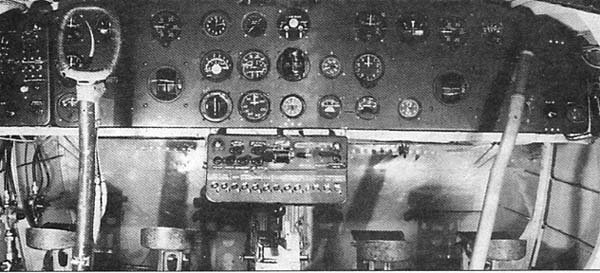
Flight Navigation Equipment: Ensures flight control both day and night. It includes, among others, the GMK-2 gyromagnetic compass and the KI-11 compass.
Radio-Electronic Equipment: The aircraft is equipped with an RSI-6 radio station, an RPKO-10M radio compass, an SC-3 identification transponder, and an SPUF-3 aircraft intercom system.
Photo Equipment: The aircraft provides for the possibility of installing an AFA-3s mapping camera with remote control in the aft part of the hull on the right side, and an AFA-27T panoramic camera. For AFA-3s photography, a hatch with a hermetically sealing lid is made in the bottom of the hull. In the stowed position, the AFA-27T is installed in the radio equipment compartment, and photography is performed through the hatches of the pilots’ cockpit canopy.
Technical Specifications
| Modification | Be-8 |
| Wingspan, m | 19.00 |
| Aircraft length, m | 13.00 |
| Height, m | 4.48 |
| Wing area, m2 | 40.00 |
| Empty weight | 2815 |
| Normal takeoff weight | 3624 |
| Maximum takeoff weight | 3800 |
| Engine type | 1 Piston engine Shvetsov ASh-21 |
| Power, hp | 1 x 700 |
| Maximum speed, km/h | 266 |
| Cruising speed, km/h | 165 |
| Ferry range, km | 1205 |
| Practical range, km | 810 |
| Service ceiling, m | 5550 |
| Crew, crew members | 1-2 |
| Payload | 4-6 passengers |
Image and diagram gallery of the Be-8
 Be-8 |
 Be-8 |
 Be-8 |
 Be-8 |
 Be-8 |
 Be-8 |
 Be-8 |
 Be-8 |
 Be-8 |
 Be-8 |
 Be-8 |
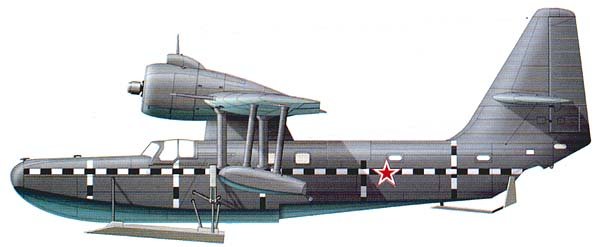 Be-8 |
ArchivoAéreo Editorial Team
A group of aviation researchers and enthusiasts dedicated to documenting and preserving global aeronautical history. All articles are reviewed to ensure historical accuracy.
Sources & Accuracy
The information presented in this technical sheet has been compiled from declassified flight manuals, historical archives, and specialized literature. While we strive for maximum accuracy, some performance data may vary depending on the specific variant or operational conditions.