Beechcraft Model 34 Twin-Quad
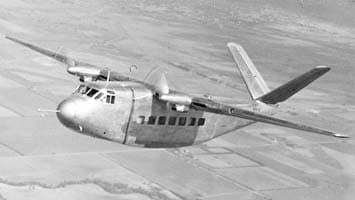
While the Douglas DC-8 Skybus remained on paper, the Beechcraft Model 34 Twin-Quad stands out as the most original and interesting aircraft among those built to replace the DC-3. With its unique technical features, it broke with the monotony of mid-20th century regional airliners.
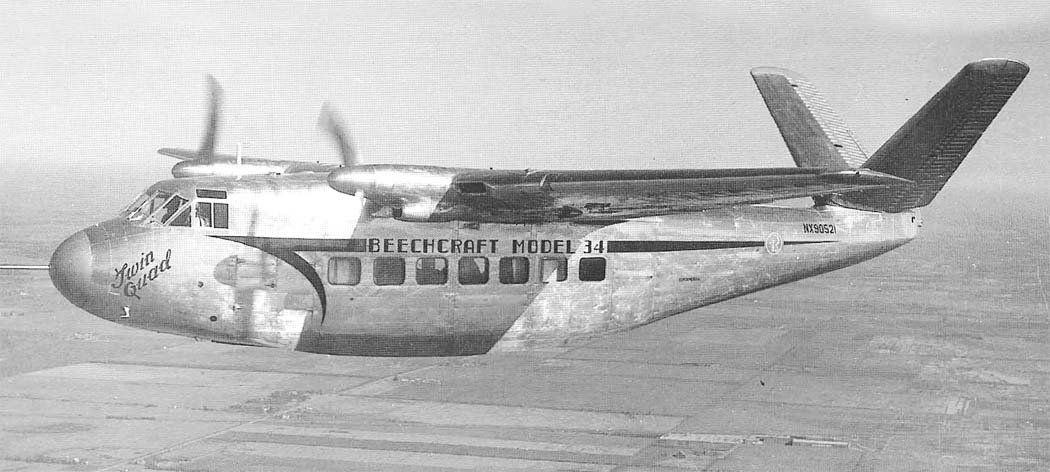
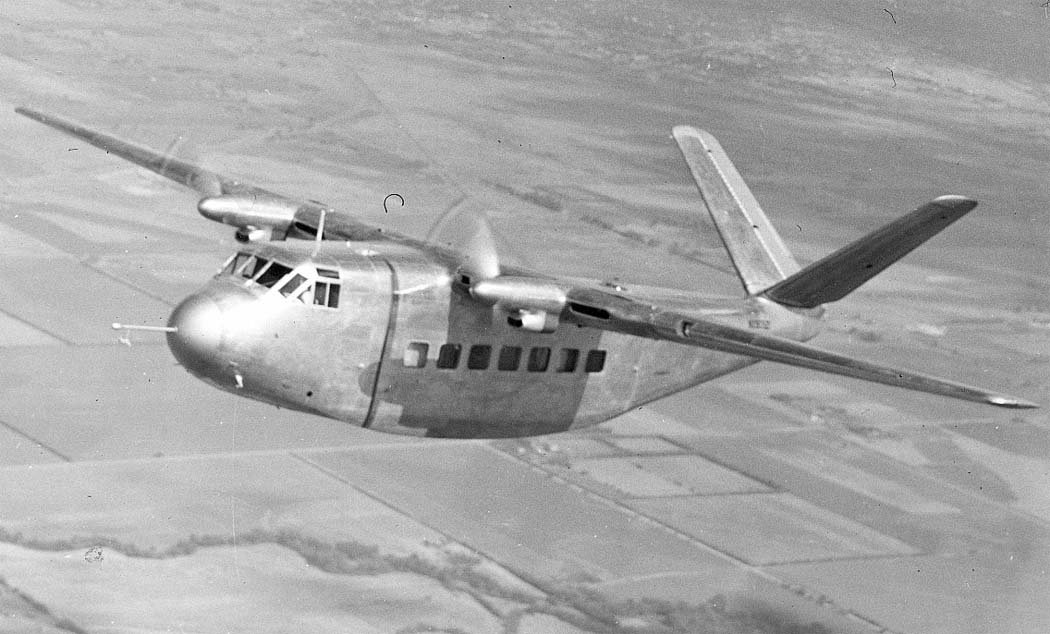
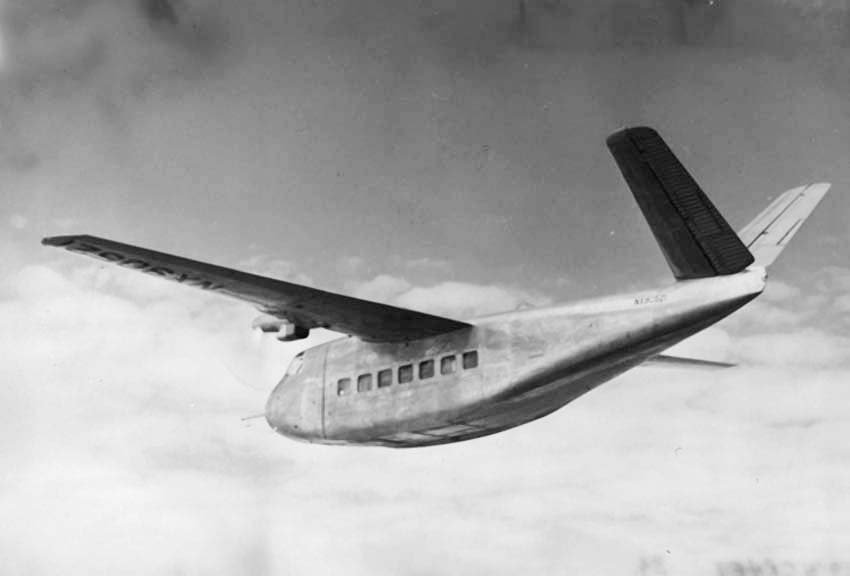
Work on this new Beechcraft aircraft began in late 1944, driven by the optimistic expectation of a boom in postwar regional airlines. The project involved T.A. Wells, Alex Sergeous Odevseff, W.A. Day, J.W. Massey, and W.O. Stephens. This team designed a very unconventional high-wing monoplane—a rare feature for this genre—with a V-tail, previously tested on the AT-10 and also used on the concurrently developed Beechcraft Bonanza, a future superhit for Beechcraft.
Innovative Design and Capacity
The all-metal aircraft was designed to carry 20 passengers and approximately 450 kg of cargo or mail. It was intended for operation on low-traffic regional routes, from poorly prepared airfields. The aircraft had an unpressurized cabin, with a cargo compartment forward of the passenger cabin, separated by a bulkhead. This bulkhead could be repositioned to increase cargo volume by reducing passenger seating by six, or two rows. The underside of the fuselage was reinforced with keels for safe belly landings in case of landing gear failure. The main landing gear struts were long and massive; due to the specific engine layout, space for them remained in the wing, and they retracted towards the fuselage.
The Twin-Quad Propulsion System
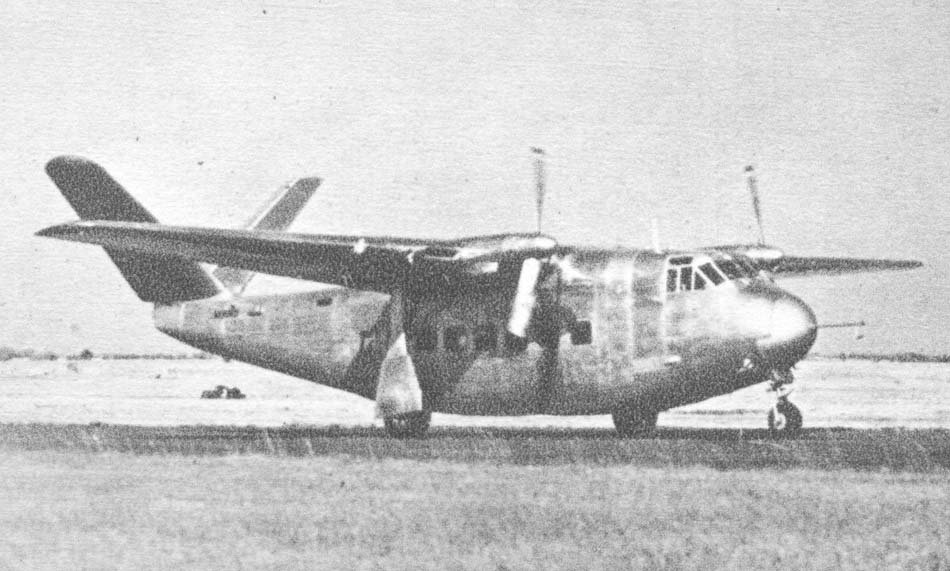
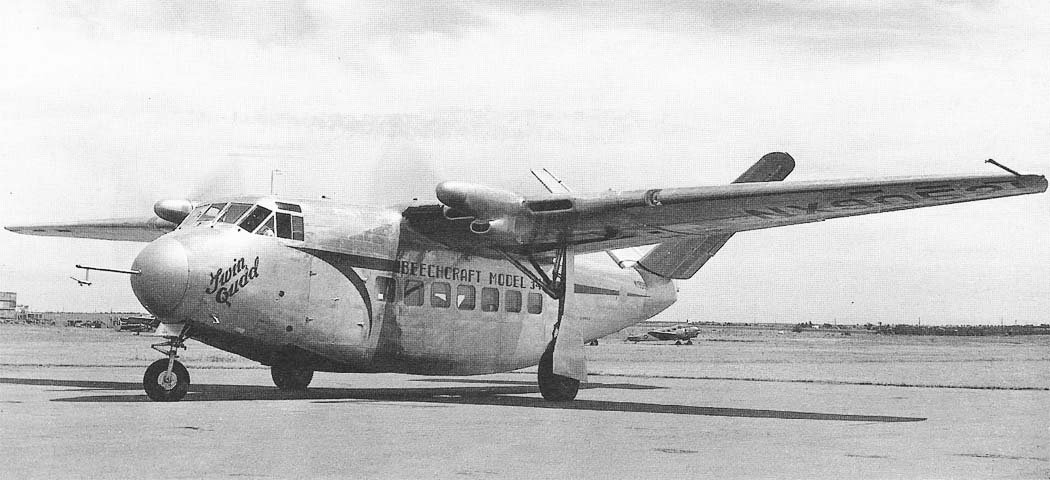
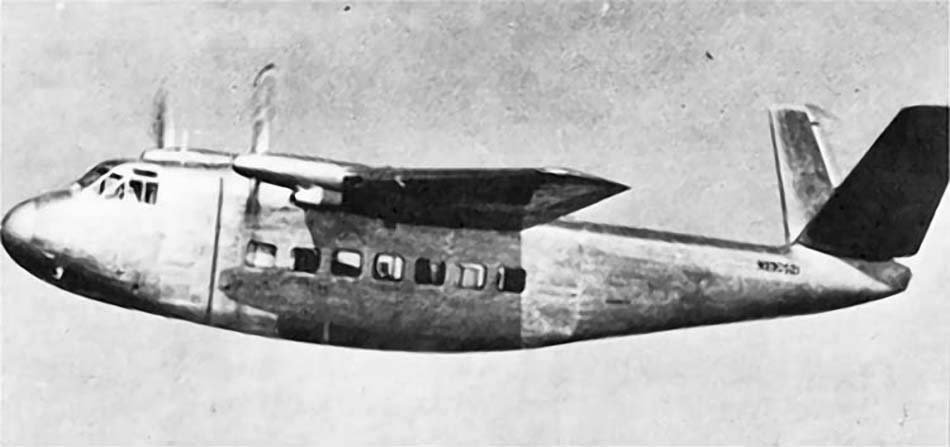
The most distinctive feature of the Model 34 was, of course, its power plant. Each wing housed two Lycoming GSO-580 engines. These were 375 hp, eight-cylinder, air-cooled opposed aircraft engines. The engines were placed along the wing, literally in its leading edge, operating through a clutch to a common propeller. Creating a power transmission mechanism that drove a single shaft from two engines was a complex engineering challenge.
Beechcraft succeeded in this task; the unit operated reliably and provided propeller drive in all modes: with one engine suddenly failing, with one engine suddenly starting, and so on, all in an automatic mode using only mechanics. The design of such a transmission began in 1943 for an unrealized coupled power plant, and by 1946, it was fully refined. The patent (US2653670) for this unit belongs to Odevseff.
The main purpose of using four engines instead of two on a small aircraft was to enhance flight safety. The failure of one engine would result in the loss of only a quarter of the power, instead of half, as with twin-engine aircraft. The Model 34’s configuration offered another advantage: a failed engine and its propeller did not create drag, hanging on the wing as useless weight. Safety considerations made the rejection of coaxial propellers reasonable: in the event of an engine failure, the Twin-Quad pilot did not have to perform any manipulations other than cutting off fuel to the inoperative engine. To accommodate the engines, which were about half a meter high, the wing had to be thick.
The aircraft could not be called a beauty, especially when recalling the elegant Lockheed 75 Saturn or the graceful Douglas DC-5. However, when compared to, for example, the Northrop N-23 Pioneer, the Beechcraft seemed quite alright. The aircraft’s nickname, Twin-Quad, describes its main feature: two propellers, four engines.
Operational History and Program End
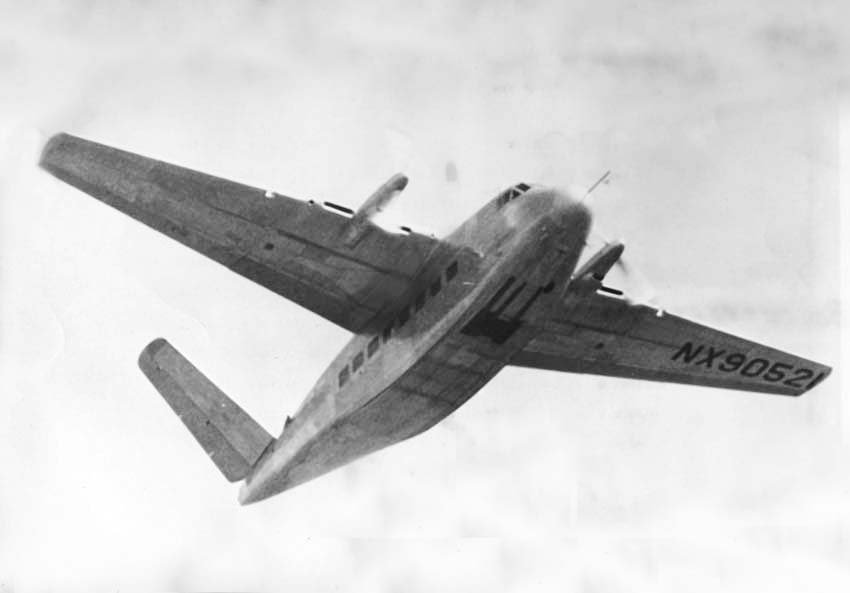
The aircraft’s first flight (NX90521) was on October 1, 1947. The prototype accumulated 200 flight hours before a crash on January 17, 1949. During takeoff, a small fire occurred in the electrical system; the crew focused on extinguishing it, and someone in a panic cut off all engines with an emergency switch. After impact with the ground, the co-pilot died, and three others—the captain and two observers—were injured. Without the reinforced keels on the underside of the fuselage, the situation might have been even more tragic.
The aircraft was completely destroyed, but work began on a second aircraft, and there was also a static test article. However, the lack of commercial prospects soon led to the program’s closure. The development of the Twin-Quad cost somewhere between 2 and 5 million dollars (according to other data, about 6 million). Beechcraft hoped to achieve a maximum speed of 480 km/h, but this was not attained during testing.
Technical Specifications
| Modification | Beech 34 |
| Wingspan, m | 21.34 |
| Length, m | 16.15 |
| Height, m | 5. 18 |
| Maximum takeoff weight | 8845 |
| Engine type | 4 Piston engines Lycoming GS0-580 |
| Power, hp | 2 x 375 |
| Maximum speed, km/h | 370 |
| Cruising speed, km/h | 290 |
| Practical range, km | 2655 |
| Practical ceiling, m | 7000 |
| Crew | 2 crew |
| Payload | up to 20 passengers or 454 kg of cargo |
Image and diagram gallery of the Beechcraft Model 34 Twin-Quad
 Beech 34 Twin-Quad |
 Beech 34 Twin-Quad |
 Beech 34 Twin-Quad |
 Beech 34 Twin-Quad |
 Beech 34 Twin-Quad |
 Beech 34 Twin-Quad |
 Beech 34 Twin-Quad |
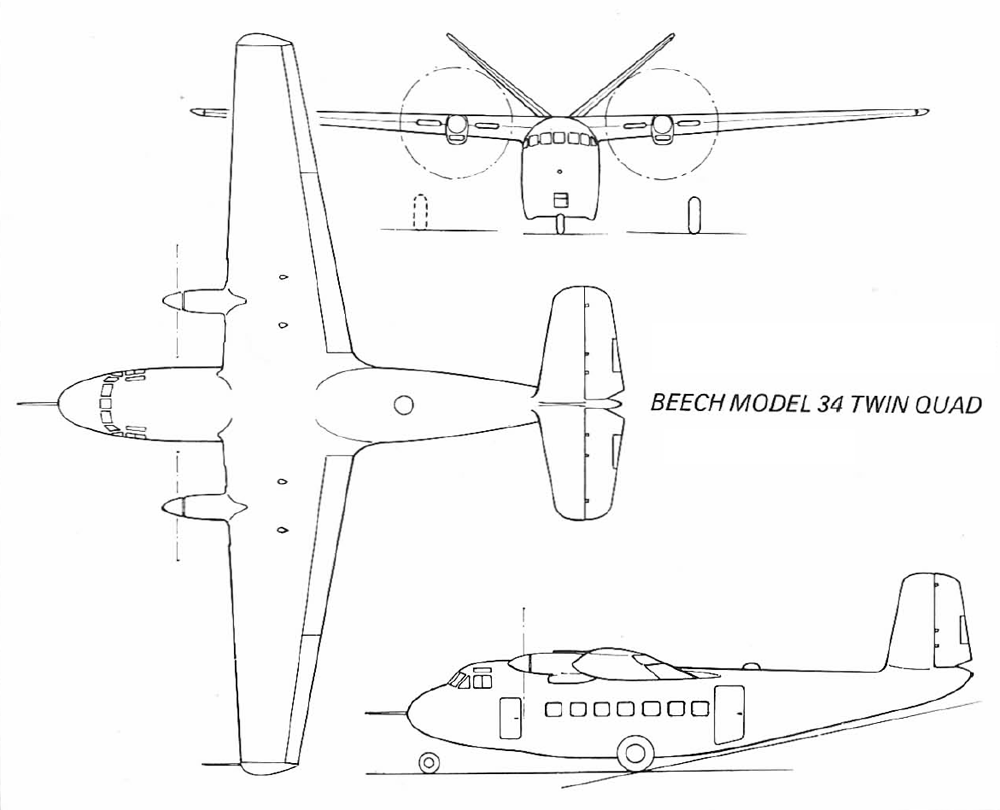 Beech 34 Twin-Quad |
ArchivoAéreo Editorial Team
A group of aviation researchers and enthusiasts dedicated to documenting and preserving global aeronautical history. All articles are reviewed to ensure historical accuracy.
Sources & Accuracy
The information presented in this technical sheet has been compiled from declassified flight manuals, historical archives, and specialized literature. While we strive for maximum accuracy, some performance data may vary depending on the specific variant or operational conditions.