Bell 222
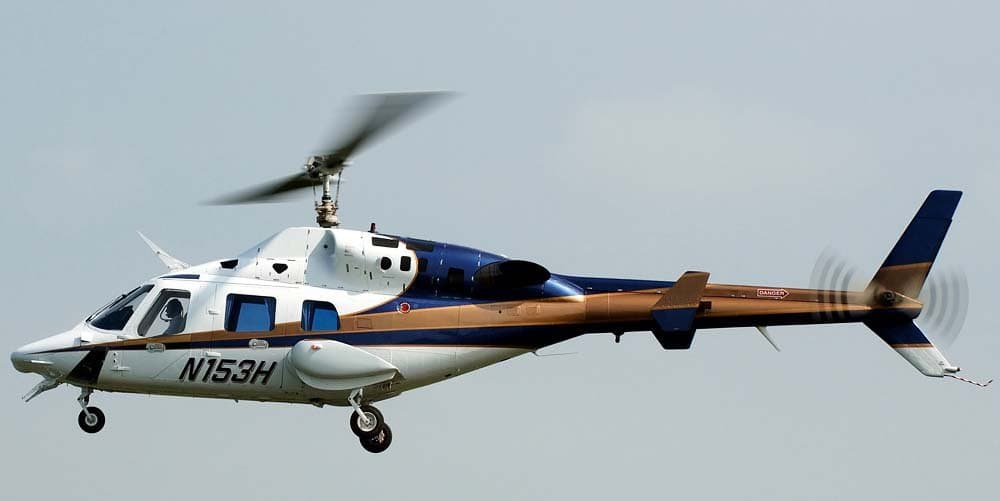
The Bell 222 marked Bell Helicopters’ initial foray into the lucrative corporate helicopter market. This first attempt, however, met with limited buyer interest, although the helicopter remains in operation to this day.
Bell Helicopters began exploring the development of a twin-engine light helicopter in the mid-1960s. The company officially presented a mock-up of the future Model 222 at a Helicopter Association conference in the US in January 1974, announcing the program’s launch that April.
The Bell 222 was the first American-built civil light twin-engine helicopter, primarily intended for the corporate sector. It also saw service with police forces and for supporting offshore oil platforms. Despite its versatility, the project was commercially challenging, with only 188 helicopters built over a decade until 1989.
Development and Certification Journey
Construction of five prototypes commenced on September 1, 1974. However, Bell decided to conduct additional marketing research and incorporate changes based on prospective customer feedback. These adjustments led to program delays, and the first aircraft finally took to the air on August 13, 1976.
The second prototype flew later that year, with all five machines ready by March 1977. Flight tests revealed several shortcomings, requiring designers to refine the tail section and flight control system, causing further program setbacks. Consequently, the FAA certification for the pre-production 222 was only obtained on August 16, 1979.
VFR (visual flight rules) certification for the production Bell 222A followed on December 20, 1979. “Petroleum Helicopters” became the launch customer, receiving the first aircraft on January 16, 1980, with the London police department also among early buyers. A certificate for single-pilot IFR (instrument flight rules) operations under Category I weather conditions was granted on May 15, 1980.
Key Design Features and Variants
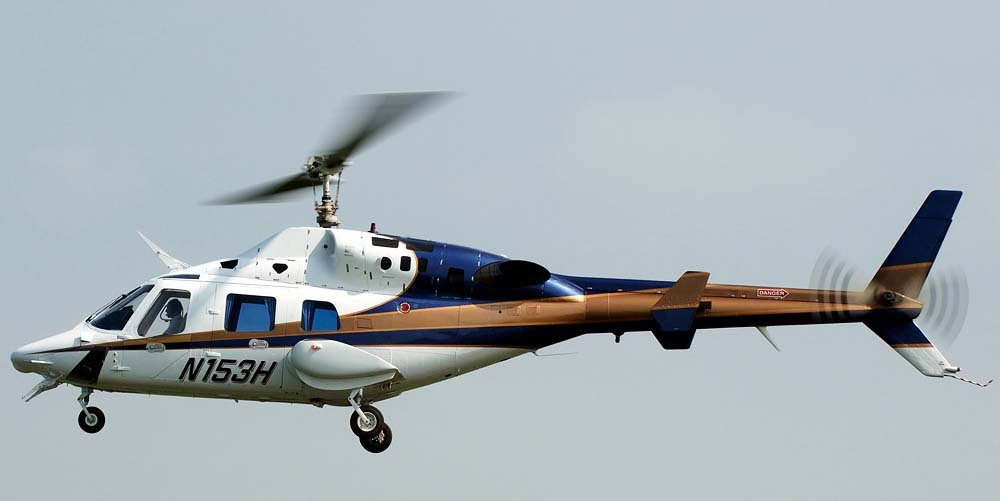
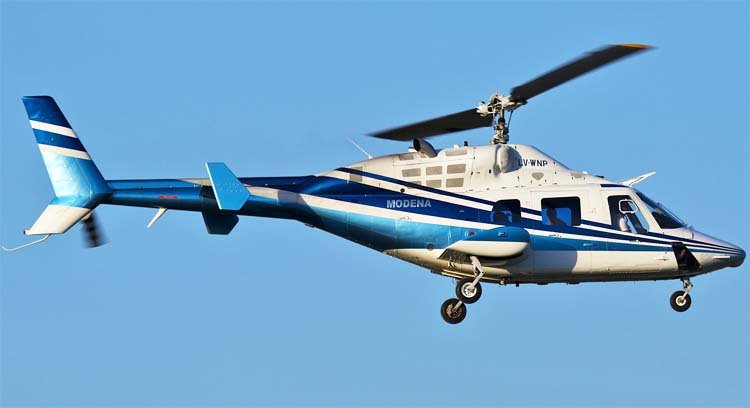
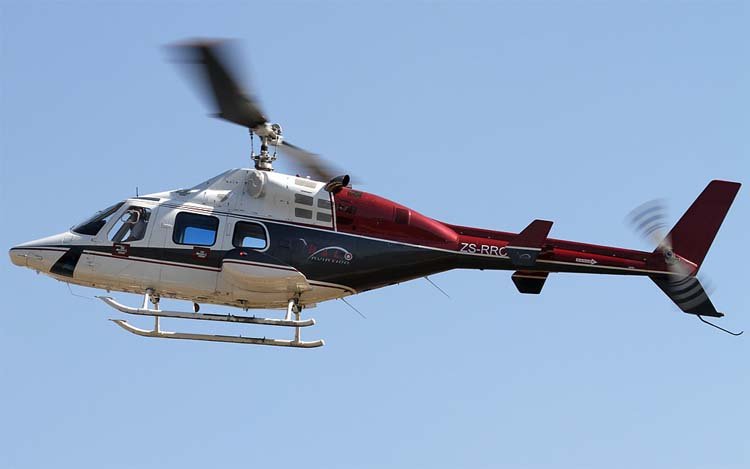
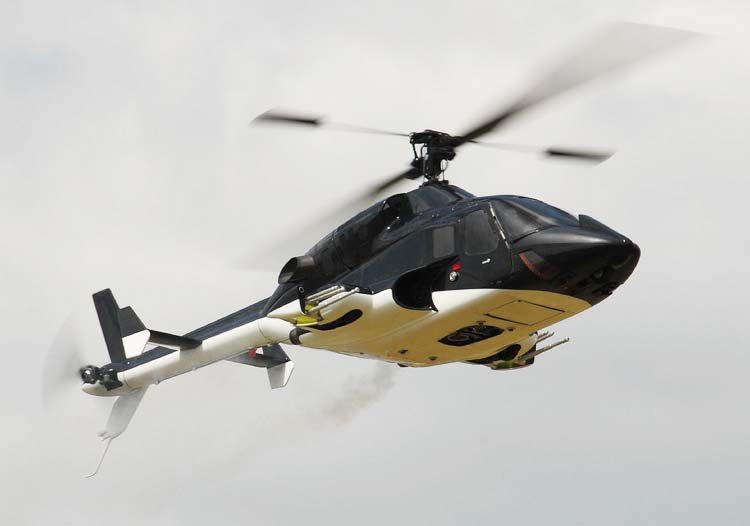
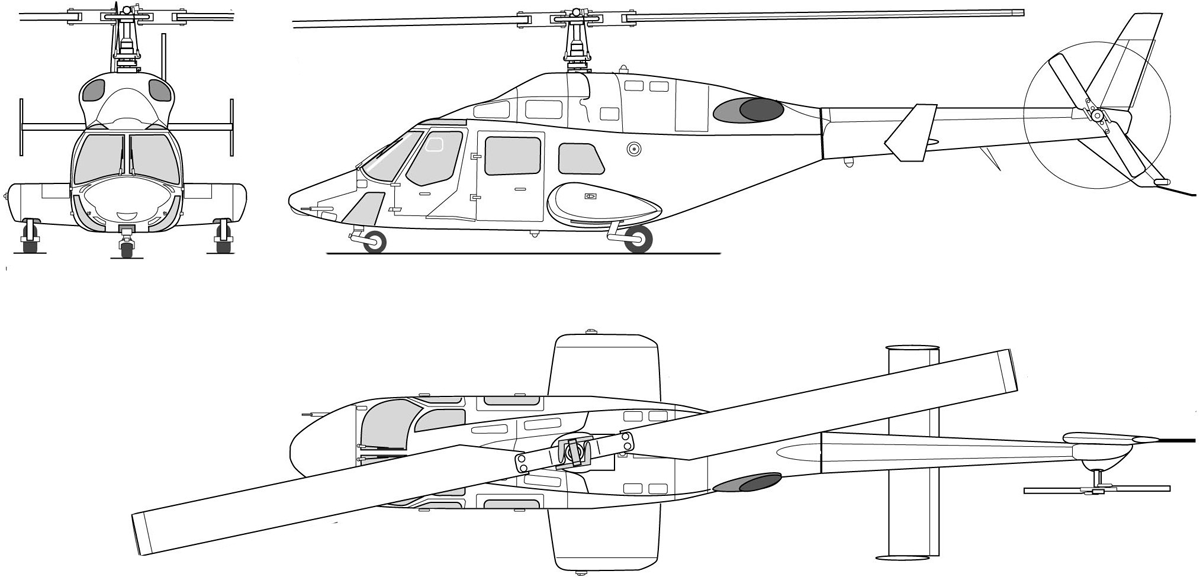
The Bell 222 employs a traditional design for its class, making extensive use of light alloys. Access to the avionics compartment is provided via a hinged nose fairing. The tail features swept upper and lower fins, and a stabilizer with endplates mounted midway on the tail boom.
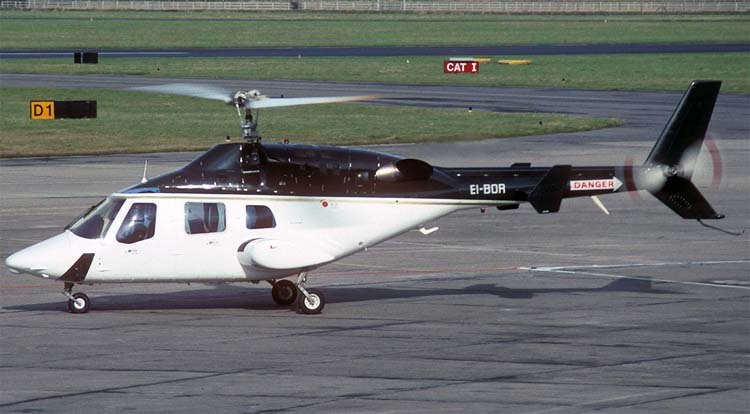
The lower fuselage incorporates small, cantilevered strakes with a wing profile, generating minor lift during straight horizontal flight to assist the main rotor. These fairings also house the fuel tanks and the main components of the retractable tricycle landing gear. The landing gear retracts forward, and the nose gear is self-orienting, capable of turning 360°.
The helicopter is equipped with a two-bladed main rotor, featuring a common horizontal hinge and elastic titanium plates. Blades are attached using conical elastomeric bearings, with radial elastomeric bearings also used in the main horizontal hinge. Main rotor blades combine stainless steel and composites like fiberglass and Nomex. The two-bladed tail rotor also has semi-rigid stainless steel blades.
Power is supplied by two Lycoming turboshaft engines, installed above the cabin, each delivering 684 hp for takeoff. Fuel is stored in five soft tanks. The basic variant carries a two-person crew and six passengers, with an option for two additional seats. A 1.05 m³ baggage compartment is located behind the cabin.
The basic production model, Bell 222A, was powered by two Lycoming LTS 101-650C-3 turboshafts (620 hp each). By late 1982, it was replaced by the 222B, which featured more powerful LTS 101-750C-1 engines (684 hp each), a 0.43m longer fuselage, and a 0.69m increased main rotor diameter. The Bell 222B first flew on August 1, 1981, and received FAA certification on June 30, 1982. In July of the same year, it became the first helicopter certified for unrestricted single-pilot IFR flight.
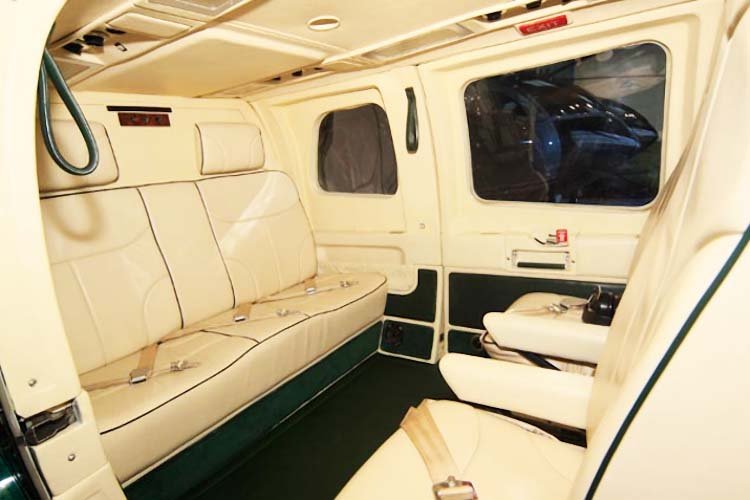
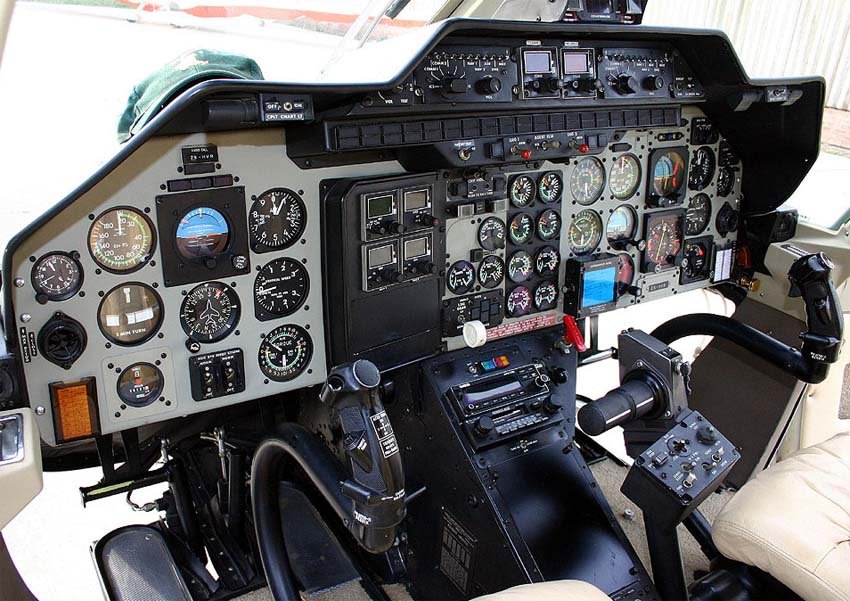
Corporate versions of the helicopter could be equipped with a Honeywell automatic flight control system, Collins Pro Line avionics suite, and a modified, higher-comfort cabin for five passengers. Deliveries of the Bell 222UT (Utility Transport) began in September 1983, quickly becoming a leading member of the family.
The 222UT featured the same improvements as the 222B, but its most significant difference was the replacement of the standard wheeled tricycle landing gear with skids. Its first flight took place on September 7, 1982, and VFR and IFR certifications for single-pilot operations were obtained in spring 1983.
Legacy and Advanced Developments
Between 1990 and 1991, two Model 222 helicopters were converted at a facility in Mirabel, Canada, into experimental aircraft for the Bell 230 successor program. The Bell 230, which made its first flight on August 12, 1991, represented a major industrial modification of the 222 with an enlarged fuselage, larger rotor, and more powerful turboshaft engines. The Bell 230 was certified in 1992 and began serial production by Bell’s Canadian division that same year.
Additionally, the Bell 222’s powerplant, transmission, and main rotor were utilized by Bell in the early 1980s for the D292 prototype (ACAP – Advanced Composite Airframe Program), characterized by extensive use of composites and developed within the framework of a US Army program. Bell also conducted flight tests on a Model 222 helicopter equipped with a new four-bladed composite main rotor, built with a bearingless “680” type hub. On November 10, 1987, a prototype helicopter fitted with an adaptive digital engine control system, co-developed with Lucas, took flight.
The Bell 430 emerged as a further development of the Bell 230, featuring a four-bladed main rotor with a “type 680” hub, providing greater thrust, improved maneuverability, and reduced noise and vibration levels. The Bell 430 made its first flight in November 1994 and has been in serial production in Canada since 1995.
Perhaps one of the most famous Bell 222s was “Airwolf,” the star of the US television series aired from 1984 to 1986. According to the show’s script, the helicopter was created by a special agency, piloted by Vietnam veteran Stringfellow Hawke (played by Jan-Michael Vincent) and Dominic Santini (Ernest Borgnine), owner of “Santini Airways.” The helicopter was depicted with a system enabling supersonic speed and an armament suite including guided missiles, capable of downing other helicopters, enemy fighters, and various ground targets from trucks to tanks.
The Bell 222 helicopter is designed with a single main rotor, a tail rotor, two turboshaft engines, and a tricycle landing gear. Its fuselage features an all-metal, semi-monocoque construction. The nose section houses radio-navigation and electronic equipment.
The crew cabin is two-seated, with one door on each side for the pilots. The passenger cabin, measuring 2.16 x 1.47 x 1.45m with a volume of 3.67m³, is typically equipped with two rows of three seats each, or up to seven seats in a high-density configuration. For executive comfort, the cabin can be arranged with two seats and a three-passenger sofa.
When seats and the baggage compartment are removed, the cabin length extends to 3.8m, allowing for two stretchers and seats for 3-4 medical attendants. Passenger seats are designed to withstand a descent speed of 9m/s and vertical overloads up to 20g. Fairings for the main landing gear struts are located on the fuselage sides, shaped like small aspect-ratio wings with a NACA 0035 profile, a 5° incidence angle, and a 3°12′ transverse V angle.
The tail boom is of monocoque construction, housing the tail rotor and a swept vertical empennage. Its dimensions and profile curvature ensure the possibility of continued flight even if the tail rotor fails. The stabilizer is rectangular in plan, equipped with endplates, a span of 2.83m, and a chord of 0.56m.
The retractable tricycle landing gear includes a self-orienting nose wheel. The main struts, equipped with oil-air shock absorbers, retract into their fairings. Main wheel tires operate at 0.52 MPa pressure, and the nose wheel at 0.41 MPa. The landing gear track is 2.75m, and the wheelbase is 3.71m.
The main rotor is two-bladed, featuring a common horizontal hinge and elastic titanium plates. Blade attachment is achieved via conical elastomeric bearings, while radial elastomeric bearings are employed in the main horizontal hinge. The blade profile is Wortmann 090, with a relative thickness of 0.08, a chord of 0.66m, and a tip speed of 212m/s. The blades are rectangular in plan, with tapered tips and roots.
The tail rotor, with a diameter of 2.1m, is two-bladed and features semi-rigid blade attachment. Its blades are crafted from stainless steel, with a profile designed for a large critical angle of attack. Needle bearings are used in the horizontal hinge, and double “dry” spherical bearings in the axial. The blade profile has a relative thickness of 0.08, a chord of 0.25m, and a tip speed of 185m/s.
The powerplant consists of two turboshaft engines, mounted behind the main gearbox. Each engine integrates its own oil system, control system, and fire suppression system. A torque limiter and power distribution system are also present. The air intakes are equipped with dust protection devices.
The transmission system comprises the main gearbox, two drive shafts extending from the engines to the main gearbox, two freewheel clutches, the tail rotor drive shaft, and the tail gearbox. The engine output shaft rotates at 9265 rpm, while the tail rotor drive shaft rotates at 3298 rpm. The main gearbox is designed to transmit the full power of one engine in the event of the other’s failure. The main gearbox is suspended from the fuselage using a “Nodamatic” system, which reduces vibration levels transmitted to the airframe.
The fuel system incorporates four soft tanks, engineered for high resistance to impact loads, forming two autonomous fuel systems. Two tanks are positioned behind the passenger cabin, and two within the side fairings. A roof tank and a fairing tank collectively form a system that supplies fuel to the engine. The total tank capacity is 715 liters, with an option to install additional 225-liter auxiliary fuel tanks.
The control system utilizes hydraulic boosters and is fully duplicated; one circuit supplies power to the boosters, while the other supplies both boosters and the landing gear subsystem. The hydraulic system operates at 10.3 MPa pressure with a flow rate of 15 l/min. The electrical system features dual generators, converters, and a nickel-cadmium battery.
Standard electronic equipment for instrument flight is included, comprising a digital automatic control system, an autopilot, and a meteorological radar. The service life for main rotor blades, hub, and flight control system is 5000 hours; and for the engines, 2400 hours.
Technical Specifications
| Modification | Bell 222B |
| Main rotor diameter, m | 12.80 |
| Tail rotor diameter, m | 2.10 |
| Length, m | 15.36 |
| Height, m | 3.51 |
| Empty weight | 2223 |
| Maximum takeoff weight | 3742 |
| Internal fuel, l | 714 |
| Engine type | 2 Textron Lycoming LTS101-750C-1 turboshaft engines |
| Power, kW | 2 x 510 |
| Maximum speed, km/h | 289 |
| Cruising speed, km/h | 259 |
| Range, km | 532 |
| Rate of climb, m/min | 512 |
| Service ceiling, m | 4815 |
| Static ceiling, m | 2165 |
| Crew, crew | 1-2 |
| Payload | 10 passengers |
Image and diagram gallery of the Bell 222
 Bell 222 |
 Bell 222 |
 Bell 222 |
 Bell 222 |
 Bell 222 |
 Bell 222 |
 Bell 222 |
 Bell 222 |
ArchivoAéreo Editorial Team
A group of aviation researchers and enthusiasts dedicated to documenting and preserving global aeronautical history. All articles are reviewed to ensure historical accuracy.
Sources & Accuracy
The information presented in this technical sheet has been compiled from declassified flight manuals, historical archives, and specialized literature. While we strive for maximum accuracy, some performance data may vary depending on the specific variant or operational conditions.