Bf.109Z Zwilling
While the Bf.109K was the last production model of the Messerschmitt fighter, several experimental machines were built before the end of the war. One of these was the Bf.109L, essentially a prototype high-altitude fighter based on the Me.209-II, whose development had been officially ceased by the Technical Department.
The original prototype for this project, the Me.209-V6, was transferred to the Bf.109H program and flew as the Bf.109H-V55. Despite the Air Ministry withdrawing the order, Messerschmitt decided to prepare another experimental aircraft, which was discreetly named Bf.109L.
In 1943, when work on the Me.209-II as a potential successor to the Bf.109 still had official support, the Technical Department requested Messerschmitt’s design bureau to explore a variant with a Jumo-213E-1 engine and a Junkers VS-19 propeller. This powerplant was designed as a single unit with a frontal radiator and oil tank.
While the Me.209-II was being designed for this setup, a Bf.109F-1 was equipped with such a powerplant. The project concluded in November 1943, and work on the experimental aircraft began in Augsburg the following month. Although the entire Me.209-II program was terminated, work on this prototype secretly continued, finishing in April 1944, when it received the designation Bf.109L.
The Bf.109Z Zwilling Concept
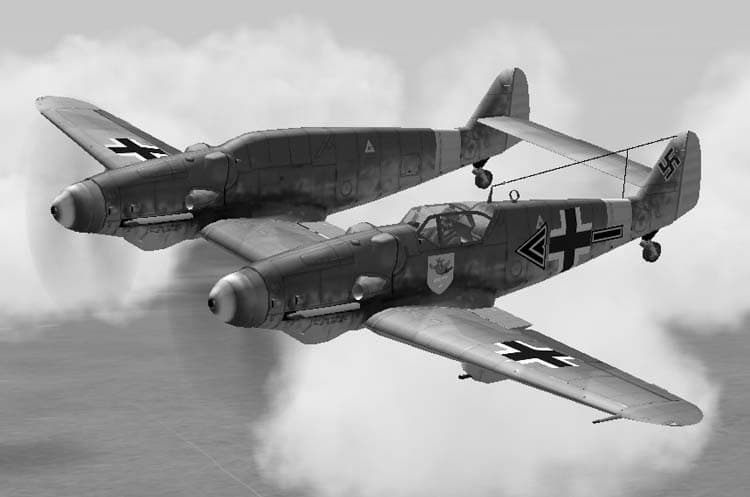
Perhaps the most intriguing variant of the Bf.109 was the “Zwilling” or “Siamese twins,” assembled from two Bf.109F airframes. The idea for the Zwilling was first put forward in 1940 by Ernst Udet, when considering a suitable tug for the enormous Me.321 and Ju.322 cargo gliders.
The success of “marrying” two He.111s encouraged Messerschmitt designers to consider creating a heavy fighter based on two Bf.109s. A key advantage was that its serial production would not impact existing assembly lines, which was otherwise impossible.
This proposal generated significant interest from the Technical Department, concerned with the necessity of improving the flight performance of aircraft in this category, due to the Air Ministry’s demands to reduce the number of basic types of serial machines.
Prototype Design and Specifications
For testing, two Bf.109F airframes were converted into a Zwilling in late 1942. Both fuselages, with their DB-601E-1 engines, were used almost without alteration, except for an under-fuselage beam to mount the landing gear struts closer to the center and the installation of an ETC-250 bomb rack.
One right and one left wing panel were retained, but their spar structure was slightly modified to accommodate new landing gear retraction bays. The fuselages were joined by a central rectangular wing section, which included a pair of radiators, a 500 kg bomb attachment point, and flaps, along with a stabilizer.
The experimental Zwilling was ready in 1943, boasting a takeoff weight of 5900 kg, a wingspan of 13.3 m, and a fuselage separation of 3.3 m. This unique aircraft was reportedly prepared for flight trials.
Proposed Production Variant and Tragic End
While work on the experimental Zwilling was ongoing, Messerschmitt also developed a production variant based on Bf.109G airframes, utilizing DB-605A or Jumo-213E engines. The planned armament included two 30 mm MK-108 cannons in the cylinder banks and two identical cannons under the wings.
As a fast bomber, the aircraft could carry a 500 kg bomb under the central wing section and one 250 kg bomb under each fuselage. It was planned to retain only the left cockpit, with the right one covered by an aerodynamic fairing, and its space used for a fuel tank.
Allegedly, the experimental Zwilling, despite being ready, was destroyed during an air raid before any flight tests could be conducted. Consequently, by the time work concluded in 1944, this ambitious project had not seen its potential realized in the air.
For comparison, work on a similar variant of the P-51 Mustang at North American began in late 1943, and the first P-82 Twin Mustang flew in April 1945, highlighting the parallel developments in multi-fuselage aircraft designs during the war.
Technical Specifications
| Modification | Bf.109z |
| Wingspan, m | 13.30 |
| Length, m | 8.90 |
| Height, m | 2.70 |
| Wing area, m2 | 23.20 |
| Empty weight | 6000 |
| Normal takeoff weight | 7290 |
| Maximum takeoff weight | 8120 |
| Engine type | 1 Piston engine Junkers Jumo-213E-1 |
| Takeoff power | 1 x 1750 |
| Cruise power | 1 x 1320 |
| Range without external stores | 1560 |
| Range with 500 kg bomb and two 30 mm cannons | 1200 |
| Cruise speed, km/h | 670 |
| Practical range, km | 2000 |
| Service ceiling, m | 11700 |
| Crew | 1 crew |
| Armament | Four 30 mm MK-108 cannons or one 30 mm cannon and 1000 kg of bombs |
Image and diagram gallery of the Bf.109Z Zwilling
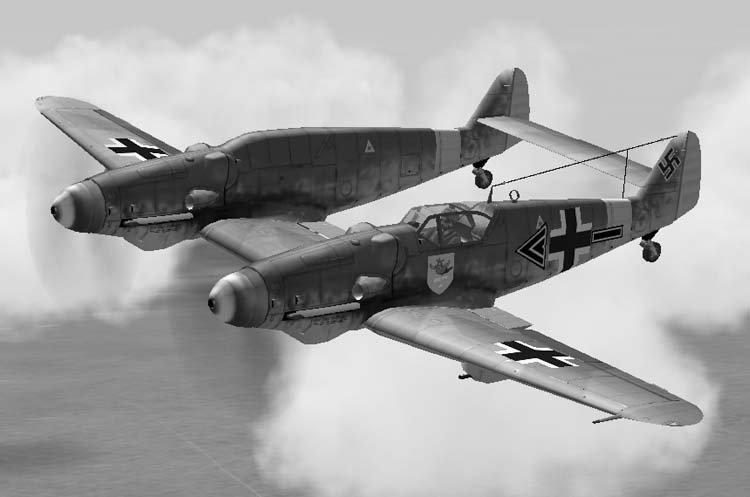 Bf.109Z Zwilling |
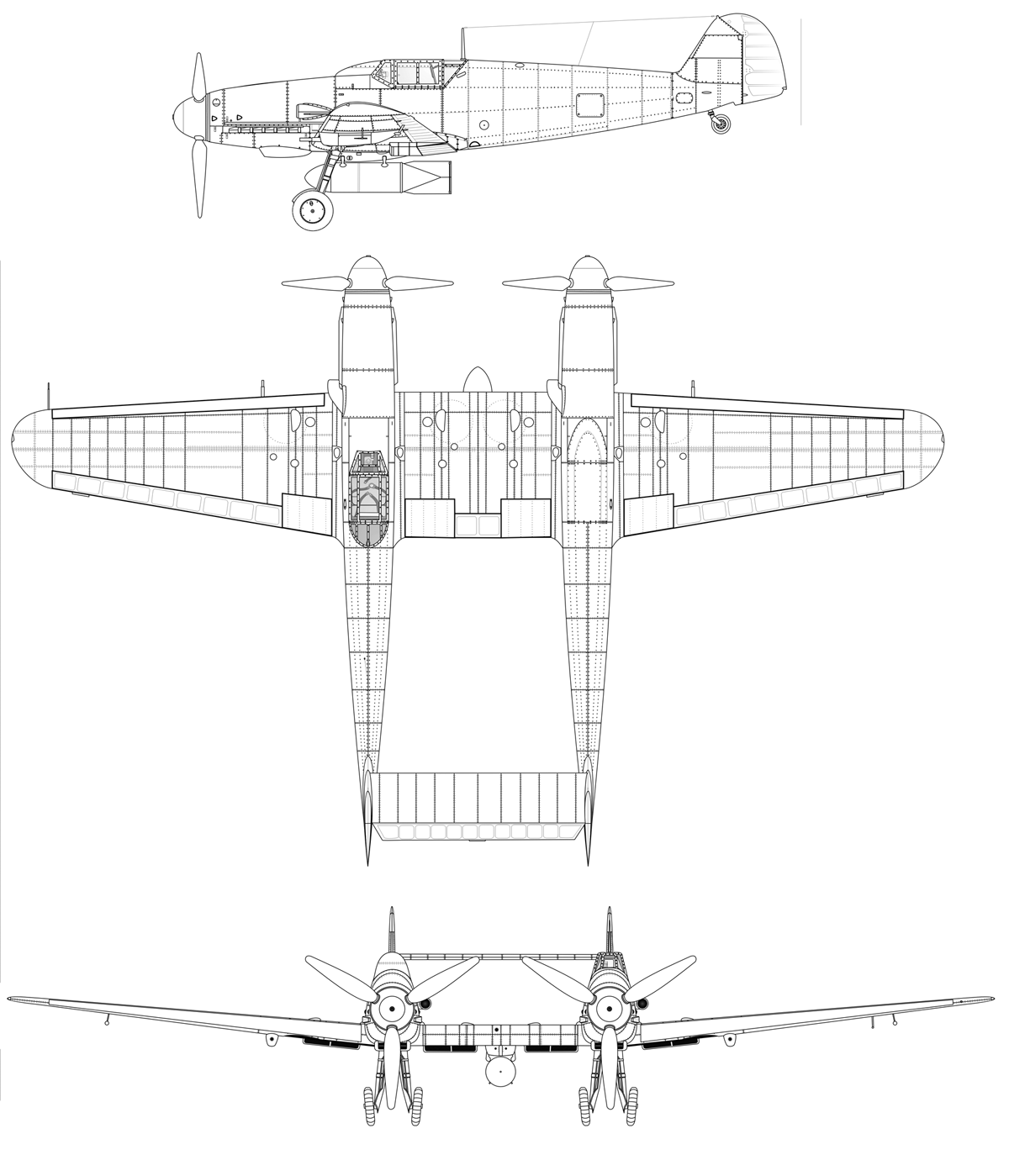 Bf.109Z Zwilling |
ArchivoAéreo Editorial Team
A group of aviation researchers and enthusiasts dedicated to documenting and preserving global aeronautical history. All articles are reviewed to ensure historical accuracy.
Sources & Accuracy
The information presented in this technical sheet has been compiled from declassified flight manuals, historical archives, and specialized literature. While we strive for maximum accuracy, some performance data may vary depending on the specific variant or operational conditions.