BLG66 Belouga
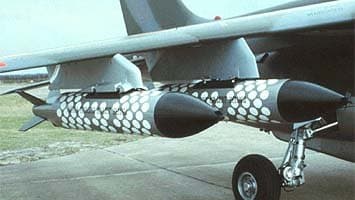
In 1978, the French firms Matra S.A. and Thomson Brandt Armements created the BLG66 Belouga air-launched cluster bomb. It features an aerodynamic shape and externally resembles a conventional aircraft bomb with a four-fin stabilizer. The loaded cluster bomb weighs 290 kg, is 3.3 m long, and has a diameter of 0.36 m. Its suspension base is 356 mm, which is standard for NATO countries.
Design and Key Components
The cluster bomb is armed with 151 spherical submunitions, each weighing 1.2 kg and having a diameter of 66 mm. These bombs and their ejection mechanisms are housed in the cylindrical section of the casing, arranged in blocks of eight units. The guiding tubes of each block, each containing one bomb, spread out fan-wise relative to the cluster’s longitudinal axis and are angled approximately 45 degrees towards its tail section.
The cluster’s nose section contains an electrogenerator with an air turbine, a programmable sensor for the temporal sequence of bomb ejection mechanisms, and distribution and pyrotechnic devices. A parachute braking system is located within the fairing of the cluster’s tail section, contributing to its stabilization.
Operational Capabilities and Loadout Types
The Belouga cluster bomb is designed for combat deployment from altitudes of 60-120 m, with carrier aircraft speeds between 630-1000 km/h, and capable of withstanding overloads up to 8.5 g. It can operate in a wide temperature range, from -30 to +70 °C. Under these conditions, the bombs from a single cluster disperse over an area of 120×40 m or 240×40 m. The length of the target area, 120 or 240 m, is selected depending on the mission and set by the pilot before bombing. A Mirage F-1 fighter, for instance, can carry up to six of these cluster bombs.
Three main types of submunitions have been developed for the cluster: fragmentation bombs with instantaneous fuzes, ideal for attacking vehicle convoys, parked aircraft, or oil depots. There are also anti-tank (HEAT) bombs, capable of penetrating up to 300 mm of armor to destroy tanks and armored infantry fighting vehicles. The third type comprises fragmentation bombs with mine-type fuzes, designed for mining airfields, port facilities, and railway stations.
The deployment procedure for the cluster bomb is as follows: after release from the carrier aircraft, a braking parachute deploys from the cluster, enabling its deceleration and stabilization in horizontal flight. Subsequently, the bombs are ejected in a predetermined sequence; each submunition also has its own braking device, ensuring a near-vertical fall trajectory, which maximizes its destructive effect. According to French specialists, the ejection order ensures uniform coverage of the target area.
ArchivoAéreo Editorial Team
A group of aviation researchers and enthusiasts dedicated to documenting and preserving global aeronautical history. All articles are reviewed to ensure historical accuracy.
Sources & Accuracy
The information presented in this technical sheet has been compiled from declassified flight manuals, historical archives, and specialized literature. While we strive for maximum accuracy, some performance data may vary depending on the specific variant or operational conditions.