BN-2 Maritime Defender
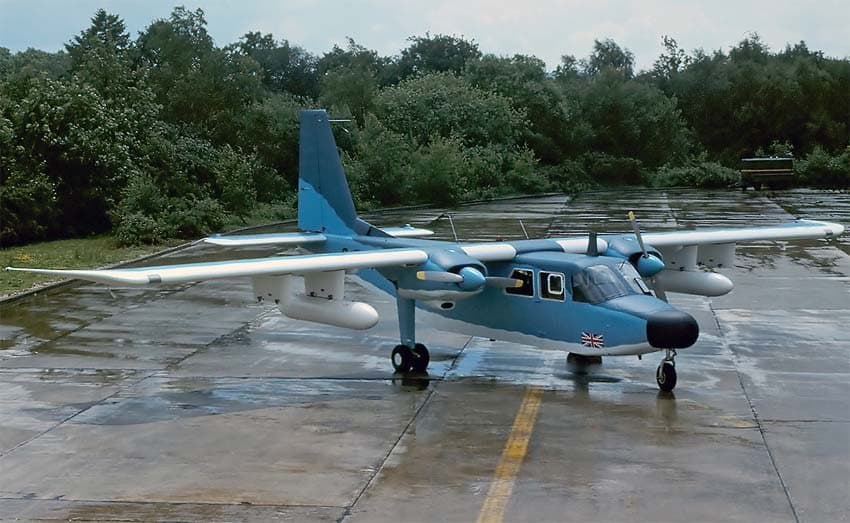
The BN-2 Maritime Defender aircraft is designed for patrolling, maritime reconnaissance, search and rescue (SAR) operations, evacuation of the sick and wounded, and transport of small cargo. It is a modification of the reliable BN-2 Islander multi-purpose aircraft, manufactured by the English firm Pilatus Britten-Norman, with over 1100 units of this type produced.
Design and Propulsion
The BN-2 is an all-metal high-wing monoplane with a rectangular cross-section fuselage, a single-fin tail, and fixed tricycle landing gear with dual wheels on the main struts. Britten-Norman developed two modifications: the BN-2B with two Avco (Textron) Lycoming O-540-K1BS piston engines of 300 hp each, and the BN-2T with two Allison 250-B17C turboprop engines generating 320 hp on the shaft. The Maritime Defender is a modernized version based on the BN-2T Turbine Defender.
In aircraft of both modifications, the fuel supply (740 liters) is housed in two wing tanks installed between the wing spars and in two wingtip tanks. There is also an option to accommodate two additional underwing fuel tanks, each with a capacity of 227 liters.
Patrol and Detection Capabilities
The “Maritime Defender” aircraft feature modern onboard radio-electronic equipment, the main component of which is the Bendix RDR-1400 search or multi-functional radar, installed in the nose section of the fuselage. The antenna scan of the multi-functional radar covers 60° from each side, with the water surface coverage width reaching up to 110 km when flying at optimal altitude.
The electronic equipment also includes Omega radio-navigation system apparatus, a radio altimeter, and modern radio communication means. These aircraft are capable of performing patrol duties for up to 8 hours. To enhance the BN-2’s capabilities in searching for aircraft and ships, Britten-Norman and Thorn EMI experimentally installed a Skymaster radar complex, capable of simultaneously detecting up to 100 air and 32 sea targets, with a detection range of 230 km for ships and aircraft.
Operational Versatility
The Skymaster radar is housed in a large nose radome and can scan both the lower and upper hemispheres (in the latter case, the scanning angle is 280°). When the aircraft is used in search and rescue operations, rescue equipment can be parachuted through a large cargo hatch in the rear part of the fuselage.
If necessary, armament can be installed on the aircraft, for which four underwing hardpoints are provided. These can accommodate 7.62mm machine guns, unguided rocket launchers, aerial bombs, and other weapons weighing up to 525 kg. The aircraft has been supplied to the navies of Cyprus, India, and the Seychelles.
Technical Specifications
| Modification | BN-2B |
| Wingspan, m | 16.15 |
| Aircraft length, m | 10.86 |
| Aircraft height, m | 4.18 |
| Wing area, m2 | 31.31 |
| Empty weight | 1925 |
| Maximum takeoff weight | 2993 |
| Internal fuel, kg | 585 |
| External fuel tanks, l | 2 x 227.3 |
| Engine type | 2 Piston engine Textron Lycoming IO-540-K1B5 |
| Power, hp | 2 x 300 |
| Maximum speed, km/h | 339 |
| Cruising speed, km/h | 264 |
| Practical range, km | 2773 |
| Operational range, km | 1136 |
| Patrol endurance, h | 6 |
| Service ceiling, m | 5240 |
| Crew, crew | 1 + 3 operators or 870 kg of cargo |
| Armament | Combat load – 907 kg on 4 hardpoints. 227-kg or 113-kg bombs, AS.11 air-to-surface missiles. Launchers for 4×80-mm SURA unguided rockets, or Matra 155 launchers for 18×68-mm rockets, or Matra 122 launchers for 7×68-mm unguided rockets, pods with 7.62-mm machine guns. |
Image and diagram gallery of the BN-2 Maritime Defender
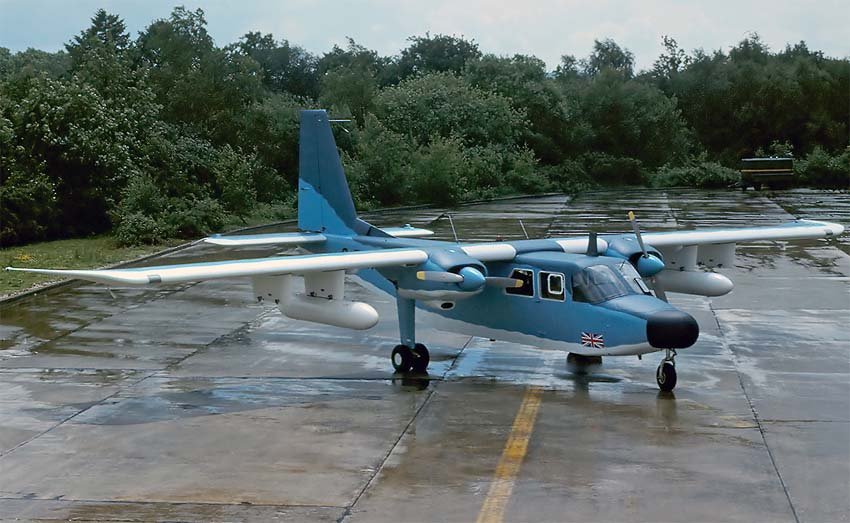 BN-2 Maritime Defender |
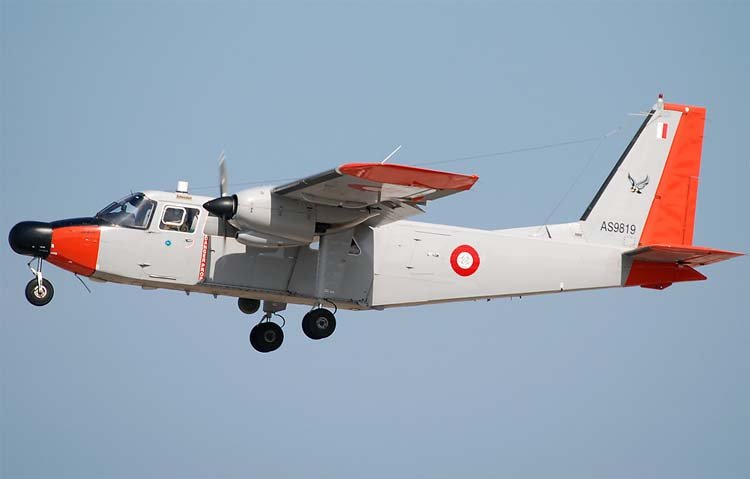 BN-2 Maritime Defender |
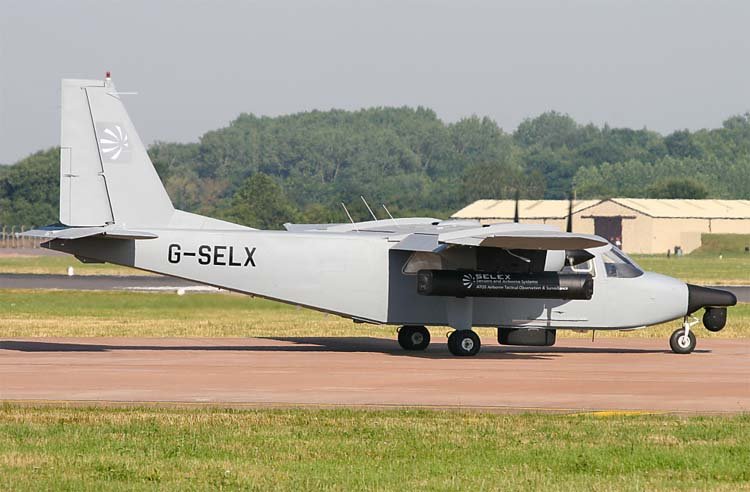 BN-2 Maritime Defender |
ArchivoAéreo Editorial Team
A group of aviation researchers and enthusiasts dedicated to documenting and preserving global aeronautical history. All articles are reviewed to ensure historical accuracy.
Sources & Accuracy
The information presented in this technical sheet has been compiled from declassified flight manuals, historical archives, and specialized literature. While we strive for maximum accuracy, some performance data may vary depending on the specific variant or operational conditions.