Bo.105
Development and Early Prototypes
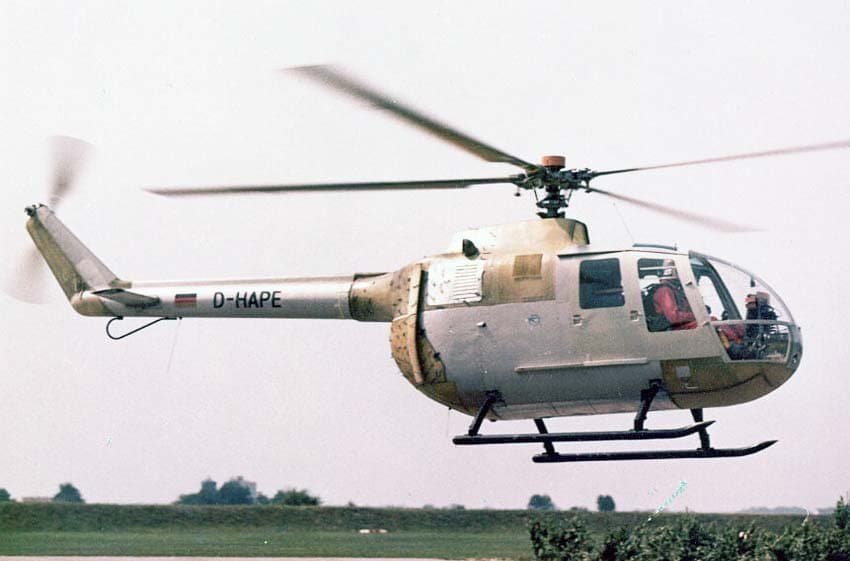
In 1961, the “Belkov” company, part of the “Messerschmitt-Bölkow-Blohm” (MBB) conglomerate, initiated the self-funded development of a light helicopter with two turboshaft engines, aiming for wide application in civil and military sectors. A new type of main rotor with rigid blade attachment was developed for this helicopter; its hub lacked horizontal and vertical hinges, featuring only axial hinges similar to variable-pitch propeller hubs on airplanes. The flapping motion of the blades was achieved through their high elasticity, enabled by their fiberglass construction. The helicopter was designed to be a four to five-seater, characterized by a simple structure.
The decision for full-scale development was made in 1964, supported by the Ministries of Economy and Defense, which funded 60% of the helicopter’s development. The first of three prototype Bo.105 helicopters, equipped with two Allison 250-C18 turboshaft engines and a hinged main rotor from a Westland “Scout” helicopter, began ground tests in September 1966. However, it was immediately destroyed due to intense ground resonance. Structural refinement and ground tests continued with the second prototype, featuring a rigid main rotor, which made its first flight on February 16, 1967.
The third prototype, with two BMW6022 turboshaft engines, flew on December 20, 1967; however, preference was given to the American Allison 250 turboshaft engines. These were installed on two pre-production helicopters, which commenced flight tests in 1969 and were certified in West Germany in 1971 and in the USA in 1972.
Global Production and Operational History
In 1976, the West German government ordered 227 Bo.105M helicopters for the Ministry of Defense in reconnaissance and liaison (VBH) variants, and 212 Bo.105P helicopters in the anti-tank intermediate (PAH-1) variant. Deliveries for these models began in 1979 and 1980, respectively.
Serial production of the Bo.105 began in 1975, and by 1994, over 1400 helicopters had been produced, approximately 800 civilian and 600 military, gaining widespread use in 40 countries. Additionally, Bo.105 helicopters were license-produced from 1975 onwards in the Philippines by PADC (76 helicopters), in Indonesia by IPTN (155 helicopters), in Spain by CASA (160 helicopters), in Canada by MBB Canada (250 helicopters), and in Chile by ENAER (96 helicopters).
The German Army received 124 BO.105M/VBH reconnaissance helicopters and 219 Bo.105/PAH-1 anti-tank helicopters, with deliveries completed by 1984. Twelve helicopters were supplied to the Mexican Navy, and 24 to the Swedish Army and Air Force. Under contract, 70 Bo.105 CB helicopters were delivered to the Spanish Ministry of Defense, including 18 for army reconnaissance, 14 for surveillance, and 28 anti-tank variants.
The price of a Bo.105 CBS helicopter (at 1992 exchange rates) was $1.95 million, while the Bo.105 LS cost $2.2 million. Bo.105 helicopters are known for their high maneuverability, capable of performing all aerobatic figures, including the Nesterov Loop. The Bo.105 has set several international records, including a 1714 km range record in 1974.
Technical Specifications
The helicopter is designed with a single-rotor scheme, featuring a tail rotor, two turboshaft engines, and skid landing gear.
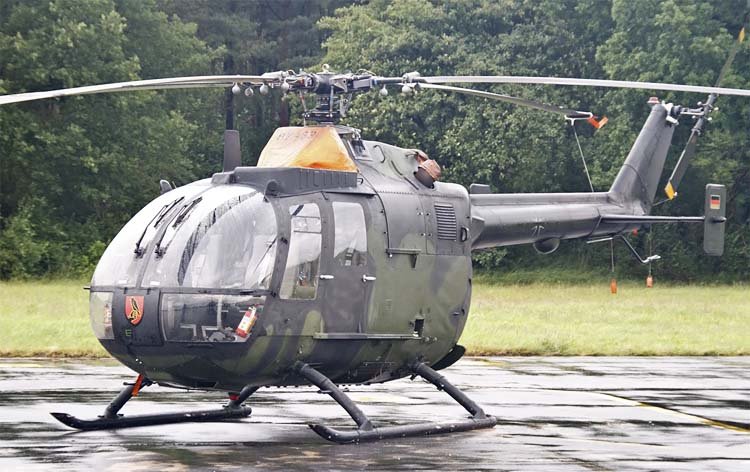
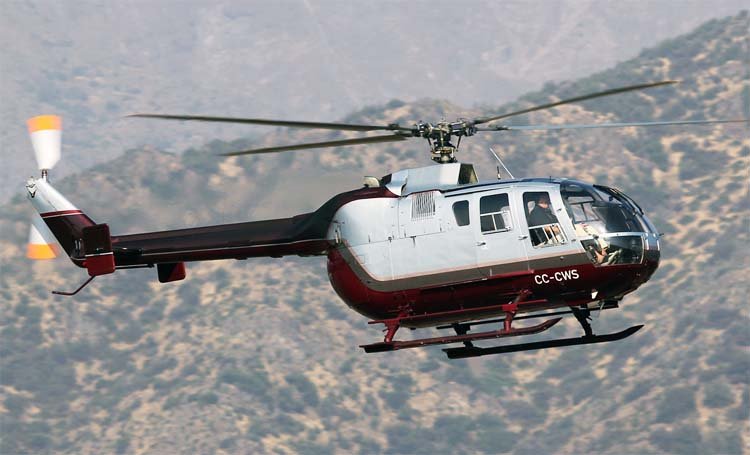
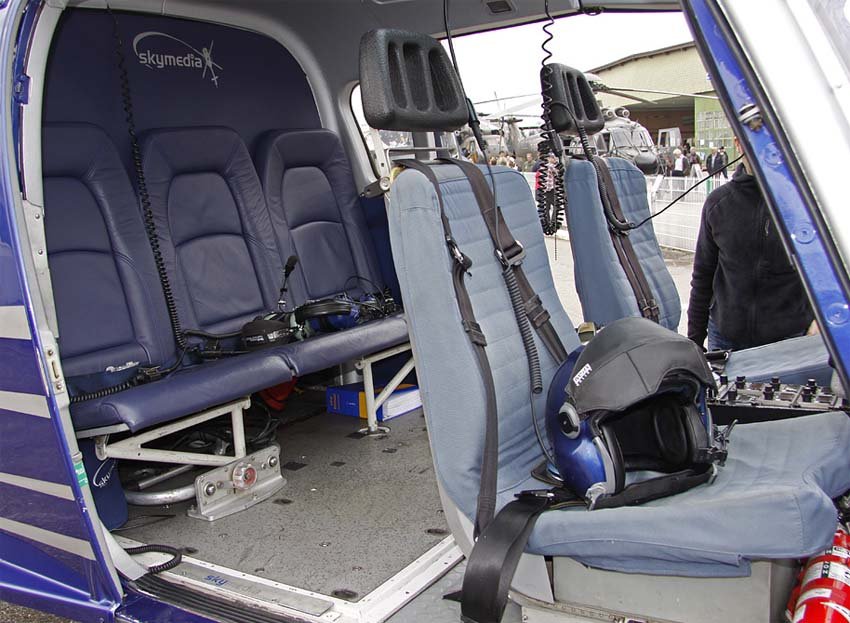
The fuselage is an all-metal, semi-monocoque type, made of aluminum alloys. The engine fairings and other non-structural elements are made of fiberglass. The nose section houses a cockpit with two seats – one for the pilot and one for the co-pilot (or passenger) – and three removable passenger seats. The cabin length is 4.55 m, width 1.4 m, height 1.25 m, and volume 4.8 m³. On the sides of the fuselage are two hinged front doors and two rear sliding doors. In the rear lower part of the cabin is a baggage compartment measuring 1.85 x 1.2 x 0.57 m, with a rear cargo hatch featuring side-opening doors. With the rear seats removed, two stretchers can be installed in the cabin and baggage compartment. The cabin and baggage compartment floor consists of seven removable panels, providing access to the fuel tanks and control system wiring. The power panel beneath the engines is made of titanium alloy. The conical tail boom is a semi-monocoque type, with a front section integrated with the fuselage and a detachable rear section. The fin and stabilizer with end plates are uncontrolled.
The main rotor is four-bladed with rigid blade attachment. The blades are rectangular in plan, foldable, made of reinforced fiberglass with an anti-erosion titanium alloy strip along the leading edge, and equipped with pendulum vibration dampers at the root.
The blade profile is a modified asymmetrical NACA 23012 with increased leading edge curvature, a chord of 0.27 m, and a linear twist of -8°. The titanium alloy hub features only axial hinges with roller bearings and torsion bars made of steel strips. The circumferential speed of the blade tips is 218 m/s.
The tail rotor is two-bladed, with a diameter of 1.9 m, and semi-rigid blade attachment. The blades are rectangular in plan, made of reinforced fiberglass, with an anti-erosion titanium alloy strip along the leading edge. The blade profile is NACA 0012, with a chord of 0.12 m. The circumferential speed of the blade tips is 221 m/s.
The powerplant consists of two turboshaft engines with a free turbine, Allison 250-C20B or C28C, installed in the upper part of the fuselage. The exhaust nozzles are angled at 45°. The dry weight of the engine is 71.5 kg.
The transmission comprises a three-stage main gearbox, an intermediate gearbox, a tail gearbox, and drive shafts for auxiliary units. The gear ratio from engine to main rotor is 14.2:1, and to the tail rotor is 2.7:1. The transmission is designed to transmit 514 kW/690 hp when two engines are operating, and 283 kW/380 hp when one engine is operating.
The fuel system includes main and expendable soft fuel tanks with a total capacity of 580 liters, four fuel pumps, filters, valves, and pipelines. Additional tanks can be installed. The engine lubrication system includes an oil tank with a capacity of 12 liters, and the transmission lubrication system has 11.6 liters.
The landing gear is a non-retractable skid type. Shock absorption is provided by the elastic deformation of the transverse struts. Removable wheels (for ground movement) or four inflatable pontoons can be installed on the skids. The landing gear track is 2.5 m, and the skid length is 2.7 m.
The main rotor control system is modular, redundant, and boosted, operating at a pressure of 10.2 MPa/105 kg/cm² and a flow rate of 6.2 l/min. The electrical equipment includes two 24V DC starter-generators with a capacity of 22 Ah and a ground power connector receptacle.
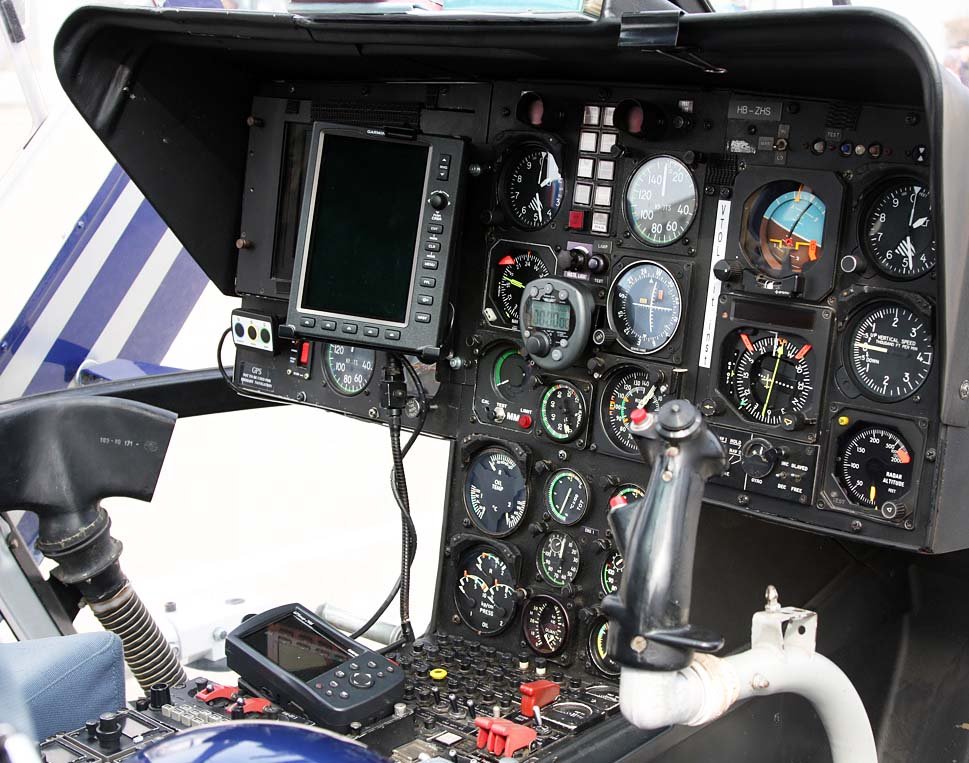
Standard equipment includes HF and VHF radios, flight instruments, engine operation monitoring, Doppler radar navigation, a stability augmentation system, a rescue winch, and a landing light.
Technical Specifications
| Modification | Bo.105 |
| Main rotor diameter, m | 9.84 |
| Tail rotor diameter, m | 1.90 |
| Length, m | 8.56 |
| Height, m | 3.00 |
| Empty weight | 1688 |
| Normal takeoff weight | 2380 |
| Maximum takeoff weight | 2500 |
| Internal fuel, kg | 320 |
| Engine type | 2 Allison 250-C20B turboshaft engines |
| Takeoff power | 2 x 313 |
| Flight power | 2 x 298 |
| Maximum speed, km/h | 270 |
| Cruising speed, km/h | 240 |
| Practical range, km | 1112 |
| Operational range, km | 318 |
| Rate of climb, m/min | 540 |
| Service ceiling, m | 4265 |
| Static ceiling, m | 2560 |
| Crew | 2 |
| Payload | 4 passengers or two stretchers |
Image and diagram gallery of the Bo.105
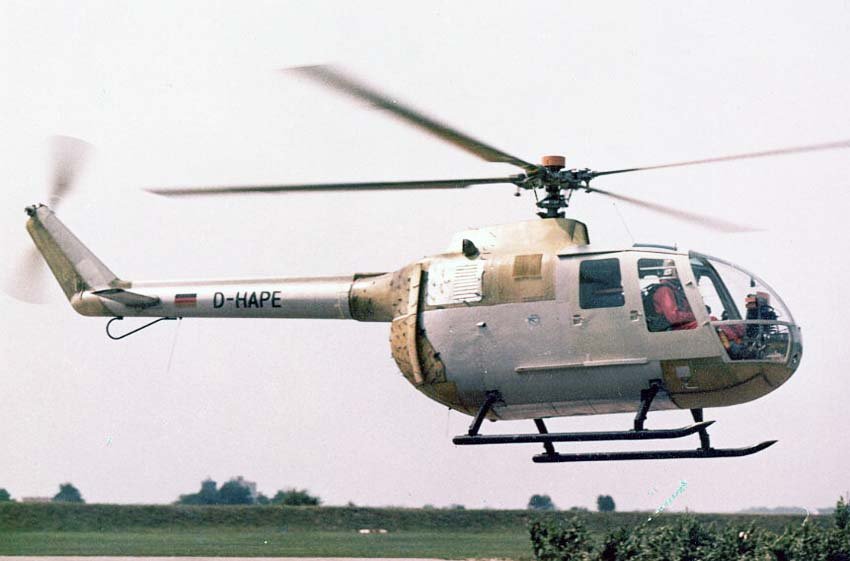 Bo.105 |
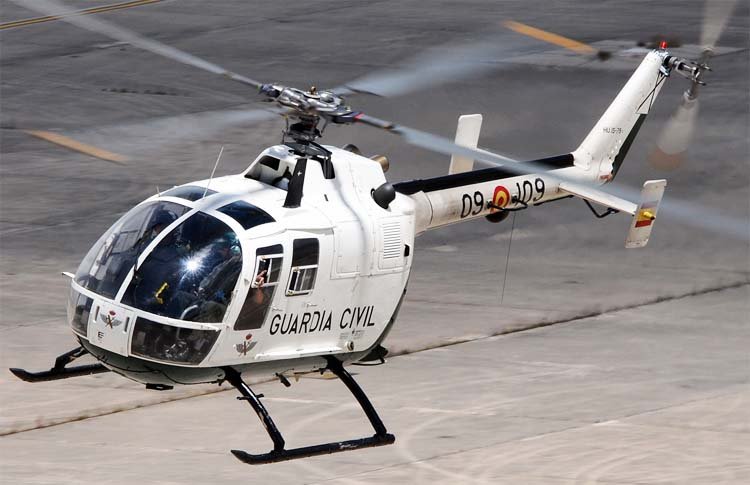 Bo.105 |
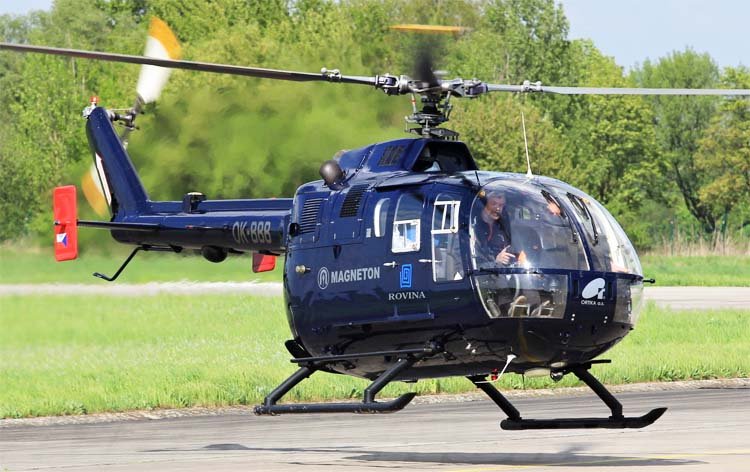 Bo.105 |
 Bo.105 |
 Bo.105 |
 Bo.105 |
 Bo.105 |
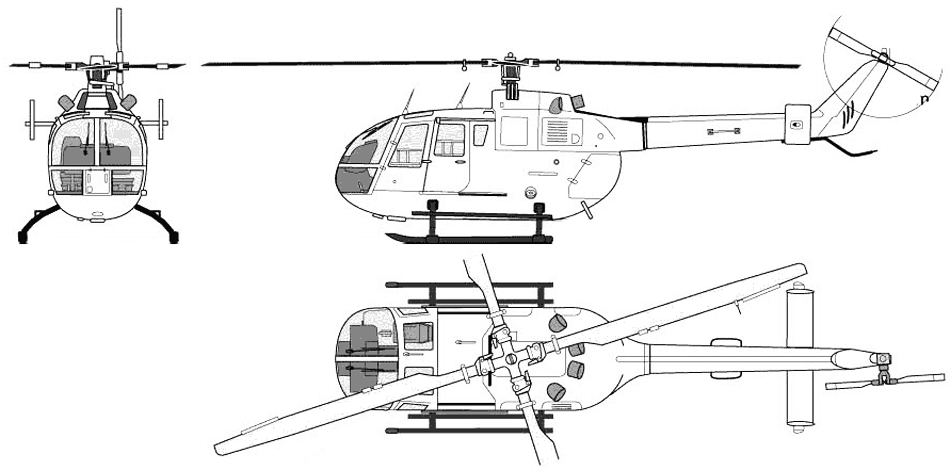 Bo.105 |
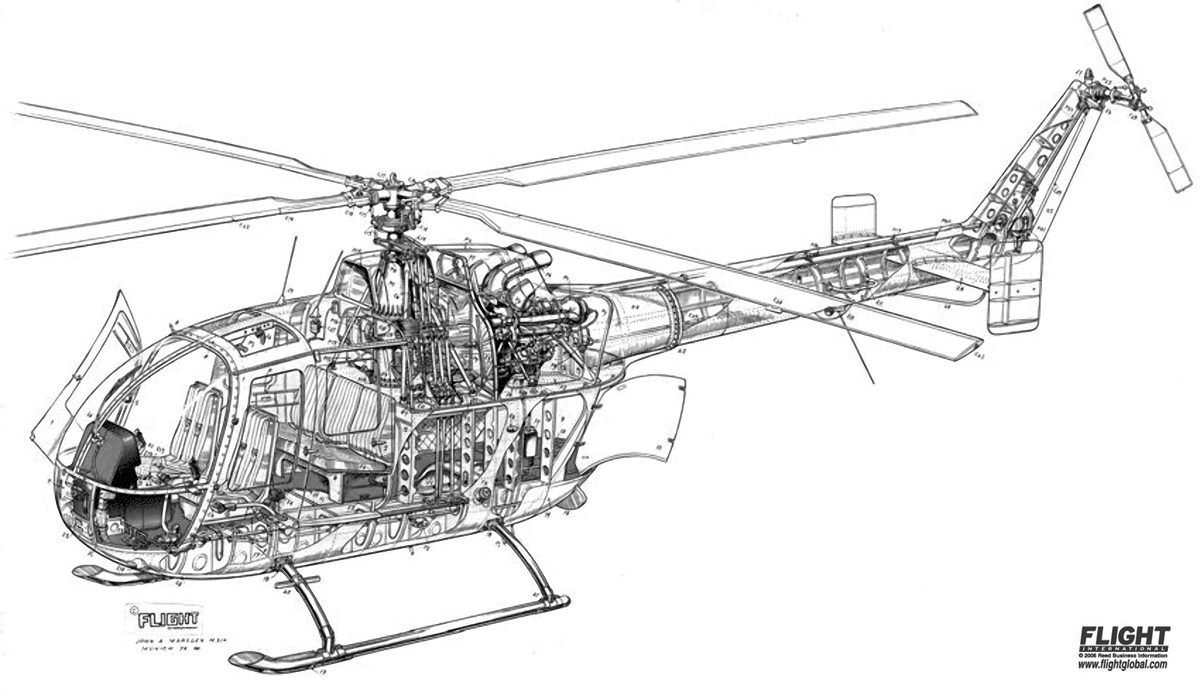 Bo.105 |
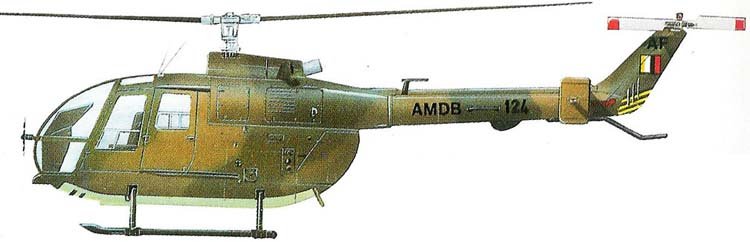 Bo.105 |
ArchivoAéreo Editorial Team
A group of aviation researchers and enthusiasts dedicated to documenting and preserving global aeronautical history. All articles are reviewed to ensure historical accuracy.
Sources & Accuracy
The information presented in this technical sheet has been compiled from declassified flight manuals, historical archives, and specialized literature. While we strive for maximum accuracy, some performance data may vary depending on the specific variant or operational conditions.