Borriss Karl
Early Life and Initial Service
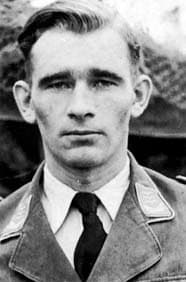
Borriss Karl was born on March 3, 1916, in Heinsdorf, Germany. He began his military service in December 1939, joining 5./JG 26 of the Luftwaffe. His early combat experiences included participation in the invasion of Belgium and the Battle of France.
On May 13, 1940, he was shot down near the Dutch coast by an RAF Defiant crew. Fortunately, he returned to his unit by May 17. He achieved his first aerial victory during the British evacuation from Dunkirk in early June 1940.
Rise and the Battle of Britain
Karl actively participated in the Battle of Britain, accumulating six aerial victories by its conclusion. His skill and dedication quickly made him a notable figure within his unit.
In March 1941, Borriss served as a Technical Officer (Technischer Offizier) in II./JG 26. He was selected among 30 pilots sent to Rechlin to master six pre-production Focke Wulf Fw 190 A-0 aircraft. Upon his return, he was appointed Staffelkapitän (Squadron Leader) in 8./JG 26.
Victories, Injury, and Recognition
By the end of 1941, his tally of victories reached 9, a number that grew to 21 by the end of the following year. On May 14, 1943, his Fw 190 A-5 (W.Nr. 7326) was hit by gunners from a group of USAAF B-17 bombers.
Despite the severity of the incident, Karl successfully bailed out. However, he had an unfortunate landing, resulting in multiple fractures that sent him to the hospital. After recovering, he returned to the front on June 23. For his 41 victories, he was awarded the Knight’s Cross (Ritterkreuz) on November 25. In May 1945, Borriss Karl was captured by British forces, having achieved a total of 43 aerial victories. He passed away on August 18, 1981.
ArchivoAéreo Editorial Team
A group of aviation researchers and enthusiasts dedicated to documenting and preserving global aeronautical history. All articles are reviewed to ensure historical accuracy.
Sources & Accuracy
The information presented in this technical sheet has been compiled from declassified flight manuals, historical archives, and specialized literature. While we strive for maximum accuracy, some performance data may vary depending on the specific variant or operational conditions.