C-141B Starlifter
History and Evolution of the C-141B
In 1974, as part of efforts to improve military transport aviation (MTA) capabilities, it was deemed expedient, following a Lockheed proposal from December 1973, to increase the cargo compartment of C-141A aircraft. Ilyushin adopted a similar approach to enhance transport capabilities in the 1990s with the Il-76MF. However, unlike the StarLifter, the extended “Ilys” would be newly built rather than converted from existing aircraft.
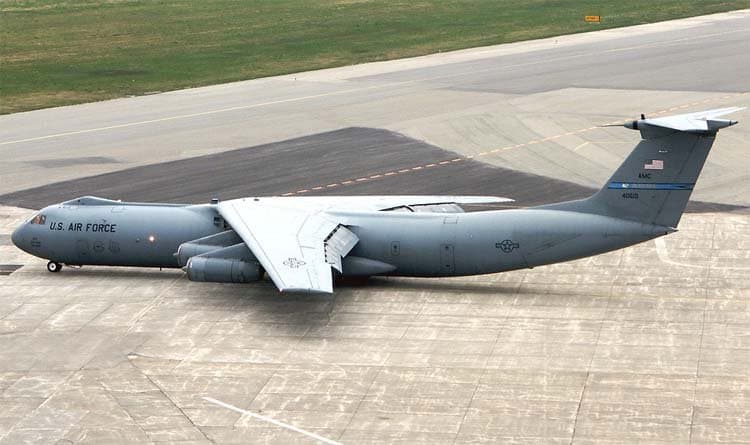
Lockheed secured the new contract in June 1975, and the experimental modified YC-141B made its first flight on March 24, 1977. A total of 271 (out of 275 remaining in service) C-141A aircraft were modified to the C-141B variant. These upgraded aircraft were redelivered to the USAF between December 4, 1979, and June 29, 1982, with the modernization program costing $1.5 billion.
The C-141B served for a long time as the primary operational-strategic military transport for the U.S., until the early 21st century, when it was succeeded by the C-17 Globemaster III. The C-141 boasted the lowest Class A accident rate among its contemporary “haulers,” recording a figure of 0.39 for its entire operational history by early 1988, significantly lower than the C-5 (1.53) and C-130 (1.16). Additionally, the C-141 set two world records for parachute drops: one platform with a 15,900 kg load and seven platforms carrying a total of 31,840 kg.
At Farnborough ’92, Lockheed announced a proposal to the USAF to modify C-141 aircraft to extend their service life. The company reasonably believed that even with 120 C-17s, the USAF would still require military transport capabilities. Consequently, a contract was signed, under which, starting in fiscal year 1994, 178 StarLifters began an upgrade program to increase their operational lifespan from 45,000 to 85,000 hours. The initial service life of the C-141 was 30,000 hours, which had previously been extended to 45,000 hours by installing a new center wing section.
During the C-141’s development, Lockheed aimed not only to meet military transport aviation command requirements but also to create a competitive aircraft for the civilian transport market. However, the original C-141 was deemed too expensive for civil use, unable to compete with existing transports converted from airliners, primarily due to high operating costs. The military’s demands for C-141 runway quality and takeoff/landing characteristics, which significantly impacted the product’s price, were clearly excessive for a civil aircraft. Moreover, the cargo compartment volume could not accommodate the stated payload of 43,000 kg, considering the low average density of commercial goods.
The civilian variant of the C-141A, designated L-300A, could have been lightened by 4,200 kg by removing military-specific components, such as the retractable rear ramp for paratroopers and strengthening elements for the cargo floor, landing gear, wing, and part of the wing’s mechanization. However, the primary requirement for cargo compartment volume remained unmet, leading to the project’s abandonment in favor of another commercial StarLifter variant, the L-300B. This version featured a fuselage lengthened by 7.1 meters, achieved by adding two sections, one forward and one aft of the wing.
Preliminary economic studies showed that, despite increased fuel and maintenance costs, the new transport would be 35-40% more economical than its main competitors. The aircraft could deliver 41 tons of payload on a single non-stop flight from the U.S. to Germany (approximately 6,700 km), while still retaining a two-hour fuel reserve. However, the commercial StarLifter project was never completed, primarily due to economic reasons, as insufficient buyers could be found to offset its development costs.
Operational Challenges and Modernizations
Meanwhile, the USAF continued to actively operate the StarLifter, using these aircraft extensively during the 1991 Gulf War. In May 1993, the USAF imposed a load restriction on C-141 aircraft, limiting the payload to 24,950 kg (74% of normal) for all operational aircraft, both in the regular fleet and the reserve. This restriction was prompted by the appearance of cracks in the wing box structure, originating from fuel transfer holes in the wing fuel tank bulkheads. Lockheed proposed a $4.45 billion program to modify 178 aircraft to extend their service life, involving the replacement of outer wing panels and other structural changes.
In August 1993, the USAF grounded 45 C-141Bs and restricted air refueling for another 116 StarLifters due to cracking concerns. The previously imposed load restriction remained for the remaining 88 aircraft. The USAF planned to make a final decision on the scope of C-141B modernization in late 1993, after inspecting all remaining aircraft operating under restrictions. However, with plans to introduce the next-generation C-17 transport and due to cuts in the U.S. military budget, the future of further StarLifter modernization became uncertain. By early 1994, the Pentagon completely abandoned the plan to replace the wings on the C-141B.
Nevertheless, from 1996, the American Air Force embarked on another phase of modernization for 148 StarLifters (all remaining in service at that time). This upgrade notably included the installation of new digital autopilots in the C-141B, which reduced maintenance labor by 95% compared to the older analog systems. StarLifters also began to be re-equipped with new cockpit instrumentation, including four full-color 100×150 mm LCD screens. A MIL-STD-1553 data bus was installed, making it possible to fly the C-141B with a two-person crew.
The aircraft were also equipped with ground proximity warning systems (the first StarLifter with an experimental kit for such a system was delivered to the USAF in March 1995). Furthermore, during the modernization, the C-141B was outfitted with a satellite communication system. In total, 63 C-141B aircraft underwent comprehensive modernization by the early 2000s.
Nine StarLifters underwent additional modernization for special operations under the SOLL (Special Operations, Low-Level) program. These aircraft were primarily intended for delivering special forces teams over long distances, with extended low-altitude flight segments and parachute drops. They received a terrain-following radar (with the antenna complex located in two bulbous fairings in the lower forward fuselage), a Head-Up Display (HUD), and a forward-looking infrared (FLIR) system, housed in a retractable turret behind the nose radome.
Furthermore, missile approach warning systems (installed in the nose and tail sections of the fuselage) were integrated into the avionics. Cockpit instrumentation and cargo compartment lighting were adapted for the crew and paratroopers using night vision goggles. A suite of measures to reduce the airframe’s radar visibility was also implemented.
C-141B aircraft directly or indirectly participated in numerous U.S. local wars and conflicts throughout the 1990s and 2000s. Transports of this type, equipped with a special transport-residential module in the cargo bay, were used for carrying very important passengers.
In the early 2000s, the inevitable process of phasing out C-141B aircraft from USAF service began. By mid-2006, only 20 StarLifters remained in the Air Force, all assigned to the Air Force Reserve. In 2005, the author saw several C-141Bs at Frankfurt International Airport. However, in the coming years, the only place where StarLifters will be found is in aviation museums.
Technical Specifications and Design
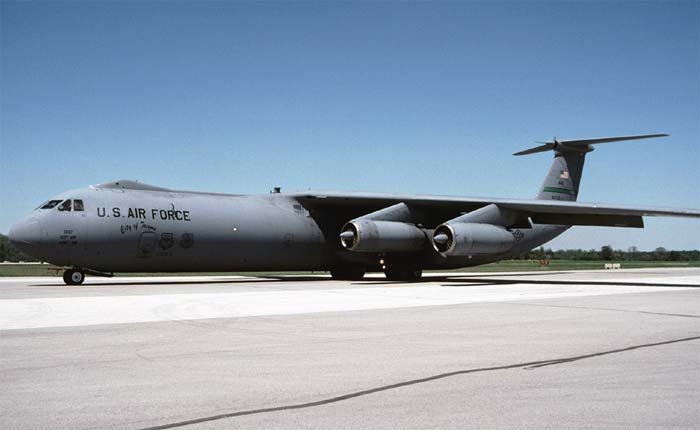
The aircraft features a conventional aerodynamic configuration, with a high-mounted wing and a T-tail. It possesses an all-metal construction, built according to damage-tolerant principles. The airframe’s designated service life was initially set at 40,000 hours but increased to 60,000 hours in the late 1980s due to the strengthening of the center wing box.
The wing is a two-spar box-type structure, with truss ribs and skin made of machined panels. The sweep angle at the 1/4 chord line is 25°. The leading edge of the wing, from the center section to the inner engine pylons, is of laminated construction with a honeycomb core. The rest features a duct for an air-thermal anti-icing system. In 1979, glass-graphite-epoxy leading-edge root sections measuring 2.39×0.89 m were installed on 10 aircraft.
The wing airfoil is of the NACA 00 series, with a relative thickness of 13% at the root and 10% at the tips. The angle of incidence is 4.9° at the root and -0.7° at the tips, with a dihedral angle of 1.2°. The mean aerodynamic chord length is 6.77 m, the root chord length is 10.11 m, and the aspect ratio is 7.9. The wing is equipped with ailerons (total area 15.88 m²) and Fowler flaps (49.15 m²). Spoilers (25.55 m²) are installed on the upper and lower wing surfaces forward of the flaps, with a maximum deflection angle of 21° on the upper and 5° on the lower surface. These spoilers are used as lift dumpers and air brakes.
The fuselage is a semi-monocoque type, with a circular cross-section, constructed using 7079 aluminum alloy known for high crack resistance. Crack arrestors, in the form of titanium patches, are installed. There are four main doors (forward left for crew, aft on both sides for paratroopers, and a cargo door in the upward-sloping tail section of the fuselage with a cargo ramp), as well as six emergency exits. Paratroop door dimensions are 1.83×0.91 m, and the cargo hatch is 2.77×3.11 m. The C-141B fuselage length was increased by 7.11 m due to two inserts, one 4.06 m long forward of the wing and another 3.05 m long aft of the wing.
The cockpit is designed for two pilots, a flight engineer, and a navigator. The cargo compartment can transport equipment, supplies, and personnel. The C-141B can accommodate 13 standard cargo platforms of the automated 463L loading system.
The aircraft’s horizontal stabilizer (span 15.34 m, area 35.02 m²) is trimmable and electrically actuated. Maximum deflection angles are 4° up and 12.5° down. It features elevators (9.85 m²). The vertical stabilizer, with an area of 30.57 m², is equipped with a rudder (8.04 m²). An electrical anti-icing system for the fin and stabilizer with 16 heating elements is also present.
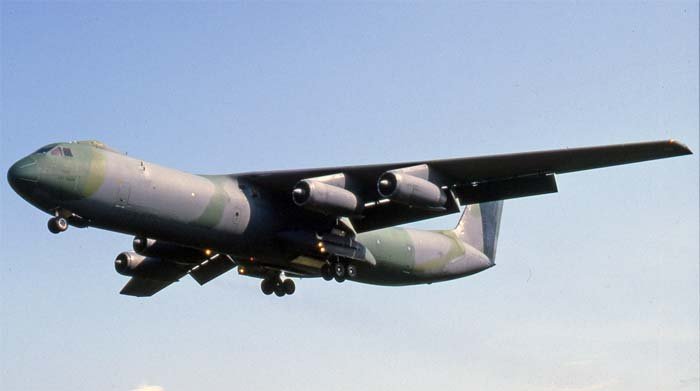
The landing gear is tricycle type. The main landing gear, with four-wheel bogies, retracts forward into fairings on both sides of the fuselage. The nose gear is two-wheeled, retracts forward into the fuselage, is equipped with a shimmy damper, and can swivel on the ground from +80° to -80°. The main wheel tire sizes are 44×16 Type VII, and the nose wheel tires are 36×11.0 Type VII. Tire pressures are 10.5-12.7 kgf/cm² and 14 kgf/cm², respectively. The shock absorbers are oleo-pneumatic, and the wheel brakes are multi-disc, with automatic braking systems. The landing gear track is 5.33 m, and the wheelbase is 20.22 m.
The aircraft is powered by four Pratt & Whitney TF33-P-7 turbofan engines (4×9525 kgf). These turbofans are mounted on pylons beneath the wing and are equipped with two-petal thrust reverser devices, generating reverse thrust equal to 45% of forward thrust. The TF33-P-7 is the military variant of the civilian JT3D-8A turbofan. The engine features a two-stage fan, seven-stage low- and high-pressure compressors, a single-stage high-pressure turbine, and a three-stage low-pressure turbine. The bypass ratio is 1.27, the overall pressure ratio is 16.0, the diameter is 1.35 m, the length is 3.62 m, and the mass is 2090 kg. The air intakes are equipped with an air-thermal anti-icing system.
An AirResearch GTCP85-106 APU is installed in the left landing gear fairing. Fuel is stored in 10 wing tank compartments with a total capacity of 89,300 liters. Pressure refueling is carried out via a connection in the right main landing gear bay. Gravity refueling is also possible through individual connections for each tank on the wing. The C-141B has an in-flight refueling receptacle located behind the cockpit.
The flight control system is irreversible, boost-type, with artificial feel units corrected for dynamic pressure. Control linkages under the cockpit floor are rigid, while other sections use dual cable systems. The hydraulic system consists of three independent systems with an operating pressure of 211 kgf/cm², powered by engine-driven pumps, ensuring normal operation of hydraulic actuators even if one or two engines fail.
The first hydraulic system operates one of the dual actuators for the flight controls. The second system powers the other chamber of the control actuators, as well as the retraction and extension of the landing gear, nose gear steering, wheel brakes, flaps, spoilers, stabilizer trim, and the emergency generator drive. In the event of a simultaneous failure of both systems, manual control of the flight surfaces is possible. The third hydraulic system is used to control the aft pressure bulkhead of the cargo compartment, the ramp, and the cargo door leaves, and also serves as a backup for the flap, spoiler, and wheel brake control systems.
Cabin pressurization and air conditioning are provided by an air cycle system, fed by compressed air from the engines. The cabin overpressure is 0.58 kgf/cm². The cockpit is equipped with a liquid oxygen gasifier system, designed for eight people. The cargo compartment features a continuous oxygen supply system with removable oxygen cylinders. Four portable oxygen devices are located in both the forward and aft sections of the cargo compartment.
The electrical system includes four 40 kVA AC generators driven by the engines and a 40/50 kVA auxiliary generator driven by the APU for ground system services. There is also a 2.5 kVA emergency generator with hydraulic drive, two 200 A DC converter-rectifiers, and a battery (24 V, 11 Ah).
Flight and navigation equipment includes the Bendix PB-60 autopilot, an AN/ASN-24 computer, ADF, VOR/ILS receiving equipment, TACAN (ARN-21) and LORAN-C (AN/APN-151) radionavigation systems, an APN-147 Doppler radar with an ASN-35 computer, an APN-59B weather radar, and a radio altimeter. From 1981, C-141B aircraft were equipped with the A24J-23 flight mode optimization system. HF and VHF communication equipment is also present. Electromechanical flight control actuators were tested on one aircraft converted into a flying laboratory starting in 1986.
The 463L cargo handling system in the cargo compartment includes four roller conveyors and guide rails, as well as an 18-ton capacity loader. Standard cargo platforms measuring 2.23×2.75 m and 2.23×1.35 m are used for loads up to 4540 kg and 2270 kg, respectively. For transporting cargo without platforms, including wheeled vehicles, the roller conveyors can be covered, and the guide rails retracted into recesses, creating a smooth floor. For mechanized unloading and loading from ground vehicles or for air dropping cargo, the cargo ramp is set to a horizontal position, forming an extension of the cabin floor. For loading/unloading wheeled equipment, the ramp is lowered to the ground.
Technical Specifications
| Modification | C-141B |
| Wingspan, m | 48.74 |
| Length, m | 51.29 |
| Height, m | 11.96 |
| Wing area, m2 | 299.88 |
| Empty weight | 67185 |
| Maximum takeoff weight | 155580 |
| Fuel | 69650 |
| Engine type | 4 Turboprop Pratt Whitney TF33-P-7 |
| Thrust, kN | 4 x 93.41 |
| Maximum speed, km/h | 910 |
| Cruising speed, km/h | 796 |
| Ferry range, km | 10280 |
| Practical range, km | 4725 |
| Service ceiling, m | 12680 |
| Crew, crew members | 4 |
| Payload | 154 soldiers or 41220 kg of cargo |
Image and diagram gallery of the C-141B Starlifter
 C-141B Starlifter |
 C-141B Starlifter |
 C-141B Starlifter |
 C-141B Starlifter |
 C-141B Starlifter |
 C-141B Starlifter |
 C-141B Starlifter |
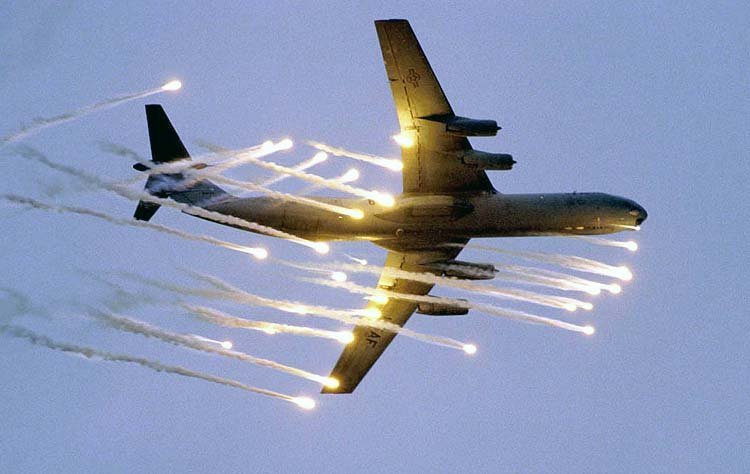 C-141B Starlifter |
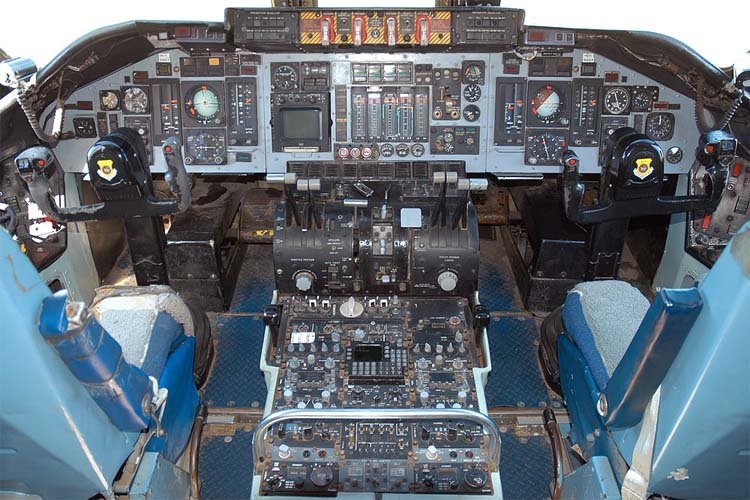 C-141B Starlifter |
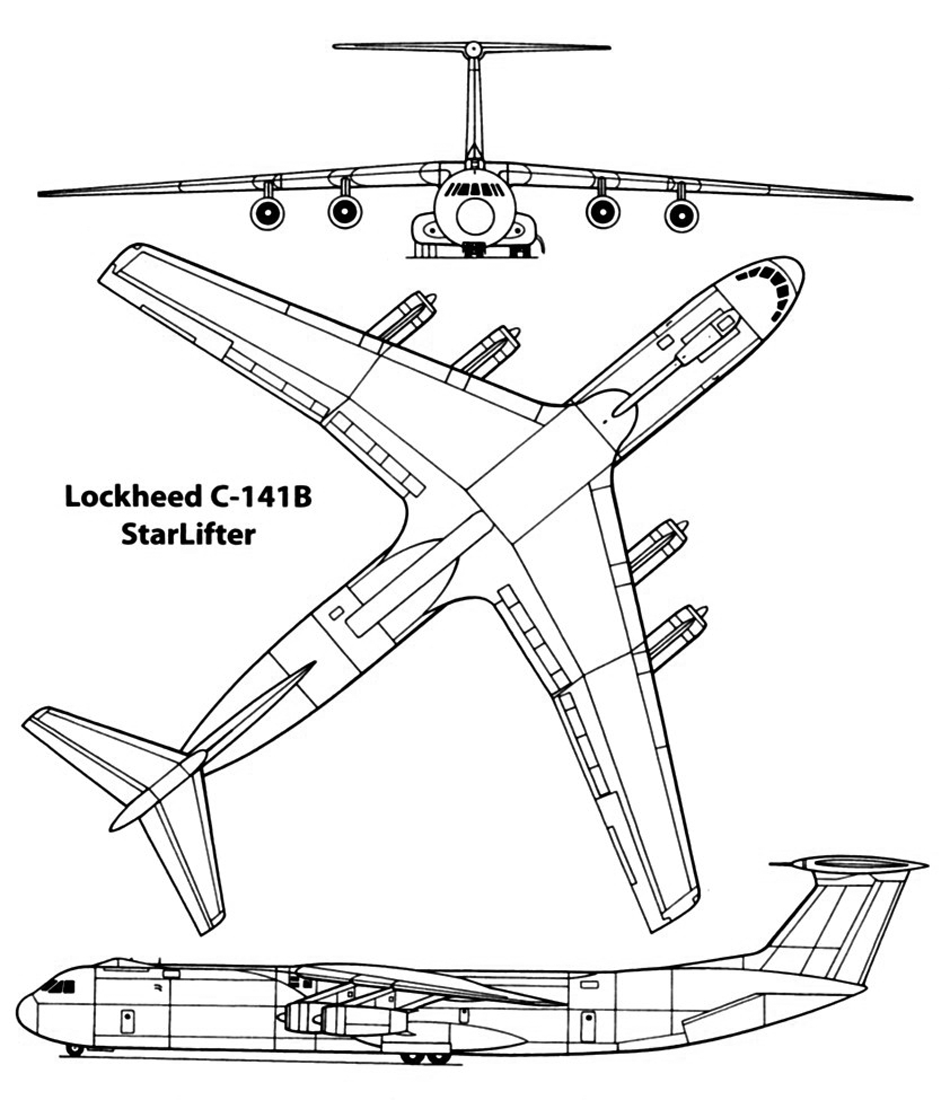 C-141B Starlifter |
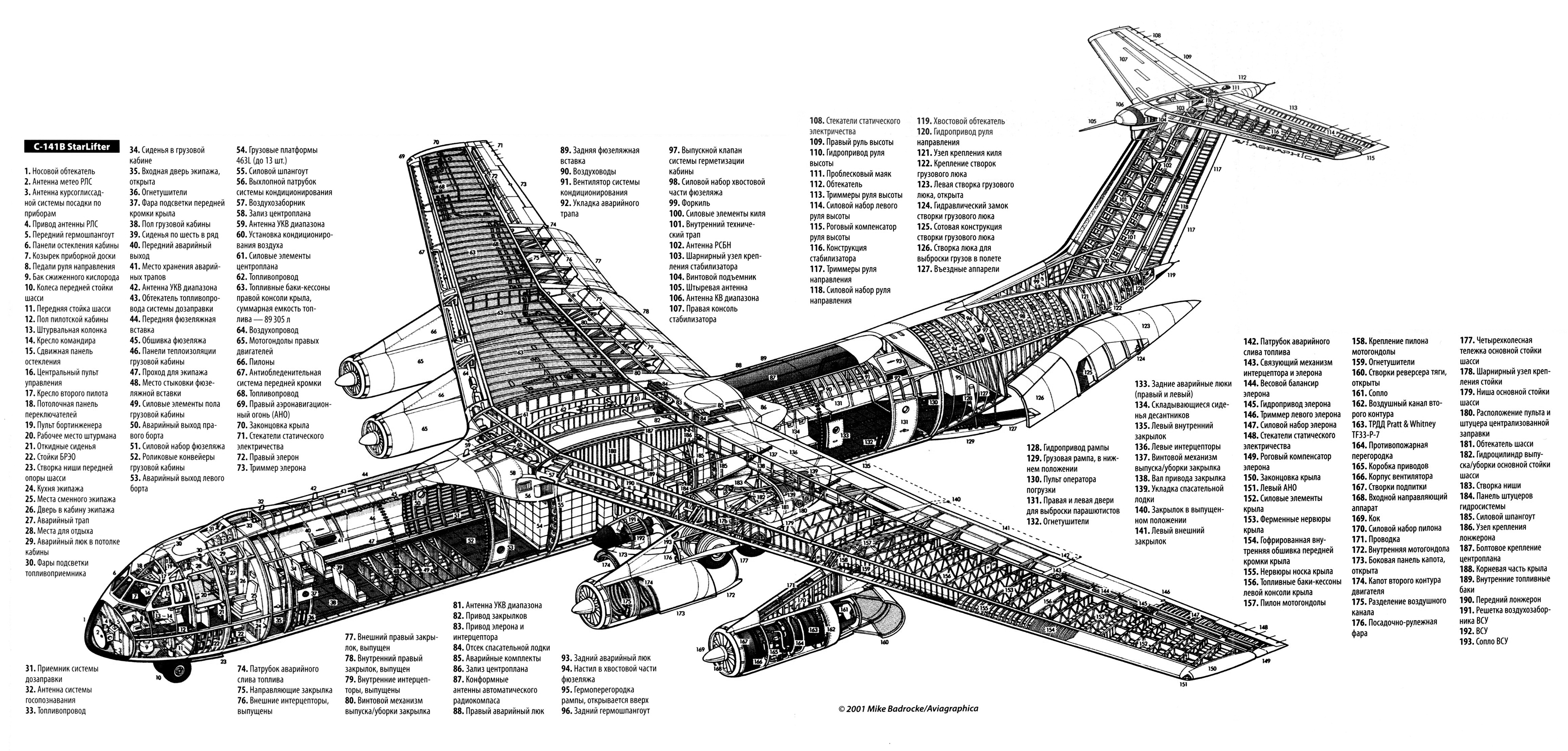 C-141B Starlifter |
 C-141B Starlifter |
 C-141B Starlifter |
ArchivoAéreo Editorial Team
A group of aviation researchers and enthusiasts dedicated to documenting and preserving global aeronautical history. All articles are reviewed to ensure historical accuracy.
Sources & Accuracy
The information presented in this technical sheet has been compiled from declassified flight manuals, historical archives, and specialized literature. While we strive for maximum accuracy, some performance data may vary depending on the specific variant or operational conditions.