C.25S
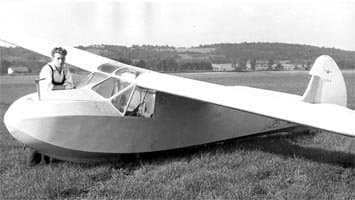
In September 1941, in France, much of which was occupied by the Germans, a program for renewing the glider fleet was adopted. This initiative was spearheaded by the Department of Sports Aviation (Sports Aeriens) with active support from the Secretariat for Youth and Sports (Secretariat a la Jeunesse et aux Sports).
The task of developing new sports gliders was given to the firms Caudron and Castel. The latter, Castel, presented the C.25 project, which was accepted for implementation. The first C.25 prototype was ready in early 1942.
During test flights conducted over the next few months, the C.25 demonstrated excellent flight characteristics, making it suitable for initial pilot training. Despite the C.25 project being purely civilian, the German administration permitted the start of serial production for these gliders.
Even after the full occupation of the country, the assembly of production gliders under the designation C.25S continued, and by early 1944, a first series of 20 units had been built. Caudron’s C.800 project was less fortunate; its first prototype was tested only in 1943 and was mass-produced solely after the war.
Revival of French Gliding Aviation
The program was revived in September 1944, following Charles de Gaulle’s government coming to power. According to the new domestic aviation development program, over 500 gliders of several types were initially planned, but this number was significantly reduced later on.
The order for the production of the C.25S was accepted in 1946. A total of 100 units were built, with the last one delivered in 1948. The glider proved to be very successful and was widely used by many French aero clubs.
Moreover, French pilots flying the C.25S became world champions in gliding in 1953 and 1955, underscoring its exceptional performance.
The C.25S in Popular Culture
There was another interesting moment in the C.25S’s history. In 1966, during the filming of “The Great Stroll” (“La Grande Vadrouille”), starring Louis de Funès, two authentic gliders were needed for the final escape scene. Two post-war C.25S gliders were chosen as they were perfectly suitable for the role.
Interestingly, their unlucky pursuer in the film was a Morane-Saulnier MS-500 “Criquet,” a copy of the German Fieseler Fi-156 liaison aircraft equipped with a radial engine. The occupiers, meanwhile, gave chase in American M3 half-tracks, which had been supplied to France by the Allies during the war.
Technical Specifications
| Modification | C.25S |
| Wingspan, m | 16.00 |
| Length, m | 7.30 |
| Height, m | 2.30 |
| Empty weight | 256 |
| Maximum weight | 430 |
| Maximum speed, km/h | 100 |
| Max. glide ratio | 22 |
| Service ceiling, m | 4600 |
| Crew | 2 |
Image and diagram gallery of the C.25S
 C.25S |
 C.25S |
 C.25S |
 C.25S |
 C.25S |
 C.25S |
 C.25S |
 C.25S |
 C.25S |
 C.25S |
ArchivoAéreo Editorial Team
A group of aviation researchers and enthusiasts dedicated to documenting and preserving global aeronautical history. All articles are reviewed to ensure historical accuracy.
Sources & Accuracy
The information presented in this technical sheet has been compiled from declassified flight manuals, historical archives, and specialized literature. While we strive for maximum accuracy, some performance data may vary depending on the specific variant or operational conditions.