Cierva C.17 Autogiro
The Cierva C.15 and C.16 designations seemingly remained as mere projects. Cierva’s subsequent autogiro received the index C.17 (Avro Type 612). This was a scaled-down version of the C.8L Mk III aircraft, featuring a 90 hp (67 kW) Cirrus III engine and based on the Avian IIIA fuselage.
Development and Initial Trials
Juan de la Cierva himself flew it on October 23, 1928. The aircraft proved to be insufficiently powered. A second version, the C.17 Mk II (G-AABP), was later built with a 100 hp (75 kW) Alpha radial engine. This machine also proved unsuccessful and was converted back into an airplane in 1935.
The Cierva C.18 Autogiro
The designation C.18 was assigned to a two-seater autogiro, constructed in France by the “Weymann-Lepere” company in 1929. It was equipped with a 195 hp (145 kW) Salmson AC7 radial engine. The sole example was imported to Britain by the “Cierva Autogiro Company” and registered there in June 1929. It was rumored to have later made its way to the USA.
Technical Specifications
| Modification | С.17 Mk.1 |
| Main rotor diameter, m | 10.14 |
| Fuselage length, m | 8.77 |
| Height, m | 3.38 |
| Empty weight | 458 |
| Normal takeoff weight | 655 |
| Engine type | 1 Piston engine ADC Cirrus III |
| Power, hp | 1 x 90 |
| Maximum speed, km/h | 145 |
| Cruising speed, km/h | 125 |
| Practical range, km | 338 |
| Crew, crew members | 1+1 |
Image and diagram gallery of the Cierva C.17 Autogiro
 C.17 |
 C.17 |
 C.17 |
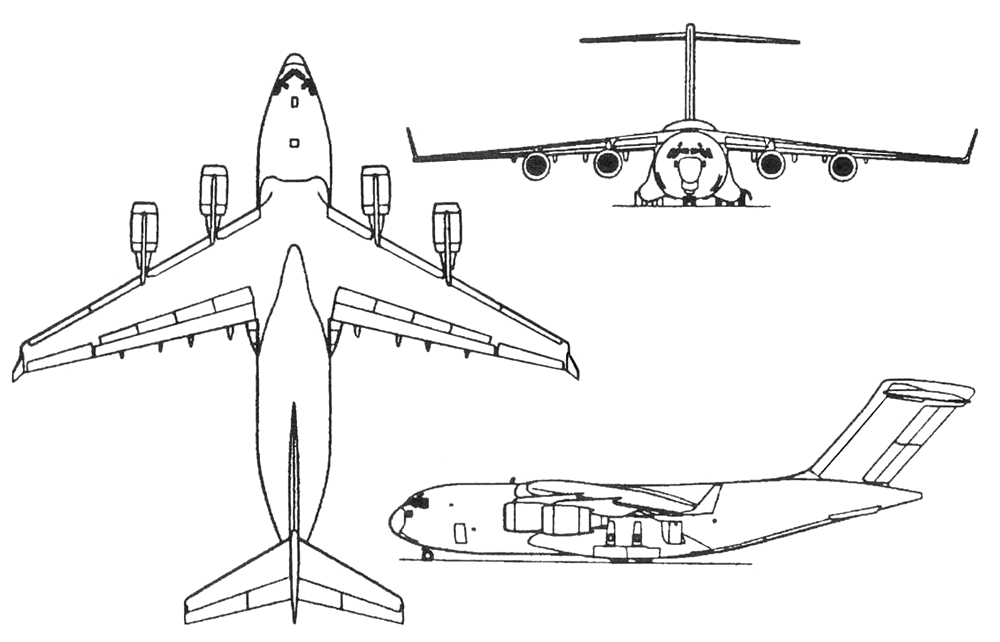 C.17 |
ArchivoAéreo Editorial Team
A group of aviation researchers and enthusiasts dedicated to documenting and preserving global aeronautical history. All articles are reviewed to ensure historical accuracy.
Sources & Accuracy
The information presented in this technical sheet has been compiled from declassified flight manuals, historical archives, and specialized literature. While we strive for maximum accuracy, some performance data may vary depending on the specific variant or operational conditions.