Ernst Börngen
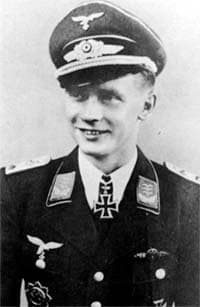
Ernst Börngen was born on February 7, 1916, in Meuselwitz. On June 27, 1940, he began flying as part of 4./JG 27. He achieved his first victory on August 18, shooting down two RAF Spitfires.
He participated in the Balkan Campaign, where he shot down a Greek Gladiator on April 15, 1941. Shortly after, he found himself fighting on the Eastern Front.
Eastern Front and North African Engagements
On June 25, Börngen added two Soviet DB-3s to his tally. By late September, II./JG 27 was deployed to North Africa. By the end of 1942, he had shot down 13 British fighters and one enemy bomber.
On May 20, 1943, he was promoted to Staffelkapitän in 5./JG 27. His leadership and skill proved crucial in the subsequent campaigns, establishing him as a formidable ace.
On July 11, he shot down a Spitfire, but his own Bf 109 F-4trop (W.Nr. 102 03) “black 3” was so severely damaged that he was forced to make an emergency landing. Börngen continued to lead 5./JG 27 during the intense fighting in Southern Italy.
On July 16, 1943, he managed to shoot down a B-24. However, his Bf 109 G-6trop (W.Nr. 183 71) was hit by return fire and shot down, forcing the pilot to make another emergency landing.
The Ultimate Sacrifice
In March 1944, III./JG 27 was redeployed for the Defense of the Reich. On May 19, 1944, while flying a Bf 109 G-6 (W.Nr. 441 101), Börngen rammed an American B-24 in an act of extreme bravery.
Although he managed to parachute out, doctors on the ground were unable to save his right arm. As a result, he did not participate further in the war. In total, Börngen achieved 41 victories in 450 combat missions.
No information is available regarding his post-war fate.
ArchivoAéreo Editorial Team
A group of aviation researchers and enthusiasts dedicated to documenting and preserving global aeronautical history. All articles are reviewed to ensure historical accuracy.
Sources & Accuracy
The information presented in this technical sheet has been compiled from declassified flight manuals, historical archives, and specialized literature. While we strive for maximum accuracy, some performance data may vary depending on the specific variant or operational conditions.