Franco Bordoni-Bisleri
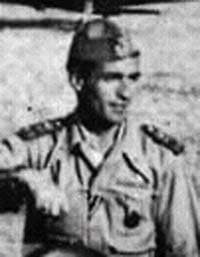
Early Flights of an Ace
Franco Bordoni-Bisleri’s career in the Regia Aeronautica was a continuation of his sporting achievements as a pilot. The young man did not engage in the family business—his family owned the trademark of the famous Ferro-China Bisleri liqueur, well-known throughout Italy. Instead, he was captivated by the sky, finding the pursuit of speed more intoxicating than even the most renowned liqueur.
Born on January 10, 1913, in Milan, Franco Bordoni-Bisleri had already proven himself a talented race car driver by the time he completed his studies at the prestigious San Carlo College. Despite his passion, issues with his nasopharynx prevented him from passing the medical examination for entry into the Regia Aeronautica. However, he did not give up: he obtained an amateur pilot’s diploma and, in 1937, finally broke into the Air Force, albeit as a reserve pilot.
Air Combat Over the Channel and Africa
Bisleri was called up for service just before Italy’s entry into the war. In the autumn of 1940, as part of the 95th Squadron of the 18th Group, he participated in battles over the English Channel. Bisleri quickly became convinced of the inferiority of his CR.42 compared to the RAF’s monoplane fighters.
In January 1941, the 18th Group returned to Italy, from where it was almost immediately transferred to North Africa. The open cockpit of the biplane proved more suitable for desert conditions; in Europe during winter, CR.32 and CR.42 pilots would freeze in the cold wind. Around this time, Bordoni-Bisleri earned the nickname “Robur,” linked to a family liqueur advertising campaign running throughout Italy, and he even painted his nickname on the fuselage of his biplane.
His first victory came in March 1941, when he shot down a Blenheim 100 km from Benghazi, a kill shared with Marcello Longhi. During his first deployment to North Africa, Bordoni-Bisleri shot down several aircraft: two in April (a Hurricane on the 14th and a Blenheim on the 17th), and two in June (both Blenheims). In August, the 18th Group returned to Italy, where personnel received G.50 fighters, but these were replaced by more advanced C.200s before deployment to Greece. In Greece, no pilot from the group achieved success in air combat.
A Surviving Ace of War and Beyond
In July 1942, the group reappeared in North Africa. The personnel were tasked with striking ground targets, providing support for Rommel’s advancing forces. Bordoni-Bisleri, however, preferred to demonstrate his achievements as a “pure” fighter pilot: between October 20 and November 7, he shot down six P-40 fighters and a “Boston” bomber. Ironically, the ace who had passed through the crucible of aerial combat without a scratch sustained serious injuries in a car accident. On November 19, the wounded Bordoni-Bisleri was evacuated by sea to Italy.
After a lengthy recovery, the pilot returned to service in June 1943, assigned to the Cerveteri base, where units of the 3rd Stormo were stationed. Flying the faster and better-armed C.205V “Veltro” fighters, the Stormo was responsible for the air defense of central Italy, primarily Rome. Over mainland Italy, between July 30 and September 5, Bordoni-Bisleri shot down six “Flying Fortresses” and one B-26 bomber. With 19 confirmed victories, he became, alongside his colleague “Gigi” Gorrini, the most successful Italian fighter pilot to survive World War II, decorated with three Silver Medals and the Iron Cross Second Class.
After the war, the veteran ace finally had to engage in the liqueur business, but for his soul, Bordoni-Bisleri also took part in car races with great success, winning the Italian sports car championship in 1953. Franco Bordoni-Bisleri tragically died in a plane crash on September 15, 1975, when the light single-engine SIAI-Marchetti F.260 he was piloting crashed into Mount Ancetta in Liguria due to bad weather. His ten-year-old son Francesco and friend Gianni Allegri also perished in the crash. Bordoni-Bisleri, who was president of the Milan Aero Club, was returning to Milan from Rome, where he had been discussing issues related to parachuting competitions. The Italian press responded to Franco Bordoni-Bisleri’s death, mourning the respected and well-known figure, though only a few obituaries remembered him as one of the best fighter pilots of the Regia Aeronautica.
ArchivoAéreo Editorial Team
A group of aviation researchers and enthusiasts dedicated to documenting and preserving global aeronautical history. All articles are reviewed to ensure historical accuracy.
Sources & Accuracy
The information presented in this technical sheet has been compiled from declassified flight manuals, historical archives, and specialized literature. While we strive for maximum accuracy, some performance data may vary depending on the specific variant or operational conditions.