Giuseppe Biron
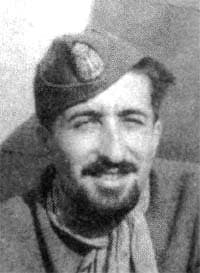
Giuseppe Biron was born on October 12, 1914, in Legnano, Verona province. In April 1933, he enrolled as a cadet in the Regia Aeronautica. By September, he had earned his military pilot’s “wings.” The young pilot began his service in the 4th Stormo, from where he was almost immediately transferred to the 104th Squadriglia Osservazione Aerea, stationed in West Africa. However, Biron’s health did not permit him to remain long in West Africa, and he was recalled to Italy.
Early Service and Spanish Civil War
After a brief stay in the 6th Stormo, Biron volunteered for Spain, where he initially flew with the 33rd Squadron of the VI Gruppo “Gamba di Ferro,” and later with the “Cucarachas” squadron. Upon returning from Spain, Biron completed advanced officer courses and was promoted to lieutenant. He was then assigned to the 369th Squadron of the 22nd Gruppo Autonomo, which was preparing for deployment to the Eastern Front. The group was equipped with C.200 fighters.
En route to Ukraine, the group made a stop in Tirana. Here, Biron painted an emblem on his fighter that clearly evoked associations with the “Cucarachas” squadron’s emblem. The first enemy fighters the Italians encountered in the skies of the Eastern Front were the I-16s, familiar from Spain. The pilots considered the “Spanish” emblem a good omen, and it still adorns the sides of the Italian Air Force’s jet Starfighters today.
Eastern Front and Aerial Victories
The frosty Russian winter complicated the use of C.200 fighters with their open cockpits exposed to all winds. Despite the harsh Ukrainian climate, Biron shot down several I-16 and MiG-3 fighters in February-March 1942. During that period, the group’s staff did not keep individual victory counts, but it can be said with high confidence that Biron accounted for four to six downed aircraft.
Returning from the Eastern Front in spring 1942, the 22nd Group was integrated into the air defense system of southern Italy. From August 21 to 28, 1943, Biron shot down a “Flying Fortress” and three “Lightning” fighters. By this time, individual victories were meticulously recorded, and pilots were paid a certain sum for each downed aircraft, depending on the number of engines of the defeated machine (single, twin, or multi-engine).
Post-Armistice and Distinguished Career
After the armistice, Biron sided with the fascists and joined the Squadriglia Complementare Montefusco-Bonet, which later became part of Major Visconti’s I Gruppo Caccia. Like most ANR pilots, Biron was discharged after the war, but in 1950, he was allowed to return to the Air Force. The ace finally retired in 1971 with the rank of colonel. For his service in World War II, Biron received five Silver Medals, two Bronze Medals, and the Iron Cross Second Class. After retirement, Biron lived in Treviso and worked closely with the press.
ArchivoAéreo Editorial Team
A group of aviation researchers and enthusiasts dedicated to documenting and preserving global aeronautical history. All articles are reviewed to ensure historical accuracy.
Sources & Accuracy
The information presented in this technical sheet has been compiled from declassified flight manuals, historical archives, and specialized literature. While we strive for maximum accuracy, some performance data may vary depending on the specific variant or operational conditions.