Heinz-Edgar Berres
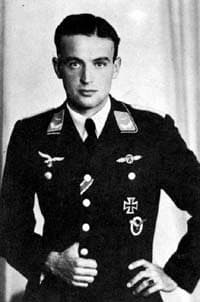
Born on January 10, 1920, in Koblenz, Germany. After completing flight school in the summer of 1941, he was assigned to 3.(J)/LG 2. On November 29, he achieved his first aerial victory, downing a Soviet SB-3 bomber.
Early Combat and Mediterranean Deployment
In March 1942, Berres was transferred to 1./JG 77. On June 12, 1942, he shot down a USAAF B-24 over Romania. In early July, his unit was redeployed to the Mediterranean Theater of Operations.
During that summer, Berres distinguished himself by downing 11 RAF Spitfires over Malta, showcasing his prowess as a fighter pilot. From October 1942, he began flying missions in North Africa, engaging Allied forces in that crucial front.
Final Mission and Disappearance
On July 25, 1943, Berres, flying a BF 109 G-6 (W.Nr. 18 101, “BF + QU”), was assigned to escort a Ju 52 transport. Near Milazzo, the convoy came under attack from RAF Spitfires. During this engagement, the pilot’s traces were lost.
At the time of his disappearance, Berres had accumulated 52 aerial victories in 354 combat sorties. He was posthumously awarded the Ritterkreuz (September 19, 1943) and promoted to the rank of Hauptmann, recognizing his valor and service.
ArchivoAéreo Editorial Team
A group of aviation researchers and enthusiasts dedicated to documenting and preserving global aeronautical history. All articles are reviewed to ensure historical accuracy.
Sources & Accuracy
The information presented in this technical sheet has been compiled from declassified flight manuals, historical archives, and specialized literature. While we strive for maximum accuracy, some performance data may vary depending on the specific variant or operational conditions.