Messerschmitt-Bölkow-Blohm Bo 105 (PAH-1)
Development and Key Features
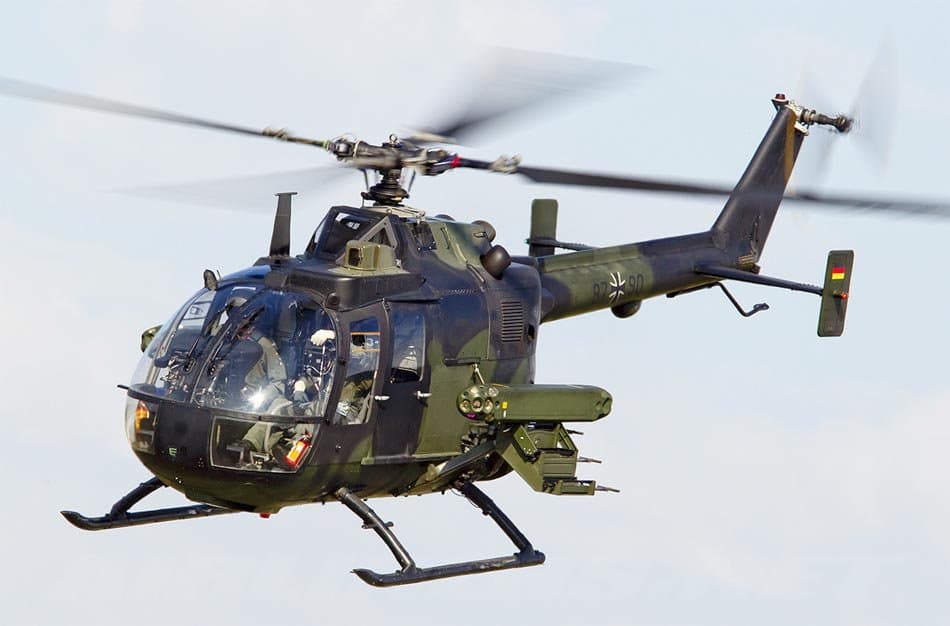
Almost simultaneously with the French “Gazelle,” Messerschmitt-Bölkow-Blohm (MBB) developed the Bo 105 helicopter in West Germany. Externally, with the exception of the “fenestron,” it largely resembled the “Gazelle.” The helicopter featured a single-rotor design, with a tail rotor and skid landing gear.
Unlike the SA.342, the Bo 105 was a twin-engine machine equipped with Allison 250-C20B turboshaft engines, each with a takeoff power of 313 kW. In the event of one engine failing, the other could switch to an emergency operating mode, allowing the aircraft to return to its airfield. Thanks to its more powerful propulsion system, the Bo 105 could carry a greater load compared to the “Gazelle,” and the German machine’s maximum takeoff weight was 250 kg heavier, reaching 2500 kg.
Performance and Maneuverability
The flight performance of the German helicopter proved to be quite high. It achieved a maximum speed of 270 km/h and a cruising speed of 240 km/h. Its combat radius exceeded 300 km, and it could carry a combat load of 456 kg. The first flight of the Bo 105 took place on February 16, 1967, with serial production commencing in 1970.
The helicopter possessed excellent maneuverability, a feature the manufacturer MBB quickly capitalized on, promoting the Bo 105 at aerospace shows. During demonstration flights, highly lightened aircraft, piloted by experienced aviators, performed aerobatic maneuvers. The West German helicopter was noted for its high rate of climb and an operational overload of 3.5G.
Military Variants and Armament
More than half of the Bo.105C/CB helicopters produced were used in military variants, serving as reconnaissance, liaison, and anti-tank helicopters. These were equipped with the French SLIM aiming system, which included television and IR observation equipment for the forward hemisphere, along with a laser rangefinder.
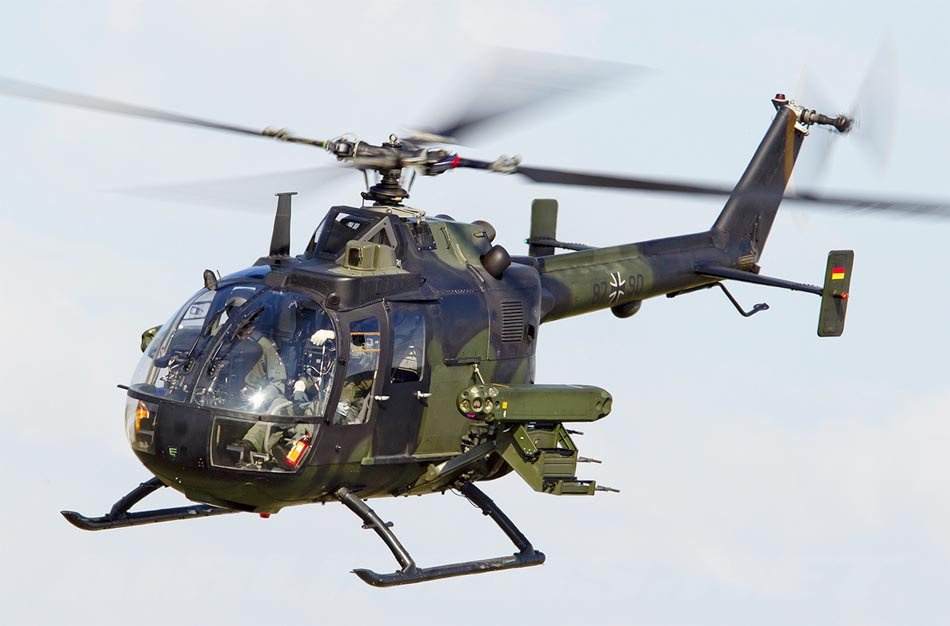
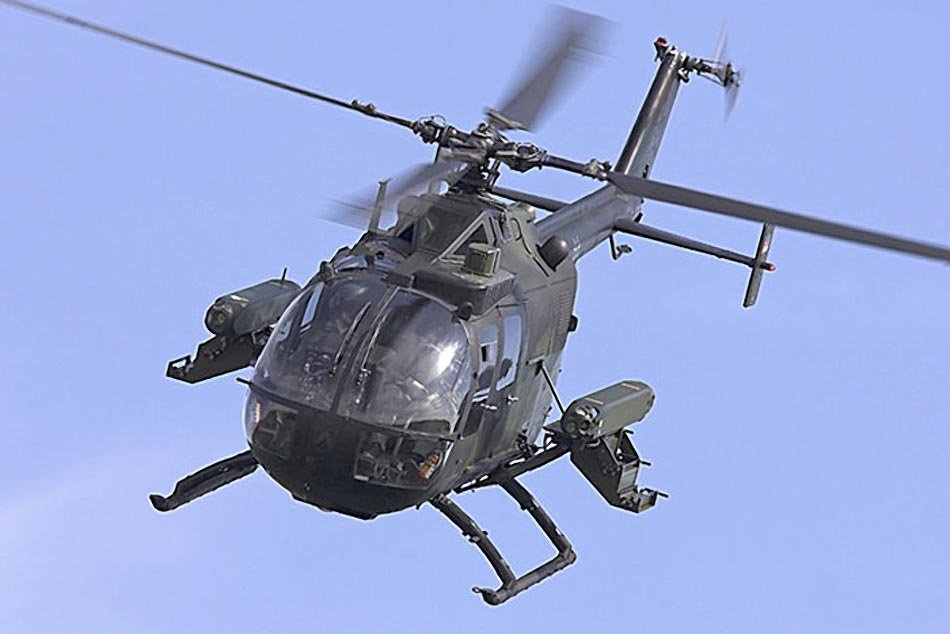
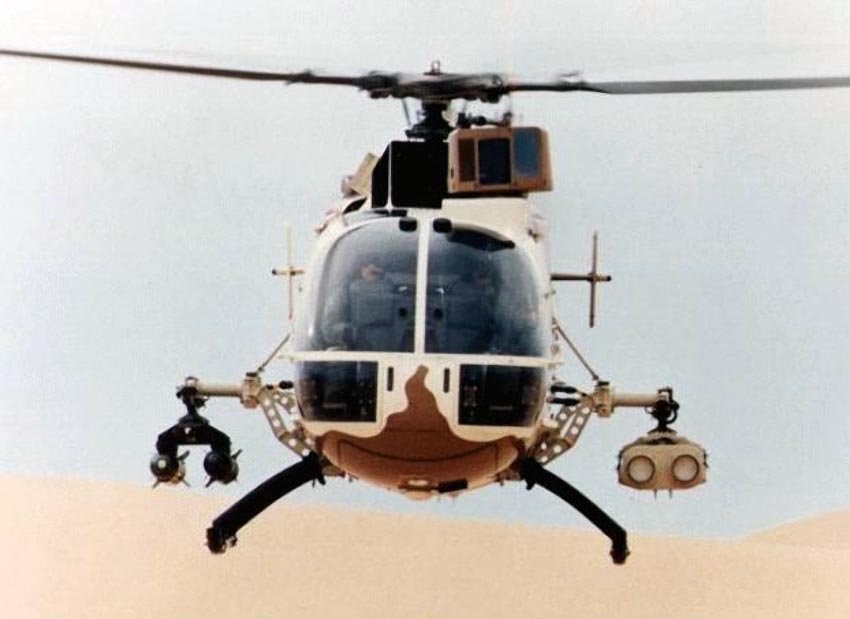
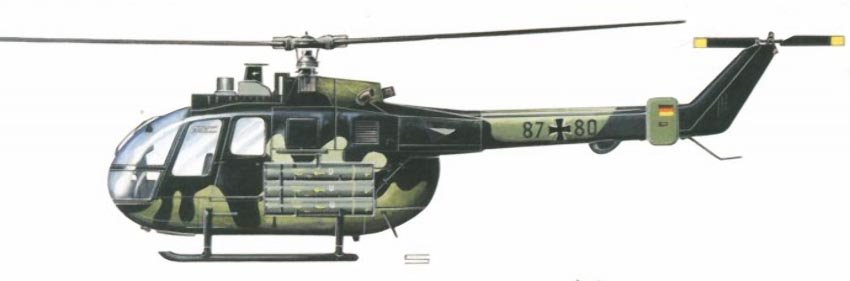
In 1975, the Bundeswehr command decided to order 212 Bo 105 PAH-1 anti-tank helicopters armed with HOT ATGMs. The modernized anti-tank modification, the Bo 105 PAH-1A1, used HOT-2 ATGMs and featured the same French SLIM aiming and observation system with TV and IR channels and a laser rangefinder. The most noticeable external difference of the modernized variant was the altered arrangement of the plastic ATGM containers.
Beginning in 2007, German anti-tank Bo 105s were gradually replaced by the latest Tiger attack helicopters. Machines deemed suitable for further use were disarmed, with their aiming and search equipment dismantled. The use of the Bo 105 for reconnaissance and liaison roles in the West German armed forces continued until 2016.
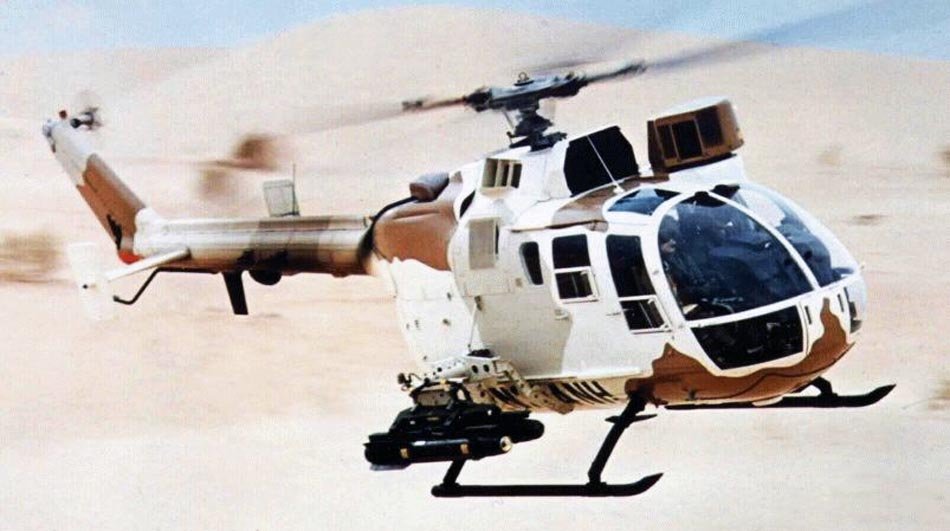
Beyond anti-tank guided missiles, customers could also opt to arm the Bo 105 with 7.62-12.7mm machine guns, 20mm cannons, and unguided rocket pods. Deliveries of anti-tank helicopters took place from 1978 to 1984. By the late 1980s, the cost of a Bo 105 PAH-1A1 anti-tank helicopter on the international market was $2 million. The composition of armament and avionics on export models could differ significantly from the German variant. Due to reliability issues with HOT ATGMs, a number of foreign buyers preferred American TOW anti-tank missiles.
Technical Specifications
| Modification | Bo.105 PAH-1 |
| Main rotor diameter, m | 9.84 |
| Tail rotor diameter, m | 1.90 |
| Length, m | 8.56 |
| Height, m | 3.00 |
| Empty weight, kg | 1688 |
| Normal takeoff weight, kg | 2380 |
| Maximum takeoff weight, kg | 2500 |
| Internal fuel, kg | 320 |
| Engine type | 2 Allison 250-C20B turboshaft engines |
| Takeoff power, kW | 2 x 313 |
| Flight power, kW | 2 x 298 |
| Maximum speed, km/h | 270 |
| Cruising speed, km/h | 240 |
| Practical range, km | 1112 |
| Operational range, km | 318 |
| Rate of climb, m/min | 540 |
| Service ceiling, m | 4265 |
| Static ceiling, m | 2560 |
| Crew | 2 |
| Armament | HBS 202 system with 20-mm Rheinmetall Mk.20 Rh 202 cannon with 525 rounds or Emerson Flexible Turret System with 7.62-mm M134 Minigun six-barrel machine gun with 1000 rounds. Combat load: 456 kg on 2 hardpoints, 6 HOT ATGMs or 8 BGM-71 TOW ATGMs. |
Image and diagram gallery of the Messerschmitt-Bölkow-Blohm Bo 105 (PAH-1)
 Bo.105 (PAH-1) |
 Bo.105 (PAH-1) |
 Bo.105 (PAH-1) |
 Bo.105 (PAH-1) |
 Bo.105 (PAH-1) |
 Bo.105 (PAH-1) |
ArchivoAéreo Editorial Team
A group of aviation researchers and enthusiasts dedicated to documenting and preserving global aeronautical history. All articles are reviewed to ensure historical accuracy.
Sources & Accuracy
The information presented in this technical sheet has been compiled from declassified flight manuals, historical archives, and specialized literature. While we strive for maximum accuracy, some performance data may vary depending on the specific variant or operational conditions.