Nedelcho Bonchev
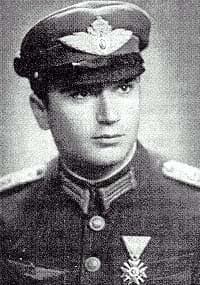
Nedelcho Bonchev was born in 1917 in Bulgaria. He graduated from the Bulgarian military academy’s pilot class and was sent to Piacenza, Italy, to refine his flying skills. Subsequently, he completed training at a fighter school in Bulgaria.
From 1941, he served as a pilot in the 222nd Fighter Squadron, flying aircraft such as the B-534, D.520, and Me-109. He achieved his first aerial victory on December 20, 1943, by shooting down a B-24 bomber.
Aerial Exploits
On April 17, 1944, Lieutenant Bonchev, commander of the 222nd Squadron, took off in his Me-109G-6 to repel a massive American air raid on Sofia. The attack involved 350 B-17 bombers escorted by 150 P-51 fighters.
During the engagement, Bonchev successfully shot down a B-17 bomber. After exhausting his ammunition, he deliberately rammed a second bomber in an act of taran. The impact ejected him from the cockpit along with his seat, but with great difficulty, he freed himself from the harness and deployed his parachute. Following a lengthy recovery in the hospital and with his relatives in the village of Mirkovo, Lieutenant Bonchev returned to his unit.
Capture and Sacrifice
On September 9, 1944, Bulgaria switched sides and began fighting alongside the anti-Hitler coalition states. On October 10, during an assault on a German column, Bonchev was shot down and captured by the enemy.
In a German prisoner-of-war camp in southern Germany, he was twice unsuccessfully offered collaboration with Professor Tsankov’s Bulgarian émigré government. In early May 1945, during the evacuation of the camp, Nedelcho Bonchev was tragically shot by SS members. He was posthumously awarded the highest Bulgarian distinctions.
ArchivoAéreo Editorial Team
A group of aviation researchers and enthusiasts dedicated to documenting and preserving global aeronautical history. All articles are reviewed to ensure historical accuracy.
Sources & Accuracy
The information presented in this technical sheet has been compiled from declassified flight manuals, historical archives, and specialized literature. While we strive for maximum accuracy, some performance data may vary depending on the specific variant or operational conditions.