Viktor Petrovich Borodin
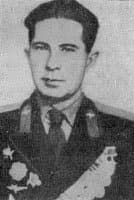
Viktor Petrovich Borodin was born on June 6, 1923, in the village of Prilepy, Kursk region, Russia. From childhood, he lived in the city of Kremennaya, Luhansk region, Ukraine.
By the time Senior Lieutenant Borodin was appointed commander of an attack aircraft squadron, his officer’s tunic already bore two Orders of the Red Banner, the Order of the Red Star, and the Order of the Patriotic War 2nd degree. These awards were a testament to his courage, fearlessness, and combat mastery. As a flight commander, he often led formations of nine aircraft.
Heroic Exploits on the Eastern Front
His commendation sheet preserved Viktor Borodin’s “combat record”: 59 vehicles, 25 ammunition carts, 6 mortar batteries, one anti-aircraft battery, and two tanks destroyed by the fire of his attack aircraft. He also blew up two ammunition depots. His squadron conducted 250 successful sorties without losses.
Let’s recount the execution of just one combat mission. An enemy armored train in the area of Zebrzydowice station (Poland) often conducted fire raids on Soviet combat formations. It would speed out and, within minutes, unleash hundreds of heavy shells on Soviet artillery positions and tank concentrations. Soviet artillerymen responded to the fascist aggressor, and pilots hunted him, but the “pirate” always escaped unpunished.
The commander of the air regiment, Major Serikov, gathered the pilots and briefly set the combat task: “Destroy the armored train at all costs. Senior Lieutenant Borodin will lead the six attack aircraft.” The attack aircraft approached the target just as the armored train, after another sortie, tried to retreat deep into the rear. The commander instantly assessed the situation and decided to destroy the railway track in front of and behind the armored train.
The armored train, like an animal caught in a trap, darted back and forth on a small section of track. It bristled with fire from all its anti-aircraft guns and machine guns. The attack aircraft were not deterred by the multilayered barraged fire. Their rockets struck the armored platforms, followed by dozens of bombs. But the train continued to move. The Il-2s made a second and third pass over the target. Suddenly, an explosion of enormous force ripped apart the locomotive. Flames spread to the wagons and armored platforms.
Distinguished Career and Accolades
A few days later, Soviet soldiers liberated the Polish station of Zebrzydowice. Not far from the station, on the destroyed tracks, they saw the twisted armored train. Senior Lieutenant Borodin made his last, 120th combat sortie, in the skies over Berlin. It was then that he was awarded his third Order of the Red Banner.
On August 8, 1945, he was awarded the title of Hero of the Soviet Union. For many post-war years, Viktor Petrovich Borodin served in the air force, retiring with the rank of Major. He currently lives and works in the city of Chernivtsi, Ukraine.
ArchivoAéreo Editorial Team
A group of aviation researchers and enthusiasts dedicated to documenting and preserving global aeronautical history. All articles are reviewed to ensure historical accuracy.
Sources & Accuracy
The information presented in this technical sheet has been compiled from declassified flight manuals, historical archives, and specialized literature. While we strive for maximum accuracy, some performance data may vary depending on the specific variant or operational conditions.