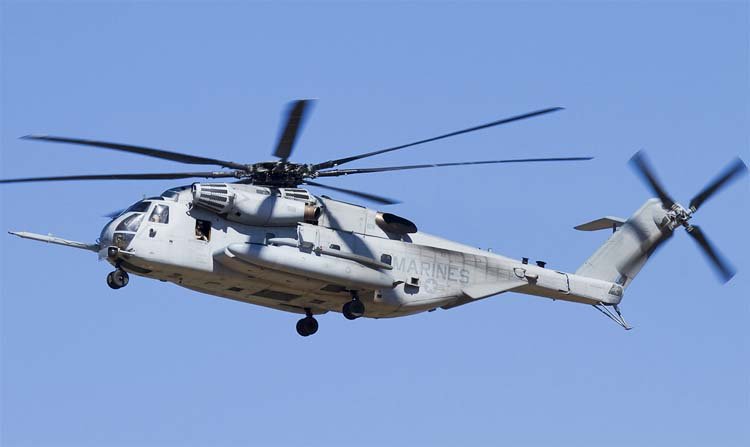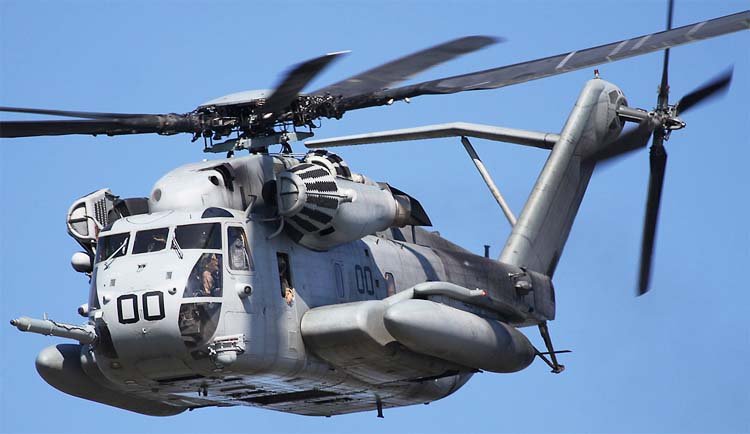
By the fall of 1970, tests of the CH-53A conducted by the U.S. Marine Corps revealed the need for a helicopter capable of lifting 1.8 times more cargo than the Sea Stallion. The first step towards such a machine was the development on October 24, 1967, of special requirements for a helicopter with an 18-ton payload, yet small enough to operate from an amphibious assault ship. The U.S. Navy and Army aviation also sought a new heavy-lift transport helicopter.
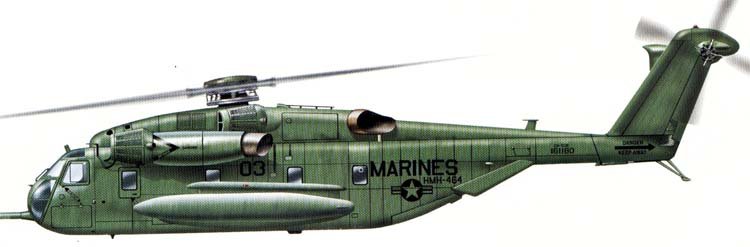
Development of the heavy-lift assault transport helicopter CH-53E for the U.S. Marine Corps began in 1971. The CH-53E Super Stallion is an evolution of the CH-53A, sharing 50% of its components and parts, but featuring increased payload, a triple-engine power plant, and larger cargo cabin dimensions, as well as main and tail rotor diameters. Requirements for the CH-53E included carrying an external load of 16 tons with a range of 92 km, taking off from a sea-level site, to compete with the Army’s S-64B crane helicopter with a maximum payload of 18 tons carried on a sling. Other tasks involved transporting an internal load of 3630 kg with a range of 185 km, taking off from a site at 915m altitude at 33°C, or transporting 37 marines over a distance of 536 km. The ferry range was 1870 km.
Development and Production
The first of two experimental YCH-53E helicopters made its maiden flight on March 1, 1974, but it was soon destroyed during ground tests. Flight testing continued from January 24, 1975, with the second experimental helicopter. The first of two pre-production helicopters made its maiden flight on December 8, 1975. Serial production began in 1980, with deliveries to the Marine Corps starting in 1981.
Procurement for the Marine Corps included 172 CH-53E helicopters and 50 MH-53E helicopters, totaling 222 aircraft. The overall cost of the program and procurement of these 222 helicopters was estimated at $4.85 billion, with the price of a CH-53E helicopter being $24.36 million.
Variants and Modernization
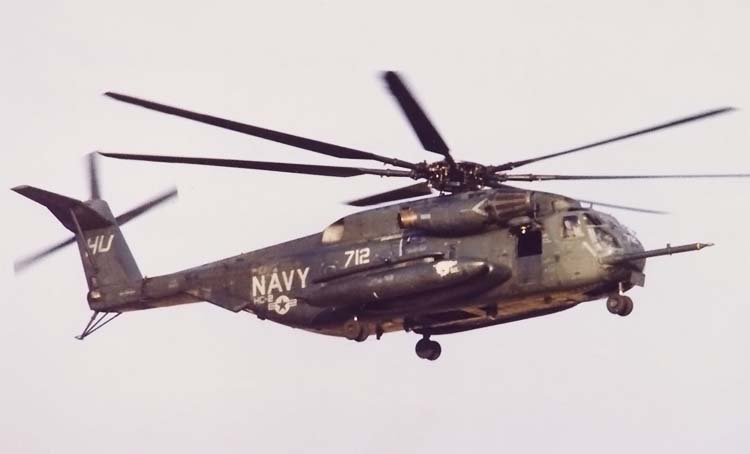
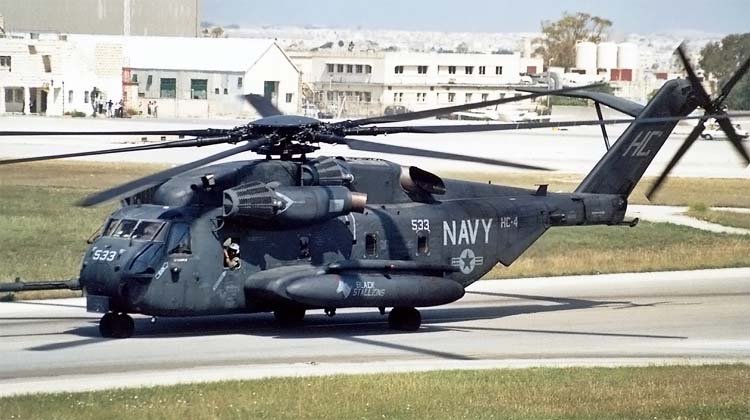
In 1980, development began for the MH-53E Sea Dragon mine countermeasures helicopter for the U.S. Navy. In 1981, construction of the prototype helicopter was completed, making its first flight on December 18, 1981, and a two-year flight test program commenced, including towing tests with a Mk.106 hydrofoil trawl. The MH-53E differs from the CH-53E with larger side fairings, larger fuel tanks with a total capacity of 12110 liters, and a towing hook rated for 13600 kg. The first flight of the pre-production MH-53E prototype occurred on September 1, 1983.
CH-53E helicopters are offered for export under the designation S-80E. The Japan Self-Defense Forces ordered 10 CH-53E helicopters under the designation S-80M Sea Dragon. The CH-53E helicopter improvement program includes the use of higher-power T64-416 turboshaft engines, main and tail rotor blades made of composite materials, an Omega navigation system, night vision system for the crew, and a ground radar warning system. The helicopters are intended to be armed for self-defense with AIM-9 Sidewinder air-to-air missiles, and equipped with chaff/flare dispensers, with an inert gas system in the fuel tanks. Additionally, the cabin is slated to receive an improved cargo lifting and moving system.
Technical Design and Systems
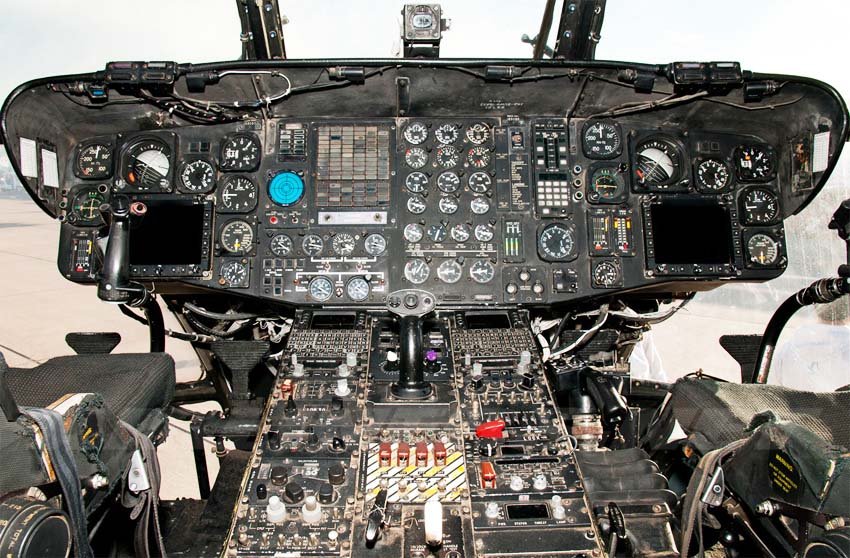
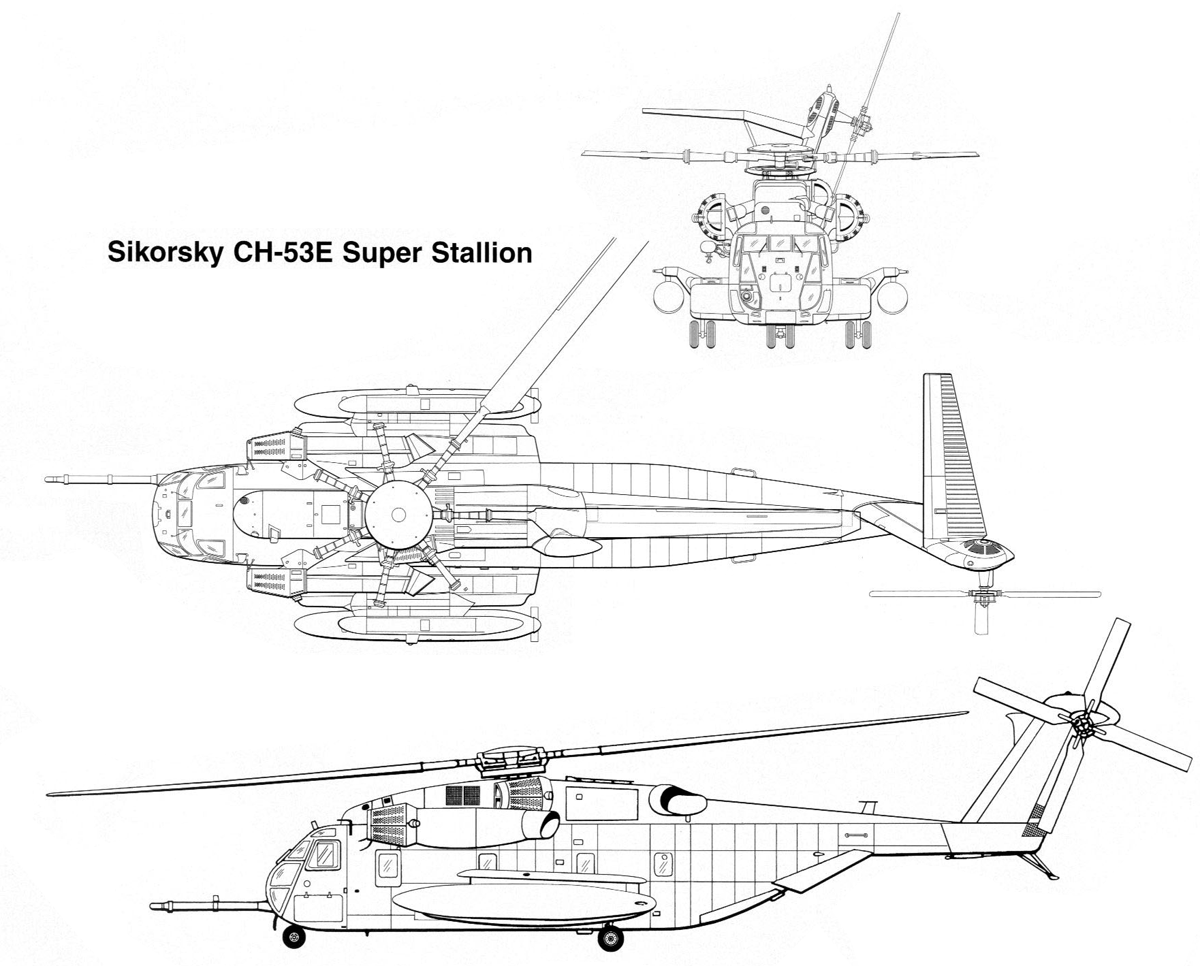
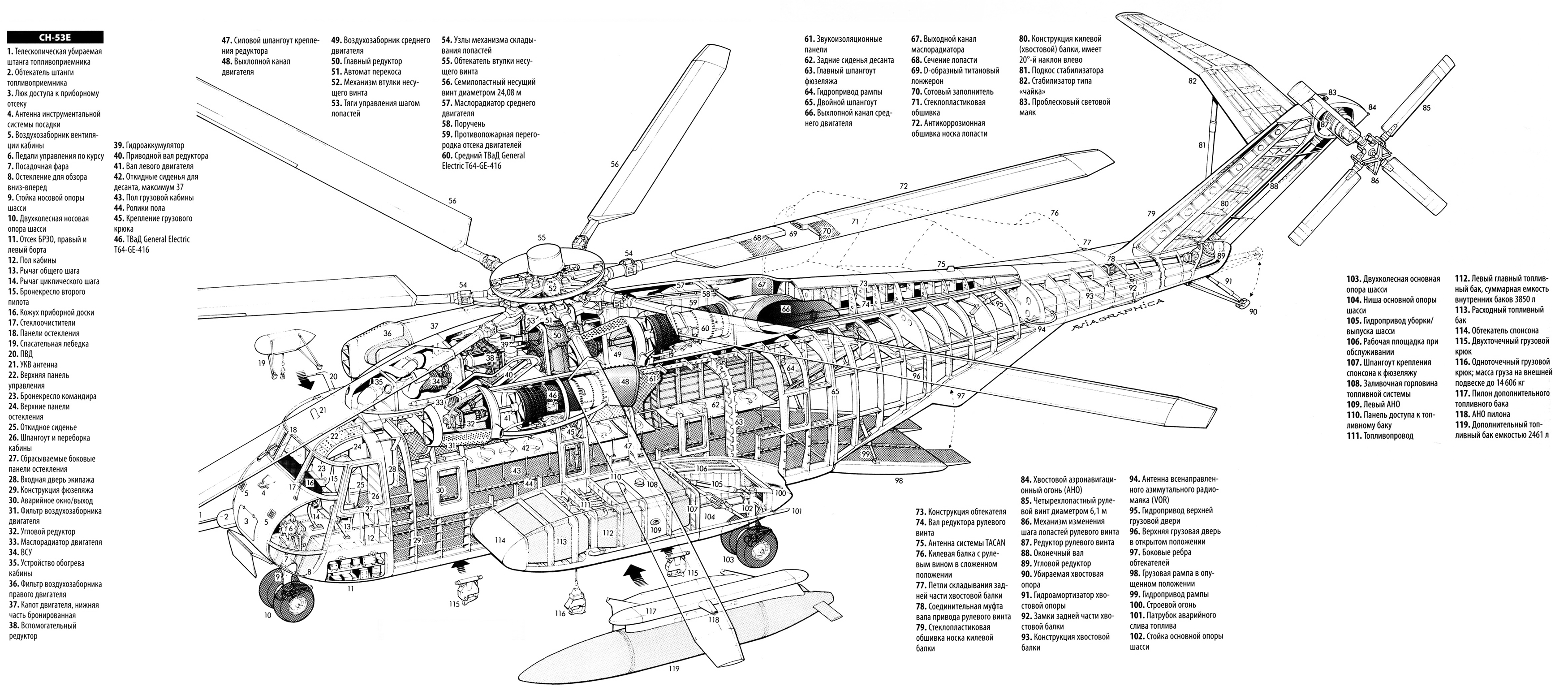
The helicopter features a single-rotor design with a tail rotor, three turboshaft engines, and tricycle landing gear. The fuselage is waterproof, of semi-monocoque type, constructed using light alloys, steel, and titanium. Individual sections of the cockpit are made from glass-epoxy composite materials. The fairings for the main rotor hub, gearbox, and engine cowlings are made of Kevlar. The fuselage is designed to withstand vertical overloads up to 20g and lateral overloads up to 10g. The cockpit is three-seater, with side-by-side seating.
The cargo cabin, measuring 3.15 x 2.3 x 1.38m, can accommodate up to 55 troops or up to 13 tons of cargo on seven standard 1 x 1.2m platforms, which are loaded via a hydraulically operated rear cargo ramp. For towing, there is a hook rated for 16330 kg of force.
The horizontal stabilizer is installed on the right side of the tail rotor pylon and supported by a strut. Both the horizontal stabilizer and the pylon are made of Kevlar. The landing gear is retractable, tricycle, with a nose gear. The nose gear retracts into a well in the lower fuselage, while the main wheel struts retract into the side fairings. The wheelbase is 8.31m, and the track is 3.96m.
The main rotor is seven-bladed, with hinged blade attachments to the hub. The blades are of a new design, with an improved profile and increased twist up to -14°. The oval-section spar is made of titanium alloy, the blade’s honeycomb core is made of Nomex fiberglass, and the skin from epoxy fiberglass composite materials. There is a blade fault detection system that uses excess pressure created inside the spar. The hub, made of titanium and steel, features elastomeric bearings. Blade folding is performed by a hydraulic system.
The tail rotor is four-bladed, 6.1m in diameter, with hinged blade attachments. The blade is of conventional construction, with a D-shaped spar made of aluminum alloy with ribs. The plane of rotation of the tail rotor is tilted 20° to the left to provide a vertical thrust component that compensates for the aft center of gravity due to the installation of the third engine.
The power plant consists of two engines located in separate nacelles with side air intakes on top of the fuselage. A third engine is positioned behind the main gearbox and covered by a fairing. Removable and hinged panels facilitate engine inspection. The fuel system includes two protected tanks with a total capacity of 2385 liters, located in the side fairings, and two pumps positioned directly near the engines. With auxiliary tanks, the total internal fuel capacity reaches 12110 liters. Disposable external fuel tanks with a capacity of 4920 liters can be suspended from the fairings. A retractable telescopic refueling probe for in-flight refueling is located at the front. Additionally, refueling can be performed from a ship via a refueling hose when the helicopter is in hover mode.
The transmission comprises engine gearboxes, intermediate shafts, angular gearboxes, the main gearbox, the auxiliary power unit’s shaft and gearbox, the intermediate angular gearbox shaft, and the tail rotor drive gearbox. Through the angular gearbox, the engine’s output shaft rotation speed is reduced from 14280 to 6320 rpm. The main gearbox reduces the angular rotation speed of the main rotor to 177 rpm. The tail rotor transmission shaft speed is 4270 rpm. The tail rotor gearbox reduces the tail rotor shaft speed to 700 rpm.
The main gearbox, located in the fairing above the cargo cabin, is made of magnesium, aluminum, and titanium alloys, weighing 1746 kg. The gears, bearings, and main rotor drive shaft (0.28m diameter) are made of steel. The transmission is designed to transmit 10060 kW of power.
The control system is boosted, duplicated, and includes an automatic stabilization system with a digital computing device and a four-channel autopilot from “Hamilton Standard”. Five hydraulic boosters are housed in a separate unit behind the pilot’s seat. The electrical system includes three AC generators each providing 40-60 kVA (115V, 400 Hz) and two DC generators (28V, 200A).
The hydraulic system includes four pumps with an operating pressure of 20.7-27.6 MPa, providing power for the control system’s hydraulic boosters, landing gear retraction and extension, blade and tail boom folding, and cargo winches. A separate hydraulic system is dedicated to driving the mine trawl.
Special equipment includes an automatic flight control system with two digital flight computers and an autopilot, an AN/ASQ-14 dipping sonar, an AN/ALQ-166 towed hydrofoil trawl for detonating magnetic mines, an AN/AQS-17 towed mine trawl, and an AN/ALQ-141 electronic trawl.
Technical Specifications
| Модификация | CH-53E |
| Диаметр главного винта, м | 24.08 |
| Диаметр хвостового винта, м | 4.88 |
| Длина, м | 22.35 |
| Высота ,м | 8.66 |
| Пустого | 15071 |
| Максимальная взлетная | 33339 |
| Внутренние топливо, л | 2385 |
| Птб, л | 2 х 1703 |
| Тип двигателя | 3 ГТД General Electric T64-GE-416 |
| Мощность, квт | 2 х 3266 |
| Максимальная скорость, км/ч | 315 |
| Крейсерская скорость, км/ч | 278 |
| Практическая дальность, км | 2075 |
| Дальность действия, км | 878 |
| Скороподъемность, м/мин | 631 |
| Практический потолок, м | 6220 |
| Статический потолок, м | 3565 |
| Экипаж, чел | 2 |
| Полезная нагрузка: | 37- 64 солдата или 24 носилки или 13608 кг груза в кабине или 9072 кг на подвеске два или три 7.62-мм шестиствольных пулемета GAU-2B/A Minigun |
Image and diagram gallery of the CH-53E Super Stallion