Numerous local military conflicts worldwide after World War II revealed an urgent need for specialized counter-insurgency (COIN) aircraft. In 1963, the US Air Force announced a competition for the development of such an aircraft, which was intended to replace World War II-era B-26 bombers and A-1 attack aircraft.
The competition’s conditions laid down quite strict requirements for a COIN (Counter-insurgency) aircraft with two turboprop engines. A two-seater with a tandem crew, it had to be based on poorly prepared, limited-size airfields and operate from an aircraft carrier deck (take-off and landing distances with a 15m obstacle—no more than 240m).
Special emphasis was placed on good cockpit visibility and the low cost of the aviation complex. Among other requirements was the possibility of replacing the wheeled landing gear with floats for operations from water bodies.
Armament included built-in machine guns, bombs, and unguided rockets on five hardpoints. Maximum speed was limited to 500 km/h, but the minimum patrol time in a given area was set at no less than two hours. Besides delivering strikes with its onboard weapons, the COIN aircraft was intended for reconnaissance, transporting people and cargo, and escorting helicopters.
The technical specifications for the COIN aircraft, prepared in September 1963, were sent to all American and one Canadian (Canadair) aircraft manufacturing firms. Nine of them responded to the proposal. There were three favorites: North American with the NA-300 project; Convair, which proposed the “Model 48” project; and the Martin firm’s aircraft. All three projects shared a common feature: the aircraft were monoplanes built in a twin-boom configuration with a short fuselage gondola. North American, presenting the NA-300 project (which became widely known as the OV-10 “Bronco”), emerged as the competition winner.
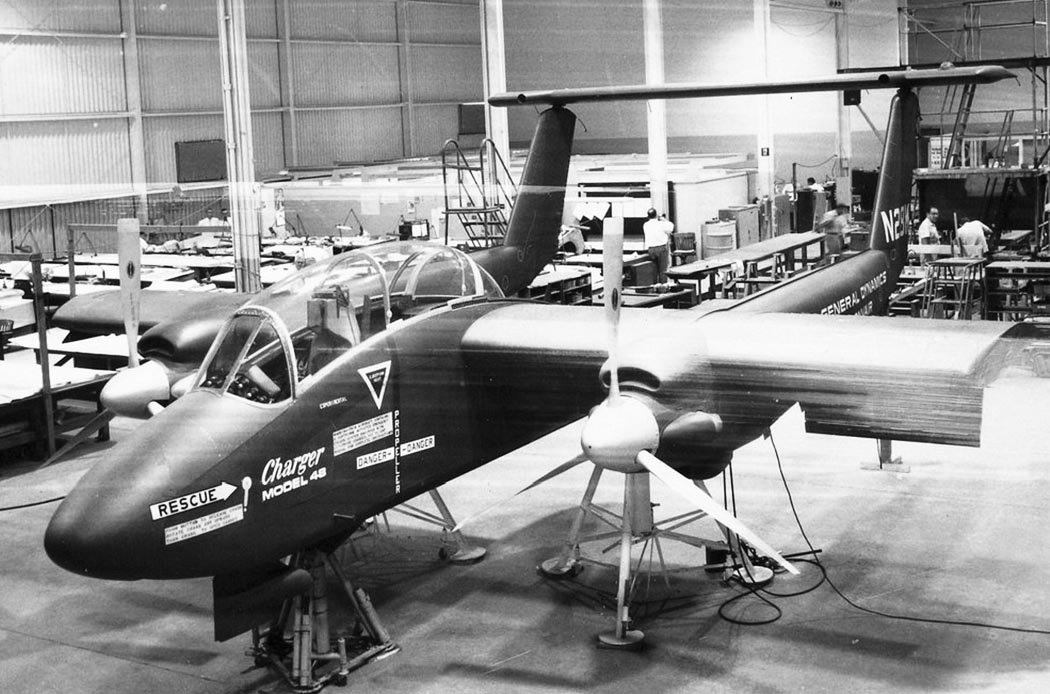
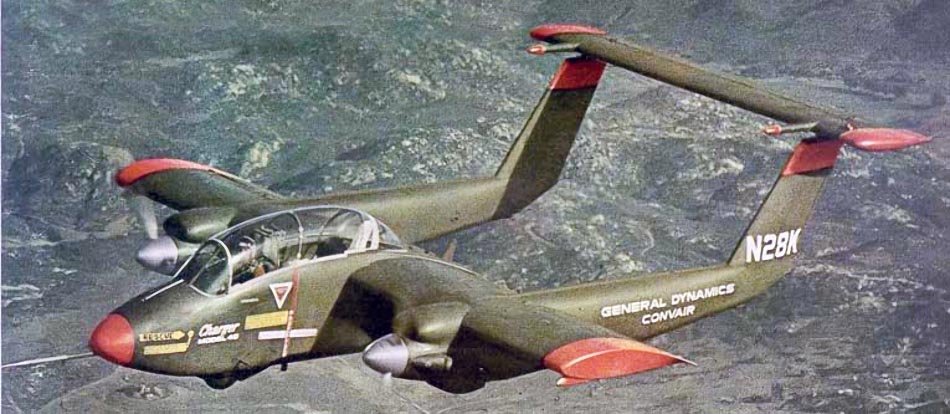
The US Navy was the main interested party in the organized competition; however, the Army and Marine Corps showed clear interest in a completely different aircraft – the Convair “Model 48,” also known as the Charger. Under pressure from the Army and Marine Corps leadership, the Department of Defense was compelled to sign a contract with Convair, providing for the construction of an experimental COIN aircraft and its flight testing.
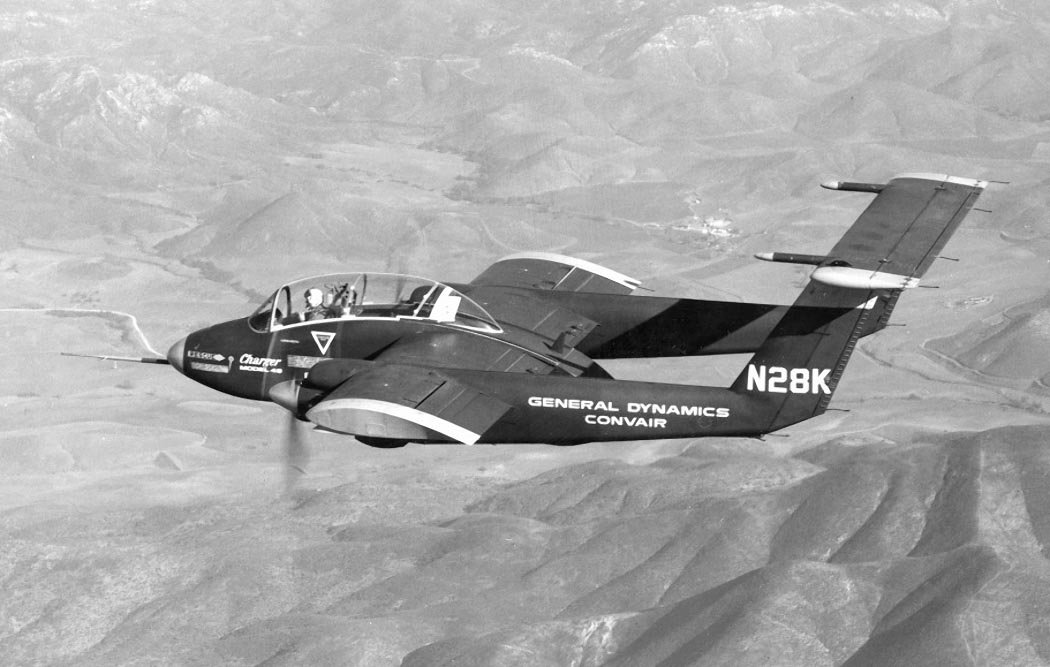
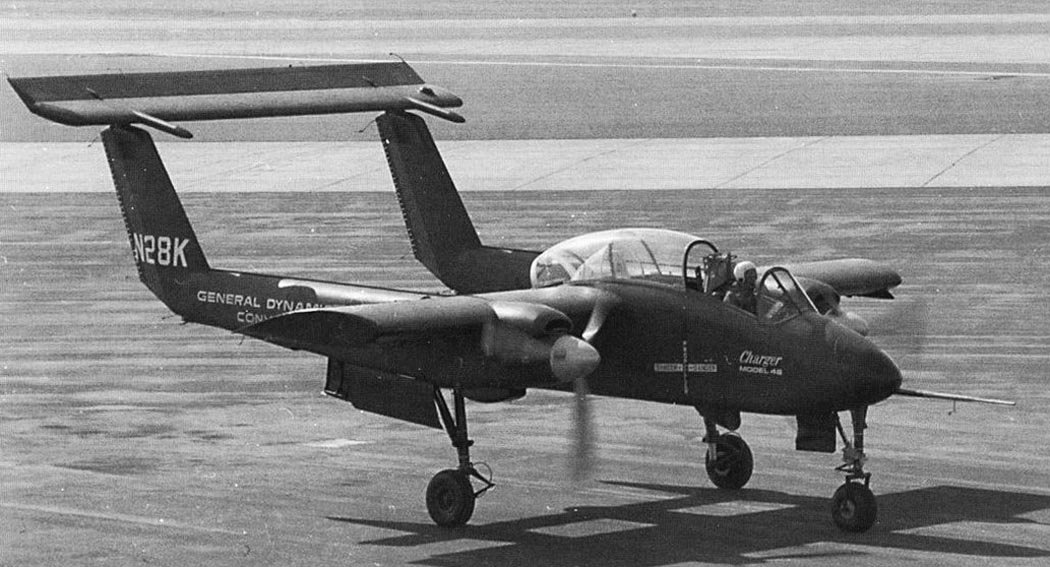
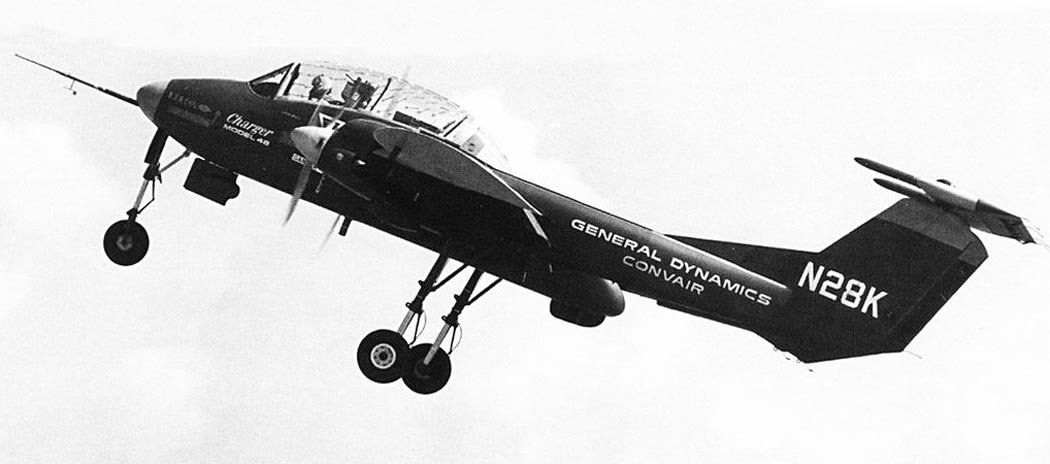
The prototype’s construction was completed in September 1964; full-scale design and manufacturing of the flying example took only 40 weeks. The “Charger” first took to the air in November 1964. The operational life of the single built example proved short – at San Diego airbase on October 9, 1965, a Navy pilot crashed the aircraft during an emergency landing with one engine operating. In total, the “Charger” flew 193 hours: 162 hours piloted by company test pilots, ten hours by NASA pilots, and 21 hours by military pilots.
Design and Technical Features
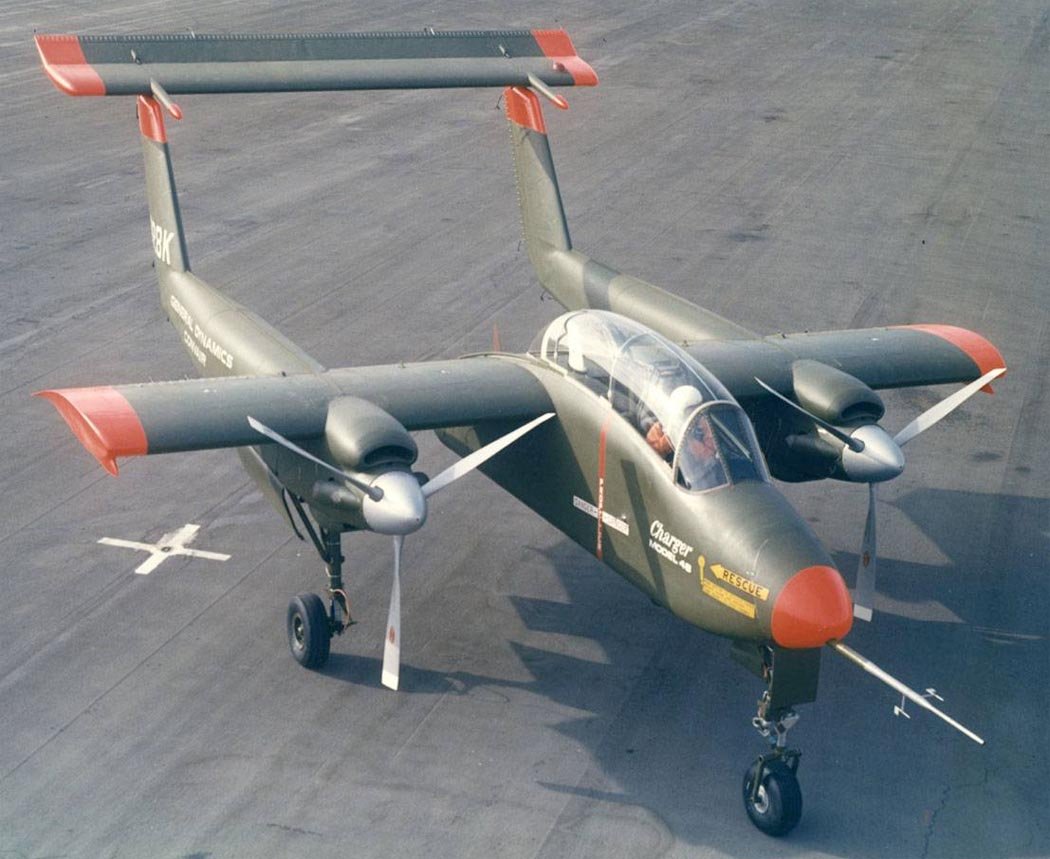
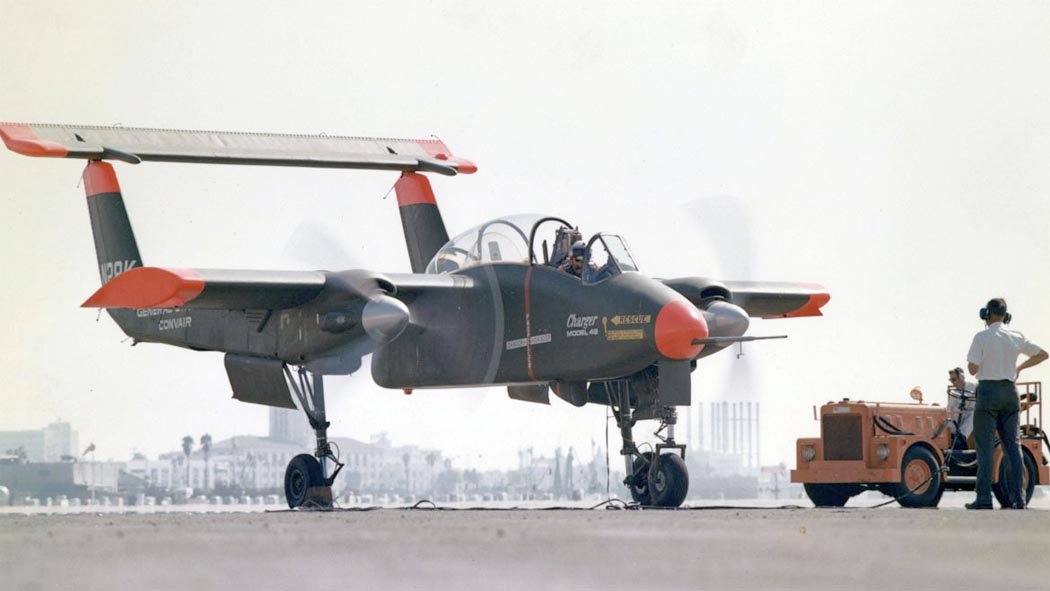
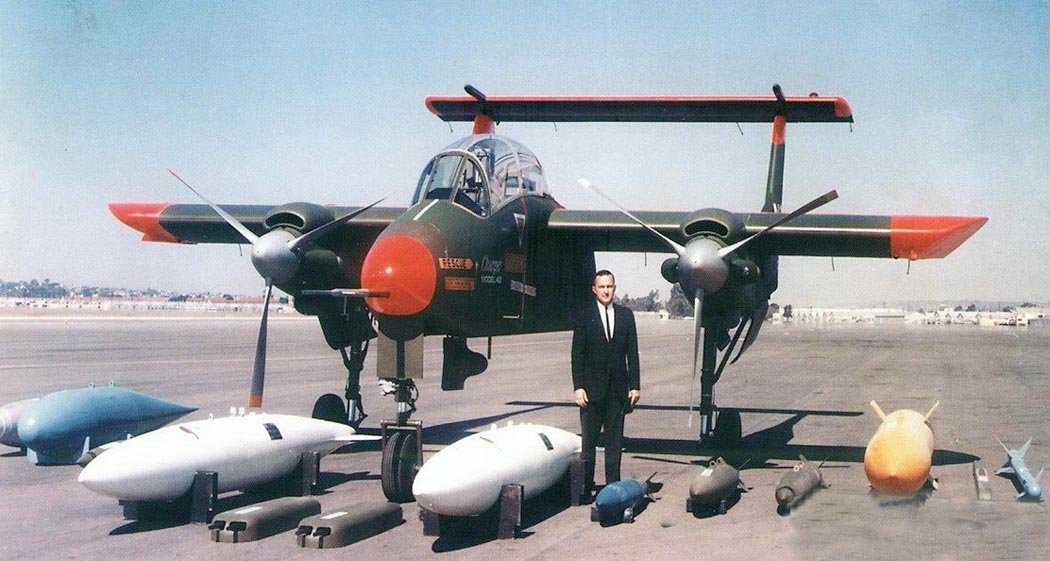
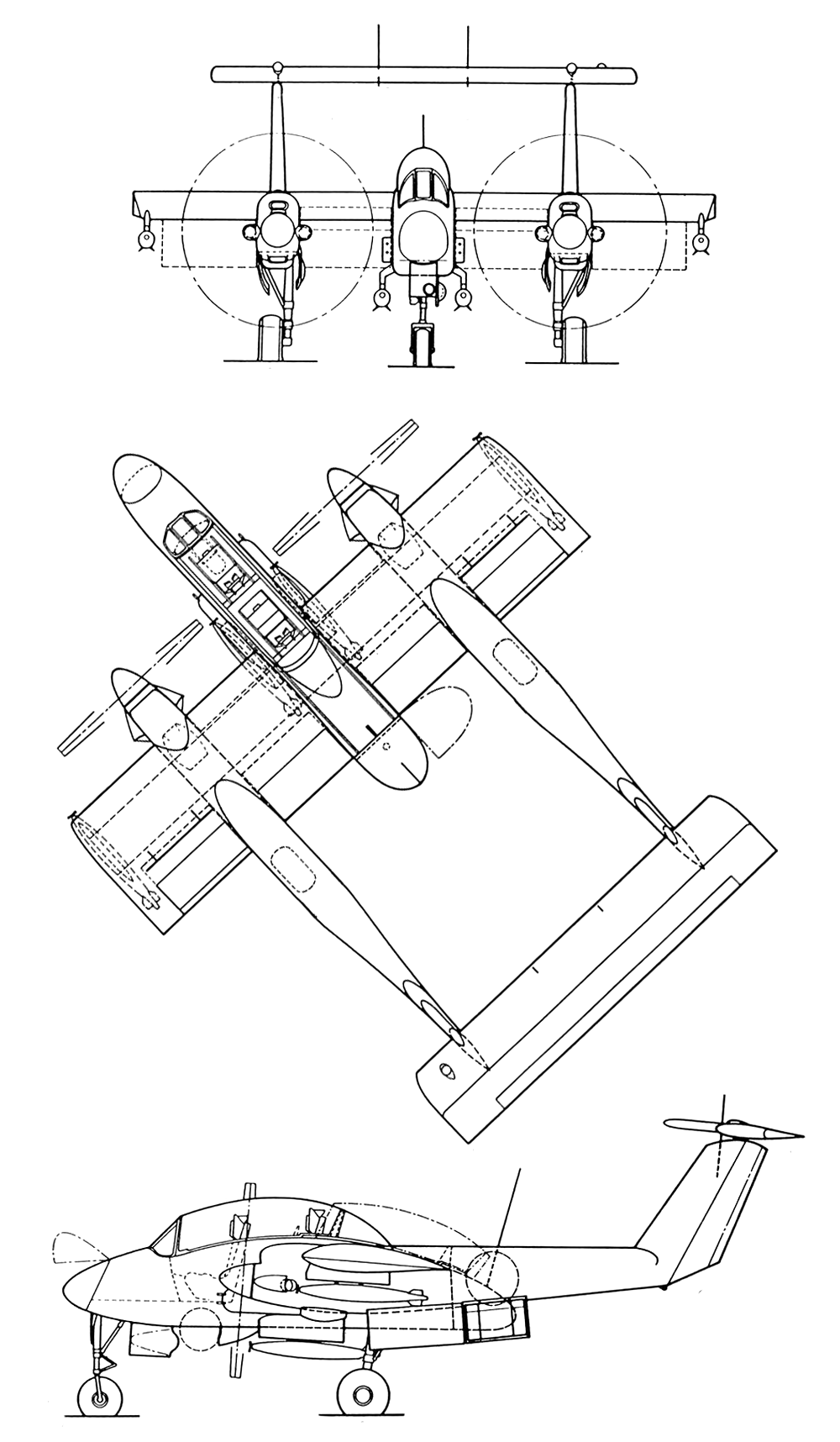
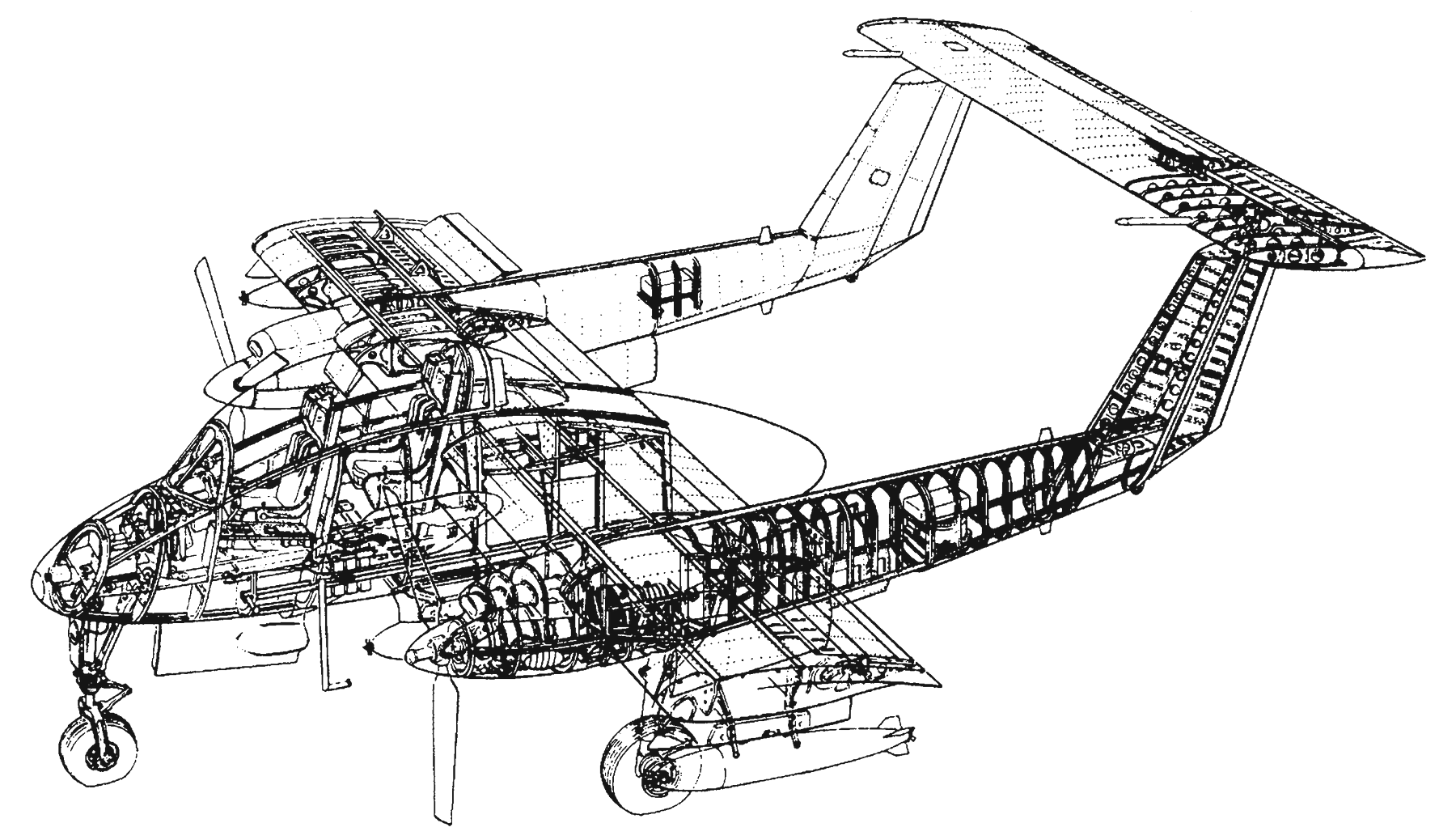
A distinctive feature of the aircraft was its rectangular wing of constant profile with four-section flaps across the entire span. The turboprop nacelles smoothly transitioned into the tail booms, which were connected by a T-shaped empennage. The short gondola with the crew cabin was attached to the wing.
The powerplant included two Pratt & Whitney T74 turboprop engines, each with 650 shp, driving three-bladed counter-rotating propellers. Installation of Garrett-AiResearch T76 engines was also planned instead of the Pratt & Whitney motors. The engine placement was chosen to maximize propeller wash over the wing and single-slotted flaps in all flight regimes. Nose flaps, located between the fuselage and engine nacelles, also contributed to increased wing lift at low flight speeds.
Roll control was achieved through ailerons and interceptors; interceptors were engaged in the control system only at low speeds when aileron effectiveness decreased. Pitch changes were provided by an originally designed controllable stabilizer. It was divided into two parts, with the tail section deflecting in the opposite direction to the nose section’s deflection, thereby achieving a change in the stabilizer’s profile curvature and, consequently, the amount of lift it generated. Conventional rudders were used for yaw control. Linkages from the controls to the actuators were cable-based.
Structurally, the aircraft was almost entirely made of aluminum alloys; only the fuselage nose cone and wingtips were crafted from fiberglass.
Despite the T74 engines being envisioned as standard, the prototype received two Garrett-AiResearch T76 turboprops, each rated at 550 shp. Fuel was stored in four 197-liter tanks located in the wing, between the spars. The two outer tanks were unprotected, while the inner ones were protected.
The landing gear was retractable, tricycle-type, with a nose strut. The retraction system was hydraulic. All struts retracted by rotating aft, with the nose strut stowing into the fuselage and the main struts into the tail booms.
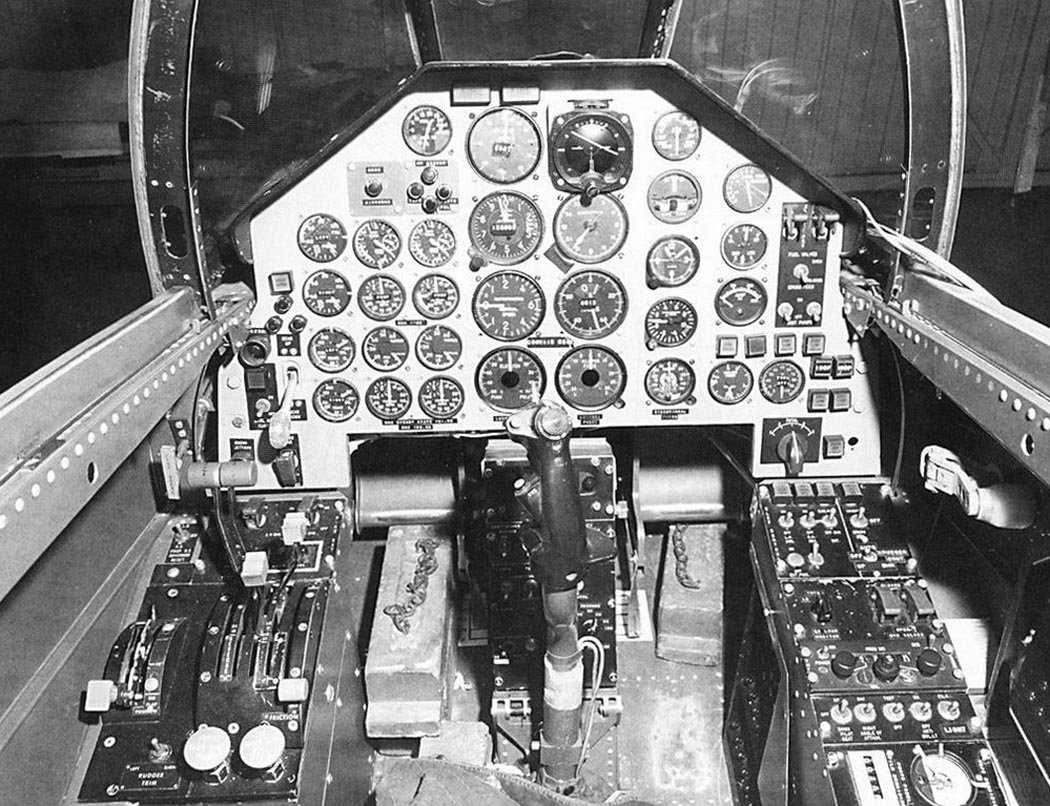
The two-seater cockpit was enclosed by a large, common, teardrop-shaped sliding canopy. The front panel of the cockpit glazing visor was made of bulletproof glass. Crew members were seated on 0-0 class ejection seats, arranged in tandem. Aircraft control was possible only from the front seat; the second crew member was intended for observation, dropping parachutists, or cargo.
Armor was not installed on the experimental aircraft, although in the event of series production, crew compartment armor was not ruled out. Aluminum armor plates could have been externally attached to the fuselage around the pilot’s and observer’s seats. Furthermore, the “Charger’s” design provided for the installation of armor plates in the front and lower parts of the fuselage.
For transporting people and cargo, a special cabin could be installed on the center wing section behind the crew cockpit, designed to accommodate five paratroopers or three wounded on stretchers.
Armament and Tactical Roles
Armament consisted of four 7.62mm M60 machine guns with 500 rounds of ammunition each. The machine guns were mounted in two blisters on the sides of the fuselage. A wide assortment of weapons could be placed on five hardpoints, ranging from Sidewinder missiles to gun pods. One pylon was located at each wingtip (calculated load up to 270 kg), one under each wing root section (load up to 500 kg), and one more under the fuselage (load up to 270 kg).
Crew safety during combat missions was ensured not so much by cockpit armor as by a well-thought-out layout and high maneuverability of the aircraft at low speeds and altitudes.
Convair failed to snatch victory in the competition from its North American rivals, although, in the opinion of many, the “Charger” looked preferable to the “Bronco.” However, besides engineering, politics and lobbying also played a role. Overall, it can be said that the specialized COIN aircraft did not live up to the hopes placed upon it.
The “Bronco” never became a mass-produced machine, and the functions of COIN aircraft were and are primarily performed by two-seat jet trainer/combat aircraft.
Technical Specifications
| Модификация | Charger |
| Размах крыла, м | 8.38 |
| Длина самолета,м | 10.61 |
| Высота самолета,м | 4.14 |
| Площадь крыла,м2 | 24.10 |
| Пустого самолета | 2040 |
| Нормальная взлетная | 3220 |
| Максимальная взлетная | 3300 |
| Топлива | 530 |
| Тип двигателя | 2 ТВД Pratt Whitney T76 (T74) |
| Мощность, л.с. | 2 х 550 (650) |
| У земли | 510 |
| На высоте | 740 |
| Крейсерская скорость, км/ч | 450 |
| Перегоночная дальность, км | 4800 |
| Боевой радиус действия, км | 470 |
| Продолжительность патрулирования, ч | 2 |
| Практический потолок, м | 6400 |
| Экипаж, чел | 2 |
| Полезная нагрузка: | 5 десантников или 900 кг груза в грузовом отсеке или 3 носилок с ранеными |
| Вооружение: | четыре 7,62-мм пулемета М60 с боезапасом по 500 патронов. На пяти узлах подвески можно было размещать широкий ассортимент вооружения: от УР Сайдуиндер до пулеметных контейнеров. По одному пилону имелось на концах крыла (расчетная нагрузка до 270 кг), еще по одному – под корневыми участками крыла (нагрузка до 500 кг) и еще один – под фюзеляжем (нагрузка до 270 кг). |
Image and diagram gallery of the Convair Model 48 Charger