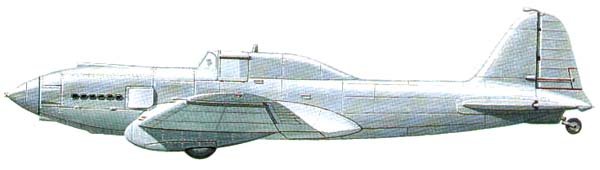
The resolution of the Defense Committee under the Council of People’s Commissars of the USSR regarding the production of 10 BSh-2 AM-35 aircraft of the military series was signed by Marshal K. E. Voroshilov on June 26. It was further planned to produce another 150 such aircraft in 1941. However, virtually nothing was done by the People’s Commissariat of the Aviation Industry within the established deadlines.
Meanwhile, starting from May 15, 1940, intensive work was underway on BSh-2 No. 1 to eliminate defects noted by the State Commission. On August 16, the modified aircraft was presented to the Air Force Scientific Research Institute (NII VVS) for repeated state tests.
However, due to the unsatisfactory performance of the AM-35 engine, the tests were not completed. On August 23, the aircraft was returned to the factory for the installation of an AM-38 engine, which had successfully passed 50-hour in-house tests from August 6 to 10.
The Strategic Decision: Single-Seat TsKB-57
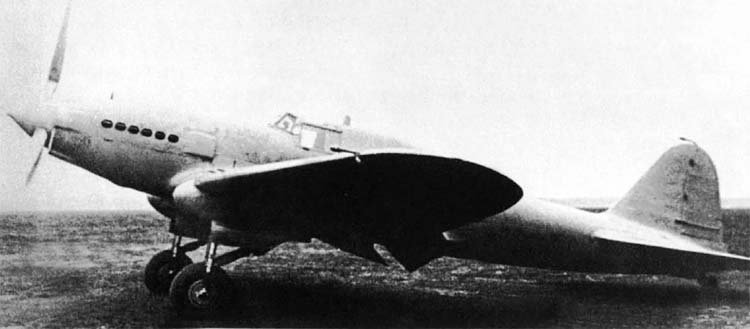
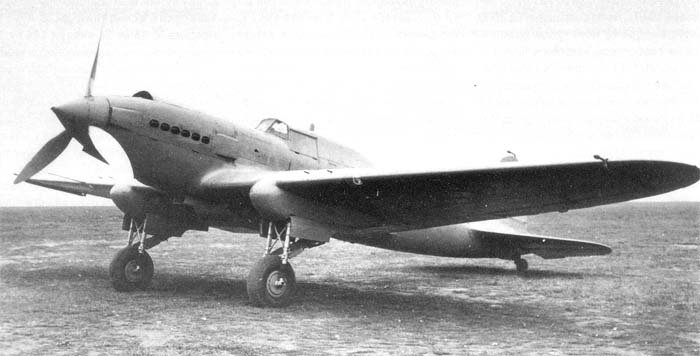
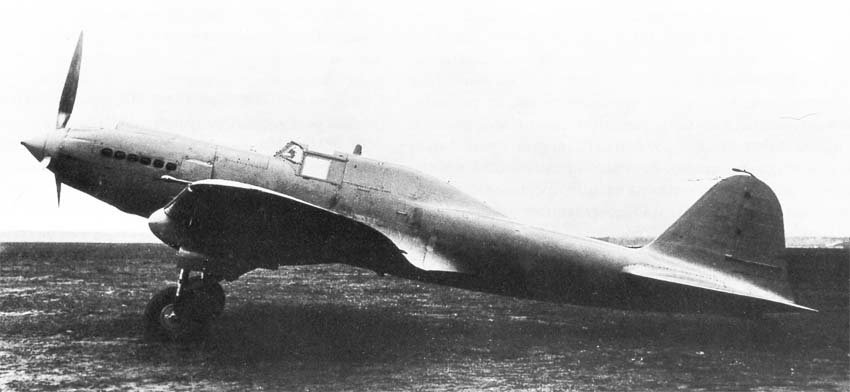
On September 12, one of the newly assembled AM-38 engines, with a modified reduction ratio (0.732 instead of 0.902), was delivered to Factory No. 39. This factory immediately began installing it on BSh-2 No. 1 and converting the latter into a single-seat variant without an aerial gunner, reinforcing the rear armor and adding an additional fuel tank. The new machine received the factory designation TsKB-57.
The conversion of the BSh-2 from a two-seater to a single-seater was exclusively an initiative of the Design Bureau (OKB). There was no resolution from the Defense Committee, nor even a decision to change S. V. Ilyushin’s assignment, nor a corresponding order from the People’s Commissariat of the Aviation Industry (NKAP), in existence for such a modification. Ilyushin’s decision was, to some extent, forced, as he and his closest associates understood that simply installing a more powerful AM-38 engine (without fundamental structural changes to the attack aircraft) instead of the AM-35 could not quickly meet the required tactical and technical specifications (TTT).
Everyone understood that such a replacement would not only increase the aircraft’s flight speed and improve its maneuverability but also significantly reduce its flight range due to the AM-38’s higher fuel consumption (270-280 g/hp-hr, instead of 245-255 g/hp-hr for the AM-35). This was tactically unacceptable for the military, meaning the aircraft would once again fail state tests.
Refining the two-seat variant with the new, still unreliable engine, to meet the required TTT through internal design reserves, would have demanded much time and significant effort. S. V. Ilyushin’s desire to quickly bring the BSh-2 into large-scale production was strong. His authority as Chief Designer of combat aircraft was steadily declining, with the threat of losing serial aircraft factories and facing “organizational conclusions.”
During this period, S. V. Ilyushin faced a very complex situation due to the extremely unsatisfactory state of affairs with the refinement and serial production of the new long-range bomber, the DB-3f, which was a deep modification of the already outdated DB-3. Serial prototypes of the DB-3f showed very depressing results during state tests at the NII VVS KA, falling far short of the level required by the military.
Plans for the production and delivery of the new bomber to the Red Army Air Force (VVS KA) by NKAP factories were constantly disrupted. In early May 1940, the head of the Main Directorate of Military Aviation of the Red Army, Komdiv P. A. Alexeev, was forced to order military acceptance at Factories No. 18 and No. 39 to “cease final processing and payment for aircraft as defective.”
Order No. 195s from the NKAP dated May 8, 1940, noted: “the government’s decision regarding the production of DB-ZF aircraft by Factories No. 39 and 18 has not been fulfilled.” The absolutely intolerable situation with plan fulfillment was the result of the irresponsible attitude of Factory No. 39’s director, Comrade Zhuravlev, and chief designer, Comrade Ilyushin, toward the state task.
Ilyushin had released an unfinished machine into serial production, protracting its refinement for a very long time. Even at that moment, there was no certainty of its complete refinement, as the management of Factory No. 39 and Chief Designer Ilyushin still lacked a well-thought-out, clear plan for the DB-3f aircraft’s development.
The Collegium of the NKAP specifically noted the failure to meet the government’s set task for speeds and that no adequate measures had been taken by Ilyushin and Zhuravlev to accelerate the transfer of the DB-3f for state tests. Citing only engine-propeller group defects, they failed to address the aircraft’s issues for over two months.
As a result, machines were moved from the assembly shop to the airfield with numerous defects and returned to the shop, disrupting normal production. The Collegium warned the management of Factory No. 39 and Chief Designer Ilyushin, obliging them to take immediate necessary measures to rectify the situation with the DB-ZF’s refinement and mobilize the factory’s technical forces to fulfill government decisions on its production.
Moreover, Ilyushin’s DB-3f was literally “treading on the heels” of the long-range bomber DB-240, which by NKAP Order No. 278ss dated July 10, 1940, was launched into large-scale production at the Voronezh aircraft factory No. 18. This factory was to produce 700 DB-3f and 70 DB-240 that year, and in 1941, fully switch to the “two hundred fortieth.” Ilyushin’s DB-4 bomber, a potential competitor to Ermolaev’s machine, also progressed slowly, and VVS interest waned, leading to the eventual cessation of its development.
Regarding armored attack aircraft, S. V. Ilyushin had no competitors yet. The closest rival to Ilyushin’s BSh-2, P. O. Sukhoi’s single-seat armored attack aircraft OBSH M-71, promised to significantly surpass the BSh-2 but was still in the final design stage. Other attack aircraft by S. A. Kocherigin, A. A. Dubrovin, A. I. Mikoyan’s OKB, and NKAP Factory No. 32 OKB had just begun development.
S. V. Ilyushin found himself in a stalemate: on one hand, the military rightly demanded the urgent alignment of the flight data of both the two-seat BSh-2 and the DB-3f with the required TTT. On the other hand, Ilyushin and his assistants knew that bringing each of these aircraft to the necessary level “the right way” would be a very laborious and lengthy process, with timelines unsatisfactory to both government and military. His authority was steadily declining, and the loss of serial aircraft factories was looming, with an NKAP order even obliging his OKB to vacate Factory No. 39.
In this regard, the conversion of the as-yet unrivaled armored attack aircraft BSh-2 from a two-seater to a single-seater (with a subsequent transition to the two-seat variant as the AM-38 was improved, as required by the task) and the acceleration of its refinement work were quite logical. This step allowed for a very quick solution to both the problem of launching the new attack aircraft into series production and equipping the VVS KA with such a necessary modern type of combat aircraft, as well as the problem of preserving a powerful experimental and production base for the OKB. The price of such a decision, measured in hundreds of pilots’ lives during a major war, was apparently not given much thought at the time.
After so many years, one can only speculate about the true reasons for S. V. Ilyushin’s decision. The facts remain: the existence of the TsKB-57 was legalized only on the eve (!) of its first flight. An order from the NKAP, signed on October 11, 1940, by A. S. Yakovlev, Deputy People’s Commissar of the Aviation Industry for Experimental Construction and Science, instructed S. V. Ilyushin to release BSh-2 No. 1 with the AM-38 for factory flight tests in both single-seat and two-seat variants by October 15 (!), 1940. The same order appointed test pilot V. K. Kokkinaki to conduct the flight tests, which were required to be completed within 1.5 months.
The content of this order raises questions. Firstly, how could the same aircraft unit be submitted for factory tests in both single-seat and two-seat variants on the same day? Secondly, the order had a space for People’s Commissar A. I. Shakhurin’s signature, but it was signed and countersigned by A. S. Yakovlev, the second person in the commissariat’s hierarchy, suggesting the absence of the commissar’s signature was not a simple coincidence.
Thirdly, the order’s text did not specify the number of the Defense Committee Resolution under the Council of People’s Commissars, “in execution” of which this order should have been issued. Such a number was an integral part of any NKAP order changing a designer’s technical assignment at that time and could not have been “accidentally forgotten.” A new aircraft variant could only be mandated through a Resolution or an Order from the Defense Committee, which would define prototypes and deadlines.
The aforementioned order contained no reference to a Defense Committee Resolution. Fourthly, it appears from the order’s text that the commissariat knew nothing about the work done in S. V. Ilyushin’s OKB to convert the BSh-2 into a single-seat variant, which itself is unlikely. It is to be assumed that the conversion of the BSh-2 to the single-seat variant was completed by October 5, and S. V. Ilyushin approached the NKAP leadership for permission to begin factory flight tests of the new machine.
The “wise leadership” of the commissariat, A. I. Shakhurin and A. S. Yakovlev, understanding that the task of creating a two-seat armored BSh-2 attack aircraft was still active and that Stalin might favor a “Solomon’s solution,” provided in the order for simultaneous factory flight tests of the BSh-2 in both single-seat and two-seat variants. This was considered safer, as VVS specialists were then developing both two-seat and single-seat concepts for armored attack aircraft. With this order, the NKAP covered for S. V. Ilyushin’s initiative, hoping to deflect a possible “blow” from the military or rely on Stalin’s known favor towards A. S. Yakovlev. Unfortunately, the Main Directorate of the VVS KA did not show due principled stance regarding the conversion of the BSh-2 AM-38 from a two-seater to a single-seater.
Flight Tests and the Engine’s Achilles’ Heel
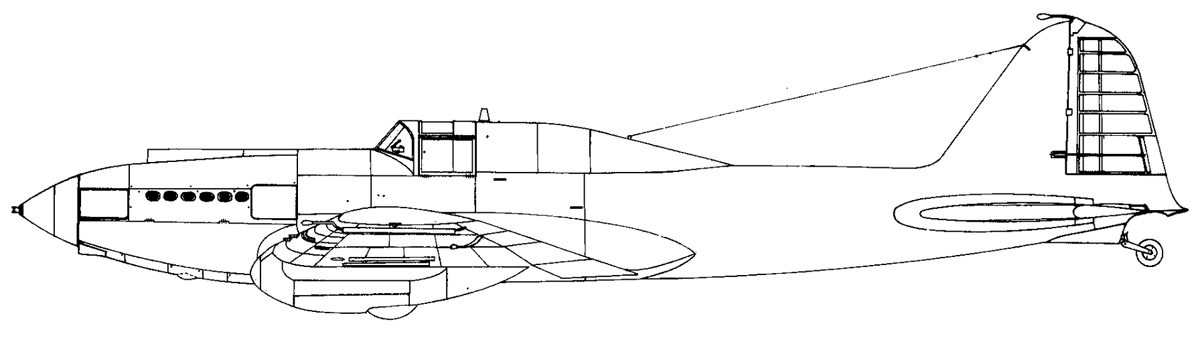
Be that as it may, on October 12, 1940, the single-seat TsKB-57 made its first flight under the control of V. K. Kokkinaki. On the aircraft, a 12-mm armored bulkhead and an additional 155 kg fuel tank were installed within the armored fuselage instead of the gunner’s cockpit.
The pilot’s cockpit canopy, closed by an opaque fairing, was designed to slide backward, rather than hinge open as with the TsKB-55. To improve longitudinal stability, the engine was shifted forward by 50 mm; the wing sweep at the leading edge was increased by 5°, and the stabilizer area by 3.1%, shifting the aircraft’s center of gravity from 31% to 29.5% MAC. Additionally, to ease aileron control, their degree of aerodynamic compensation was changed. Other less significant structural changes were also made.
Due to the unreadiness of the 23-mm MP-6 wing cannons (Ilyushin’s OKB only received the dimensional drawing of the cannon from OKB-16 NKV on October 16, 1940), the armament of the TsKB-57 remained unchanged. This included 4 ShKAS machine guns in the wing with a total ammunition load of 3000 rounds and 400 kg of aerial bombs on internal hardpoints. The reinforcement of the attack aircraft’s side armor, as requested by Air Force specialists, was simulated by a corresponding increase in the machine’s weight.
The factory tests of the TsKB-57 were conducted in an exceptionally short period – in just 10 flight days. In flight near the ground, with a normal takeoff weight of 4988 kg and with a VISH-22Yu propeller, a maximum speed of 423 km/h was achieved, and at the engine’s altitude limit (2800 m), 437 km/h. The flight range near the ground with a normal bomb load was 850 km at an average speed of 380 km/h.
The time to climb to 5000 m was 10 minutes, landing speed was 140 km/h, landing roll was 260 m, and takeoff roll was 250 m. V. K. Kokkinaki noted that the aircraft was exceptionally simple in its flight characteristics; controllability and maneuverability had significantly improved compared to the TsKB-55. Takeoff and landing roll distances normalized and corresponded to the TTT.
The TsKB-57 was not submitted for state tests due to the unsatisfactory performance of the AM-38 engine, which became the “Achilles’ heel” of the attack aircraft. The engine utterly refused to operate reliably. Factory No. 24, in October-November 1940, failed to successfully complete the 50-hour joint tests due to an exhaust valve burn-through and was forced to continue working on its refinement and defect elimination into 1941.
Technical Specifications
| Модификация | ЦКБ-57 |
| Размах крыла, м | 14.60 |
| Длина, м | 11.60 |
| Высота, м | 4.17 |
| Площадь крыла, м2 | 38.50 |
| Пустого самолета | 3792 |
| Нормальная взлетная | 4988 |
| Тип двигателя | 1 ПД Микулин АМ-38 |
| Мощность, л.с. | 1 х 1500 |
| У земли | 423 |
| На высоте | 437 |
| Практическая дальность, км | 850 |
| Скороподъемность, м/мин | 588 |
| Практический потолок, м | 8500 |
| Экипаж, чел | 1 |
| Вооружение: | четыре 7.62-мм пулемета ШКАС и такой же пулемет сзади кабины бомбовая нагрузка – 400 кг бомб в различных вариантах (до 600 кг в перегрузку) |
Image and diagram gallery of the Ilyushin TsKB-57 (BSh-2)