Beechcraft Bonanza
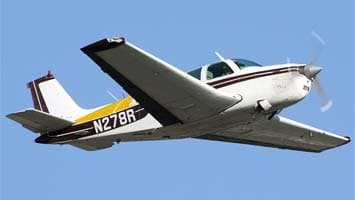
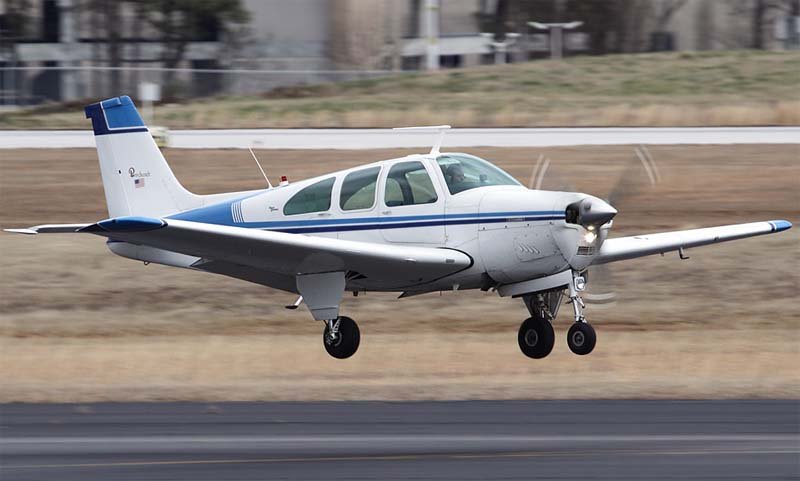
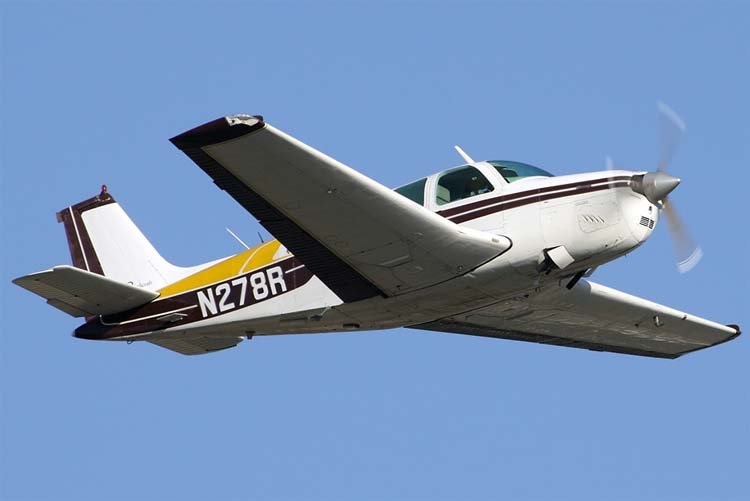
Despite strong demand for the V-tailed Model 35, many potential buyers considered such a tail an odd feature capable of causing problems. Responding to these buyers’ wishes, Beech developed the Model 33 Debonair, which made its first flight on September 14, 1959. It featured a conventional tail, a slightly less powerful engine, and accommodated a pilot and three passengers.
The aircraft was a cheaper modification of the Bonanza, built and sold in parallel until 1966, by which time almost 1,200 units had been constructed. In 1967, it was replaced by the Model E33 Bonanza—a four/five-seat modification outwardly identical to the V-tailed Model 35, except for a conventional swept vertical fin at the rear.
There were a standard Model F33A modification and an aerobatic (or utility) Model F33C modification.
Model 36 and Cargo Variants Development
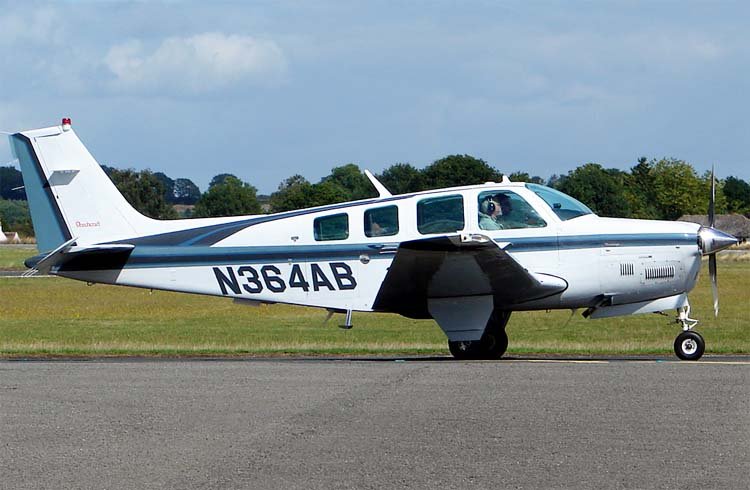
The third member of the Bonanza family appeared in 1968 as the six-seat utility aircraft Model 36 Bonanza. It was an elongated modification of the Model V35B, combining the tail section from the Model 33 with a reinforced landing gear developed for the Beech Baron.
It featured bi-fold doors on the right side of the fuselage to facilitate loading and unloading when the aircraft was used as a cargo plane. These cargo doors were also installed on Model 33 and Model 35 aircraft. In 1979, a turboprop modification appeared: the Model A36 TC Turbo Bonanza.
By 2009, a single Bonanza modification remained in production, manufactured by Hawker Beechcraft, a division of Raytheon Corporation. The Beechcraft G36 Bonanza’s design included the classic Model 36 airframe and a 300 hp Teledyne-Continental IO-550-B engine.
Military Modifications of the Bonanza
Two military modifications of the Model A36 Bonanza should be briefly noted. At least 27 QU-22B aircraft (company designation – Model PD.1079) were equipped with special electronic equipment during the Vietnam War under the US Air Force’s “Pave Eagle” program, designed to collect and transmit data from ground acoustic sensors to a ground station.
For the US Air Force’s “Pave Coin” competition, Beech developed a two-seat armed modification of the A36—a close air support aircraft (company designation Model PD.249), the prototype of which, after evaluation, received the designation YAU-22A and was equipped with various types of weaponry on underwing hardpoints (up to 535 kg). However, not a single serial production unit was ever built.
Technical Specifications
| Modification | B36TC |
| Wingspan, m | 11.53 |
| Aircraft length, m | 8.38 |
| Aircraft height, m | 2.62 |
| Wing area, m2 | 17.47 |
| Empty weight | 1 104 |
| Maximum takeoff weight | 1746 |
| Engine type | 1 Piston engine Teledyne Continental TSI0-520-UB |
| Power, hp | 1 x 300 |
| Maximum speed, km/h | 394 |
| Cruising speed, km/h | 370 |
| Practical range, km | 2022 |
| Maximum rate of climb, m/min | 321 |
| Practical ceiling, m | 7620 |
| Crew, crew members | 1 |
| Payload | 3 or 5 passengers |
Image and diagram gallery of the Beechcraft Bonanza
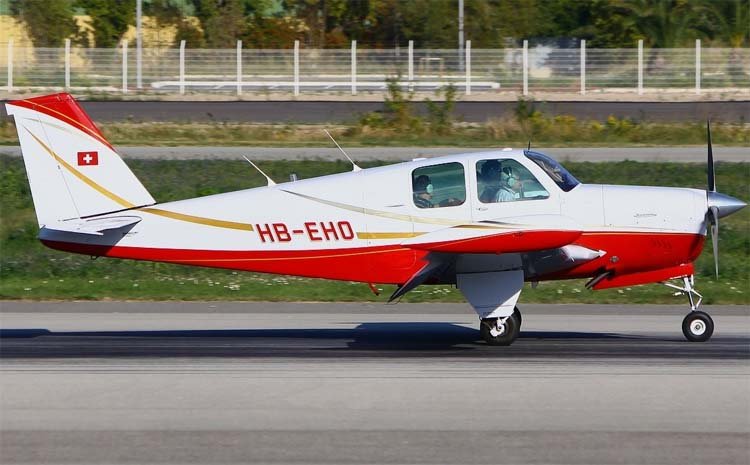 Beech 33(36) Bonanza |
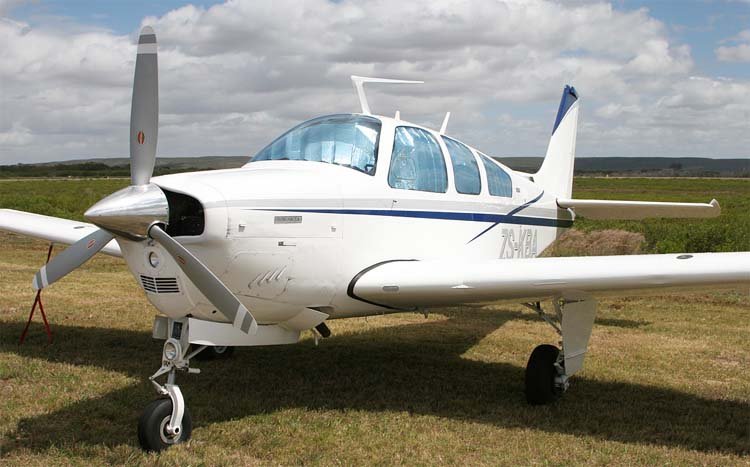 Beech 33(36) Bonanza |
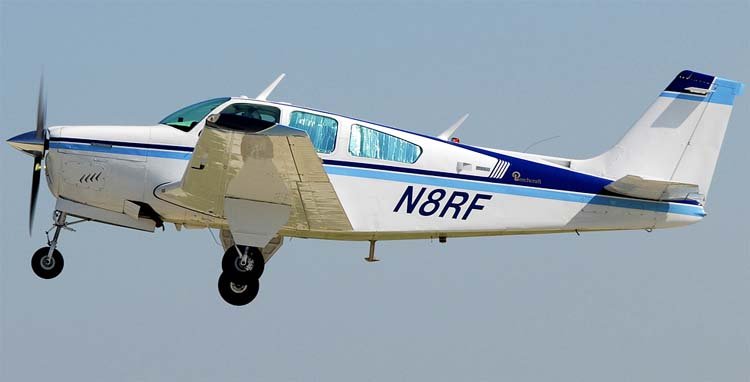 Beech 33(36) Bonanza |
 Beech 33(36) Bonanza |
 Beech 33(36) Bonanza |
 Beech 33(36) Bonanza |
 Beech 33(36) Bonanza |
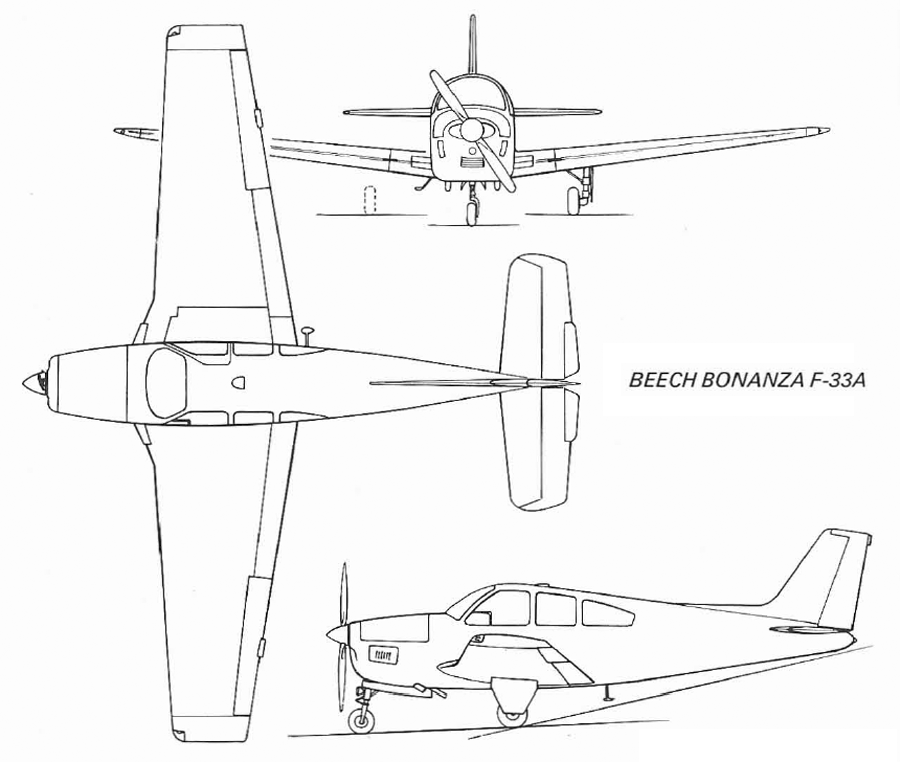 Beech 33(36) Bonanza |
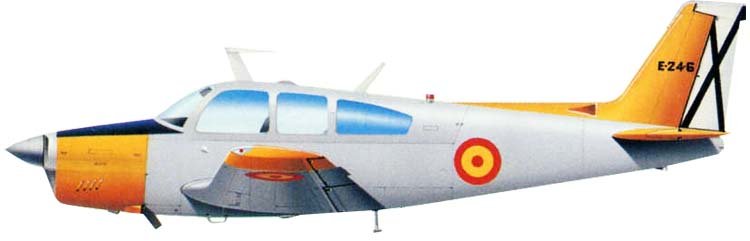 Beech 33(36) Bonanza |
Equipo Editorial de ArchivoAéreo
Grupo de investigadores y entusiastas de la aviación dedicados a documentar y preservar la historia aeronáutica mundial. Todos los artículos son revisados para garantizar precisión histórica.
Fuentes y Rigurosidad
La información presentada en esta ficha técnica ha sido compilada a partir de manuales de vuelo desclasificados, archivos históricos y bibliografía especializada. Aunque nos esforzamos por mantener la máxima precisión, algunos datos de rendimiento pueden variar según la variante específica o las condiciones operativas.