Beriev Be-103 Amphibious Aircraft
The Global Market for Light Amphibious Aircraft
Many areas across the globe feature extensive coastlines and numerous inland bodies of water. This criterion is particularly met by Canada, the northeastern United States, Australia, New Zealand, the Asia-Pacific region, Latin America, the Caribbean Basin, Siberia, and the Russian Far East.
All these, along with other island territories, represent a highly promising market for light amphibious aircraft, especially since most of the aforementioned countries and regions already possess experience in operating such technology. Currently, several thousand light seaplanes and amphibious aircraft are in service worldwide.
Light amphibians can effectively fill a functional niche between land-based aircraft and helicopters, particularly for passenger and cargo transport in regions with underdeveloped conventional airfield networks and an abundance of rivers and lakes. An amphibious aircraft, capable of taking off and landing on water, can efficiently solve tasks such as combating smugglers and poachers, conducting maritime search and rescue operations, monitoring the ecological state of the aquatic environment, patrolling forests, and promptly extinguishing small fires.
Origins and Design of the Beriev Be-103
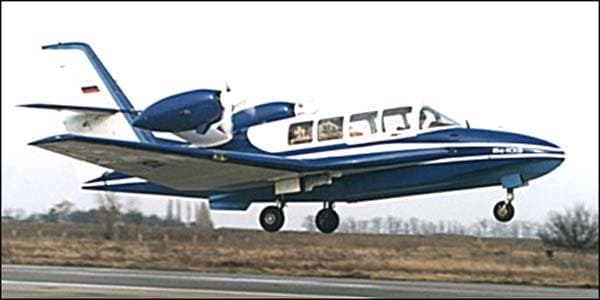
It is therefore not surprising that in recent years, Russia has seen the emergence of many seaplanes of this class, created by various design teams and typically featuring classic aerohydrodynamic schemes. Standing apart in this lineup is the Be-103 amphibian, developed in Taganrog.
The development of the light multi-purpose Be-103 amphibious aircraft began at the Taganrog A.N.T.K. named after G.M. Beriev in the early 1990s. The project was an initiative with two main goals. Firstly, to develop hydrodynamic and aerodynamic configurations for super-heavy seaplanes with a takeoff weight exceeding 500 tons.
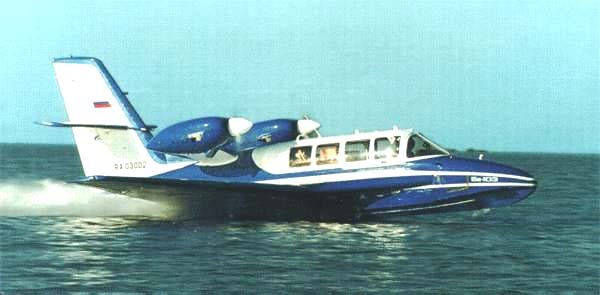
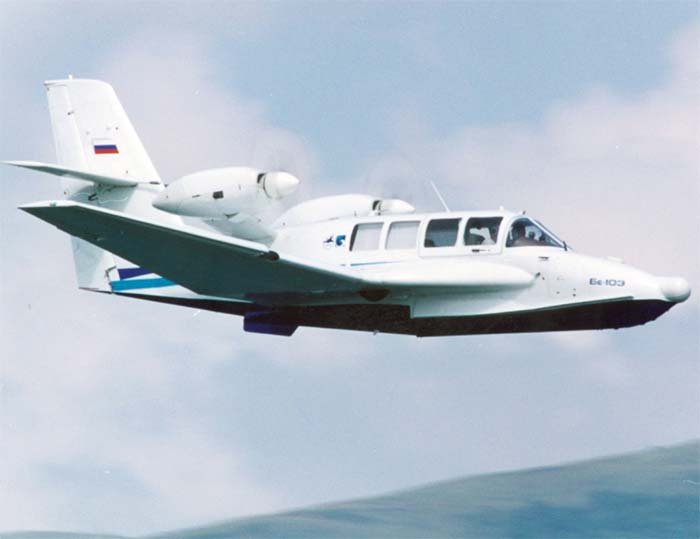
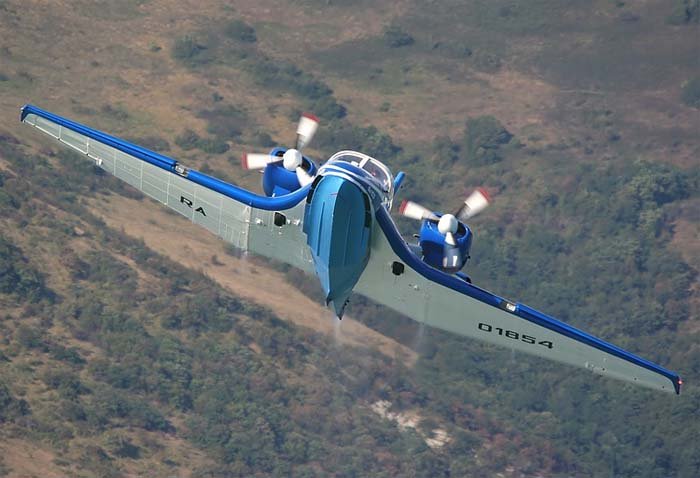
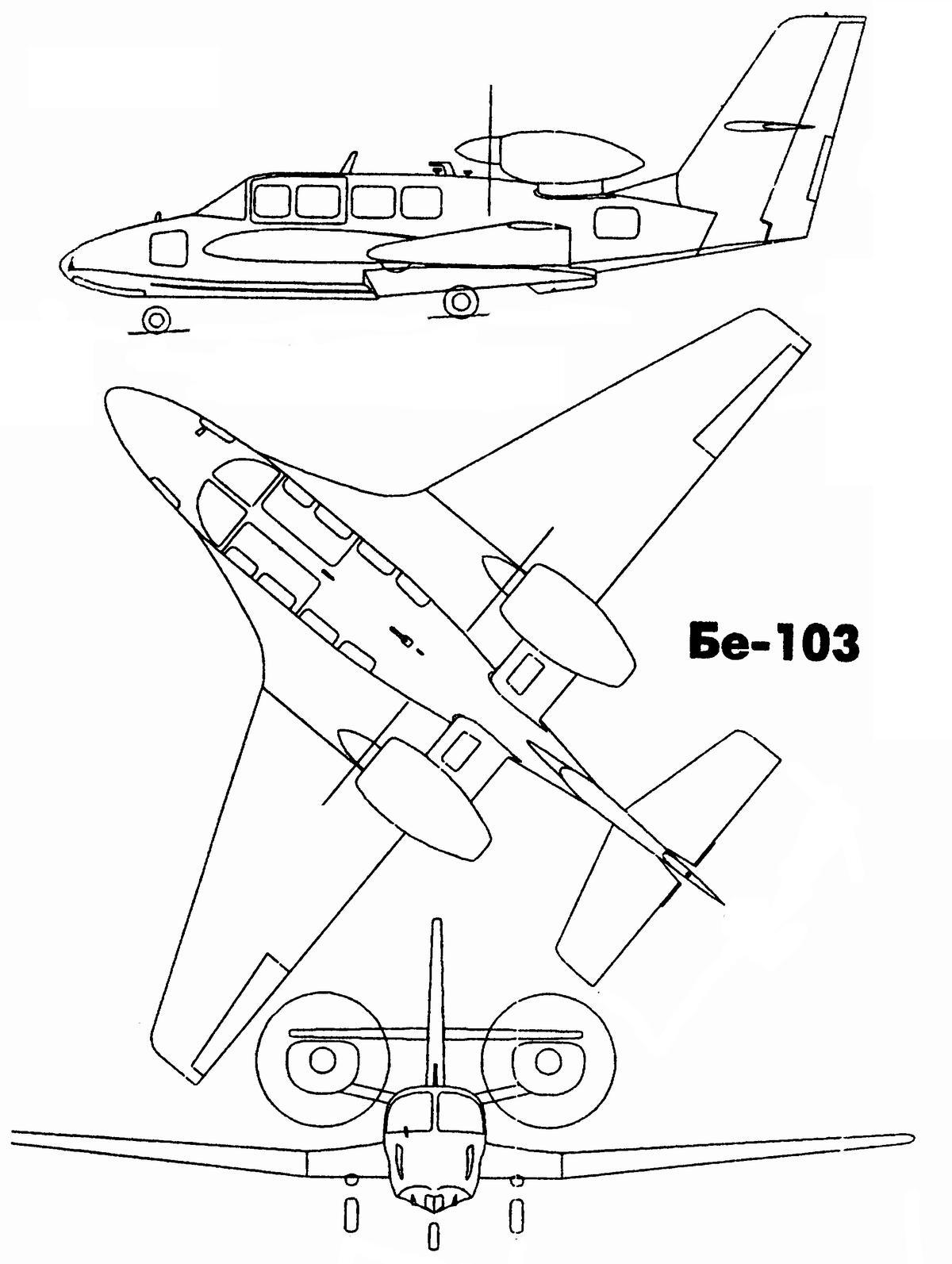
Secondly, as the era of “advanced conversion” had arrived, to create a multi-purpose amphibian for air transport on local routes within the country, especially in Siberia and the Far East. The fact that the Be-103 was intended to be a full-scale flying model led to a highly unusual aerohydrodynamic configuration for aircraft of its class: a monoplane with a low-mounted, displacement, and planing wing.
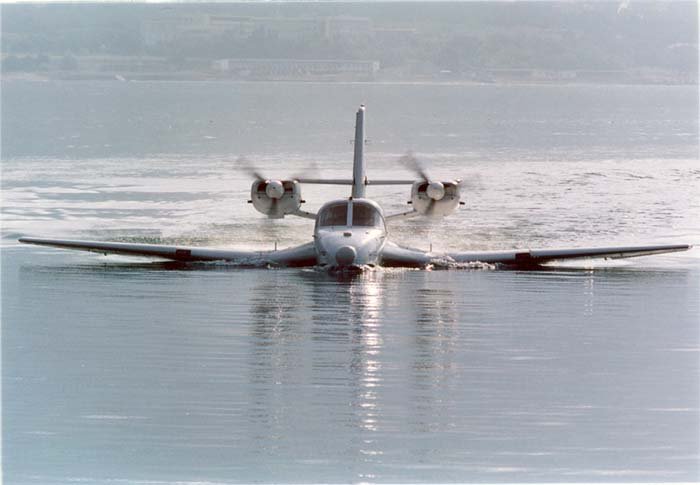
Such a scheme was not new to Taganrog specialists. It had previously been used in the projects of heavy flying boats LL-600 (1963) and A-150 (1965), developed at the design bureau under the leadership of G.M. Beriev. The realization of the displacement wing concept with three-point planing capability (the step, and the right and left trailing edges of the center-wing) offered significant gains in waterborne stability during takeoff and landing phases, and improved seaworthiness.
The low position of the wing relative to the hull, in turn, created a significant increase in lift due to the ground effect during takeoff and landing, allowing for the elimination of flaps and simplifying and lightening the airframe structure. However, all these were, for now, only theoretical calculations and results of laboratory research on models. It was necessary to practically test the new concept while simultaneously obtaining real data from a flying seaplane.
According to the initial project, the new amphibian was to feature a T-shaped tail, a three-strut landing gear with a tail wheel. The estimated maximum takeoff weight was 1600 kg, payload 375 kg, maximum speed 230 km/h, and maximum flight range 3150 km. Two M-17 engines (175 hp each) were positioned on pylons in the tail section of the fuselage.
The aircraft cabin accommodated the pilot and five passengers, as well as a baggage compartment. In the ambulance variant, it could carry two patients on stretchers and an accompanying medical professional. During the design process, the aircraft’s appearance changed somewhat; the Be-103 received an all-moving mid-mounted horizontal stabilizer and a landing gear with a nose wheel support.
Other variants, including a single-engine version, were also considered. However, the final decision settled on two engines, as the aircraft had to comply with the requirements of Russian aviation rules AP-23 and the standards of the US Federal Aviation Register (FAR-23).
Production, Testing, and Certification Milestones
A serious problem during the period of general production decline and widespread disruption of long-established connections was finding a serial production plant for the new amphibian.
Initially, the aircraft was planned for construction at a machine-building plant in Lukhovitsy, near Moscow. The first flight prototype of the Be-103 was expected to leave its workshops in the second half of 1994, with flight tests scheduled to begin in 1995. However, due to a number of circumstances, these plans did not materialize.
TANTK had to seek a new partner. This became the Komsomolsk-on-Amur Aircraft Production Association (KnAAPO), which in the early 1990s, when tackling the task of conversion, selected two civilian projects for implementation: the S-80 and the Be-103. To promote the amphibian in foreign markets, TANTK and KnAAPO, in late 1994, joined forces with the Foreign Economic Association “Mashinoexport,” forming CJSC “Takom-avia.”
The final decision to build the first prototype machines in Komsomolsk-on-Amur was made in early 1995. The first series was to consist of four aircraft: two for flight and two for static and fatigue testing. By this time, the Be-103’s powerplant configuration had changed. The unavailable M-17 engines (with very vague prospects for their future acquisition) were replaced by two American (but Russia-certified) Teledyne Continental Motors TCM-IO-360ES4 piston engines, each rated at 210 hp.
The release of drawings for production was completed in July 1995. The first flight prototype of the Be-103 (factory No.3001, RA-37019) was built by KnAAPO and delivered to Taganrog. The aircraft appeared publicly even before its first flight, participating in the First International Exhibition and Scientific Conference on Hydroaviation “Gelendzhik-96,” held from September 24 to 29, 1996.
Although the Be-103 was displayed only on a static stand, the new amphibian generated significant interest, constantly attracting the attention of specialists, journalists, and ordinary exhibition visitors alike. After the exhibition, the amphibious aircraft returned to Taganrog, where its preparation for flight tests continued.
V.N. Ulyanov became the Be-103’s test pilot, with S.A. Shokin serving as the aircraft technician. Concurrently, for static tests, a transport Il-76 delivered another Be-103 (factory No.3003) from KnAAPO to Taganrog. After ground equipment testing, structural modifications (a hydraulic cylinder for emergency opening of the entrance hatch flaps was installed), and taxi runs, the amphibian was finally prepared for its maiden flight.
The Be-103 first took to the air from the factory airfield in Taganrog on July 15, 1997. The initial flight lasted 12 minutes, piloted by V.N. Ulyanov. From the ground, the flight was observed by TANTK General Designer G.S. Panatov, KnAAPO General Director V.I. Merkulov, numerous guests, and journalists. A few days later, an official presentation of the new amphibious aircraft took place.
The festivities quickly concluded, and regular test flights from the airfield began to evaluate the aircraft’s stability and controllability. Simultaneously, KnAAPO was completing the second flight and fatigue test examples of the Be-103 (factory No.3002 and 3004, respectively).
In mid-August, after completing a total of about 30 test flights, the aircraft flew from Taganrog to Zhukovsky. Its participation in the MAKS-97 International Aviation and Space Salon was planned. However, on August 18, 1997, the day before the salon’s opening, during a training flight, the first prototype Be-103 crashed, and test pilot V.N. Ulyanov tragically died.
As it later became known, the aircraft successfully took off and climbed to about 100 meters. Then the pilot, trying to stay within the limits of the designated flying zone, entered a steep turn without having gained sufficient speed. Low speed and high g-forces led to an unintentional entry into supercritical angles of attack and a stall. Ulyanov did not have enough altitude to recover the aircraft and bring it to level flight. The Be-103 crashed into the ground five hundred meters from the runway. This was a severe blow to TANTK and KnAAPO, but nevertheless, it was decided to continue work on the program. V.P. Dubensky then became the new Be-103 test pilot.
To keep the testing schedule from falling behind, aircraft No.3004, originally intended for fatigue testing, was converted to a flight article. Simultaneously, in Komsomolsk-on-Amur, construction began on three more aircraft: one for certification tests (No.3102), one for operational tests and demonstration flights (No.3103), and another (No.3101) to replace Be-103 No.3004 in fatigue testing.
The second flight prototype Be-103 (factory No.3002, RA-03002) was transported by an Il-76 to Taganrog. There, on November 17, 1997, test pilot V.P. Dubensky took it into the air from land and continued the test program flights. In total, the second Be-103 completed 13 flights in 1997. The following year, tests resumed on April 6 with a flight from the factory airfield.
On April 9, the maritime phase of testing began, with the aircraft piloted by V.P. Dubensky. The goal of the first stage of seaworthiness trials was to determine the aircraft’s behavior during floating, taxiing, turns, transition to planing mode up to takeoff, as well as spray characteristics, loads on the airframe structure, and comparison of flight test results with calculations. Hydrometeorological conditions ranged from calm to wave conditions with a wind wave height of 0.35 m and swell height up to 0.17 m. Takeoff and landing weights were at maximum.
On April 13 and 15, taxi runs were conducted, reaching planing mode at speeds up to takeoff speeds. According to the pilot’s assessment, the aircraft responded well to the rudder throughout the speed range, and longitudinal stability was normal.
On the morning of April 24, after performing a pre-takeoff speed taxi run, at 9:32 Moscow time, V.P. Dubensky for the first time took the Be-103 into the air from water. Twelve minutes later, the amphibian landed “cleanly” directly on the step without any bounces or oscillations, and the landing run was significantly shorter than calculated, only 150-200 m, after which it taxied to the slipway, where those present began to cheer the hero of the day, the test pilot, as he emerged from the cockpit.
After a thorough inspection of the aircraft to determine the condition of the hull’s structural frame and the wings, water flights continued on April 30. On May 7, test pilot G.G. Kalyuzhny made his first flight in the Be-103. In late June, V.P. Dubensky ferried the Be-103 from Taganrog to Gelendzhik, where the aircraft participated in the Second International Hydroaviation Exhibition “Gelendzhik-98,” held from July 1 to 5, 1998.
Although the aircraft was no longer a novelty at “Gelendzhik-98,” it marked the first public demonstration of the amphibian, so to speak, “in its full glory,” in its native element. Exhibition visitors could now observe the Be-103’s flights from water with great interest.
After returning from the exhibition, testing continued, and during a break, the amphibian was demonstrated to an official Israeli delegation (led by the ambassador of Israel) that visited TANTK on July 28, 1998. It is worth noting that the Be-103 flew from water in front of the guests, and the wind wave height on that day reached 0.4 m.
In the winter of 1999, a team of TANTK specialists, led by Be-103 Chief Designer V.F. Ponomarev, traveled to Komsomolsk-on-Amur to prepare for the first flight of the third flight-worthy Be-103 (factory No.3004, RA-30004). The third Be-103 was taken into the air from the KnAAPO airfield on February 19, 1999, by V.P. Dubensky. The flight lasted 20 minutes. Further aircraft tests were continued by factory test pilot A.V. Pulenko.
In spring, Be-103 (No.3002) began preparations for participation in the “AERO-99” International Light and Sport Aircraft Show held in Friedrichshafen, Germany. From April 15-18, 1999, the Be-103 flew from Taganrog along the route Taganrog – Voronezh – Bryansk – Gomel – Brest – Wroclaw – Prague – Friedrichshafen. The aircraft was piloted by V.P. Dubensky.
After the exhibition, during which the aircraft managed to make two training flights and only one demonstration flight, nevertheless attracting significant interest from specialists and the general public, the amphibian flew to Walmühle airfield near the German city of Straubing. This is where MT-Propeller, the manufacturer of the aircraft’s propellers, is located. It was planned that the aircraft would perform a series of flights there to determine the vibrational characteristics of the propellers, after which it would return to Taganrog.
Therefore, the news from Germany on April 29 about the Be-103 crash during takeoff and the death of V.P. Dubensky came as a real shock. Around 4:30 PM local time, the Be-103, during takeoff, ran almost double the prescribed distance on the runway, struggled to lift off the ground, and without gaining altitude, crashed into a dam on the bank of the Danube.
The cause of the tragedy was the pilot’s attempt to take the aircraft into the air with insufficient engine power. The incorrect power setting was likely due to the pilot not fully understanding the explanations of German specialists, as he declined the services of an interpreter. As in 1997, the continuation of work on the aircraft was again in question.
Once more, weighing all the pros and cons, the leaders of TANTK and KnAAPO, G.S. Panatov and V.I. Merkulov, decided not to close the Be-103 program. N.A. Lavro, Deputy General Designer of TANTK, assumed the duties of chief designer of the Be-103 in place of V.F. Ponomarev.
Although the loss of the first two flight prototypes significantly delayed the program’s progress, on June 6, a transport Il-76 delivered the third flight-ready Be-103 (No.3004) from Komsomolsk-on-Amur. Naturally, the two previous crashes had severely “damaged” the aircraft’s reputation among test pilots. In these circumstances, test pilot G.G. Kalyuzhny volunteered to pilot it.
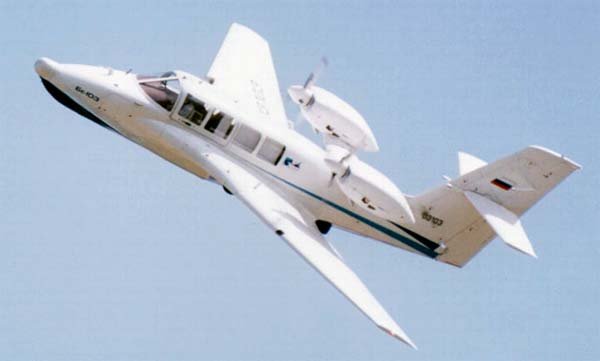
Furthermore, technical documentation for aircraft modification was issued, including airframe strengthening and the installation of fixed leading-edge slats. The modification kits were produced at KnAAPO. Flight tests resumed with a flight from the airfield on September 29 (the aircraft had not yet been modified). Flights ceased in December when both Be-103s (another amphibian, No.3103, in “exhibition” white livery, was brought by Il-76 from the Komsomolsk factory on October 9) were moved into the workshop for modifications.
Simultaneously, the static test example No.3003 was similarly modified, and in Komsomolsk-on-Amur, Be-103 factory No.3102 (equipped with domestic radio-electronic equipment) was being completed. This machine was delivered by aircraft to Taganrog on November 27, 2000. The “exhibition” amphibian No.3103 was intended to be a promotional aircraft. Its first exhibition was supposed to be LIMA-1999 in Malaysia. However, due to the need for modifications, this aircraft never made it abroad that year.
The modified Be-103 No.3004 was test-flown on April 14, 2000, by G.G. Kalyuzhny, after which training flights and preliminary test program flights, both from land and water, resumed. Before the flight, on April 11, by decision of the General Designer, aircraft No.3004 was blessed by the priest, Father Viktor Levchenko. From April 24, another TANTK test pilot, K.V. Babich, began participating in the aircraft’s tests; later, N.N. Okhotnikov and V.L. Fortushnov joined him. In total, by early May 2000, about 200 flights had been completed under the Be-103 flight test program.
On August 10, 2000, G.G. Kalyuzhny took the fourth amphibian (No.3103) into the air, first from the airfield and then from the water. The aircraft was not yet registered and was not equipped with flight instruments. Later, already registered (RA-03103), it was demonstrated in Gelendzhik at the Third International Hydroaviation Exhibition “Hydroaviasalon-2000,” held from September 6 to 10, 2000.
In March 2001, Be-103 (No.3103) was equipped with a “Bendix King” meteorological radar, and on April 19, 2001, under the control of K.V. Babich and navigator A.V. Bocharov, this aircraft flew the route Taganrog-Voronezh-Gomel-Brest-Prague-Friedrichshafen to the next “AERO-2001” exhibition. As two years prior, the Be-103 achieved great success, enjoying increased interest from specialists and attention from the large public, performing, in addition to training flights, three demonstration flights.
After the exhibition, before returning to Taganrog, RA-03103 successfully underwent propeller tests in Straubing. A little later, in August, the same aircraft also participated in MAKS-2001. The aircraft was piloted by test pilot G.G. Kalyuzhny. After receiving the type certificate for the Be-200 amphibious aircraft in August 2001, TANTK faced the task of completing the certification test program for the Be-103 by the end of the year.
Therefore, they “caught the weather” and flew extensively (up to 10 flights per day). By the end of 2001, the certification program, including such a complex element as flutter flights, was successfully completed. On December 26, 2001, G.S. Panatov, General Director of JSC “TANTK named after G.M. Beriev,” was awarded the normal category type certificate from the Aviation Register of the Interstate Aviation Committee for this aircraft.
The certification tests of the Be-103 amphibious aircraft were carried out by test pilots of TANTK named after G.M. Beriev – G.G. Kalyuzhny, V.L. Fortushnov, K.V. Babich, and test pilot of GosNII GA Yu.M. Kabanov. Within the framework of the Be-103 certification tests, 263 flights were performed, 59 of which were from water. The flight time amounted to 161 hours.
This result was achieved through close cooperation between the Aviation Register and specialists from TANTK named after G.M. Beriev, research and certification centers of aviation industry and civil aviation institutes. This collaboration allowed for the successful completion of a large volume of various certification works. Without exaggeration, it can be said that the efforts of the Interstate Aviation Committee’s Aviation Register as the ideologue and organizer, and TANTK named after G.M. Beriev as the Be-103 aircraft developer, laid the foundation for the certification system of light amphibious aircraft in our country.
International Expansion and FAA Certification
In July 2002, the Be-103 (No.3102, RA-03102) participated in the international air show “Civil Aviation – 2002,” held at Moscow’s Domodedovo airport. By September, the amphibians (No.3102 and 3103) performed “in duet” during the Fourth International Exhibition and Scientific Conference on Hydroaviation “Hydroaviasalon-2002.”
They were flown by G.G. Kalyuzhny from TANTK and Yu.M. Kabanov from GosNII GA. In one of the demonstration flights, Yu.M. Kabanov took the Deputy Commander-in-Chief of the Russian Air Force for Armaments, D.A. Morozov, on the Be-103, who familiarized himself with the new amphibian in the air. After the flight, a “dedication” ceremony into naval pilots followed, which included throwing the “initiate” into the water, followed by consuming a glass of “alcohol-containing liquid.”
In the following year, 2003, in addition to traditional participation in MAKS-2003, the amphibian ventured “overseas” for the first time. In July, the Russian amphibian made its debut on the North American continent. In September-October, TANTK named after G.M. Beriev, jointly with KnAAPO, presented the Be-103 amphibious aircraft at the “LIMA-2003” International Maritime and Aerospace Exhibition.
During the opening of the maritime section of the exhibition, the Be-103 (RA-03103) brilliantly demonstrated its capabilities before Malaysian Prime Minister Mohammed Mahathir. Subsequently, throughout the exhibition, the amphibian participated in demonstration flights, both from land and water. His Majesty the King of Malaysia, Diram Jwanqu Syed Sirajuddin, familiarized himself with the Be-103 at the static display in the airport.
Obtaining the IAC certificate was an important, but only the first step on the Be-103’s path to the international aviation equipment market. For the aircraft to finally become a real commodity, it was necessary to remove a number of operational restrictions and conduct certification according to international standards. By this time, in Komsomolsk-on-Amur, the production technology for the Be-103 had been fully mastered, and the necessary tooling prepared. Marketing research conducted over these years by TANTK and KnAAPO indicated significant interest in the aircraft from potential foreign customers, particularly from the USA, Canada, Australia, Malaysia, South Korea, and several European and Latin American countries.
However, to open the way for the amphibian to these very promising markets (primarily North America), the task of certifying the Taganrog machine in the USA became a priority. TANTK and KnAAPO’s partner in America was New Jersey businessman Kent Lynn and his company Sky Manor Airport. In accordance with the Agreement concluded between K. Lynn on one side, and JSC “KnAAPO” and JSC “TANTK named after G.M. Beriev” on the other, K. Lynn became the official dealer for the sale of Be-103 aircraft in North America. He also became the first buyer of the new amphibian, ordering three aircraft.
The implementation of the FAR-23 certification program began in late 2001. The Be-103 certification proceeded in accordance with the Bilateral Intergovernmental Agreement between Russia and the USA on aviation safety, with the direct participation of the IAC Aviation Register. Thanks to the agreement, concluded at that time between the Russian side and Kent Lynn, FAA representatives, taking into account the presence of a US citizen as a customer for the Be-103 aircraft, approached cooperation with the Russian side constructively during certification.
Nevertheless, a large volume of work was accomplished. TANTK specialists visited the USA several times for certification issues. FAA representatives also visited Russia. In March 2003, during the machine’s certification process, they performed a series of flights on the Be-103 in Taganrog. The American delegation, consisting of aviation engineer Roger P. Chadi and test pilot Brian A. Hancock, was accompanied by a group of specialists from LII named after M.M. Gromov and the Aviation Register of the Interstate Aviation Committee.
B. Hancock, together with LII named after Gromov test pilot Yu.M. Kabanov, performed a series of flights on the Be-103 amphibious aircraft (serial No.03103), including measuring the aircraft’s noise level on the ground and stall test flights. According to the American test pilot, the Russian amphibian fully meets FAR-23 requirements, is pleasant to control, and most importantly, is accessible for an average qualified American pilot to master.
Since certification of an aircraft in any country according to its rules requires the national aviation authority to also certify the serial production of that machine, in May 2003, FAA specialists also visited Komsomolsk-on-Amur, where the construction of the first serial amphibians was in full swing. The certification program was fully and successfully completed in the summer of 2003, and on July 11, 2003, the FAA issued Be-103 type certificate No.A55CE.
Assembly of the first serial batch of Be-103 amphibians, ordered by K. Lynn, began in the summer of 2002. Just one year later, the first three aircraft (with serial numbers 3301, 3302, and 3303) were built. One amphibian (No. 3301) was intended for Lynn’s own use and for promotional purposes, while the other two (No. 3302 and 3303) were for sale.
The lead aircraft of the series was first flown from the factory airfield on July 2, 2003, by KnAAPO test pilot V.A. Guber. All three aircraft successfully passed factory tests within a short timeframe and were ready for shipment to the United States. The transfer of the first production aircraft to the customer was decided to coincide with the annual experimental aviation exhibition “Air Venture 2003,” organized by the American Experimental Aircraft Association (EAA), which took place from July 29 to August 4, 2003, in Oshkosh (USA, Wisconsin).
This exhibition is the largest review of general aviation not only in the USA but worldwide. It would be difficult to imagine a better place to present the new amphibian to potential buyers and the North American aviation public. It was decided not to ferry the Be-103 across the ocean but to transport it aboard an An-124 “Ruslan.” On July 23, three Be-103 aircraft and additional equipment, weighing a total of 10 tons, were delivered by an An-124-100 of the “Volga-Dnepr” company from Komsomolsk-on-Amur along a route with a total length of 10,000 km to Wittman Airport in Oshkosh.
The Russian amphibians demonstrated at “Air Venture-2003” undoubtedly became one of the exhibition’s brightest highlights. One aircraft (No.3302) was at the static display, while the second (No.3301) was at the seaplane base. The amphibious aircraft based at the seaplane base was on water during the exhibition and performed demonstration flights from the water. The Be-103 demonstration flights were a huge success.
They were performed by KnAAPO test pilot V.A. Guber. Numerous exhibition visitors interested in the new Russian aircraft were constantly present both near the Be-103 and at the joint exposition of KnAAPO and its American partner, Sky Manor Airport. The amphibian’s unusual appearance, strikingly different from traditional seaplanes, played a significant role in this interest.
On July 31, 2003, at the exhibition’s press center, the official presentation and handover of the Type Certificate for the Be-103 amphibious aircraft took place. The type certificate was presented by Nick Sabatini, Co-Chairman of the US Federal Aviation Administration (FAA) for Regulations and Certification. From the Russian side, N.A. Lavro (chief designer of the Be-103, deputy general director of TANTK), B.D. Bregman (deputy general director of KnAAPO), and V.A. Volodarsky (head of the general aviation department of ARMAK) participated in the ceremony.
On August 1, FAA Director Marianne Blackley visited the Be-103 aircraft’s parking spot (No.3303) at Wittman Airport (outside the exhibition grounds) to personally inspect the aircraft and meet with representatives of the developer, manufacturer, and Aviation Register. During this visit, Ms. Blackley re-presented the Type Certificate for the Be-103 aircraft in front of photo and video cameras.
After the exhibition, the official handover of the Be-103 aircraft to the customer took place. The aircraft were ferried by test pilot Yu.M. Kabanov to Sky Manor Airport and received American registration. By early November 2003, the “promotional” Be-103 (No.3301, N13KL) had completed five ferry flights, accumulating over 70 hours in American skies, performing approximately 100 takeoffs and landings on land and over 200 takeoffs and landings from water.
Several Be-103 aircraft were built by early 2004, including flight, static, and fatigue test models, as well as demonstration and sales examples.
Be-103 Variants and Technical Specifications
In addition to the basic passenger variant, a number of modifications of the new amphibian have been developed to date. Thus, the Be-103 can be used in the following variants: transport, administrative, sanitary (one recumbent patient, 1-2 seated, one medical attendant), patrol (2-person crew), and ecological. Conversion of the aircraft from passenger to transport and sanitary variants can be carried out by the operating organization, while other variants require factory conditions.
The protection of the state border of the Russian Federation in maritime, river, and lake sections, as well as control of the exclusive economic zone and continental shelf, is an important and integral part of the state security system. At the current stage, hydroaviation, with its ability to take off and land on water, can effectively solve a wide range of tasks arising in the daily service of border troops.
An amphibious aircraft is capable of detecting an intruder (who typically possesses modern high-speed vessels), accurately determining their location, and if necessary, using weapons, landing in close proximity, and apprehending them by dispatching a boarding party on a motorboat. Modern amphibians are an effective means of solving the problem of sea rescue, as they can quickly deliver rescue equipment to the scene and pick up victims from the water surface.
The use of amphibious aircraft is also highly advisable for the prompt elimination of marine oil pollution and for environmental monitoring of water areas. An amphibious aircraft can be the first to arrive at the site of pollution, quickly conduct reconnaissance, cordon off the polluted area with special equipment, and guide specialized marine vessels to the site of pollution. Therefore, the need for a modern patrol aircraft for effective protection of the Russian maritime border is evident.
Great capabilities in this regard will be possessed by the patrol variant of the amphibious aircraft – the Be-103PV, designed for state border protection and patrol service in coastal marine areas, as well as on river and lake sections. Special equipment (radar, thermal imager, aerial camera, additional communication means) and light small arms can be installed on board. In addition, the Be-103PV can be used for transporting personnel, ammunition, material, and for participating in search and rescue operations. Aircraft operation is ensured from concrete and unpaved runways, as well as from the water surface with wave heights up to 0.5 m.
Worldwide, forest patrolling remains one of the primary functions of aviation to this day. The tasks of airborne scouts, which include both airplanes and helicopters (often called “Birddogs”), involve detecting fire outbreaks and directing “water bombers” to them. Directly during firefighting, “Birddogs” act as airborne command posts, coordinating and directing the actions of ground and air forces in combating fires.
A significant fleet of such aircraft is operated abroad, therefore, for the Federal Forest Service, a domestic analogue has been developed: a special variant of the light Be-103 amphibious aircraft, designed for patrolling and fire prevention surveillance of forests. The possibility of equipping the amphibian with domestic engines is being explored. The installation of the promising VAZ-4262 rotary-piston engine with a power of 270 hp on the Be-103 is being discussed with JSC AVTOVAZ.
Furthermore, the Be-103 served as a prototype for the designers of the Komsomolsk-on-Amur Aircraft Production Association for the development of a light 6-seater SA-20P amphibious aircraft based on it in 2001.
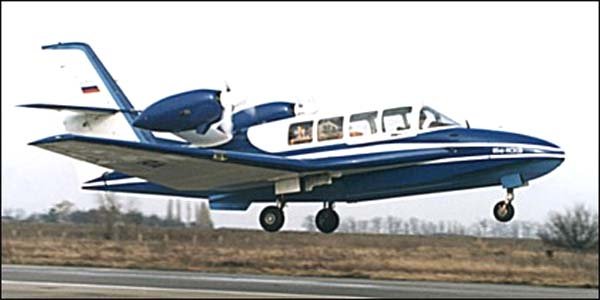
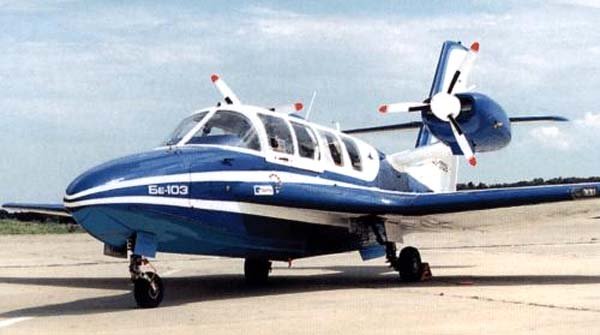
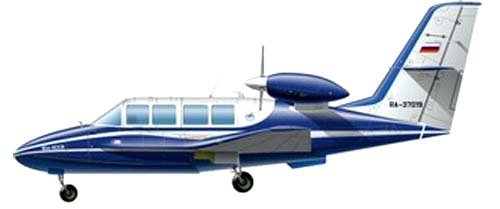
The Be-103 amphibious aircraft is a monoplane with a low-mounted, displacement, trapezoidal wing. The aircraft is designed for use on short-haul routes in various regions of the world, especially in coastal and island states and in regions with numerous rivers, lakes, and shallow bodies of water, difficult to access by other means of transport. The Be-103 can be used for passenger transport, small cargo and mail transport, fire prevention surveillance, patrolling, ecological control of water areas, emergency medical assistance, search and rescue operations, as a liaison and administrative aircraft, for aerial photography, agricultural work, recreation, and tourism.
The crew consists of one pilot. The passenger cabin can accommodate five passengers; in the sanitary variant, one severely injured person on a stretcher and two seated patients with one attendant. The hull structure is riveted, made of aluminum alloys with special anti-corrosion protection measures and composite materials based on glass fillers. The hull is divided by watertight bulkheads into five compartments: nose, front technical compartment, cockpit and baggage compartment, rear technical compartment, and tail compartment.
The nose compartment houses the front landing gear strut and its retraction/extension mechanism. A radio compass loop antenna is installed on the upper surface of the compartment. Installation of a radar is possible in the front part of the compartment. The front technical compartment contains the battery and electrical power distribution unit, as well as radio communication and radionavigation equipment blocks. For access to the equipment, service hatches are provided in the hull sides.
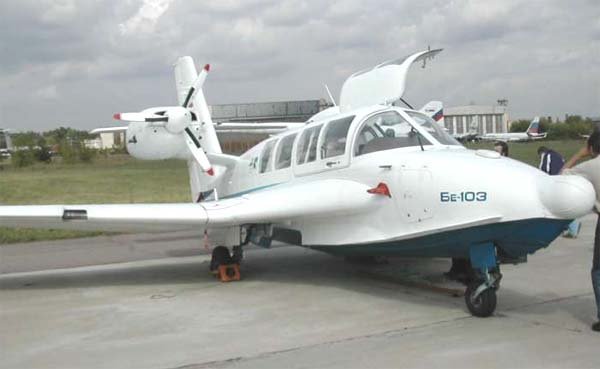
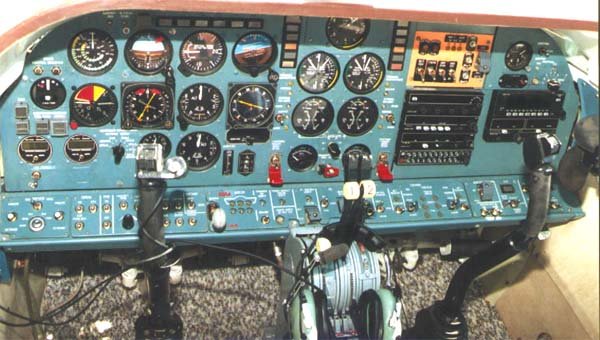
The aircraft cabin accommodates the pilot’s workstation and passenger seats. Six seats are installed in two rows with a central aisle. Access is gained through an entrance hatch measuring 1300×900 mm located on the front left side. Symmetrically, on the right side, there is an emergency hatch. For entering and exiting the cabin, an integrated ladder is provided in the left leading edge of the center wing. Under each seat is an inflatable life jacket, and an emergency radio station and a hand-held fire extinguisher are installed at the pilot’s workstation. Marine equipment is located in the front part of the cabin.
The cabin features a modern interior and a large glazing area. The interior, along with heating and ventilation systems (general and individual) and domestic equipment, ensures comfortable conditions for the pilot and passengers in various flight conditions. The rear wall of the cabin separates it from the baggage compartment. In the rear part of the baggage compartment are the electrical power system blocks and the temperature regulation unit for the cabin heating system.
Underfloor compartments of the cabin house the rods and rockers of the aircraft control system, engine control wiring, electrical harnesses, and pipelines for the cabin heating and ventilation system, as well as hydraulic system pipelines. The rear technical compartment contains the control wiring for the stabilizer and rudder, as well as engine control wiring, fuel system pipelines, MSRP objective control system blocks, and the unit of fuel system valves and filters.
In the upper part of the rear technical compartment, between frames No.15 and No.16, the engine pylon caisson is secured. In the nose part of the pylons are the hot air pipe of the heating system and electrical harnesses, and in the tail part, the engine control cables. Inside the caisson are the header tanks and fuel system pipelines.
The hull’s tail compartment contains the control wiring for the stabilizer and rudder, as well as electrical harnesses and the rear strong point, designed for mooring and towing the aircraft. The aircraft is equipped with life jackets for passengers and pilot, a hand-held OR1-1 fire extinguisher, and a first-aid kit.
The Be-103 aircraft wing is of all-metal construction, has a trapezoidal shape with root extensions, and consists of a center wing and two detachable outer panels. To ensure unsinkability, the aircraft wing is divided by watertight bulkheads into compartments. Fixed leading-edge slats are installed along the leading edge of the outer wing panels. Landing and taxi lights are installed in the nose section of the left and right detachable wing parts. Aeronavigation lights are located in the wingtips. On the lower surface of the detachable wing parts, there are attachment points for mooring the aircraft on the ground.
Tail unit: The vertical empennage is single-fin, cantilevered. The horizontal empennage is all-moving. A controllable stabilizer is installed in the middle part of the fin. The top part of the fin houses the communication radio antenna, anchor light, and tail lights. The landing gear is a tricycle type with a nose strut, retractable in flight. Landing gear retraction and extension are hydraulically controlled.
The aircraft’s powerplant consists of two air-cooled six-cylinder piston engines, TCM IO-360ES4, manufactured by “Teledyne Continental Motors Aircraft Product” (USA), with three-bladed, reversible, variable-pitch MTV-12-D-C-F-R(M)/CFR183-17C propellers from “MT-Propeller GmbH” (Germany). The propeller diameter is 1.83 m. The engines are installed in streamlined nacelles on pylons on both sides of the hull above the rear part of the center wing. An SPS-3 fire detection system is installed in the engine nacelles for fire detection.
Fuel is stored in two tank-compartments located in the left and right parts of the center wing and in header tanks in the engine pylons. Fuel is replenished through the filler necks of each tank. An airframe anti-icing system is installed at the customer’s request. To ensure flight safety when encountering icing conditions, a VUO-U-1 visual icing indicator is installed in front of the cockpit canopy windshield. To protect against fogging and icing, the cockpit canopy windshields are blown with hot air from the inside during flight. The propeller blades are equipped with an electro-thermal anti-icing system from “Goodrich.”
The aircraft’s hydraulic system consists of two independent systems for landing gear retraction/extension and a landing gear wheel braking system. The pump station, tank, drain and pressure filters, and pressure sensor are located on a panel installed on the left side of the hull between frames No.15 and No.16. The hydraulic system pipelines are located under the cabin floor. The controls for the pump station and landing gear are on the pilot’s instrument panel.
Electrical equipment: The aircraft’s electrical power sources are two TCM 653344 DC generators from “Teledyne Continental Motors” installed on the engines and one F20/17HICT-2 battery from “VARTA.” The battery is used on the ground for autonomous engine start and in flight in case of failure of both generators. A ground power connector is provided for supplying power to consumers from ground sources during aircraft preparation and maintenance.
The marine equipment includes: a grapnel anchor, a line with a throwing end, a folding boat hook, and a tool for breaking cabin glazing in emergency situations. The control system is mechanical. The control wiring is designed for a single pilot, but there is a provision for installing dual controls. The control wiring for the stabilizer and ailerons is rigid, while for the rudder it is cable-operated. Rudder trim and stabilizer trim control are electromechanical. At the customer’s request, an AP-103 or KFC-150 autopilot can be installed.
The Be-103 aircraft’s flight and navigation equipment ensures flights both day and night in simple and complex meteorological conditions. The standard kit for foreign customers includes: KR87 automatic radio compass, KCS55A course system, C2400L4VT magnetic compass, KLN89B satellite navigation system, KX165 radionavigation and communication system, P/N8000 airspeed indicator, P/N7040 vertical speed indicator, KEA130A barometric altimeter, P/N5934PAM-3 altimeter, 510-44A primary attitude indicator, 510-1A backup attitude indicator, KT-70 aircraft transponder, P/N9551B gyroscopic turn coordinator with slip indicator, 307FC outside air temperature indicator, and AChS-1MK aircraft clock.
The standard PNO kit for Russian customers includes: C2400L4VT magnetic compass, USBS-350 airspeed indicator with non-contact annunciator, VR-30PB variometer, VM-15PB mechanical altimeter, VBE-2 electronic barometric altimeter, SVVD-103BM air data perception system, two AGR-29R-15 attitude indicators, MKS-1 compact course system, IRM-1 radio magnetic indicator, KR87 automatic radio compass, KLN89B satellite navigation system, 307FC outside air temperature indicator, and AChS-1MK aircraft clock.
Radio-electronic equipment: The aircraft is equipped with a KY196A VHF radio station, a KX165 VHF radio station (as part of the radionavigation and communication system), KMA-24 intercom and switching equipment, R-855A1 emergency radio station, SO-94R aircraft transponder (for domestic customers), P-503B onboard tape recorder (for domestic customers), and BUR-LK onboard recording device. Additionally, at the customer’s request, the aircraft can be equipped with an RDR-2000 weather radar and a KRA-405.
Technical Specifications
| Modification | Be-103 |
| Wingspan, m | 12.72 |
| Aircraft length, m | 10.65 |
| Aircraft height, m | 3.76 |
| Wing area, m2 | 25.10 |
| Empty weight | 1824 |
| Normal takeoff weight | 2270 |
| Fuel | 245 |
| Engine type | 2 Piston engine Teledyne Continental Motors TCM-IO-360ES |
| Power, hp | 2 x 210 |
| Maximum speed, km/h | 285 |
| Cruising speed, km/h | 240 |
| Ferry range, km | 1350 |
| Practical range, km | 1070 |
| Radius of action, km | 500 |
| Service ceiling, m | 5020 |
| Crew, crew members | 1 |
| Payload | 5 passengers or 2 wounded or 3 patrol crew and 368 kg of cargo |
Image and diagram gallery of the Beriev Be-103 Amphibious Aircraft
 Be-103 |
 Be-103 |
 Be-103 |
 Be-103 |
 Be-103 |
 Be-103 |
 Be-103 |
 Be-103 |
 Be-103 |
 Be-103 |
 Be-103 |
Equipo Editorial de ArchivoAéreo
Grupo de investigadores y entusiastas de la aviación dedicados a documentar y preservar la historia aeronáutica mundial. Todos los artículos son revisados para garantizar precisión histórica.
Fuentes y Rigurosidad
La información presentada en esta ficha técnica ha sido compilada a partir de manuales de vuelo desclasificados, archivos históricos y bibliografía especializada. Aunque nos esforzamos por mantener la máxima precisión, algunos datos de rendimiento pueden variar según la variante específica o las condiciones operativas.