BiS-1
By 1908, the world finally turned its attention to aviation, which was still on the verge of circus artistry, and became genuinely interested in it. It took the Wright brothers almost five years for people to acknowledge their creation. Their flights lasting more than two hours, carrying passengers, and performing maneuvers captivated eyewitnesses and ignited a passion for flying.
As in Europe, aero clubs, aeronautical societies, and student circles emerged in many Russian cities. New aviation magazines began to appear, and aircraft inventors progressed from models and gliders to creating the first airplanes. Among Russian cities, Kyiv holds a special place for its significant contribution to the development of domestic aviation.
In the year the Kyiv Polytechnic Institute (KPI) opened, the X Congress of Russian Naturalists was held in Kyiv, where Nikolai Egorovich Zhukovsky delivered a powerful speech, urging systematic research and exploration in aviation and aeronautical engineering. Just a year later, Nikolai Andreevich Artemyev, a talented student of N.E. Zhukovsky from the Imperial Moscow Technical School and professor of electrical engineering at KPI, even led a campaign to open a fifth faculty at KPI – for aeronautics.
Pioneering Aviation in Kyiv
The practical activities of aviation enthusiasts particularly intensified after N.E. Zhukovsky’s arrival in Kyiv in December 1908. He gave a lecture on aviation, illustrated with original slides, in the Assembly Hall of the Merchants’ Guild (now the Kyiv Philharmonic building). Zhukovsky’s lectures, and later those of his student, KPI Professor Nikolai Borisovich Delone, generated exceptional public interest in aviation, spurring enthusiasts into practical work.
Everyone suddenly realized that mechanical human flight was possible, and, most importantly, the time for it had come. As early as 1906, an aeronautical section was organized at the KPI’s mechanical club, which was transformed into an aeronautical circle (VK) in 1908. From its inception, N.B. Delone led this section and later the circle.
This circle formed the creative core of the Kyiv Society of Aeronautics (KOV), whose founding meeting took place on May 1, 1909. By this time, the KPI’s VK had more than 200 members. A qualified team of lecturers from KPI faculty and professors ensured the enhancement of theoretical knowledge for all interested KOV members.
Two lectures were given or two reports were heard at society meetings weekly, and from October 13, 1909, N.B. Delone began teaching an optional course in aeronautics at KPI. The KOV actively participated in organizing various public events to promote aviation, assisted enthusiasts with advice, established two aviation libraries, and initiated the creation of a museum. This creative atmosphere awakened many amateur designers.
Among them were KPI Professor Prince A.S. Kudashev, I.I. Sikorsky, F.I. Bylinkin, F.F. Tereshchenko, A.D. Karpeka, the brothers I.I., A.I., and E.I. Kasyanenko, and many others. In the early years of domestic aviation, about two dozen original experimental aircraft were created in Kyiv. It is no surprise that the first flights of the first domestic aircraft took place precisely in Kyiv.
The BiS-1 Aircraft Development
In this environment of widespread enthusiasm, small design teams began to form, with each participant striving to make a meaningful contribution to the common cause. Many considered it a privilege to perform even the most rudimentary work, just to be near the aircraft under construction. This led to the formation of the first team, headed by F.I. Bylinkin and I.I. Sikorsky.
They united not primarily for collective design development, but first and foremost for joint production. Fyodor Ivanovich Bylinkin, son of a wealthy merchant, managed to independently reproduce the Wright brothers’ aircraft from pictures, albeit on a slightly smaller scale. This aircraft, powered by a 25 hp Anzani engine, was built in the autumn of 1909.
Its power plant was tested during the winter, but without success: the chain drive to the propellers kept breaking. During one test, the apparatus caught fire due to an explosion in the carburetor. The aircraft was lost, but its construction provided valuable experience, sparking ideas for a new machine.
Soon, Bylinkin learned that his institute colleague, Sikorsky, had brought two “pearls” from France – Anzani engines – and was ready to put them to use. A project quickly emerged. Both enthusiasts, as mentioned, created an unprecedented means of transport – aerosleds – and amazed the entire city with their daring rides.
Simultaneously with the construction of the sleds, Sikorsky, along with friends, began creating his first airplane. A shed was built in Kurenyovka, grandly named a “hangar.” Although Igor still attended institute classes, he spent most of his time in the hangar. Democracy reigned there, but Bylinkin and Sikorsky were the recognized leaders.
Bylinkin had his own experience in building an airplane. Sikorsky, on the other hand, brought advanced knowledge from French aviators, having seen many diverse designs and being able to judge their effectiveness. Furthermore, he had graduated from an aviator school and had flown, albeit as a passenger – which was a rare event at the time.
Sikorsky possessed far greater knowledge than his peers in Russia, who remained confined to their country. Crucially, both Bylinkin and Sikorsky had some, albeit modest, financial resources that they managed independently. Voluntary helpers could only offer their labor, delighted to be part of the mystery of creating an airplane.
These enthusiasts included students Georgy Petrovich Adler, Vasily Vladimirovich Iordan, Mikhail Fyodorovich Klimikseev, Anatoly Anatolievich Serebrennikov, Konstantin Karlovich Ergant, and mechanic-motorist Vladimir Sergeevich Panasyuk. Most of them later formed the core of the design team that, under I.I. Sikorsky’s leadership, created the pride of Russian aviation: the “Russian Knight” and the “Ilya Muromets.”
Initial Flights and Challenges
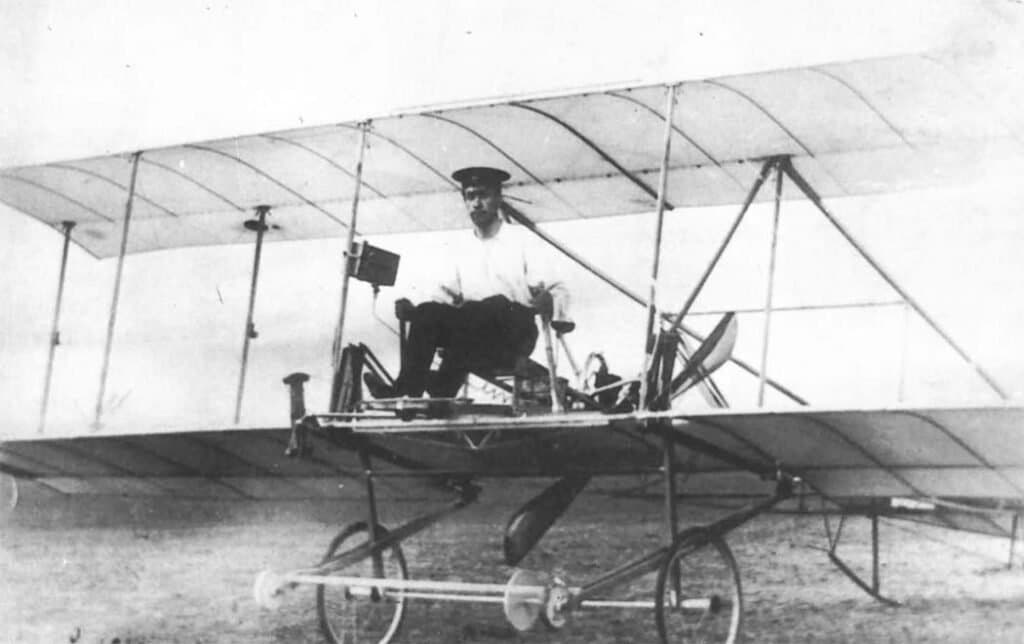
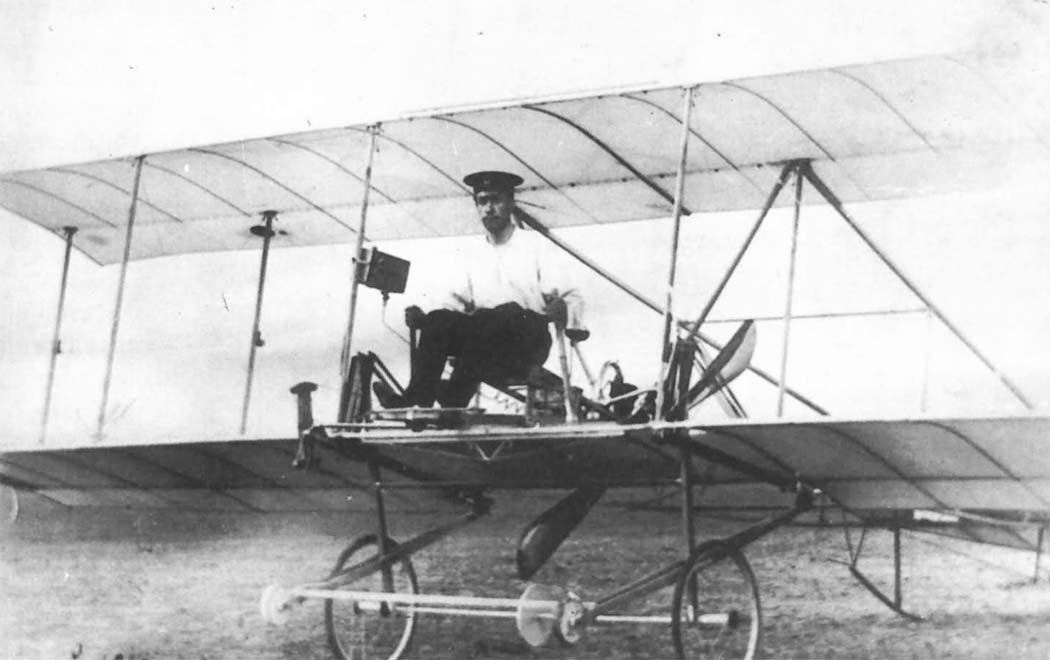
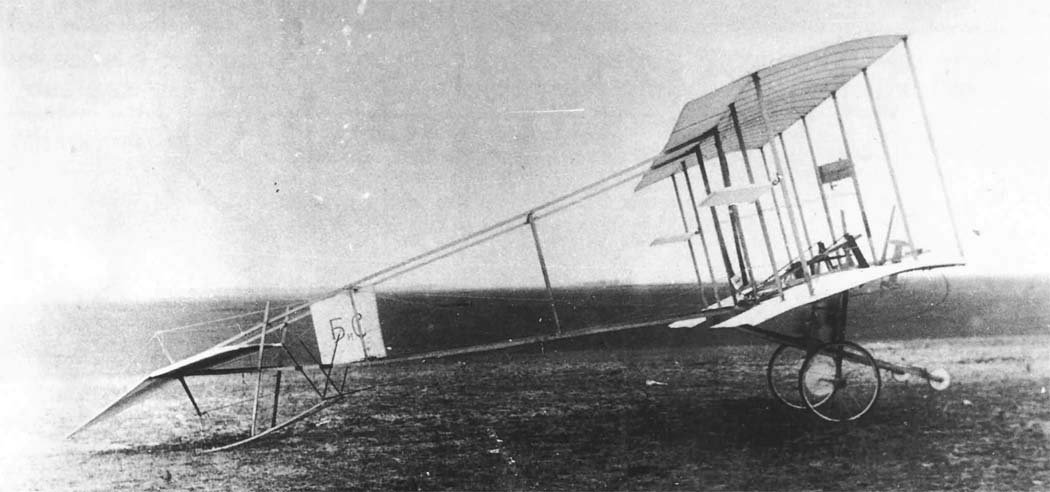
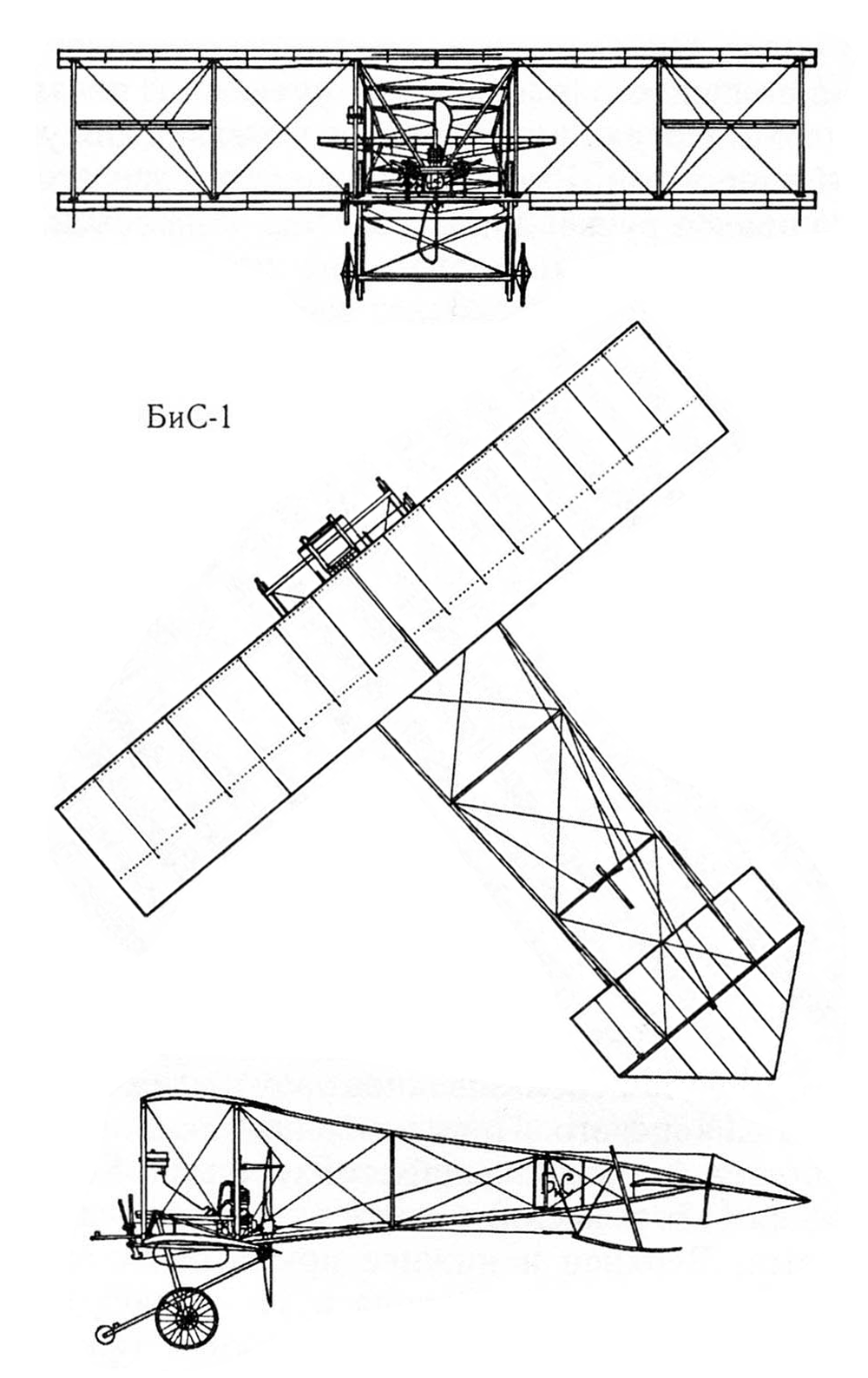
Finally, in April 1910, the work was completed. The BiS-1 aircraft was a two-bay biplane with an 8-meter wingspan and a truss tail. Its takeoff weight was 250 kg. A 15 hp Anzani engine with a pusher propeller was mounted at the rear on the lower wing, while the pilot’s seat was at the front, under the upper wing, with vertical bulkheads to prevent slipping.
The elevator was controlled by a stick to the pilot’s right, the ailerons by a stick to the pilot’s left, and the rudder by pedals, as was typical. The “Vozdukhoplavatel” magazine, in an article titled “Aeronautics in Kyiv,” reported that “Sikorsky and Bylinkin… teamed up and built 2 apparatuses: a biplane and a monoplane…” The article noted that the aircraft were “successful, stable, and strong” and that “experiments with the apparatuses are being conducted in the Kurenyovka floodplains.”
The day of testing arrived, a significant and exciting moment for the entire team. Only Sikorsky could be the pilot; he was unrivaled. Igor took the pilot’s seat and seriously commanded, “Clear propeller!” Panasyuk turned the propeller to prime the engine. “Contact!” The mechanic spun the propeller, and the pilot engaged the ignition. The engine sputtered to life.
While the engine warmed up, several people held the aircraft by its tail and wings. The slight vibration of the airplane transmitted the excitement to the pilot. Both were ready for takeoff. Igor looked back, checking the controls. Everything was in order. He then raised his hand. The helpers released the aircraft, and the BiS-1 slowly began its takeoff roll, awkwardly bouncing over irregularities.
Reaching a speed of 25-30 km/h, it suddenly started to turn. The pilot tried to counteract the turn, but the aircraft did not respond to rudder inputs. Igor reduced throttle. On the next takeoff roll, the same thing happened, but in the opposite direction. It became clear that the rudder was not effective enough.
Over the next few days, a rudder with a larger area was installed. However, the tendency to turn during taxiing remained. Eventually, the designer concluded that this time the pilot, rather than the airplane, was more to blame. The anti-capotage skids, reinforced on bicycle wheels, were catching on the irregularities of the airfield and deflecting the machine.
It was necessary to actively counter the deviation with the rudder from the very beginning. This was the first experience of controlling an aircraft! All answers had to be found independently, as there was no instructor. After several days of practice, the pilot could confidently maintain direction during the takeoff roll.
The next stage was lifting the tail, maintaining a horizontal attitude, and attempting takeoff. The test pilot gave full throttle, maintained the takeoff direction, and lifted the tail. The machine accelerated its run, reaching a speed of 55 km/h. The pilot smoothly pulled the control stick, but the aircraft did not lift off the ground and even slightly slowed down. In many attempts, Igor tried various angles of attack, but the aircraft would not leave the ground.
Three weeks passed. The pilot, if one could call the tester that, had mastered the apparatus well. One day in early May, he managed to lift half a meter off the ground, but this only happened thanks to a strong gust of wind. The lift was so brief that he couldn’t even test the controls. The engine power was clearly insufficient.
Technical Specifications
| Modification | BIS 1 |
| Wingspan, m | 8.00 |
| Aircraft length, m | 8.00 |
| Wing area, m2 | 24.00 |
| Empty weight | 180 |
| Maximum takeoff weight | 250 |
| Engine type | 1 Piston engine Anzani |
| Power, hp | 1 x 15 |
| Crew, crew members | 1 |
Image and diagram gallery of the BiS-1
 BIS-1 |
 BIS-1 |
 BIS-1 |
Equipo Editorial de ArchivoAéreo
Grupo de investigadores y entusiastas de la aviación dedicados a documentar y preservar la historia aeronáutica mundial. Todos los artículos son revisados para garantizar precisión histórica.
Fuentes y Rigurosidad
La información presentada en esta ficha técnica ha sido compilada a partir de manuales de vuelo desclasificados, archivos históricos y bibliografía especializada. Aunque nos esforzamos por mantener la máxima precisión, algunos datos de rendimiento pueden variar según la variante específica o las condiciones operativas.