BK.117
Development and Versatility
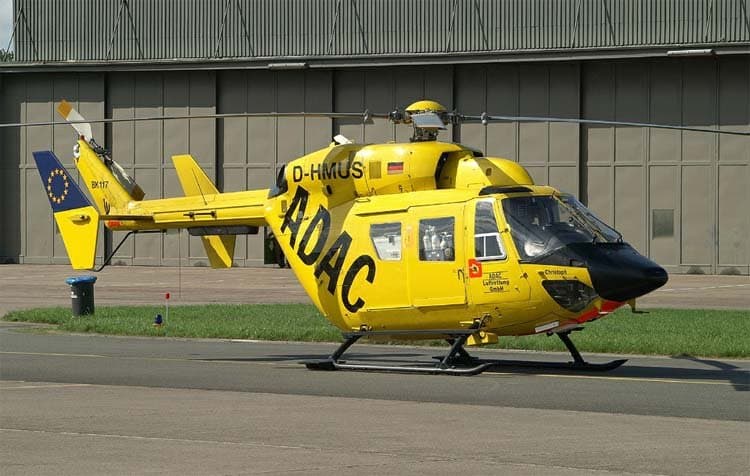
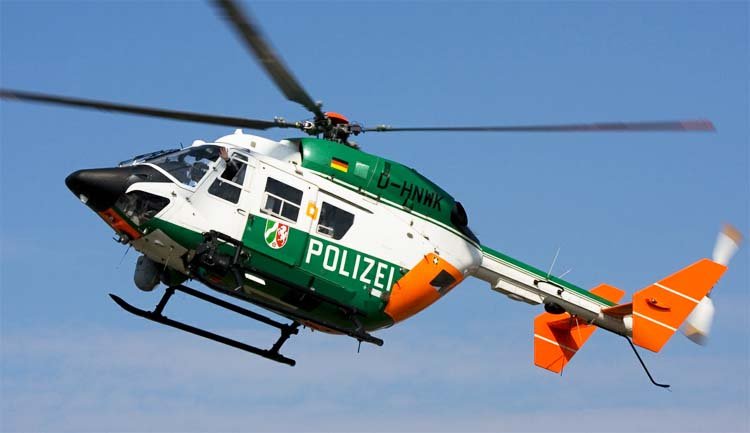
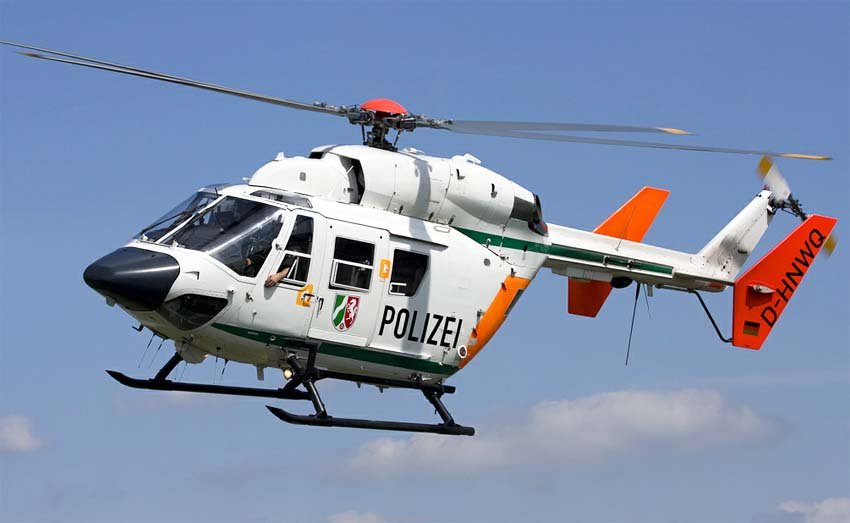
Like most multi-purpose helicopters, the BK.117 is designed for passenger and cargo transport, performing a wide range of tasks from evacuating the sick and wounded to participating in anti-terrorist operations. With installed armament and special equipment, the helicopter can be used for reconnaissance and surveillance, providing fire support for troops, and anti-tank combat.
The helicopter was developed in the second half of the 1970s by MBB (West Germany) and Kawasaki (Japan). Prototype helicopters were built in both West Germany and Japan. The first BK.117 produced in West Germany took to the air on July 13, 1979, and the first Japanese one on August 10, 1979. Series production has been carried out in both countries since 1981.
Advanced Design and Cabin Features
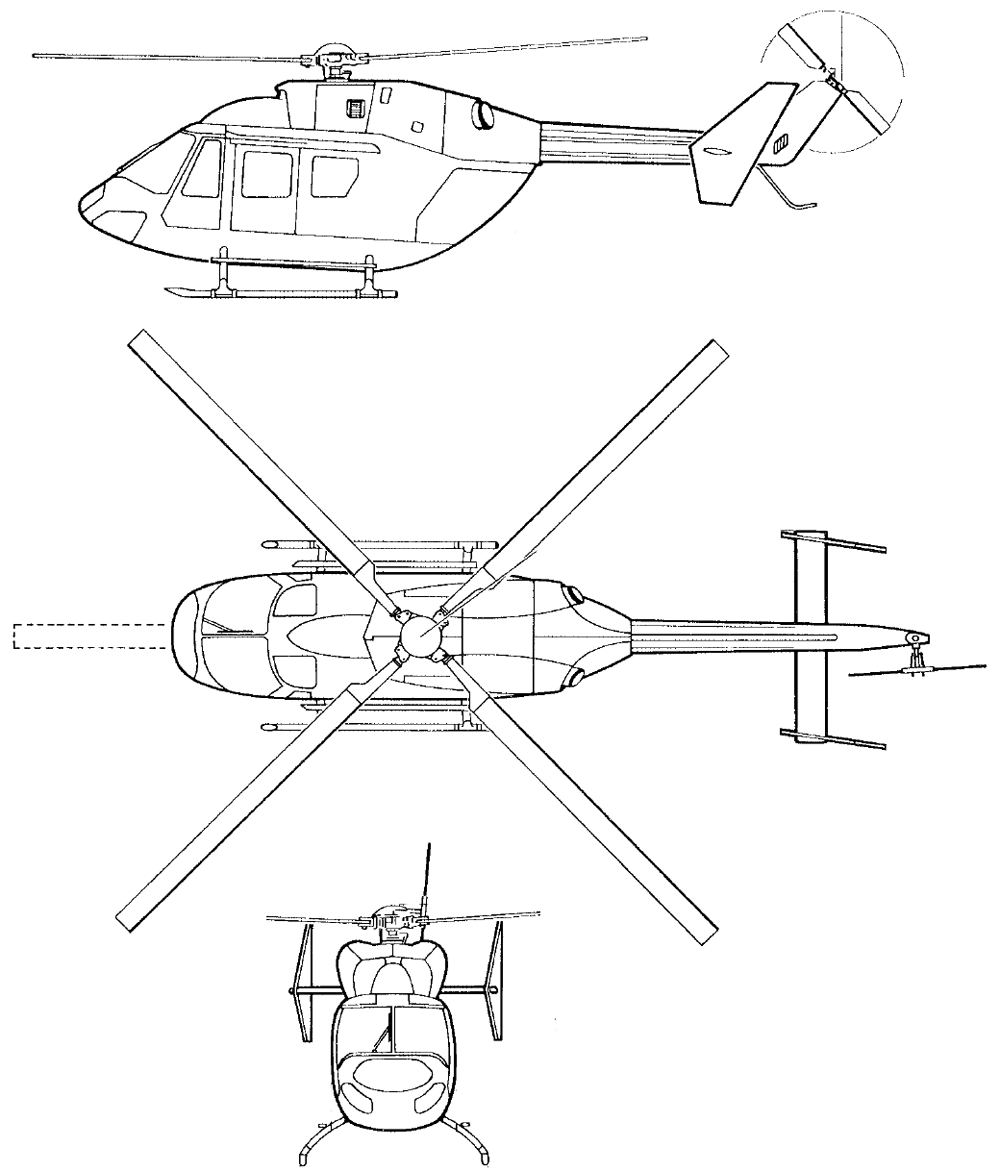
Structurally, the BK.117 is a further development of MBB’s well-known Bo-105 helicopter, extensively utilizing proven design solutions and progressive technologies. Like its predecessor, the BK.117 features a semi-monocoque fuselage with a large glazed area. The fuselage dimensions are significantly increased, allowing the passenger cabin (3.02×1.49×1.28m) to accommodate 5-9 passengers, or even up to 11 in a high-density configuration.
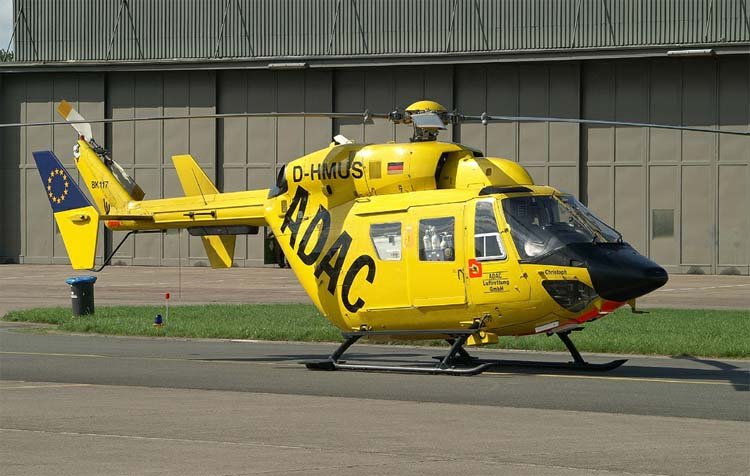
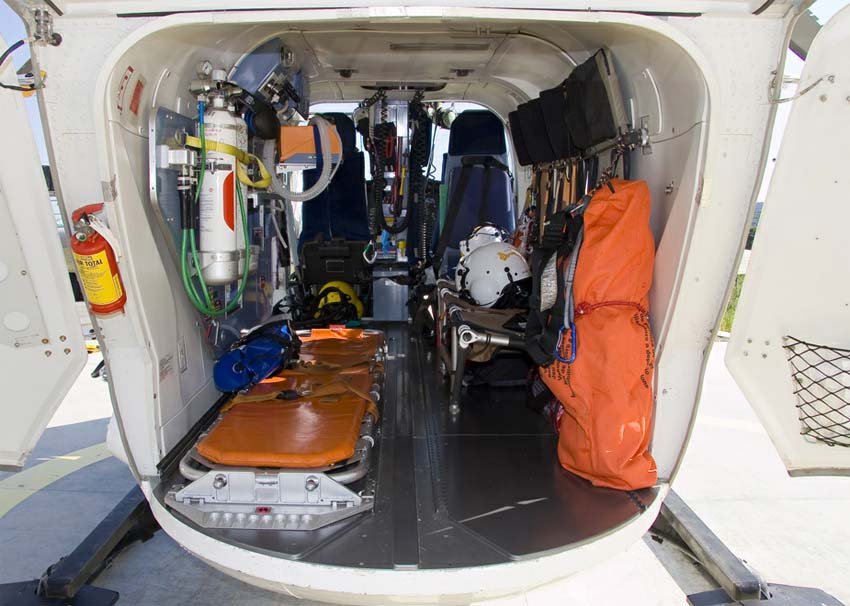
In its medical variant, the passenger cabin offers eight different configurations for special equipment, wounded individuals, and accompanying medical staff, enabling medical procedures and even surgeries during flight. Access is provided by two sliding doors on the fuselage sides and a double-leaf door, with two additional hinged doors for the two-seat cockpit.
For search and rescue operations, a swivel hoist with a 270kg lifting capacity can be installed in the left sliding door opening. This hoist allows two people (a casualty and a rescuer) in wet clothing to be lifted aboard. The hoist cable is 300m long, with a stepless lifting speed from 0 to 0.75m/s, and its swivel arm brings the casualty directly into the cabin.
The helicopter is equipped with simple skid landing gear, designed to withstand a direct impact during an emergency landing at a vertical speed of up to 15m/s, ensuring occupants sustain only minor injuries. For potential military applications, options include armored pilot seat backs, self-sealing rubber fuel tanks, and duplicated or shielded critical systems for enhanced reliability and combat survivability.
A tail boom with a horizontal stabilizer, equipped with swept end plates of a relatively large area, is attached to the fuselage. The dual-engine powerplant, mounted above the central fuselage, significantly enhances reliability and combat survivability, further boosted by independent fuel and lubrication systems for each engine and two main gearbox lubrication systems.
Powerplant and Rotor System Excellence
The powerplant accommodates two Lycoming LTS10-1750B-1 engines, each delivering 503kW takeoff power, or two Turbomeca “Arriel” 1E engines, each at 520kW. The “Arriel” system includes automatic rotor speed regulation, swiftly shifting the remaining engine to high-power mode upon single-engine failure. The main gearbox is positioned forward of the engines, ensuring effective cooling via air intakes and a common filter collector.
The fuel system consists of four flexible tanks totaling 608 liters, with an option for three additional tanks to reach a total of 1108 liters, all fed by two autonomous systems. The helicopter features a rigid, hingeless “Bolkow” main rotor system, utilizing a solid cruciform titanium head and four reinforced fiberglass blades, secured by titanium sleeves.
The main rotor blades have steel leading edge plating for erosion and damage protection, maintaining functionality even when penetrated by bullets and withstanding impacts. Tests show they can shear small tree trunks (up to 10cm diameter) without damage. The two-bladed tail rotor, also fiberglass, is mounted high on the swept fin, positioned safely above ground personnel.
Detailed Construction and Systems
The BK.117 features a single main rotor and tail rotor configuration. Its semi-monocoque fuselage is crafted from aluminum alloys, with non-structural components made from composites. A fireproof bulkhead separates the titanium engine compartment, and the forward cockpit offers two hinged side doors.
Passenger cabin layouts vary: administrative (five passengers), standard/offshore (seven passengers), and high-density (nine or eleven passengers). It can also accommodate two stretcher-bound patients with two attendants. Access is via jettisonable sliding cargo doors, while rear windows double as emergency exits. A 1.34m³ luggage compartment behind the cabin has outward-opening doors. The uniform floor in both cabins consists of removable panels for system access.
The semi-monocoque tail boom, with a detachable rear section terminating in a fin, includes a safety support. The main rotor features rigid blade attachment to a titanium alloy hub with axial hinges and steel torsion bars. Its rectangular fiberglass blades have a NACA 230-12/230-10 profile, stainless steel anti-erosion strips, and manual folding capability. Blade life is 1000 hours, with a tip speed of 220m/s.
The two-bladed, 1.96m diameter tail rotor, with a common horizontal hinge, is installed on the left side of the fin and rotates clockwise. Its twisted, rectangular fiberglass blades feature an improved MBB-S102E profile, achieving a tip speed of 218m/s. The tail boom also carries a horizontal stabilizer with end plates, spanning 2.7m.
Power comes from two turboshaft engines located above the cargo compartment, fed by filtered air from side intakes. The transmission comprises a two-stage main planetary gearbox, intermediate and angular gearboxes, and connecting shafts, with the main gearbox rated for 736kW power transfer.
The fuel system includes four flexible tanks (608 liters) under the cargo floor, augmented by three optional tanks (500 liters) for a total of 1108 liters, all supported by dual autonomous systems. The non-retractable skid landing gear, made of aluminum alloys, attaches to reinforced frames, using two curved transverse tubes as shock absorbers. Wheels are provided for ground maneuvering, and emergency inflatable floats can be installed.
The boosted control system features duplicated hydraulic boosters with a modular hydraulic design. The electrical system provides two DC generators (150A, 28V), a 24V/24Ah nickel-cadmium battery, and two autonomous AC converters.
Standard and Optional Avionics
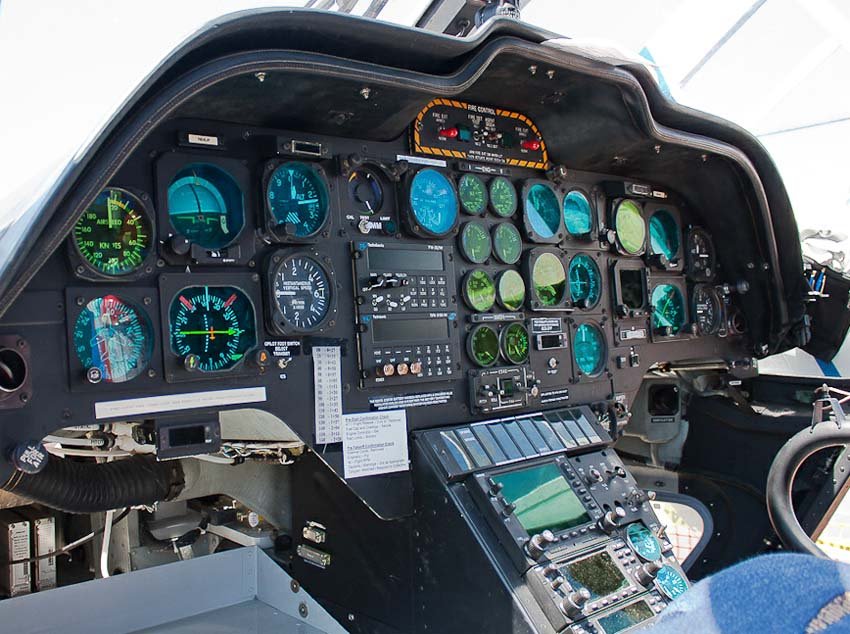
The basic helicopter variant supports single-pilot visual flight, featuring standard equipment like an airspeed indicator, encoder altimeter, 100mm artificial horizon, 96mm backup artificial horizon, gyromagnetic heading system, planned navigation indicator, and magnetic compass. Dual controls and visual flight instrument sets are available upon request.
Optional navigation and communication equipment includes VHF, UHF, and HF transceivers, automatic radio compass, long-range LORAN, Decca, and Omega low-frequency navigation systems, a light Doppler navigation system, attitude heading reference system, radar altimeter, transponder/IFF system, encoding altimeter, distance measuring system, and multi-mode radar.
Variants and Modifications
BK.117A-1: Basic civil helicopter with a maximum takeoff weight of 2850 kg; several helicopters built.
BK.117A-3: Development of the BK.117A-1, with an increased takeoff weight to 3250 kg and a large-diameter tail rotor with geometrically twisted blades.
BK.117A-3M: Military variant of the BK.117A-3, first shown as a mockup at the Paris Air Show in 1985 with armament of 8 “Hot” ATGMs and a stabilized SFIM sight.
BK.117A-4: Main production modification with increased engine power and improved flight characteristics.
BK.117B-1: Modification with increased takeoff weight to 3350 kg; produced since 1992 in Germany and Japan.
BK.117C-1: Modification produced in Germany since 1992, with new cockpit equipment, new tail rotor blades, more powerful Turbomeca Arriel 1E2 turboshaft engines, and improved high-altitude performance. 12 helicopters delivered.
BK.117C-2 (EC145): Improved variant of the BK117C-1. Made its first flight in June 1999. It featured avionics and tail rotor from the EC135, and an enlarged cabin.
NBK-117: Modification produced under license in Indonesia by IPTN.
BK.117/OHX: Experimental helicopter with fly-by-wire control system with a side-stick, onboard computer, and other systems intended for the OH-X reconnaissance helicopter being developed in Japan. Made its first flight on October 2, 1992.
BK.117M: Specialized military variant developed in Germany without Japanese participation. The BK117M appeared in 1985; besides armament, it features a digital fire control system and defensive electronic systems. The BK117M is mainly used in South Africa.
Technical Specifications
| Modification | BK-117A-3 |
| Main rotor diameter, m | 11.00 |
| Tail rotor diameter, m | 1.956 |
| Length, m | 9.91 |
| Height, m | 3.85 |
| Empty weight | 2560 |
| Maximum takeoff weight | 3200 |
| Internal fuel, kg | 460 |
| Engine type | 2 Textron Lycoming LTS101-750B-1 turboshaft engines |
| Takeoff power | 2 x 442 |
| Flight power | 2 x 410 |
| Maximum speed, km/h | 278 |
| Cruising speed, km/h | 248 |
| Practical range, km | 740 |
| Operational range, km | 570 |
| Rate of climb, m/min | 582 |
| Service ceiling, m | 3050 |
| Static ceiling, m | 2950 |
| Crew, crew members | 1-2 |
| Payload | 11 passengers |
| Armament (optional) | one 20-mm cannon on the side of the fuselage or one 12.7-mm Colt-Browning M2-3 machine gun with 750 rounds on a Lucas turret and/or one 12.7-mm Browning M2 machine gun in the cabin door. Combat load on 2 hardpoints: 8 HOT-2 or BGM-71 TOW anti-tank missiles, or 4 AIM-92 air-to-air missiles, or 2 unguided rocket launchers, or 2 pods with 12.7-mm or 7.62-mm machine guns. |
Image and diagram gallery of the BK.117
 BK.117 |
 BK.117 |
 BK.117 |
 BK.117 |
 BK.117 |
 BK.117 |
Equipo Editorial de ArchivoAéreo
Grupo de investigadores y entusiastas de la aviación dedicados a documentar y preservar la historia aeronáutica mundial. Todos los artículos son revisados para garantizar precisión histórica.
Fuentes y Rigurosidad
La información presentada en esta ficha técnica ha sido compilada a partir de manuales de vuelo desclasificados, archivos históricos y bibliografía especializada. Aunque nos esforzamos por mantener la máxima precisión, algunos datos de rendimiento pueden variar según la variante específica o las condiciones operativas.