Brazo Missile
Initial Development and Concept
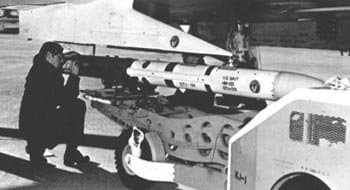
In 1972, Hughes, in collaboration with the U.S. Navy (USN), launched the Brazo program. The primary goal of this initiative was to develop a concept for an air-to-air anti-radiation missile for aircraft. For this purpose, the AIM-7 Sparrow missile was used as the base, integrated with a new broadband passive radar seeker developed at the Navy Electronics Center.
This missile was intended to home in on the powerful emissions from the onboard radars of enemy interceptors, such as the MiG-25.
Collaboration and Early Successes
In 1973, the U.S. Air Force (USAF) merged its PAVE ARM program with Brazo, strengthening the initiative. In April 1974, the Brazo missile successfully intercepted a BQM-34A Firebee target, demonstrating its potential. This initial success marked a significant milestone for the project.
Subsequently, in October 1974 and January 1975, four additional test launches were conducted. These launches were performed at maximum range and into the target’s forward hemisphere, and all proved successful.
Discontinuation and Limitations
Despite the positive results achieved in the Brazo/PAVE ARM program, it did not proceed to further development. The main reason for its discontinuation was the narrow scope of application for a missile with a passive anti-radiation seeker. If enemy aircraft operated without constantly keeping their onboard radar engaged, the Brazo missile would become useless.
Equipo Editorial de ArchivoAéreo
Grupo de investigadores y entusiastas de la aviación dedicados a documentar y preservar la historia aeronáutica mundial. Todos los artículos son revisados para garantizar precisión histórica.
Fuentes y Rigurosidad
La información presentada en esta ficha técnica ha sido compilada a partir de manuales de vuelo desclasificados, archivos históricos y bibliografía especializada. Aunque nos esforzamos por mantener la máxima precisión, algunos datos de rendimiento pueden variar según la variante específica o las condiciones operativas.