BRO-17 "Utocka"
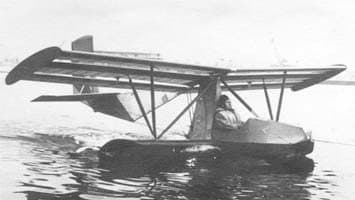
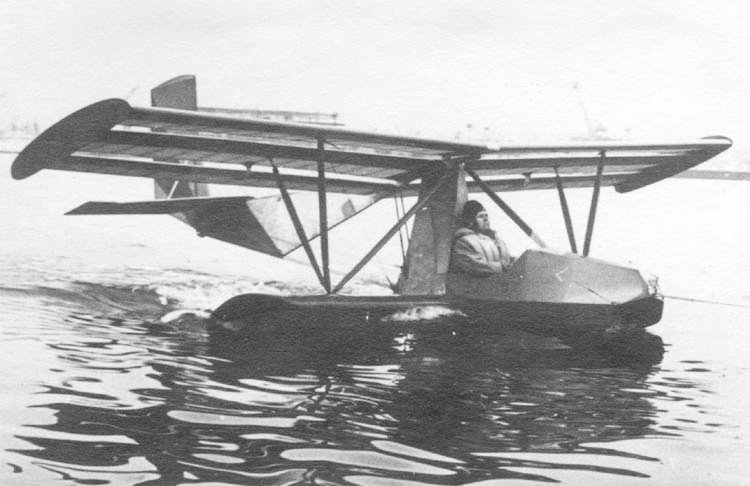
On a quiet summer evening, a curious flying apparatus appeared over the waters of Klaipėda port: its wings resembled a lattice, and the pilot was seated in a tiny cockpit reminiscent of a motorcycle sidecar. This was the new BRO-17 “Utocka” (Duckling) hydro-glider, designed by B. Yu. Oshkinis—the latest variant of the BRO-16.
According to B. Oshkinis, the “Utocka” externally strongly resembles the BRO-16, but it features many innovations. First and foremost is its slotted wing, applied for the first time in domestic glider construction. Its lift is significantly greater than that of a solid wing, which allowed for a reduced span, saved weight, and made the entire glider somewhat more miniature.
The optimal speed of the “Utocka” also decreased due to the slotted wing. Thus, while the BRO-16 hydro-glider could only be towed by a powerful cutter with a stationary engine, towing the “Utocka” merely required a motorboat with a “Vikhr” outboard motor. This, undoubtedly, would contribute to a more intensive development of hydro-gliding.
Innovative and Accessible Design
The “Utocka” was sufficiently technological and simple in design. The construction of such hydro-gliders could be organized not only at specialized enterprises but also at young technicians’ stations and school workshops. As life showed, aircraft modelers particularly easily and quickly mastered this work, as our glider is, in essence, a large flying model!
I hope, B. Oshkinis concluded, that the “Utocka” will be beloved by Soviet glider pilots and will open up new opportunities and horizons for them: the assimilation of a large number of water bodies—abundant not only in Lithuania but also in other republics of our country—as airfields.
Technical Specifications
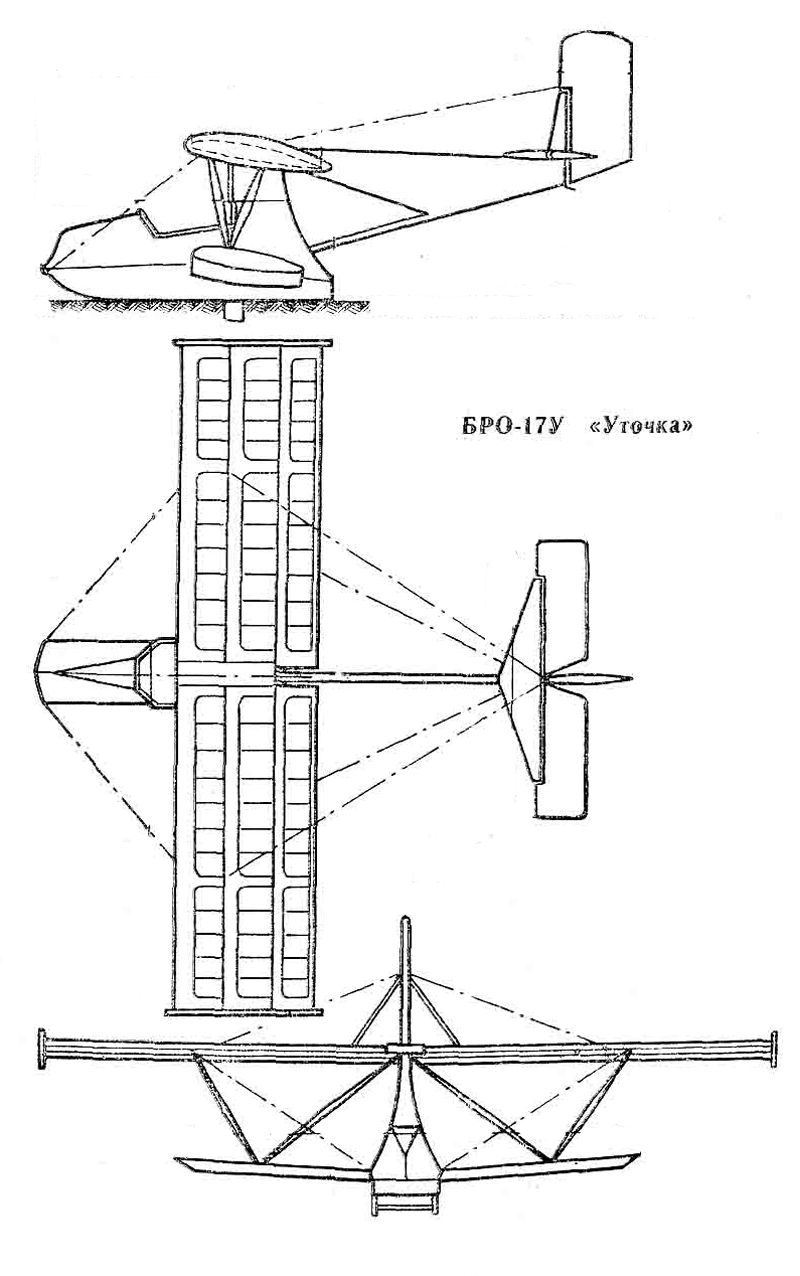
The slotted wing is structurally designed as three sections with a 300 mm chord (Clark V profile), assembled using a single-spar scheme, with the entire front part from the spar to the leading edge filled with lightweight foam. Each section is externally covered with a single layer of thin fiberglass cloth on epoxy resin, making it waterproof.
The sections are connected by continuous reinforced ribs and an end washer. A metal shoe of the upper strut assembly, connecting the wing to the boom, is attached to the middle reinforced rib. The pilot’s cockpit is a light boat with a wooden frame and 2 mm thick plywood skin, covered with a layer of fiberglass cloth on epoxy resin.
To accelerate takeoff, a small stainless steel hydrofoil, 600 mm span and 120 mm chord, is installed on the bottom of the boat. The surface of the hydrofoil, both top and bottom, should be polished to a mirror finish, as should the struts connecting the hydrofoil to the boat.
Towing Safety
For towing, the “Utocka” has a standard ski-type release mechanism in the nose, opened by a handle from the pilot’s seat. If an excessive altitude is gained above the towing boat, this lock automatically activates and detaches the glider. Towing is performed with a non-sinking polypropylene rope approximately 10 mm thick, capable of withstanding at least 1500 kg of breaking strength.
The rope should have welded (or turned from steel 20) rings at its ends; one hooks onto the glider’s towing release hook, the other onto the towing release on the boat. This scheme fully corresponds to that used by glider sports enthusiasts for aircraft towing: in case of an accident or threatening situation, the boat driver also has the option to release the glider.
The first towing flights must be carried out strictly against the wind, observing the requirements of the “Flight Operations Manual” and the following safety rules: the glider pilot must wear a life jacket fastened with all buckles; a second person—a hook-up operator—must be present on the towing boat, continuously observing the pilot and actively assisting the driver; during water towing, an auxiliary motorboat with a nurse or first aid kit, as well as a set of rescue equipment (rings, vests), is required on duty.
Technical Specifications
| Modification | БРО-1 7 |
| Wingspan, m | 7.00 |
| Length, m | 5.80 |
| Height, m | 2.60 |
| Wing area, m2 | 10.50 |
| Empty weight | 85 |
| Normal flight weight | 160 |
| Cruising speed, km/h | 40 |
| Minimum rate of descent, m/s | 1.2 |
| Landing speed, km/h | 35 |
| Crew | 1 |
Image and diagram gallery of the BRO-17 "Utocka"
 BRO-1 |
 BRO-1 |
Equipo Editorial de ArchivoAéreo
Grupo de investigadores y entusiastas de la aviación dedicados a documentar y preservar la historia aeronáutica mundial. Todos los artículos son revisados para garantizar precisión histórica.
Fuentes y Rigurosidad
La información presentada en esta ficha técnica ha sido compilada a partir de manuales de vuelo desclasificados, archivos históricos y bibliografía especializada. Aunque nos esforzamos por mantener la máxima precisión, algunos datos de rendimiento pueden variar según la variante específica o las condiciones operativas.