Bücker Bü 134
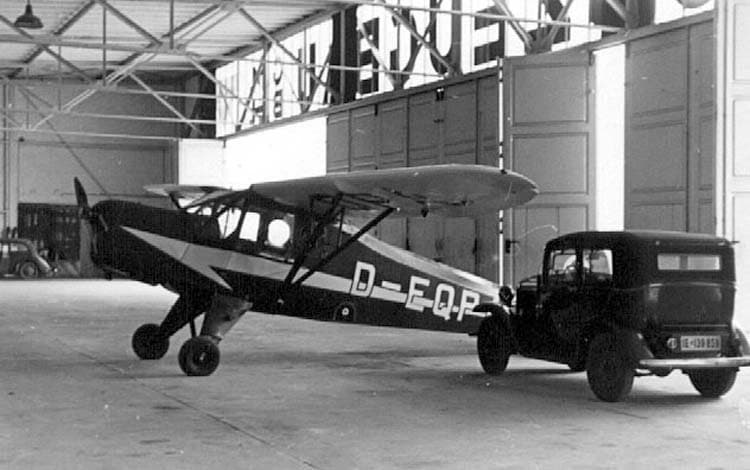
For unwanted projects, there’s a tried and true method: just as animals are driven from the herd, people who stand out sharply from the collective are sent as far away as possible. The same applies to aircraft: they are typically destroyed as quickly and thoroughly as possible, and all related documentation is eradicated.
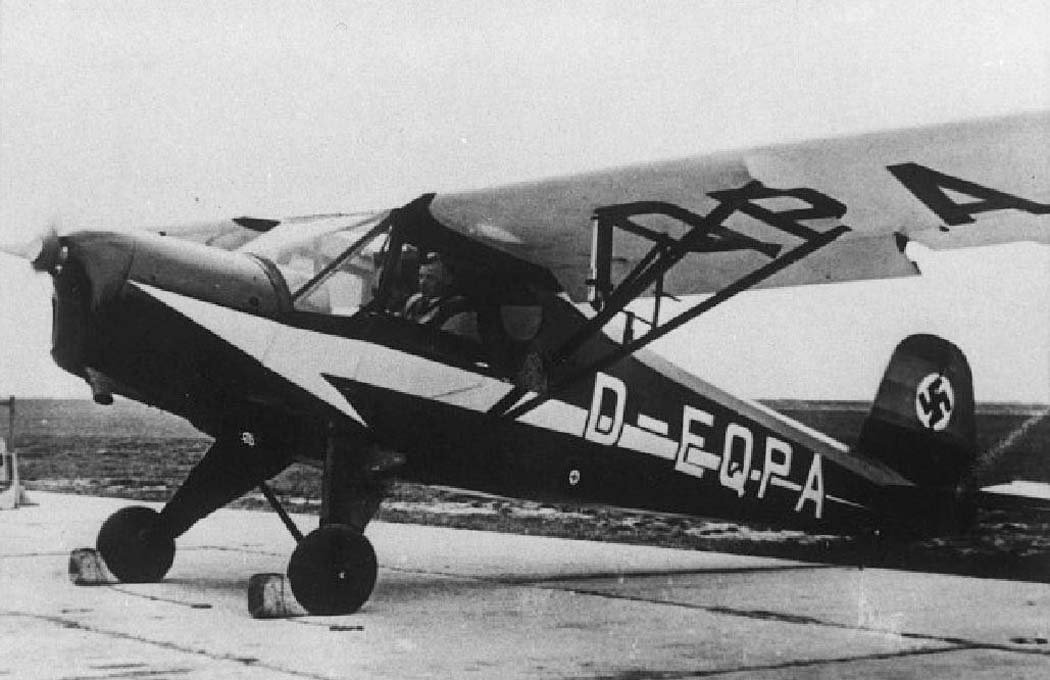
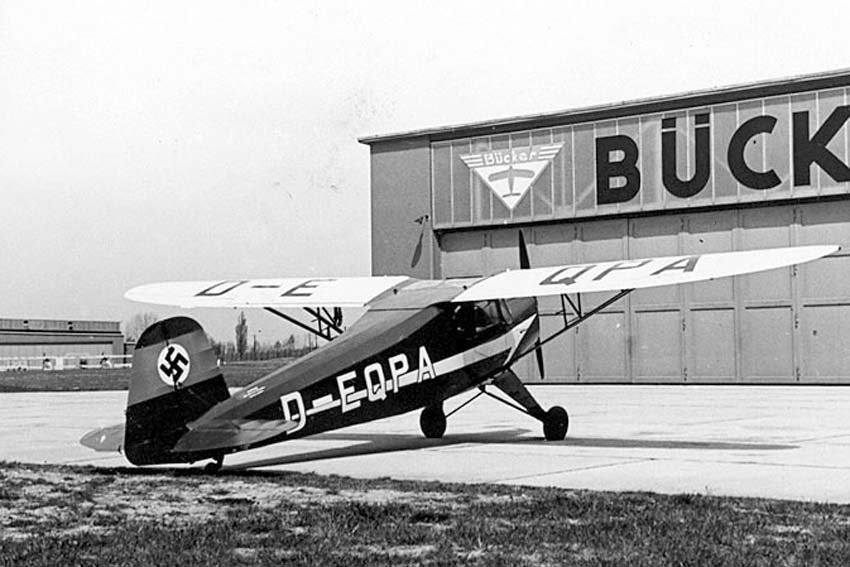
Sometimes, such events unfold very rapidly. For instance, in 1927, after the tragic crash of his ill-fated Rofix fighter, which claimed the life of pilot Paul Bäumer, Adolf Rohrbach swiftly gathered and destroyed all design documentation for the aircraft. A similar situation occurred at the Bücker company concerning the Bü 134 (civil registration D-EQPA), an aircraft about which very little is known today.
The Mystery of the Bü 134
The matter was so obscure that a well-informed East German aviation magazine, in its May 1970 issue, confidently declared that an aircraft designated Bü 134 had never existed! However, this magazine made a mistake. A closer examination of everything related to this aircraft reveals that some information, complete with photographs, was published in an American magazine as early as 1963. Further details, albeit without flight characteristics, were also published in West Germany in 1968 and 1970.
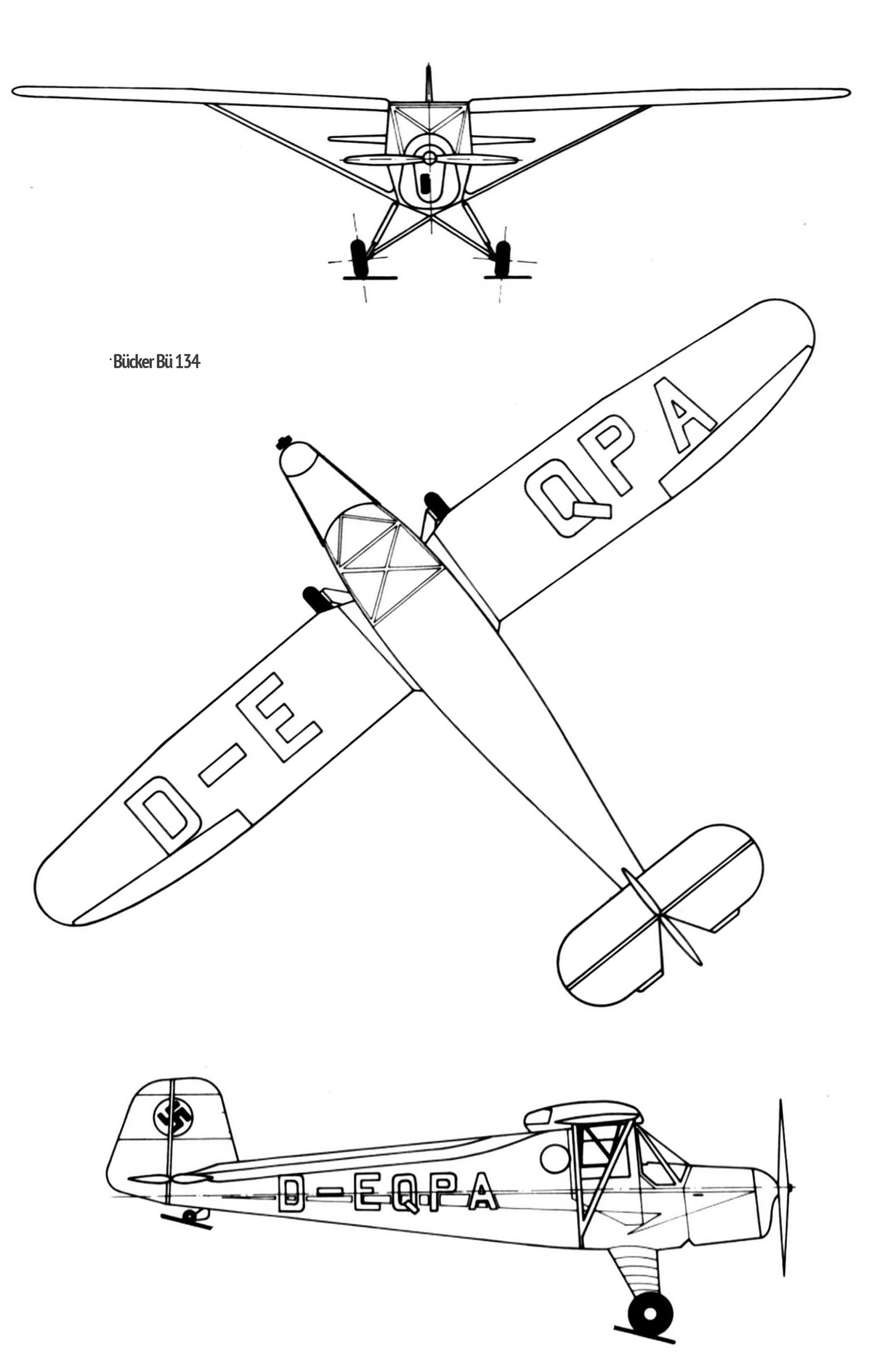
Recently, additional previously unknown information, excluding photographs, has been obtained from various personal archives and is now being published for the first time. The accompanying drawings are original, made during the aircraft’s development, and show no modifications, such as civil registration numbers.
Design and Disappointment
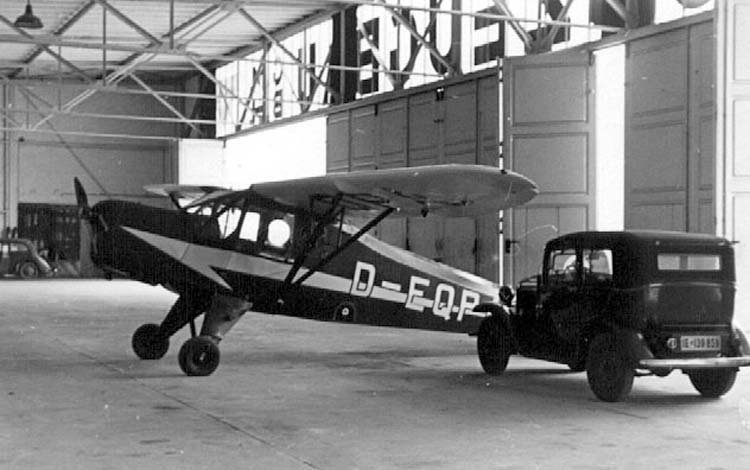
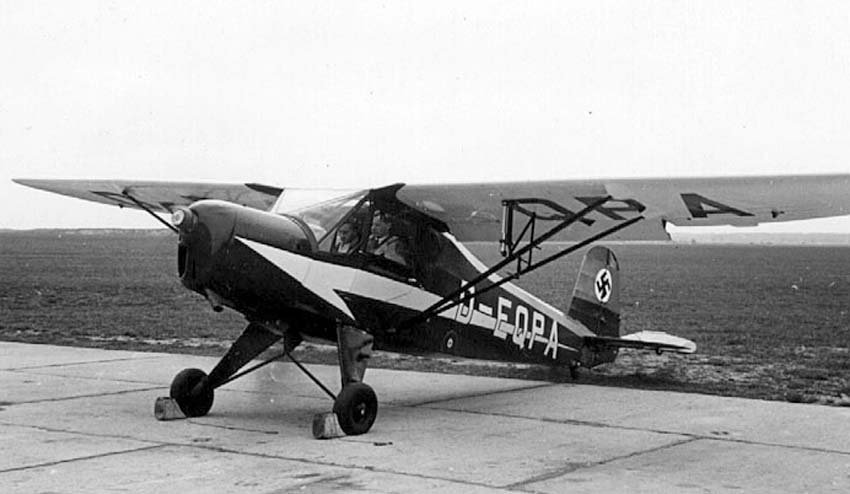
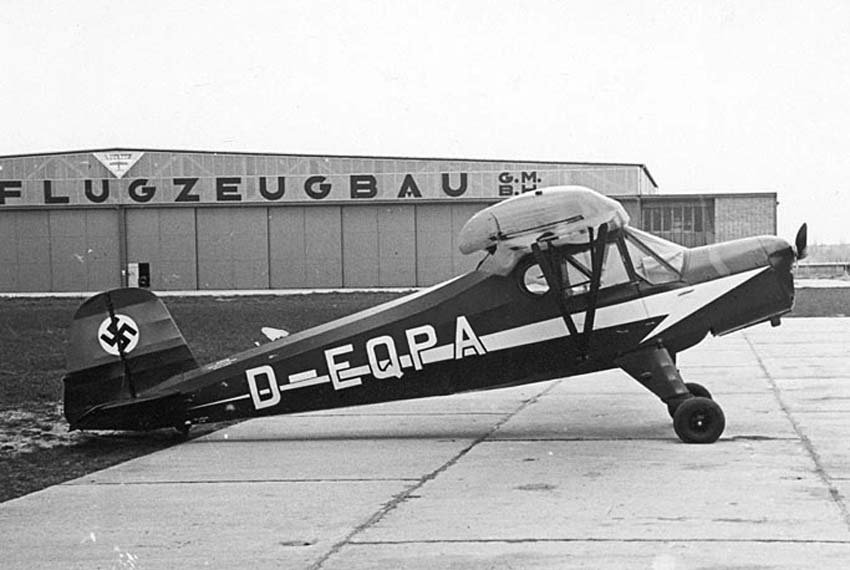
The elegant-looking Bü 134 D-EQPA, which made its first flight on May 21, 1939, was created using methods proven over time with biplanes. Surely none of the Bü 134 developers expected the aircraft to be unsuccessful. However, despite belonging to the same class of aircraft as the American Taylor Cub and Monocoupe, the Bü 134 failed to meet expectations regarding its flight characteristics and visibility. Even a series of modifications did not resolve its shortcomings, and work on the project was ultimately discontinued.
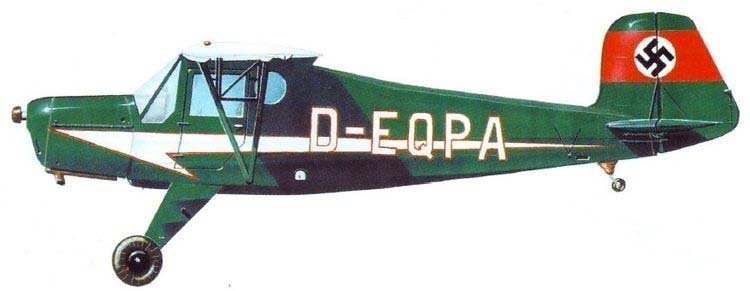
Among the three drawings of the Bü 134, notable differences can be observed, such as variations in wheel size. A rectangular box is indicated in the longitudinal section behind the pilot’s cockpit, possibly related to planned modifications that were likely never implemented. The drawings also include explanations for the inadequate visibility. Both occupants in the rear part of the cockpit were positioned close to the rear wall, behind the center of gravity, severely restricting their view. There is no precise data on the aircraft’s paint scheme, though it was most likely intended to be painted in green and white.
Technical Specifications
The Bücker Bü 134 was a strut-braced high-wing monoplane, designed for civil aviation, as well as for sports and touring purposes. Its cabin featured two side-by-side seats for the pilot and a passenger. The aircraft was powered by a four-cylinder, 100/105 hp air-cooled Hirth HM 504 engine.
The fuselage frame was constructed from welded chromoly steel tubes, with the exterior covered in fabric. The removable engine mount, to which the engine was attached, was also made of chromoly steel tubes.
The main landing gear struts were independent, featuring steel coil springs and oil shock absorbers. These main wheels were equipped with a braking system and measured 420×150 mm. The tail wheel strut was also sprung with a steel coil spring and an oil shock absorber. If required, the tail wheel could be linked to the rudder, allowing it to be deflected along the axis or rotated 360°.
Both the vertical and horizontal empennage were cantilevered. The rudder was designed as a single, integral section, while the elevators were made as two separate sections with adjustable trim tabs.
The aircraft’s high-wing configuration featured a two-spar wing with wooden struts. The center section of the wing was glazed, and the outer wing panels were foldable. The powerplant consisted of a four-cylinder, 100/105 hp air-cooled Hirth HM 504 engine, driving a two-bladed fixed-pitch propeller approximately 2 meters in diameter.
The exact paint color is unknown, but it is presumed the aircraft was intended to be painted in white and green.
Technical Specifications
| Modification | Bu.134 |
| Wingspan, m | 9.95 |
| Length, m | 7.40 |
| Height, m | 2.24 |
| Wing area, m2 | 12.40 |
| Normal takeoff weight, kg | 665 |
| Engine type | 1 Piston engine Hirth HM 504A |
| Power, hp | 1 x 100 |
| Maximum speed, km/h | 180 |
| Cruising speed, km/h | 155 |
| Practical range, km | 600 |
| Practical ceiling, m | 4000 |
| Crew | 1 crew member |
| Payload | up to 3 passengers |
Image and diagram gallery of the Bücker Bü 134
 Bu.134 |
 Bu.134 |
 Bu.134 |
 Bu.134 |
 Bu.134 |
 Bu.134 |
 Bu.134 |
Equipo Editorial de ArchivoAéreo
Grupo de investigadores y entusiastas de la aviación dedicados a documentar y preservar la historia aeronáutica mundial. Todos los artículos son revisados para garantizar precisión histórica.
Fuentes y Rigurosidad
La información presentada en esta ficha técnica ha sido compilada a partir de manuales de vuelo desclasificados, archivos históricos y bibliografía especializada. Aunque nos esforzamos por mantener la máxima precisión, algunos datos de rendimiento pueden variar según la variante específica o las condiciones operativas.