C-130J Super Hercules
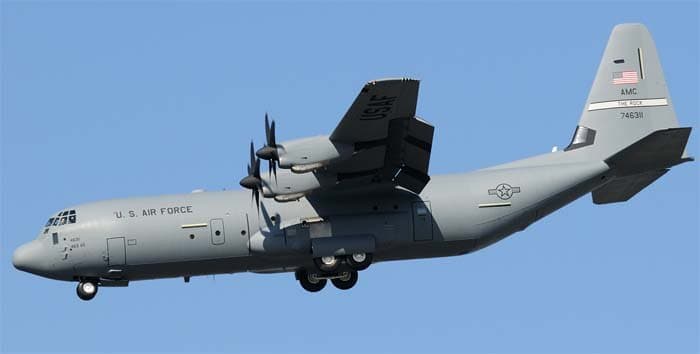
The US Air Force leadership, acting on recommendations from a group of experts from the Air Mobility Command, decided to implement the AMP program. This initiative aims to modernize the onboard equipment of medium transport aircraft C-130, which will then receive the additional designation “X”. Experts also proposed improvements to power plants and the acquisition of 150 new C-130J-30 Super Hercules aircraft.
Research for the “Hercules II” program, a deep modernization of the “Hercules” family, began as a Lockheed initiative in 1991. The plan was to create a military transport variant, the C-130J, and a version for civil aviation companies, the L-100J. The aircraft was designed with both a standard fuselage length (29.79 m) and an extended fuselage, similar to the C-130H-30 (34.37 m). The “Hercules II” features enhanced avionics, allowing the crew size to be reduced to two.
Compared to its predecessor, the C-130E, the new aircraft was projected to have a 40% increased practical range, 40% greater cruising altitude, 50% less time to reach cruising altitude, 22% shorter required runway length, and 21% increased cruising speed. Ground maintenance for an 18-aircraft squadron would require 406 personnel, a 38% reduction from the 661 required for previous “Hercules” modifications. The C-130J was fitted with new Allison GMA 2100 engines, limited to 4590 hp, featuring a full authority digital control system, six-bladed all-composite propellers, and new instrumentation with two HUDs and flat-panel color multifunction displays.
Development and Initial Orders
The US Air Force ordered two C-130J aircraft for flight testing and performance evaluation. In December 1994, the UK government signed the first contract for 25 C-130J-30 aircraft, with deliveries scheduled to begin in late 1996. The construction of the first five production aircraft commenced in 1995. On October 18, 1995, the first C-130J-30 for the RAF was rolled out, followed on October 20 by a standard-fuselage C-130J for the US Air Force. The maiden flight of the C-130J took place on April 5, 1996.
In 1997, funds were expected for an additional batch of five aircraft for the British Air Force, potentially bringing their “Hercules II” fleet to 30 aircraft. However, due to cuts in the country’s military budget, only 25 aircraft were ultimately purchased. Saudi Arabia reserved an order for 70 “Hercules II” aircraft, and Australia acquired 12 C-130J-30s, retaining an option for further purchases. Lockheed Martin also offered New Zealand’s Ministry of Defense to join this program for a discounted “package” acquisition, but new aircraft procurement for the Royal New Zealand Air Force remains problematic due to budget cuts.
Lockheed Martin specialists believe that new C-130J aircraft would quickly pay for themselves, consuming 23% less fuel than predecessors, operating with a reduced crew, and requiring half the ground maintenance. Total deliveries between 1996 and 2006 could range from 400-700 “Hercules II” aircraft. The cost of a C-130J was estimated at $40 million (1995 figures), roughly comparable to the most common C-130H modification ($30-40 million).
Advanced Technology and Features
The first Lockheed Martin C-130J military transport aircraft ordered by the UK Air Force was delivered in October 1998, with a 16-month delay. This delay was attributed to numerous technical difficulties found during testing, including issues with propeller blade airflow, oil overheating in the breather systems, and cracks in exhaust pipes. A subsequent accident, linked to a gearbox failure, was declared by Lockheed Martin to be a manufacturing defect, not a design flaw. The customer also deemed unnecessary the automatic stall warning system that would automatically put the aircraft into a 3-degree dive near the critical stall speed.
Another significant reason for delivery delays was the lack of crew training equipment; pilot retraining only began in October 1998. In the initial months of operation, the RAF faced a severe shortage of trained personnel, and it took time to achieve the desired 2:1 crew-to-aircraft ratio. The first British C-130J was assigned to the UK Ministry of Defence’s Aircraft Research Agency at Boscombe Down, where it was finally tested after all deficiencies were resolved and officially accepted by RAF representatives, after which the aircraft entered service with the 24th Military Transport Squadron, based at RAF Lyneham.
In the competitive transport aircraft market, Lockheed Martin successfully carved out a profitable niche. The company secured the necessary funds and rapidly developed a deep modernization program for its transports amidst the end of the Cold War and sharp reductions in NATO and other countries’ military budgets. The C-130, in essence, was not just offered for modernization but resumed production in a new capacity from 1997 after many years of hiatus, showcasing the wide capabilities initially inherent in its design.
Key differences of the C-130J from its predecessors include the replacement of engines with more powerful Allison AE21100-3 units featuring six-bladed propellers, and the installation of state-of-the-art avionics. The C-130J’s cruising speed increased by 21%, and its range with a full load reached 4087 km, while takeoff distance decreased by a third. The C-130J’s price is relatively modest, ranging from $50-70 million depending on configuration, contrasting sharply with other transports like the C-17 Globemaster, which costs over $300 million and is primarily accessible to US customers.
Global Reach and Future Outlook
However, the “Hercules” maintains absolute superiority as the C-130J is already flying and certified, while European NATO countries are still deciding between a Western-standardized An-70 and the new “Hercules.” As expected, major customers for the C-130J today are the financially robust US Air Force and Marine Corps, which need to replace at least four hundred older C-130 variants in the next two decades. Other early purchasers of the Super Hercules are expected to be Italy, Spain, and the UK, while India shows considerable interest. Egypt and Saudi Arabia are interested specifically in the KC-130J tanker variant.
The UK leads in replacing old C-130 modifications with new C-130Js among foreign countries, intending to purchase 25 aircraft. Lockheed Martin is also buying decommissioned British C-130Ks to refurbish and profitably sell them to Slovenia, Poland, the Baltic states, North Africa, UAE, and Oman. American specialists estimate that C-130Ks, after 25-30 years of service, can remain operational for another 10 years, suggesting that a new C-130J could serve until 2050, extending the “Hercules” family’s service life to an unprecedented century mark.
A group named “Tiger Team” was formed to address operational issues of medium C-130 transport aircraft, including reliability and maintainability, and to develop proposals for expanding onboard equipment capabilities with centralized GATM system control. Currently, the US Air Force’s regular units, National Guard, and Reserve Command operate 44 different C-130 modifications, primarily differing in avionics. The experts’ main proposals aim to reduce these variants to two: C-130X and C-130J.
The USAF decided to allocate funds from 2000-2013 to convert 360 C-130E and 150 special-purpose C-130 aircraft to the C-130X modification, an effort planned until 2016. Economically, the situation is acute: despite strong pressure from Lockheed Martin, facing reduced production due to insufficient orders, the US Air Force does not intend to acquire additional C-130Js until 2003. The AMP program includes equipping the C-130 with a new flight control system with two computers, improved inertial navigation systems, and NAVSTAR receivers. It also calls for instrument panels with multifunction displays, dual helmet-mounted display systems, new autopilots, and ground/aircraft collision avoidance equipment.
The aircraft boasts modern onboard electronic equipment, featuring four large-format color liquid crystal displays and a head-up display system. These displays provide comprehensive flight information, weather radar data from the Northrop Grumman MODAR 4000, and data from the integrated TACAN AN/ARN-153(V) communication, navigation, and identification system, as well as the NAVSTAR satellite navigation receiver, ACAWS, and various electronic countermeasures. US specialists are still formulating requirements for the C-130X’s communication equipment, though VHF, HF, and satellite communication capabilities are anticipated.
The C-130J’s defensive EW complex includes an AN/ALR-69 electronic intelligence system and an AN/AAR-47 radar warning receiver for missile attack alerts. It also integrates an AN/ALQ-157 infrared jamming system and AN/ALE-40 or AN/ALE-47 IR and radar decoy dispensers. Westinghouse additionally proposed the MESA (Multi-role Electronically Scanned Array) system for the C-130J—a multi-purpose AEW&C radar complex with an electronically scanned antenna array, housed in two 7.6m wing-mounted pods designed for 360-degree coverage.
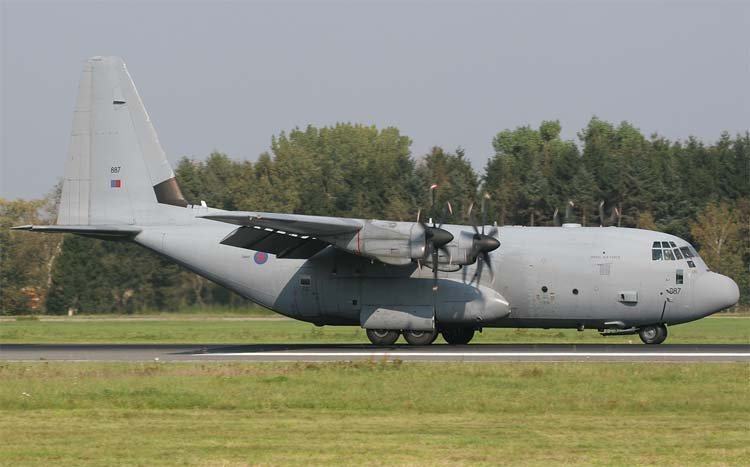
The airframe design of the C-130J and C-130J-30 is generally similar to the C-130H and C-130H-30, featuring a two-spar all-metal wing built with large panels up to 14.63m long. Unlike earlier “Hercules” models, the “Hercules II” is equipped with improved main landing gear bogies for easier wheel replacement, and a new nose landing gear. The power plant consists of four Allison AE 210D3 turboprops (4x 6000 hp) with six-bladed Dowty R391 composite propellers, controlled by a digital system, offering 30% more takeoff thrust than the C-130H.
The new propeller has 90% fewer parts and is 15% lighter than the previous four-bladed Hamilton Standard 54H60, and the C-130J employs a completely new fuel system. Aircraft for the UK and Australian Air Forces are equipped with an air-to-air refueling receptacle located above the cockpit on the left side of the fuselage. The crew and cargo compartments are pressurized, with an air conditioning system similar to the C-130H’s but with 30% increased power for avionics cooling.
The aircraft is equipped with a DS/FD digital autopilot and a conventional hydraulic control system (two hydraulic systems on board). Its aeronautical equipment includes a TACAN AN/ARN-153(V) receiver, a redundant Honeywell laser gyroscope INS interlocked with a satellite navigation receiver, and a low-power navigation radar LPCR130-1B with a color indicator. A microwave landing system receiver and an HG-9550 radio altimeter are also present.
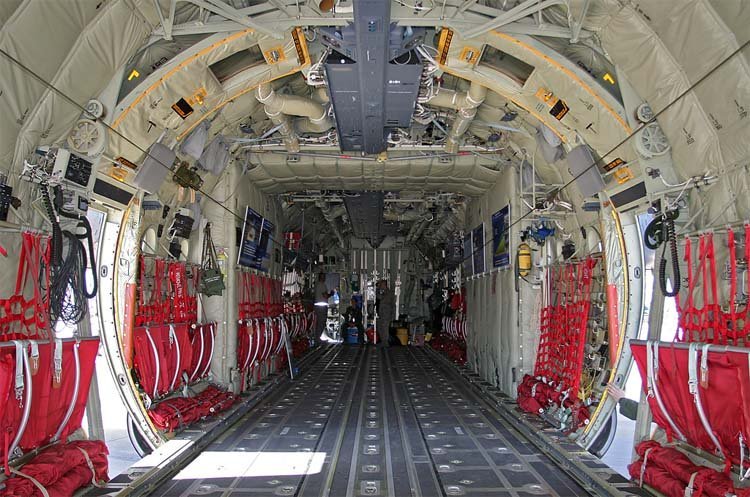
The C-130J’s cargo compartment can accommodate 92 fully equipped infantrymen or 64 paratroopers, while the C-130J-30 carries 128 infantrymen or 92 paratroopers, respectively. It can parachute drop the light “Sheridan” tank (19051 kg with platform) and other armaments through its tail cargo ramp. Paratroopers exit via two side doors, and localized armor can be installed in the cockpit to protect pilots from small arms fire.
Technical Specifications
| Modification | C-130J |
| Wingspan, m | 40.38 |
| Aircraft length, m | 34.37 |
| Aircraft height, m | 11.81 |
| Wing area, m2 | 162.20 |
| Empty weight | 34274 |
| Normal takeoff weight | 70304 |
| Maximum takeoff weight | 74390 |
| Fuel capacity, kg | 20520 |
| Engine type | 4 Turboprop Allison AE2100D3 |
| Power, shp | 4 x 4591 |
| Maximum speed, km/h | 671 |
| Cruising speed, km/h | 643 |
| Practical range, km | 5220 |
| Range with maximum payload, km | 3890 |
| Service ceiling, m | 9300 |
| Crew, crew members | 3-6 |
| Payload (C-130J-30) | 92 soldiers or 64 paratroopers or 74 stretchers or 16 standard containers or 21770 kg of cargo (maximum) |
Image and diagram gallery of the C-130J Super Hercules
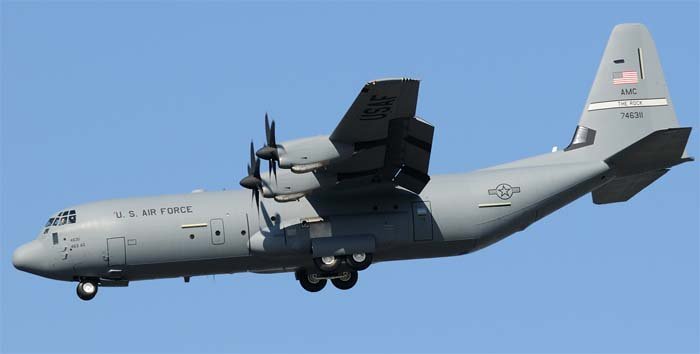 C-130J Super Hercules |
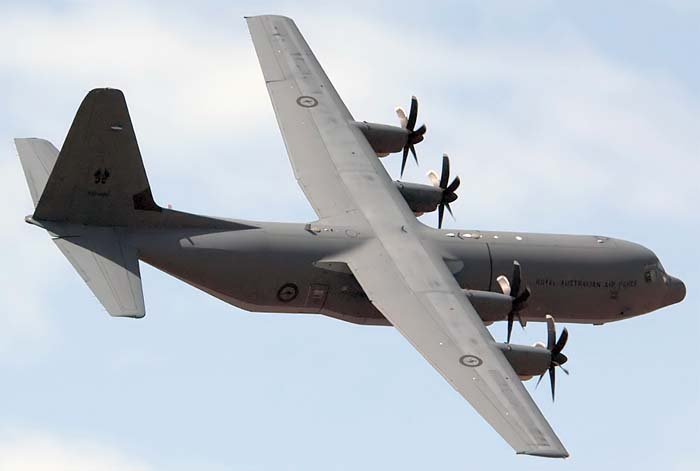 C-130J Super Hercules |
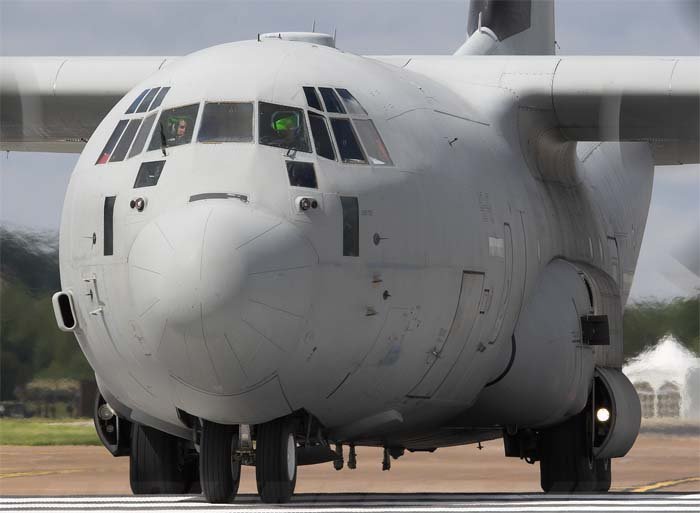 C-130J Super Hercules |
 C-130J Super Hercules |
 C-130J Super Hercules |
 C-130J Super Hercules |
 C-130J Super Hercules |
 C-130J Super Hercules |
 C-130J Super Hercules |
Equipo Editorial de ArchivoAéreo
Grupo de investigadores y entusiastas de la aviación dedicados a documentar y preservar la historia aeronáutica mundial. Todos los artículos son revisados para garantizar precisión histórica.
Fuentes y Rigurosidad
La información presentada en esta ficha técnica ha sido compilada a partir de manuales de vuelo desclasificados, archivos históricos y bibliografía especializada. Aunque nos esforzamos por mantener la máxima precisión, algunos datos de rendimiento pueden variar según la variante específica o las condiciones operativas.