C-2 Greyhound
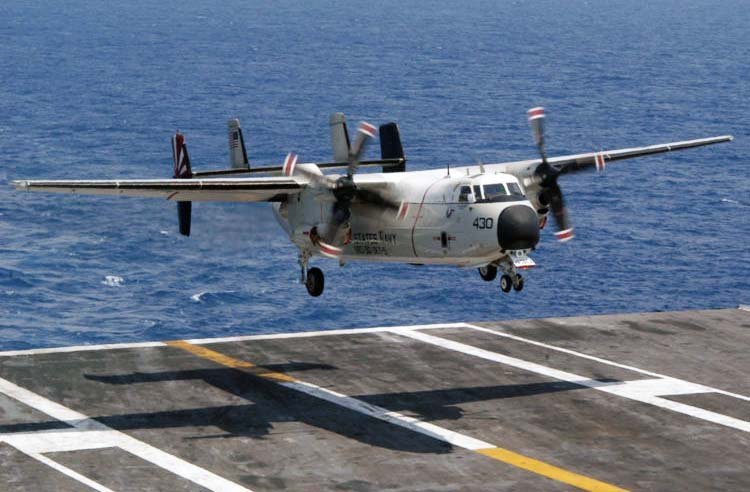
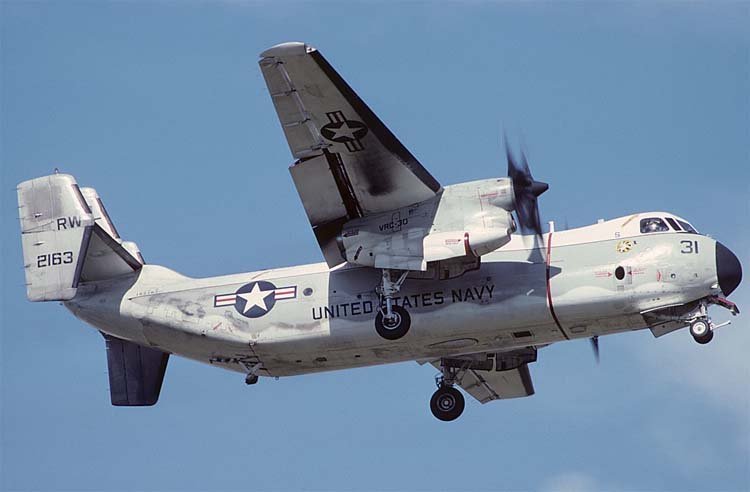
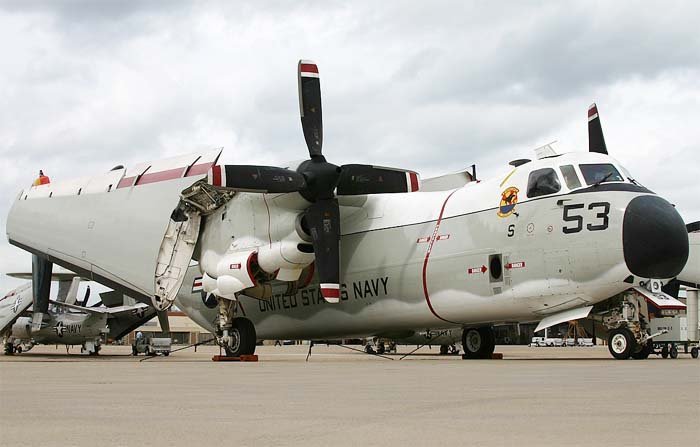
The C-2 “Greyhound” is a special transport aircraft designed to deliver supplies, spare parts, personnel, and other cargo to the decks of aircraft carriers at sea.
In the early 1960s, the small Grumman “Trader” propeller-driven supply aircraft ceased to meet fleet requirements due to its small cargo bay volume and the lack of an aft door with a ramp. The Grumman company developed a project for a new supply aircraft between 1961 and 1964, based on the airframe of the E-2A “Hawkeye” deck-based AEW and control aircraft.
The C-2A differs significantly from its Hawkeye predecessor. The main external difference is a modified fuselage of larger cross-section, in the straightened tail section of which a cargo door with a ramp was equipped for convenient loading and unloading of large and heavy objects, such as aircraft engines.
Less noticeable, but very important, are the changes to the tail section, which improved the aircraft’s aerodynamics; these changes were possible due to the absence of a large radar antenna above the fuselage. The nose landing gear strut was replaced with a more powerful one, derived from the “Intruder” deck-based bomber, and strengthened due to the aircraft’s increased flight mass compared to the E-2.
The wing and empennage with four vertical stabilizers remained practically unchanged, though the horizontal stabilizer was made without transverse V-angle. The aircraft gained a fairly spacious cargo bay measuring 8.38 x 2.23 x 1.68 m, and an aft cargo door with an integrated ramp 2.29 m wide and 1.98 m high. The fuel tank capacity was also increased. The Greyhound is capable of transporting up to 39 passengers or 20 stretcher patients with four attendants, or up to 8165 kg of palletized cargo.
Operational History and Upgrades
By November 1964, three prototype aircraft had been built. The “Greyhound” made its first flight on November 18, 1964, and by December 2, the aircraft was officially adopted by the U.S. Navy.
Deliveries of production aircraft began in 1966 and occurred in three phases: the first, 1966-1967, included 17 aircraft; the second, 1970-1971, 8 aircraft; and the third, 1973-1975, 9 aircraft. In 1987, due to intensive operation, fatigue cracks were detected in the wing structure of nine aircraft of this type. As a result, the entire “Greyhound” fleet (as well as part of the “Hawkeyes”) received new, reinforced folding wing sections.
Due to the impending complete decommissioning of the C-1A and the reduction in the number of airworthy C-2s, the Navy command decided in 1982 to resume “Greyhound” procurements. The first of 39 additional C-2A aircraft was delivered to the 24th Transport Squadron (VR-24; Sigonella Air Base, Sicily) in late 1985. The $678 million contract was fulfilled in 1989.
Currently, C-2A aircraft are in service with the 30th and 40th Transport Squadrons (VRC-30 and VRC-40) and the 20th Test Squadron. A small number of “Greyhounds” are operated by the 120th AEW squadron, which trains crews for the Hawkeye and is stationed in Norfolk. All 36 currently available C-2A aircraft are subject to modernization to extend their service life until at least 2027, with NP2000 eight-bladed propellers being installed during this upgrade, similar to those on the E-2C.
Aircraft Design and Features
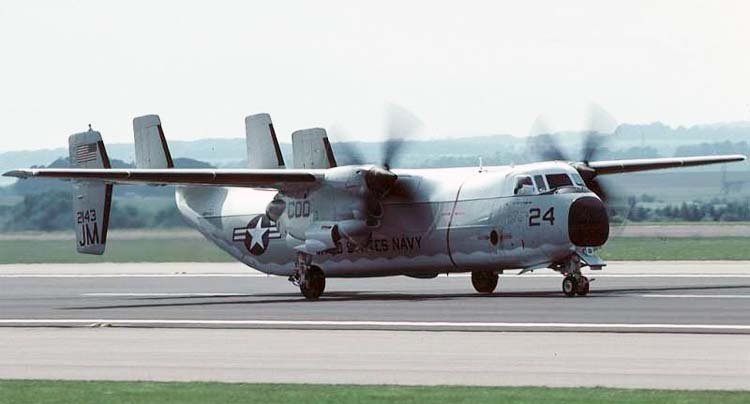
The “Greyhound” aircraft is an all-metal, cantilever high-wing monoplane with a four-fin tail, two turboprop engines, and an aft loading/unloading door equipped with an integrated ramp.
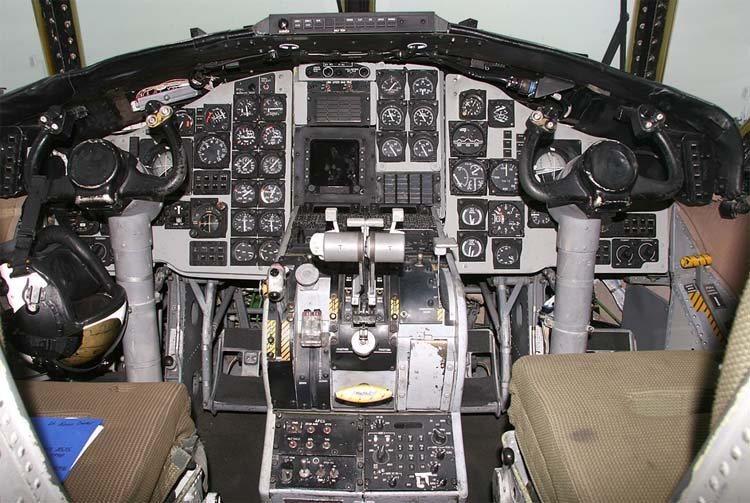
The fuselage is an all-metal semi-monocoque structure with an oval cross-section and a pressurized cabin. The forward section houses the cockpit for two pilots, a lavatory, and a baggage compartment. The central section contains the cargo bay, equipped with an electric hoist and numerous tie-down points.
The cabin can accommodate three standard cargo pallets measuring 2.74 x 2.24 m, or five standard pallets measuring 2.24 x 1.37 m. Other configurations include 39 soldiers or 20 stretcher-bound casualties with four attendants. The crew entry/exit door is located on the left side of the forward fuselage.
The wing is an all-metal, three-spar structure, with an incidence angle of 4 degrees at the root and 1 degree at the tips. The root/tip chord is 3.96/1.32 m, and the aspect ratio is 9.3.
The outer wing sections, each 7.8 m long, can be folded on the ground using hydraulic actuators, pivoting backward and resting along the fuselage. The wing leading edge is attached by hinges and can be rotated upwards for inspection of engine control wiring and the pneumatic de-icing system (PDS). Wing mechanization consists of Fowler flaps (11.03 m²) and drooped ailerons (5.76 m²).
The horizontal stabilizer (span 7.99 m, area 11.62 m²) with elevators (3.72 m²) has a zero dihedral angle. Three of the four vertical fins (total area 15.01 m², with 10.25 m² for the two outer fins and 4.76 m² for the two inner ones) are equipped with two-segment rudders (front and rear segments connected by hinges).
Fiberglass is used in the tail section’s construction to reduce the aircraft’s radar cross-section (RCS). The leading edges of the stabilizer and fins are equipped with pneumatic de-icing systems (PDS) with rubber boots. In early 1993, the airframe’s service life was 10,000 hours, which was increased in the 1990s.
The landing gear is tricycle type, with a two-wheeled steerable nose gear (retracting backward) and single-wheeled main landing gear (retracting forward into the engine nacelles with wheels rotating horizontally). The main landing gear struts are standardized with those of the “Hawkeye” aircraft, while the nose gear is borrowed from the A-6.
The landing gear struts feature oleo-pneumatic shock absorbers, and the retraction/extension system is hydraulic, with an emergency pneumatic extension system also present. The main wheel tires measure 36×11 (Type VII, 24-ply tread), with a pressure of 18.3 kgf/cm² (reduced to 14.8 kgf/cm² for ground-based airfield operations). The landing gear track is 5.93 m, and the wheelbase is 7.06 m. A retractable A-frame arresting hook is located under the aft fuselage.
C-2A aircraft are equipped with Allison T56-A-8/8A turboprop engines, each with a takeoff power of 4050 eshp. Since 1988, some aircraft have been fitted with T56-A-427 engines, delivering 5250 shp with a digital control system. The engine dimensions are 3.71 m length, 0.69 m width, and 0.99 m height, with a dry mass (for the -425 variant) of 860 kg.
The propellers are Hamilton Standard or General Electric four-bladed, feathering, reversible types with speed governors and an electrical de-icing system for the blades, with a propeller diameter of 4.11 m. A Garrett APU is installed in the aft section of the aircraft.
Fuel tanks with a capacity of 6905 liters are located in the caisson of the center wing and outer wing panels. Two external fuel tanks, each with a capacity of 1135 or 1704 liters, can be carried. For long-range ferry flights, two additional fuel tanks, each with a capacity of 3786 liters, can be installed in the cargo compartment.
The hydraulic system comprises two independent systems driven by the engine accessory gearboxes. It powers the hydraulic boosters of the control system, the wing folding system, ramp operation, flap actuators, nose gear steering, arresting hook deployment, landing gear extension and retraction, brakes, emergency generator, and windshield wash system.
The flight control system is entirely boosted, with irreversible hydraulic actuators and loading automatics. An automatic flight control system (AFCS) is present, ensuring aircraft stabilization and improved stability.
The electrical system is AC, with two 60 kW generators, three-phase, 115/200 V, 400 Hz. The auxiliary network is DC, 28 V, with two rectifiers. An emergency generator, driven by a 3 kW hydraulic motor, is also present.
The air conditioning system provides a cabin overpressure of 0.46 kg/m². The aircraft is equipped with an AN/ASW-15 autopilot, TACAN and LORAN system receivers, and a radio station operating in microwave and low-frequency bands. Some aircraft were fitted with weather radar.
Technical Specifications
| Modification | S-2A |
| Wingspan, m | 24.56 |
| Aircraft length, m | 17.32 |
| Aircraft height, m | 4.86 |
| Wing area, m2 | 65.03 |
| Empty weight | 16486 |
| Normal takeoff weight | 22450 |
| Maximum takeoff weight | 26082 |
| Internal fuel, l | 6905 + optionally 5519 |
| Engine type | 2 Turboprops Allison T56-A-425 |
| Power, ehp | 2 x 4912 |
| Maximum speed, km/h | 574 |
| Cruising speed, km/h | 465 |
| Practical range, km | 2891 |
| Range with maximum payload, km | 1930 |
| Service ceiling, m | 9144 |
| Crew, crew | 4 |
| Payload: | 28 passengers or 12 stretchers with attendant or 4536 kg of cargo in deck configuration or 6804 kg of cargo in ground configuration |
Image and diagram gallery of the C-2 Greyhound
 C-2 Greyhound |
 C-2 Greyhound |
 C-2 Greyhound |
 C-2 Greyhound |
 C-2 Greyhound |
 C-2 Greyhound |
 C-2 Greyhound |
 C-2 Greyhound |
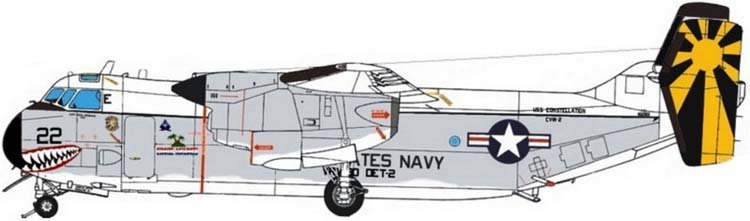 C-2 Greyhound |
Equipo Editorial de ArchivoAéreo
Grupo de investigadores y entusiastas de la aviación dedicados a documentar y preservar la historia aeronáutica mundial. Todos los artículos son revisados para garantizar precisión histórica.
Fuentes y Rigurosidad
La información presentada en esta ficha técnica ha sido compilada a partir de manuales de vuelo desclasificados, archivos históricos y bibliografía especializada. Aunque nos esforzamos por mantener la máxima precisión, algunos datos de rendimiento pueden variar según la variante específica o las condiciones operativas.