C-46 Smuggling in Mexico
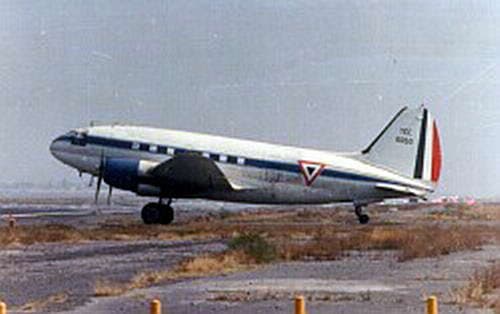
After World War II, the American armed forces began to sell off their surplus. This period saw most Latin American countries acquire a large fleet of C-46 transport aircraft.
A particularly large number of these planes ended up in the hands of Mexican private airlines. One of the first was likely Aerovias Contreras, which purchased its first C-46A (s/n 26043) on November 21, 1947, receiving registration XA-GOT, and later acquired a second aircraft, XA-JEB.
Unfortunately, the vast majority of these aircraft were used for illegal transport. This shadowy chapter of history has largely remained untold. We have attempted to compile all known cases in chronological order.
Early Incidents and Confiscations
In mid-1948, a C-46D (44-77985, s/n 33381) was seized at Mexico City airport with a cargo of weapons destined for the Dominican Republic. Due to a lack of necessary documents, the aircraft was confiscated and incorporated into the Mexican Air Force (FAM). This marked the first aircraft of its type to serve with the national air forces.
However, lacking spare parts and a trained crew, the aircraft was essentially abandoned at the capital’s airport. In 1950, businessman Zygmunt Wooren of Cables ZETWU bought the plane. It received registration XB-HUV and was sold to the USA in October 1951, where it was registered as N75866.
Another contraband aircraft was the Curtiss C-46F (N68965, s/n 22491), formally owned by Albany Industrial Corp., seized in Mexico City in 1972. Like the previous aircraft, this machine was only formally integrated into the FAM and was not decommissioned until 1993.
The Smuggling Boom of the 1980s
The highest number of C-46 smuggling cases occurred between 1981 and 1985. In late August 1981, a C-46F (N1850, s/n 22537), registered to Oklahoma Aircraft Corp., landed at Minatitlán’s old airport. The smugglers relied on surprise, but personnel radioed the military, who arrested the criminals loading the aircraft. The plane itself was transferred to PEMEX (Mexican Petroleum Govt. Agency), where it ended its days as scrap metal.
Even officially operating crews in the country sometimes attempted smuggling. One night in 1982, the crew of a C-46A (N355M, s/n 00471) belonging to Air Inc. tried to transport contraband from Huichapan. However, it was seized by the military and shared the fate of its predecessors. It is worth noting that in all these cases, the contraband was electronics.
The following year, on November 15, 1983, a C-46D (N5131B, s/n 30686) with a cargo of contraband was seized by IRS (Secretaría de Hacienda) special agents at a field site in Arriaga. Shortly after, a C-47 crew ferried the aircraft to Mexico City International Airport. A year later, the plane was transferred to the Air Force and received the number TEC-6047. This specific aircraft became the first C-46 officially inducted into service, assigned to BAM 1.
Despite a shortage of spare parts and trained pilots, the aircraft flew until 1989 and was decommissioned in 1992. An American businessman bought it, intending to restore it to flight status. However, he ran out of funds, and in January 2001, the aircraft was donated to a museum in León. Thanks to sponsors, this C-46 is now in perfect condition.
Continued Confiscations and End of an Era
Several months later in 1984, a C-46F (N67970, s/n 22587) belonging to Air Tram Leasing was confiscated. The aircraft was transferred to the Air Force and received the code TEC-6049. It flew sparingly and was decommissioned in 1989. The same American businessman who wanted TEC-6047 also sought to acquire this plane, but it was retired in January 2001.
Similarly, the Mexican Air Force acquired TEC-6050, which was seized on May 25, 1985. This was a C-46F (N7366N, s/n 22470). A few days later, the military seized another C-46 (s/n 22405) along with a DC-6 north of San Luis Potosí. The aircraft, registered N516AC, belonged to Atkins Aviation. This plane had a rich history, previously owned sequentially by Capitol Airways, Lufthansa, the Peruvian Air Force, Southern Air Transport, and Intermountain Aviation. The transport received code TEC-6051, saw limited use, and was decommissioned in 1993.
The last “contraband” C-46 was a Super C-46 (N1548V, s/n 265), seized in May 1986. Traditionally, the machine was handed over to the Air Force and received code TEC-6052. However, this was the only machine that bore an Air Force code but never actually served there. It was returned to its owners, after which the aircraft was sold to Air Services, becoming N64DT, and ended its career in Bolivia as CP-2168.
The widespread presence of such aircraft in Mexico during that time can be attributed to corrupt elements on both sides of the border who controlled the black market. The fact that the same companies owned these aircraft suggests the existence of “standardized” schemes for electronics smuggling.