C-97 Stratofreighter
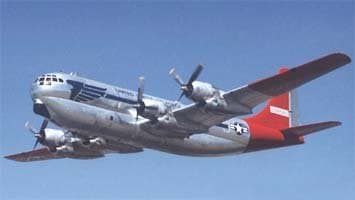
Drawing on its extensive experience in long-range bomber development, Boeing designed the C-97 military transport aircraft. This platform, in its KC-97 variant, became the primary aerial refueling tanker for the US Air Force’s Strategic Air Command (SAC). The project demonstrated a crucial evolution in aviation technology, adapting wartime innovations for new logistical needs.
Wartime Development and Design Innovations
During World War II, priority was given to combat aircraft, with transport aviation receiving residual funding. Although the Avro York, a transport variant of the Lancaster bomber, flew in 1942, its production only began in 1945. Boeing, between 1941-1942, created a transport variant of the B-29 Superfortress. In December 1942, the company secured a contract from the US Army Air Forces for three XC-97 prototypes, with the first experimental aircraft assembled by mid-1944.
Boeing’s management feared losing the civilian aircraft market to competitors like Lockheed and Douglas after the war. Nevertheless, by 1942, it was compelled to focus on fulfilling contracts for the US Army Air Forces. By July 20 of that year, the company had completed preliminary work on the Model 367 project, which primarily differed from the base B-29 in its fuselage design.
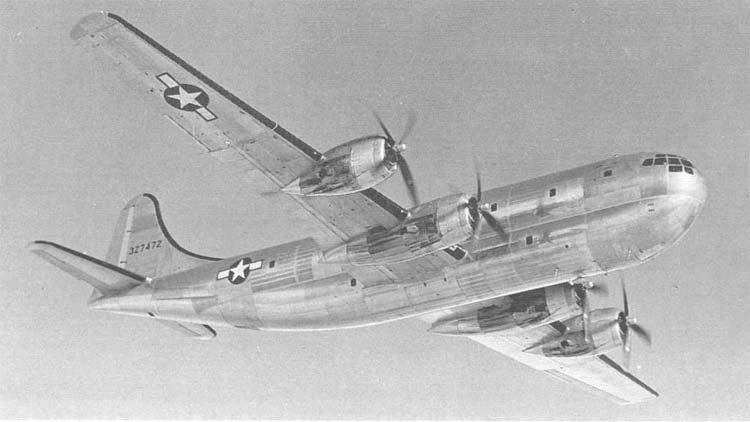
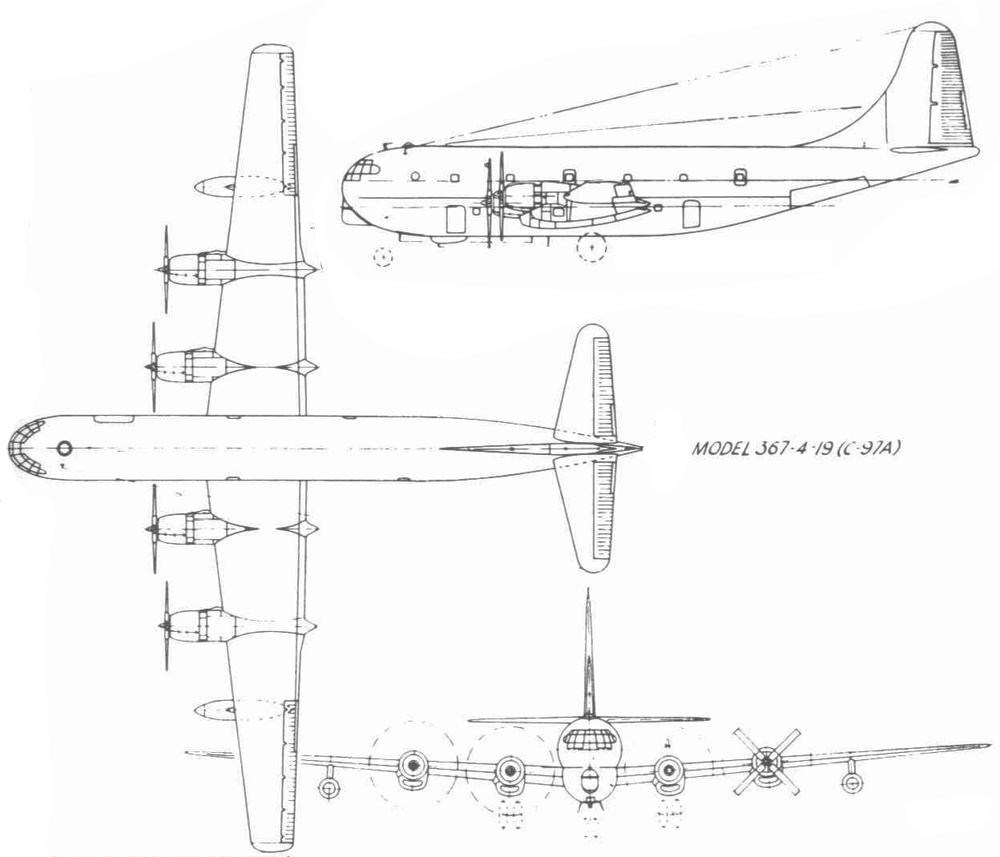
The aircraft featured a double-deck configuration: the lower section of the B-29 fuselage was retained, with bomb bays replaced by cargo compartments. An additional fuselage, with a 3.35m diameter circumference, was “attached” above the B-29’s cross-section. This gave the new fuselage a characteristic “double-bubble” (figure-eight) cross-section, with deep folds appearing along its sides. This distinct shape has persisted in modern Boeing airliners, albeit with more streamlined external contours.
Performance and Advanced Features
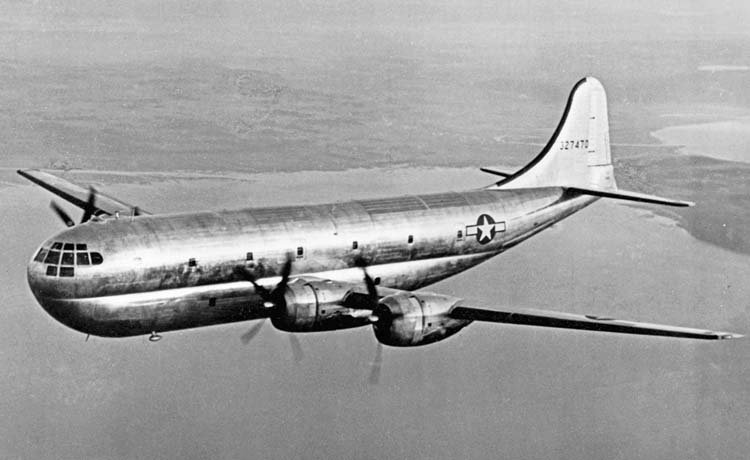
The first Stratofreighter prototype took to the skies in Seattle on November 15, 1944. Its handling characteristics mirrored those of the B-29. On January 9, 1945, the aircraft (No. 43-27470) demonstrated its speed and capability by flying 9072 kg of cargo from Seattle to Washington in 6 hours and 4 minutes, at an average speed of 616 km/h.
Initially equipped with 2200 hp Wright R-3350-23 engines, these were later upgraded to 2325 hp R-3350-57A units, with Boeing planning even more powerful engines. The US Army Air Forces ordered six YC-97s, largely identical to the prototypes, and four additional aircraft with more powerful propulsion: three YC-97As and one YC-97B. The YC-97A featured 28-cylinder Pratt & Whitney R-4360 Wasp Major engines, each delivering 3000 hp, with redesigned nacelles and new four-bladed propellers.
To maintain course with an inoperative outboard engine, the vertical stabilizer was made taller and foldable. The aircraft also incorporated a thermal de-icing system, and a new 75ST alloy was used for the wing and other components. Fuel capacity was increased to 26,670 liters, distributed among three soft fuel tanks in the center wing and sixteen such tanks in each wingtip. The aircraft could carry up to 18,598 kg of cargo, loaded through a rear cargo hatch and moved along 23.8-meter rails using an electric winch. Vehicles or light armored vehicles could drive onto the cargo deck independently.
The C-97 could transport at least 134 military personnel. In its medical evacuation configuration, it could carry 83 stretcher-bound casualties and four medical staff. The YC-97B (No. 45-59596) served as a VIP transport and was considered by Boeing as a prototype for a future commercial airliner. Its cabin featured round portholes, “3+2” seating (80 total) on the upper deck, a galley, and a spiral staircase to the lower deck. The rear cargo hatch was removed, but the aircraft could still carry 7711 kg of cargo in addition to passengers.
Operational Service and Tanker Role
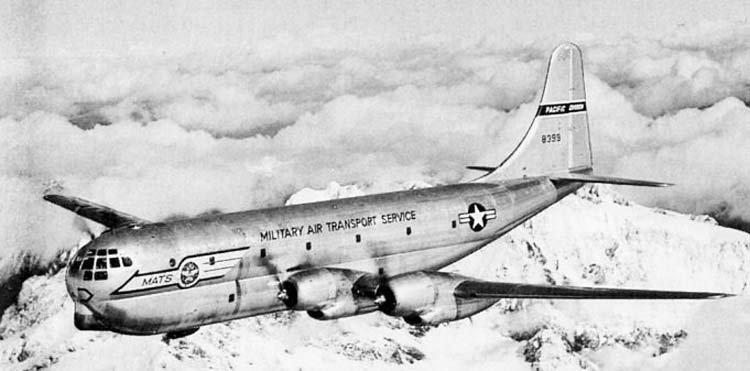
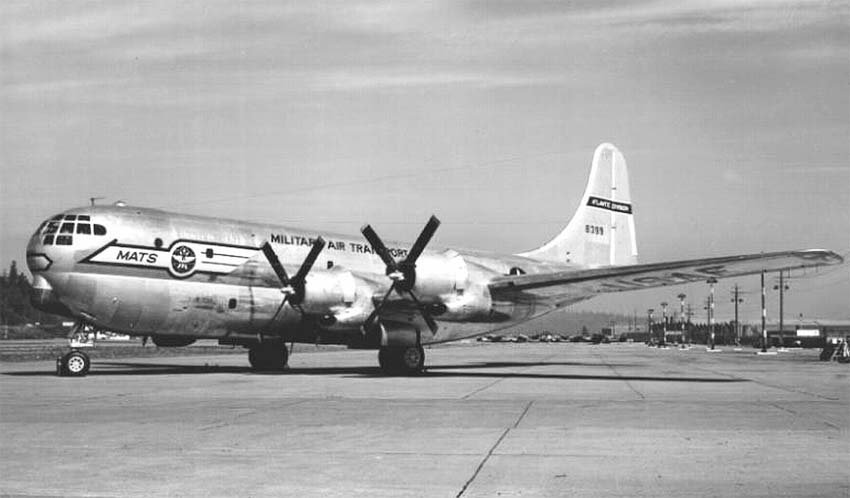
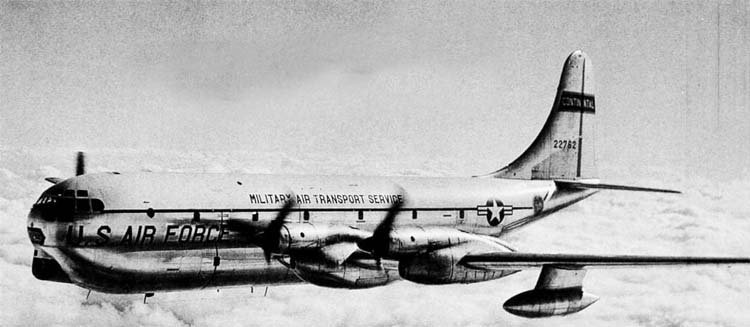
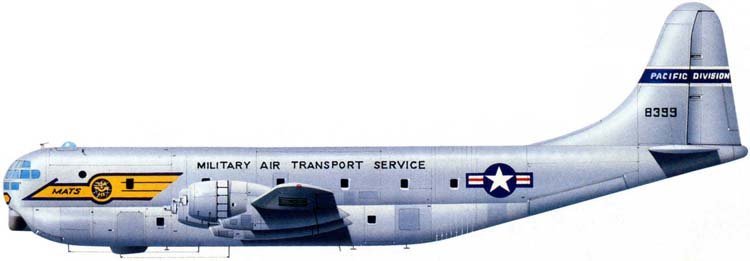
The first of six YC-97s, which was also Boeing’s last aircraft with Wright engines, first flew on March 11, 1947. These machines revolutionized air transportation, flying routes for the Air Transport Command to Hawaii, which was later renamed the Military Air Transport Service (MATS). In 1948, the first YC-97A participated in the famous Berlin Airlift, remaining airborne for 9-12 hours daily.
In 1948, the newly formed US Air Force ordered 27 C-97 aircraft, later increasing the order to 50. Early production Stratofreighters were equipped with Hamilton Standard propellers and were visually distinguishable by a small “bump” on the nose, an fairing for the APS-42 weather radar antenna. After the start of the Korean War in 1950, orders for the SC-97 significantly increased. Boeing, already managing contracts for the B-47 and B-52, struggled to keep pace, leading to the relocation of C-97 and Stratocruiser production to the Renton factory.
During these years, the US Air Force’s Strategic Air Command (SAC) desperately needed a large number of tankers to refuel strategic bombers in flight. Boeing conducted tests by installing its proprietary “Flying Boom” aerial refueling system on three KC-97As. Subsequently, the company began serial production of KC-97E, KC-97F, and KC-97G tanker aircraft, delivering 592 units to the customer. A total of 888 “military” C-97s were produced, with the last one leaving the factory on July 18, 1956.
Initial aerial tankers carried 26,498 liters of fuel. However, the KC-97E variant featured additional tanks on the main deck, increasing the fuel system’s capacity to 56,750 liters. This allowed for the transfer of a substantial portion of fuel to receiving aircraft. The refueling process was managed by an operator positioned prone in the rear of the fuselage.
Technical Specifications
| Modification | C-97C |
| Wingspan, m | 43.89 |
| Length, m | 35.78 |
| Height, m | 11.66 |
| Wing area, m2 | 164.34 |
| Empty weight | 37422 |
| Maximum takeoff weight | 79379 |
| Internal fuel, l | 56743 |
| Engine type | 4 Piston engines Pratt Whitney Wasp R-4360-59B |
| Thrust, kN | 4 x 3800 |
| Maximum speed, km/h | 604 |
| Cruising speed, km/h | 482 |
| Practical range, km | 6920 |
| Practical ceiling, m | 10670 |
| Crew | 4 |
| Payload | 96 soldiers or 69 stretchers with attendants or 9010 kg of cargo |
Image and diagram gallery of the C-97 Stratofreighter
 C-97 Stratofreighter |
 C-97 Stratofreighter |
 C-97 Stratofreighter |
 C-97 Stratofreighter |
 C-97 Stratofreighter |
 C-97 Stratofreighter |
 C-97 Stratofreighter |
 C-97 Stratofreighter |
 C-97 Stratofreighter |
 C-97 Stratofreighter |
Equipo Editorial de ArchivoAéreo
Grupo de investigadores y entusiastas de la aviación dedicados a documentar y preservar la historia aeronáutica mundial. Todos los artículos son revisados para garantizar precisión histórica.
Fuentes y Rigurosidad
La información presentada en esta ficha técnica ha sido compilada a partir de manuales de vuelo desclasificados, archivos históricos y bibliografía especializada. Aunque nos esforzamos por mantener la máxima precisión, algunos datos de rendimiento pueden variar según la variante específica o las condiciones operativas.