Camcopter
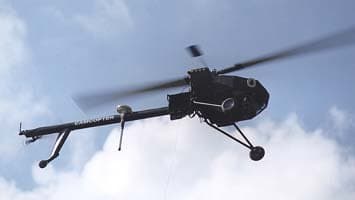
The Camcopter is a multi-purpose UAV (Unmanned Aerial Vehicle) developed by the Austrian firm Schiebel Elektronische Geräte GmbH. Development of the UAV began in the early 1990s. The Camcopter is a vertical takeoff UAV designed for observation, target designation, mine detection, and topographic surveying.
Onboard Technology and Control
For these purposes, the Camcopter is equipped with a color CCD camera that transmits real-time video. The UAV is controlled from a Ground Control Station (GCS). Its autonomous control system includes an Inertial Navigation System (INS) combined with a DGPS positioning system. Computer data generated based on a Geographical Information System (GIS) is used for accurate determination of the UAV’s and targets’ positions.
Milestones and Adoption
In 1996, the Camcopter was demonstrated to representatives of the Israeli Ministry of Defense, the Italian and Swedish armies, and the U.S. Marine Corps. A contract was signed for the supply of one UAV to the United States, with a demonstration flight taking place in 1997 at Fort Benning. Series production of the UAV commenced in 1998.
Technical Specifications
| Modification | Camcopter |
| Main rotor diameter, m | 3.02 |
| Length, m | 2.50 |
| Height, m | 0.80 |
| Width, m | 0.80 |
| Empty weight | 40 |
| Maximum takeoff weight | 66 |
| Engine type | 1 Piston engine |
| Power, hp | 1 x 15 |
| Maximum speed, km/h | 102 |
| Cruising speed, km/h | 90 |
| With standard data transmission | 10 |
| With improved transmitter | 80 |
| Flight endurance, h | 6 |
| Rate of climb, m/min | 18 |
| Service ceiling, m | 1700 |