Caudron C.366 Martinet
Development and Early Challenges
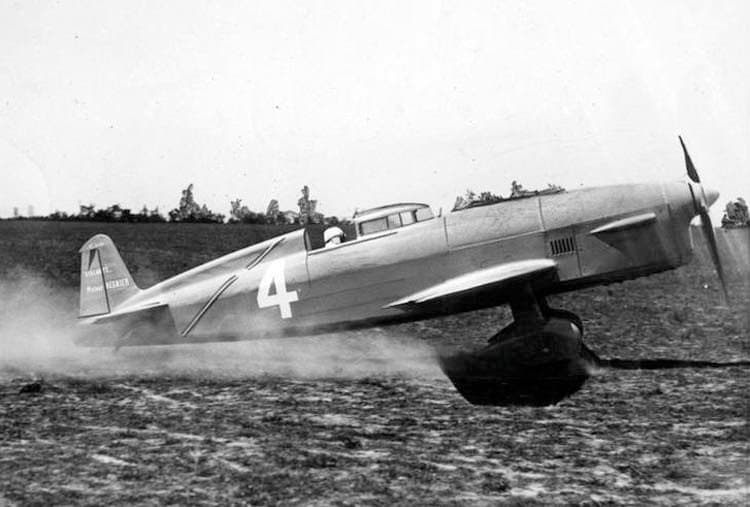
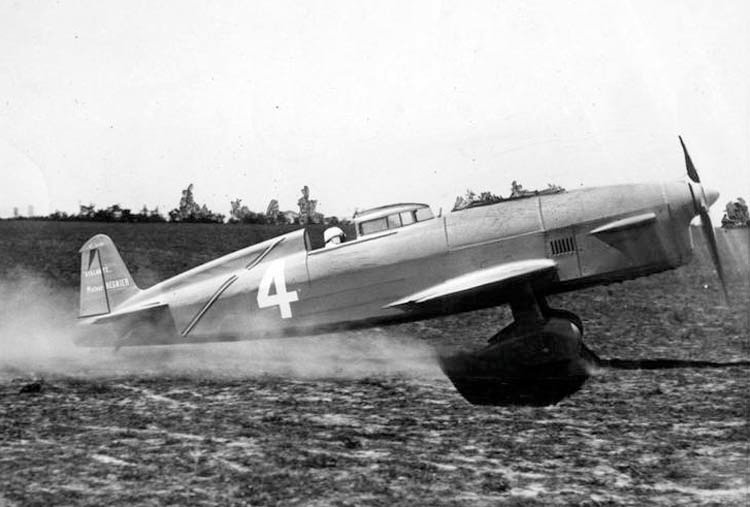
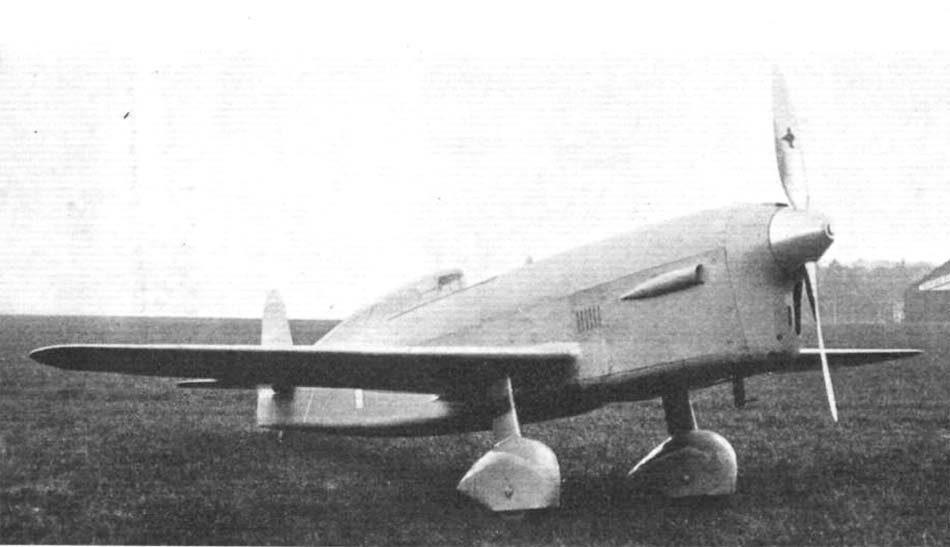
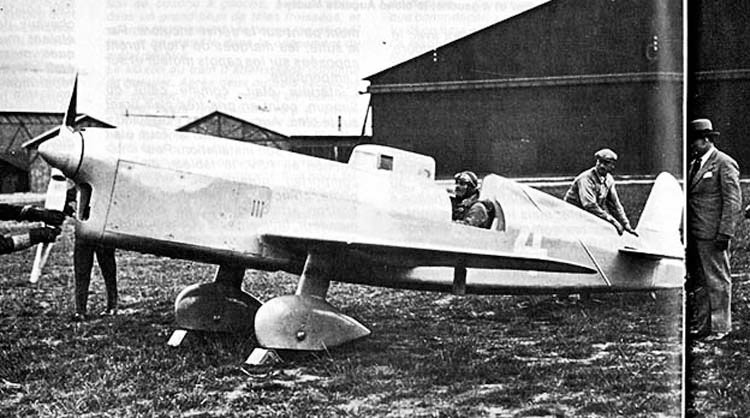
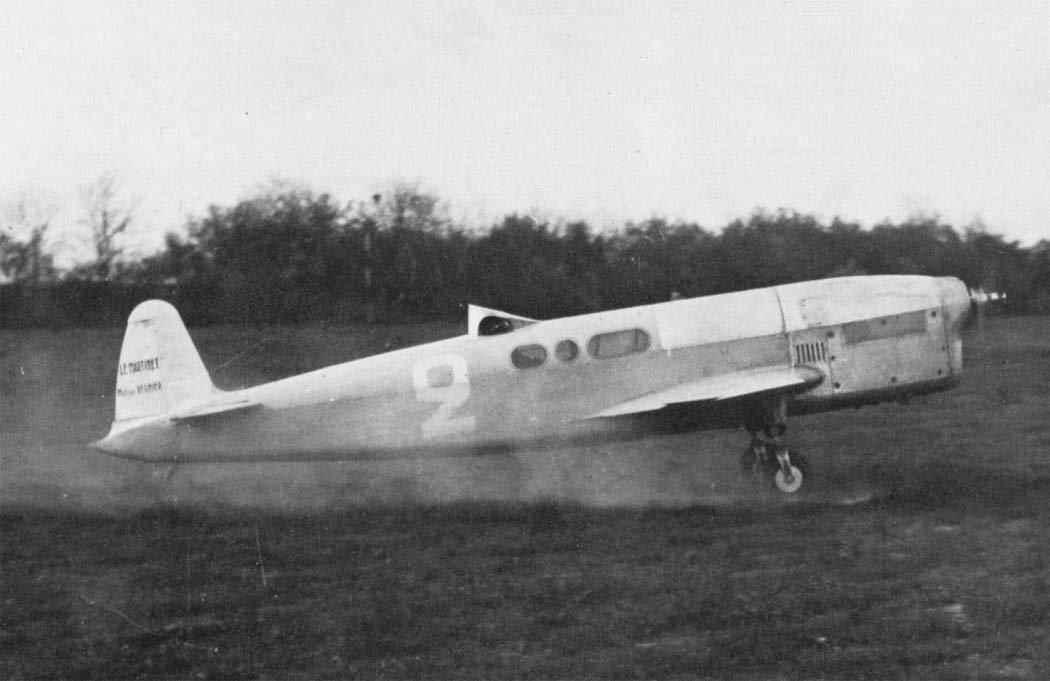
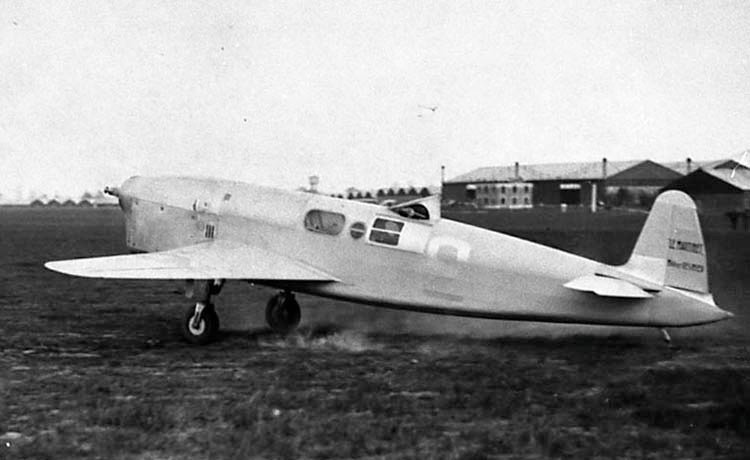
The Caudron C.366, nicknamed “Martinet” (swift), was a racing aircraft designed by André Herbemont for the Caudron company. Its name evoked the image of a bird with long, narrow wings that flies quickly. It was distinguished by its long, slender fuselage and wing, and retractable main landing gear.
For the 1933 Deutsch de la Meurthe Cup races, Caudron prepared several Caudron 360 aircraft, initially intended to be fitted with 300 hp Chaise engines. However, these plans did not materialize, and the aircraft were equipped with six-cylinder Régnier engines, which were a development of the British de Havilland Gipsy III engines.
Due to delays in engine delivery, two aircraft received 165 hp four-cylinder Renault Bengali engines (Caudron 362), and one, the Caudron 366 (also known as Atalante), was fitted with a 215 hp Régnier engine. To compensate for the 70 kg increased mass of the Régnier engine in the C.366, the engine mount was slightly reduced.
Although the estimated speeds for the Caudron 366 were 410 km/h, Henri Vallot, an instructor and head of Caudron’s training center in Ambérieu, assessed its average speed at 263 km/h. Unfortunately, on May 25th, three days before testing, the Caudron 366 suffered damage after overturning on the ground due to a wheel lock, preventing its participation in the 1933 races.
Speed Records and Massotte’s Contribution
The aircraft’s debugging was completed in the second half of 1933. Following a fatal accident, the Régnier company invited the virtuoso aerial acrobat Louis Massotte, a pilot for the “patrouille Blériot” demonstration group and a test pilot for Blériot Aéronautique. On January 7, 1934, in Istres, Massotte set a new world record in a closed-circuit race for the Beaumont Cup over a 1000 km distance, achieving an average speed of 358.185 km/h. The previous record belonged to the German Untucht and his Heinkel 70 with a BMW VI engine.
In addition to his world record, Massotte broke national records for 100 km (325.497 km/h, Sadi-Lecointe), 500 km (308.227 km/h, his own), and 1000 km (286.227 km/h, Doret). Massotte’s aircraft was equipped with an air-cooled six-cylinder Régnier engine, which had a cylinder bore of 114 mm, a piston stroke of 130 mm, and developed 205 hp at 2450 rpm.
During the record-setting flight, the engine demonstrated remarkable efficiency, consuming only 16.6 liters of fuel per 100 km (220 grams per horsepower per hour). For the 1500 km course, the aircraft used a total of 366 liters of fuel.
1934 Race and Caudron’s Advances
The Caudron 366 was successfully registered for the 1934 Deutsch de la Meurthe Cup races without issues. For this competition, the aircraft’s engine had its compression ratio increased, boosting power to 220-230 hp. The ground-adjustable Ratier propeller was replaced with a two-position (take-off and flight) Levasseur propeller, with pitch changes actuated by a Bowden cable.
Under Massotte’s control, the modified aircraft reached a speed of 440 km/h on a measured course. Meanwhile, Caudron released a new series of aircraft equipped with new 310 hp six-cylinder Renault engines. The single-spar wing of the Caudron 360 type was replaced with a two-spar wing to accommodate retractable main landing gear, and the new machines also featured slotted flaps. While the Caudron 450 had fixed landing gear, the Caudron 460 featured retractable gear, although its retraction mechanism suffered serious problems and was hastily faired over for races.
In the 1934 races, Maurice Arnoux, flying a Caudron 450, emerged as the winner, completing the course at an average speed of 387 km/h. Louis Massotte, for his part, flew a very consistent race, securing second place with an average speed of 361.083 km/h. The most astonishing aspect of his second-place finish was that Massotte’s aircraft was powered by an engine that developed 100 hp less than those of the other participants.
The ‘Martinet’ Transformation and Legacy
For the 1935 Deutsch de la Meurthe Cup races, the Régnier company, which had become the owner of the aircraft, decided to further improve it. The aircraft was delivered to the Blériot factory, where it underwent a complete redesign under the supervision of engineer André Herbemont.
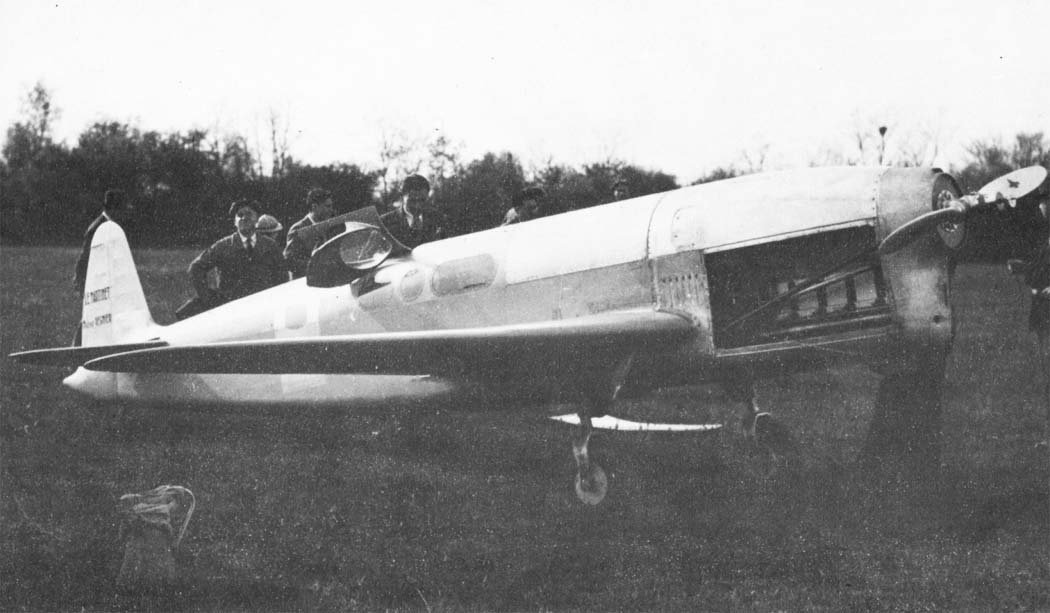
The modifications included the installation of retractable main landing gear (Blériot patent) in place of the fixed gear, requiring significant changes to the wing structure. The wing’s leading edge was extended forward to house the main gear wheel wells, the wingspan was reduced from 6.80 m to 6.7 m, and the wingtips became rounded.
The pilot’s cockpit was placed at a lower level, and all external protrusions from the fuselage were removed (a solution later adopted by Caudron), although a fixed canopy was installed during testing. The tail assembly was also reduced. The rear section of the fuselage terminated in a pointed cone, increasing the aircraft’s length from 6.80 m to 7.09 m.
Regarding the engine, it was replaced with an R.6 featuring a Sebia supercharger (Roots type) designed by engineer Dugelay. This supercharger’s shaft rotated 1.4 times faster than the engine’s shaft. With a compression ratio of 7:1, this 234 kg engine developed 250 hp at 2000 meters altitude (at 2600 rpm), which was equivalent to 310 hp at sea level (though consumption increased to 280 g/hp×h).
Louis Massotte began testing this practically new aircraft, which received the new name “Martinet” (swift) and proved to be very fast. Unfortunately, on the final day of qualification flights during testing, Massotte discovered problems with the supercharger (presumably a seizure). He had to reduce the “Martinet’s” speed to a critical 250 km/h and use all his skill to limit the damage.
However, the Caudron company’s own machines also saw progress in development. Sadly, Massotte’s death during the testing of a Blériot fighter with a butterfly tail deprived the Régnier company of a top-class test pilot. As a result, Régnier abandoned the creation of its high-speed aircraft. Nothing more was heard of the blue “Martinet,” perhaps it is now in racer’s heaven.
Technical Specifications
| Modification | C. 366 |
| Wingspan, m | 6.80 |
| Length, m | 6.88 |
| Height, m | 1.90 |
| Wing area, m2 | 7.00 |
| Empty weight | 475 |
| Maximum takeoff weight | 765 |
| Engine type | 1 Piston engine Regnier |
| Power, hp | 1 x 205 |
| Maximum speed, km/h | 370 |
| Crew | 1 |
Image and diagram gallery of the Caudron C.366 Martinet
 C.366 Martinet |
 C.366 Martinet |
 C.366 Martinet |
 C.366 Martinet |
 C.366 Martinet |
 C.366 Martinet |
 C.366 Martinet |
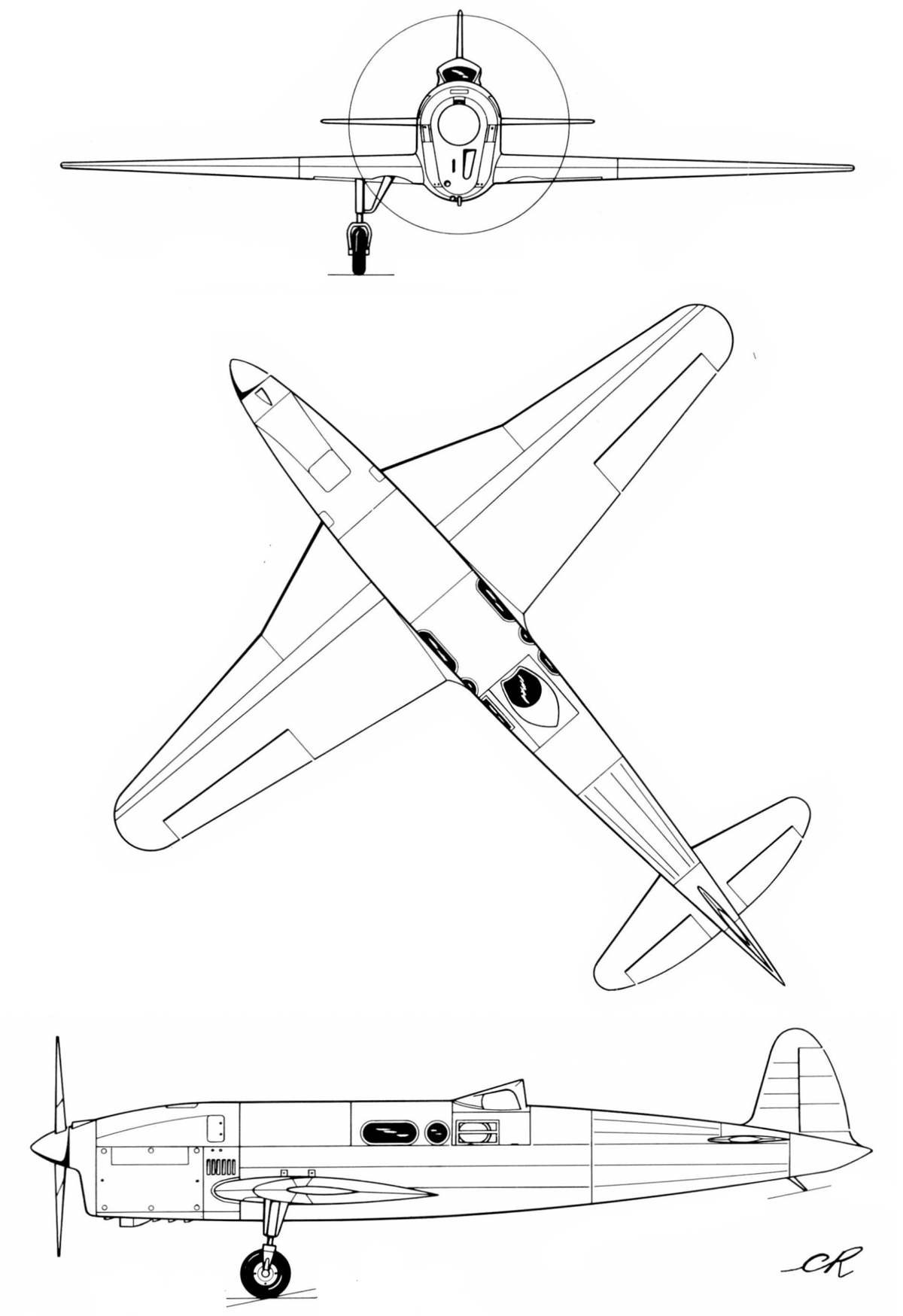 C.366 Martinet |
Equipo Editorial de ArchivoAéreo
Grupo de investigadores y entusiastas de la aviación dedicados a documentar y preservar la historia aeronáutica mundial. Todos los artículos son revisados para garantizar precisión histórica.
Fuentes y Rigurosidad
La información presentada en esta ficha técnica ha sido compilada a partir de manuales de vuelo desclasificados, archivos históricos y bibliografía especializada. Aunque nos esforzamos por mantener la máxima precisión, algunos datos de rendimiento pueden variar según la variante específica o las condiciones operativas.