Chang Kong-1 (CK-1)
Origins and Development
In the late 1950s, the People’s Republic of China acquired a batch of Soviet La-17 target drones, originally developed in 1953 by S.A. Lavochkin Design Bureau. As these units were expended, the need arose for China to establish its own production of similar UAVs. Work on copying the La-17 commenced in April 1968, leading to the construction of a series of nine aircraft for flight testing.
The development of the Chinese version of the La-17 was finalized in 1976. This UAV, designated Ba-5I and known for export as Chang Kong-1 (CK-1), was officially adopted in March 1977. Significant modifications were made to its airframe and fuel system, and its typical flight profiles were substantially altered compared to the original La-17.
Design and Operation
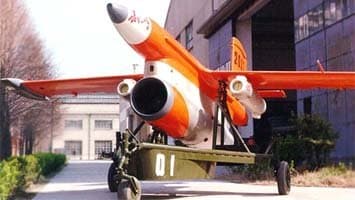
The CK-1 UAV features a conventional aerodynamic configuration with a simplified rectangular wing. Both vertical and horizontal tail surfaces are interchangeable, streamlining production and maintenance. It is powered by a WP6 turbojet engine, housed in a ventral gondola, and guided by a Chinese-developed autopilot system.
Launch is performed from a ground-based launcher using a solid rocket booster, propelling the drone into flight. The CK-1 can operate either on a pre-programmed flight path or under real-time commands from ground control. Upon mission completion, the drone safely descends via a parachute landing system.
Diverse Applications
Beyond its primary role as a target drone, the CK-1 found various critical applications. Early versions were equipped with radiological reconnaissance equipment for studying atmospheric nuclear explosions, successfully employed during nuclear tests in March 1977.
Later, the CK-1 was adapted for simulating low-flying air targets, with flight tests starting in May 1982 and official adoption in February 1983. Further modifications, beginning in May 1983, enhanced its control system to simulate new-generation combat aircraft with high maneuverability and increased G-load capabilities. Flight tests for these advanced prototypes began in 1984, culminating in a notable exercise in March 1985 where a CK-1C target was used for five successful surface-to-air missile launches.
Technical Specifications
| Modification | CK-1C |
| Wingspan, m | 7.50 |
| Length, m | 8.44 |
| Height, m | 2.96 |
| Wing area, m2 | 8.55 |
| Empty weight | 2000 |
| Fuel | 840 |
| Maximum takeoff weight | 3340 |
| Engine type | 1 Turbojet WP6 |
| Thrust, kgf | 1 x 2600 |
| Maximum speed, km/h | 900 |
| Range, km | 600 |
| Flight endurance, min | 60-70 |
| Service ceiling, m | 18000 |
| Operational ceiling, m | 500-5000 |