Durandal
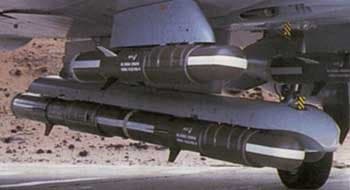
The Durandal concrete-piercing bomb was developed in the early 1970s by the French firm Marta SA, in collaboration with SAMP. It was created to meet the requirements of the French Air Force for a weapon designed to disable airfields and concrete shelters, specifically for deployment from low and very low altitudes.
To achieve this, the bomb needed to penetrate up to 400 mm of concrete runway surface before detonating beneath it, thereby overturning the runway slabs. This capability was realized through an optimal penetration angle and necessary kinetic energy, accelerated by a rocket motor. Its unique nose shape and a delayed detonation mechanism, coupled with Marta’s experience in delayed-drop bombs, enabled the creation of a double, instant-opening parachute system and a powerful rocket engine.
Global Adoption and Design
A universal adapter was developed within the Durandal program, allowing the bomb to be used on all NATO standard 356mm suspension points and bomb racks, making it compatible with any NATO aircraft. In the United States, the Durandal was designated BLU-107/B. Production began in 1977, and by late 1986, over 29,000 bombs had been exported. The Durandal subsequently won a lengthy US Air Force competition and is currently in service with 19 countries worldwide.
Structurally, the Durandal consists of four main compartments. A 100 kg high-explosive warhead, containing 15 kg of explosive material, is located in the nose. Behind the warhead are the ignition system and a solid-propellant boost motor. The motor and warhead are connected by steel rings. Further back, secured by a jettisonable clamping ring, is a compartment housing two parachutes: a brake parachute and a main parachute.
Operational Deployment
The bomb is released from an altitude of approximately 50-75 meters at a speed of 180-280 m/s. Immediately after release, the first brake parachute deploys, rapidly decelerating the bomb to 25 m/s. The second parachute deploys at an altitude of about 40 meters.
Once the bomb reaches a dive angle of 30°, the parachute system is jettisoned, the fuzing mechanism arms, and the boost motor ignites. The Durandal reaches a speed of 250 m/s upon impact with the target. A contact fuze activates upon target contact, and after penetrating the concrete surface, the bomb detonates. Alternatively, the fuze can be set before takeoff for detonation several hours later. An explosion beneath the runway surface creates a crater up to five meters in diameter and 2-3 meters deep, surrounded by large concrete debris scattered over an area of approximately 200 m². The maximum permissible speed for a carrier aircraft with Durandal bombs is 1.8M, and the maximum altitude is 10,000 meters.
Equipo Editorial de ArchivoAéreo
Grupo de investigadores y entusiastas de la aviación dedicados a documentar y preservar la historia aeronáutica mundial. Todos los artículos son revisados para garantizar precisión histórica.
Fuentes y Rigurosidad
La información presentada en esta ficha técnica ha sido compilada a partir de manuales de vuelo desclasificados, archivos históricos y bibliografía especializada. Aunque nos esforzamos por mantener la máxima precisión, algunos datos de rendimiento pueden variar según la variante específica o las condiciones operativas.