Messerschmitt Bf 163
In the summer of 1936, Gerhard Fieseler’s company created an aircraft that, thanks to its unusual properties, rightfully earned its place in aviation history. It was an aircraft with the shortest take-offs and landings and the lowest speeds in these regimes. Most readers will probably realize that this was the Fi 156 Storch – a well-known aircraft both during and after the war.
The German Reich Aviation Ministry (Reichsluftfahrtministerium – RLM) quite quickly recognized the advantages of this type of aircraft, thus deciding its fate. The new aircraft was put into mass production and began to be used as: an artillery spotter, a courier aircraft, an aircraft for transporting the wounded, and for transporting senior officers. Since the Storch operated with minimal runway dimensions, machines of this type also operated in frontline areas.
The RLM Competition and the Bf 163 Design
Soon after the prototype Fi 156’s test flight, the RLM issued technical specifications to several aircraft manufacturing companies for designing a machine that would be more suitable for the aforementioned military service functions. Several companies participated in the project competition, but interest was focused only on two of them.
Bayerische Flugzeugwerke (later Messerschmitt AG) proposed a project developed by engineer Robert Lüsser, which received the designation Projekt 1051. The RLM, or rather its technical department, at the prototype manufacturing stage, assigned this project the number 163 or Bf 163. The second machine that attracted the RLM’s attention was an extremely unusual aircraft developed by engineer Friedrich Fecher, known as the Siebel Si 201.
True to its practice, the RLM ordered three prototypes of each of the finalist projects. The aircraft to be manufactured were to be equipped with 240-horsepower Argus As 10C or Hirth HM 508E engines. It so happened that both companies chose the proven and reliable Argus engines. However, the placement of the power plant in the competing aircraft was different: on the Bf 163, the engine was located in the front part of the fuselage and rotated a pulling propeller, while on the Si 201, the power plant was placed above the wing and drove a pushing propeller.
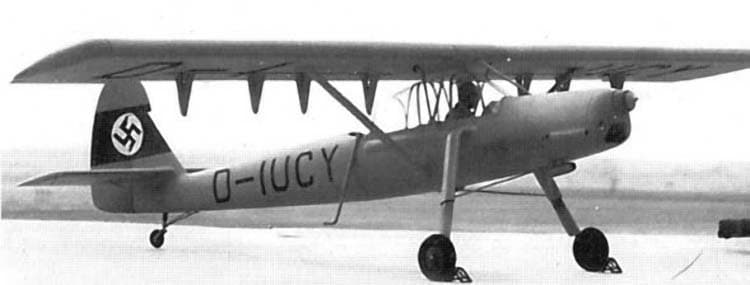
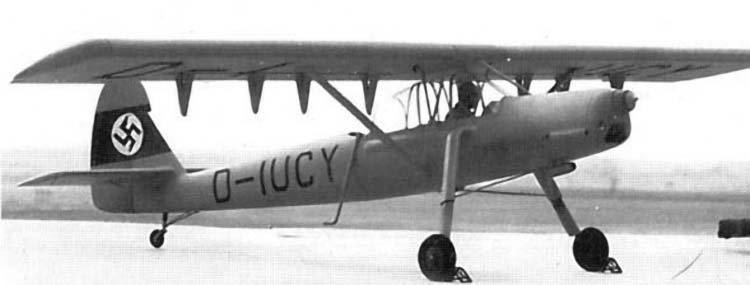
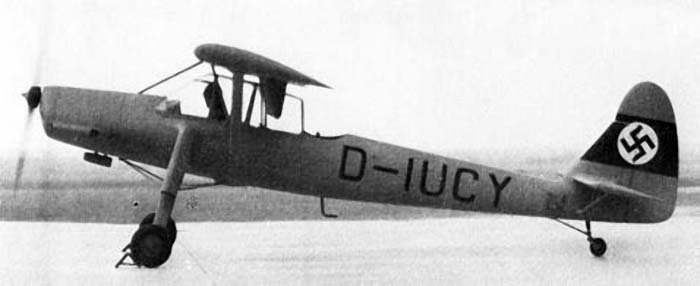
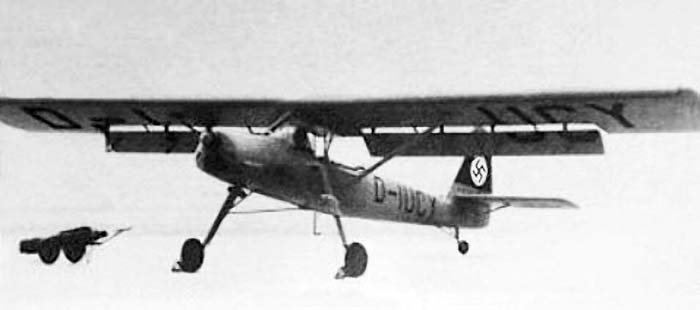
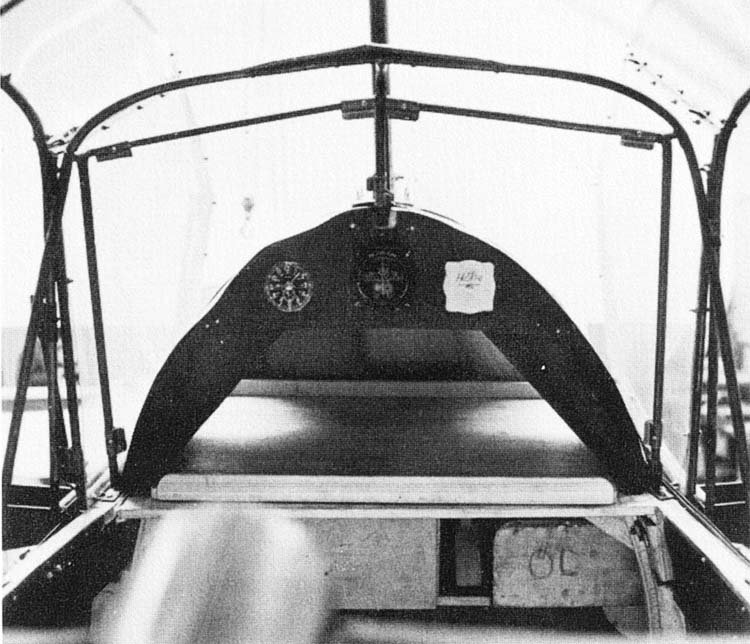
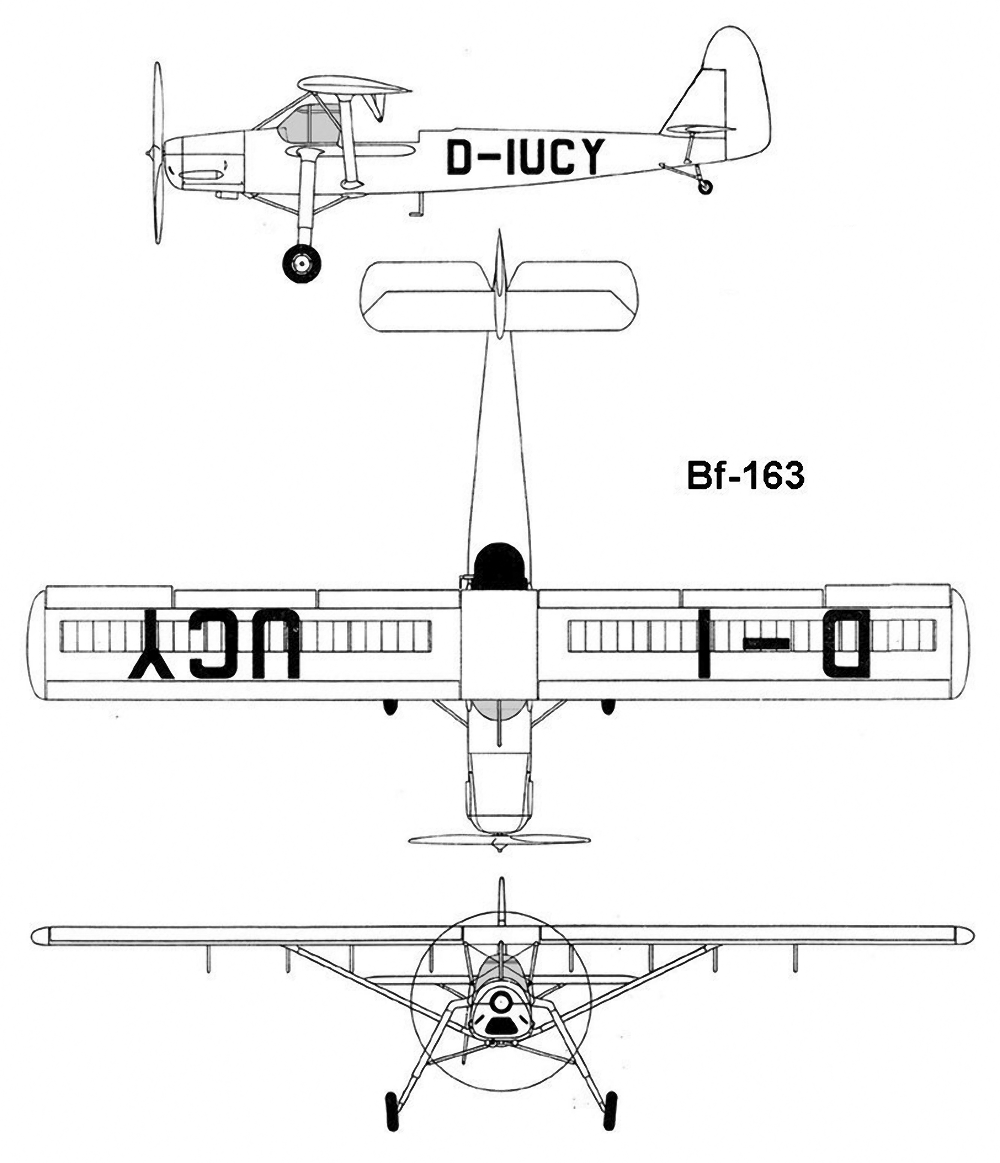
The Bf 163 demonstrated, at least at first glance, a quite ordinary layout: it was a strut-braced high-wing monoplane with a semi-enclosed cockpit, landing gear with a surprisingly wide track, and a large shock absorber travel. However, the secret was hidden in the wing, equipped with leading-edge slats and double-slotted flaps. The wing was single-spar; hinges were installed at the connection points of the wing spar and the fuselage, allowing the wing to rotate through a fairly wide range of angles. Thanks to the solutions applied, very short take-off and landing lengths were achieved, as well as a very low stall speed.
First Flight and Project Cancellation
Regarding the Bf 163 (civil registration number D-IUCY), the date of its first flight is known – it took place on February 19, 1938. However, to this day [at the time the author wrote the article], no blueprints have been preserved, and only an accurate model gives an idea of what this aircraft looked like.
At the RLM, the scales tipped in favor of the Bf 163, and an order was even issued for ten pre-production Bf 163 A-0 machines. However, the order was soon canceled, and work on even the second prototype, the Bf 163 V2, was interrupted. The third prototype, the Si 201 V3, also remained unfinished.
The reason for the cessation of work was simple: neither the Bf 163 nor the Si 201 could surpass the Storch. Its manufacturability, which allowed for inexpensive mass production of aircraft needed in wartime, confirmed the correctness of the chosen solution.
Technical Specifications
| Modification | Bf.163 |
| Wingspan, m | 13.58 |
| Length, m | 9.75 |
| Height, m | 3.00 |
| Wing area, m2 | 22.80 |
| Empty weight | 995 |
| Maximum takeoff weight | 13 10 |
| Engine type | 1 Piston engine Argus As 10C |
| Power, hp | 1 х 240 |
| Maximum speed, km/h | 180 |
| Cruising speed, km/h | 155 |
| Practical range, km | 400 |
| Service ceiling, m | 4500 |
| Crew | 2 |
Image and diagram gallery of the Messerschmitt Bf 163
 Bf.163 |
 Bf.163 |
 Bf.163 |
 Bf.163 |
 Bf.163 |
Equipo Editorial de ArchivoAéreo
Grupo de investigadores y entusiastas de la aviación dedicados a documentar y preservar la historia aeronáutica mundial. Todos los artículos son revisados para garantizar precisión histórica.
Fuentes y Rigurosidad
La información presentada en esta ficha técnica ha sido compilada a partir de manuales de vuelo desclasificados, archivos históricos y bibliografía especializada. Aunque nos esforzamos por mantener la máxima precisión, algunos datos de rendimiento pueden variar según la variante específica o las condiciones operativas.