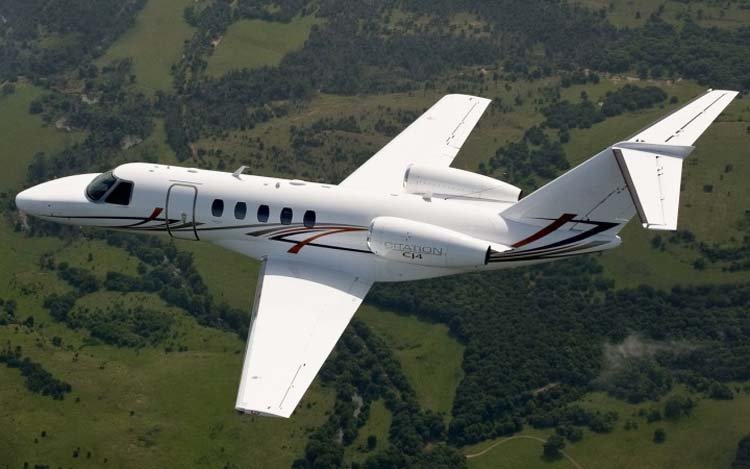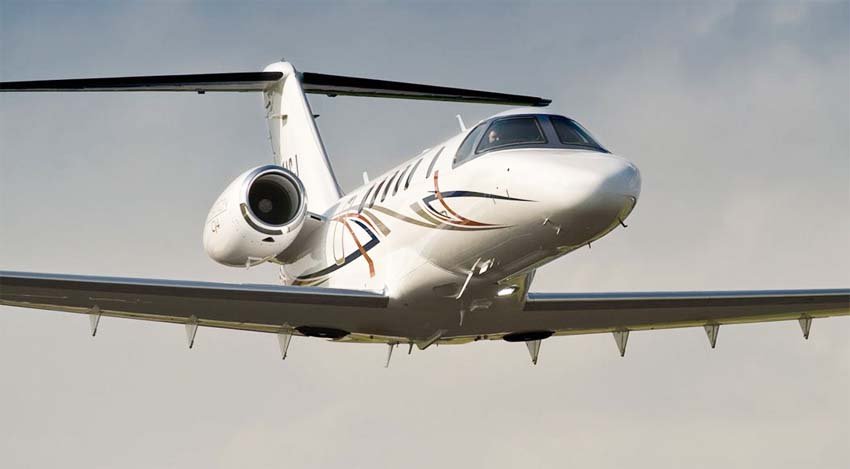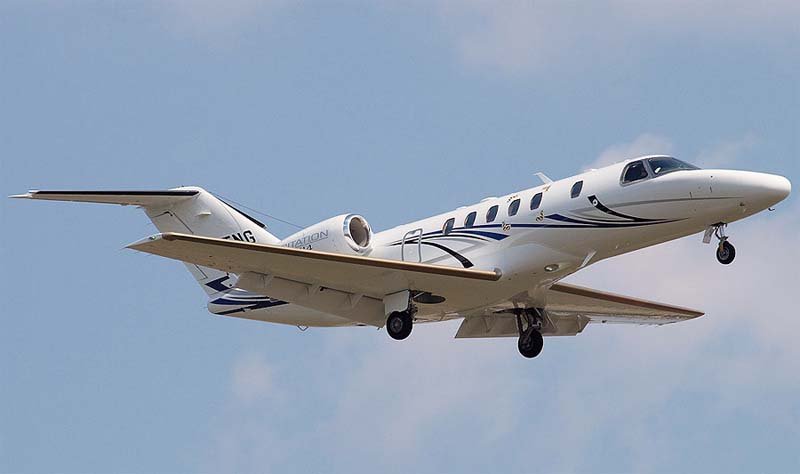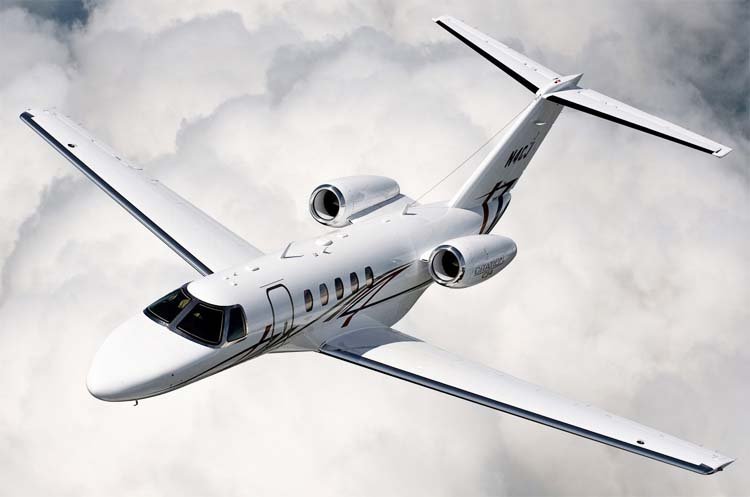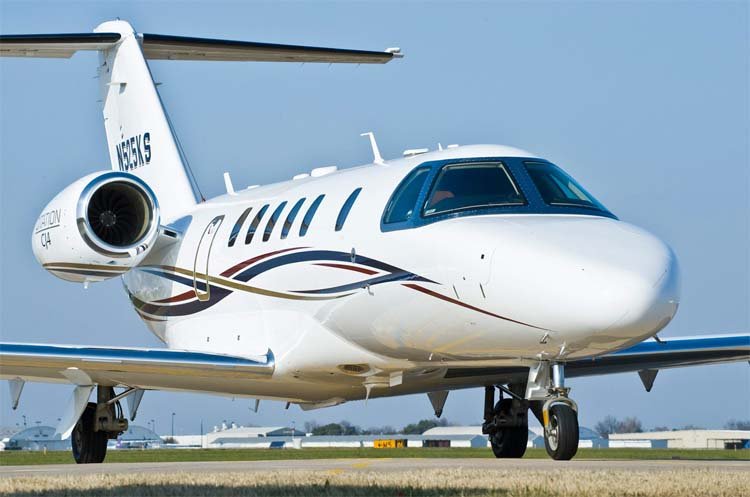
The Cessna 525C Citation CJ4, a continuation of the Citation Jet line, made its first flight on May 5, 2008. When Cessna Aircraft released the flight test results for the Citation CJ4, the figures generated considerable excitement both at the Wichita base and on the neighboring continent in Brazil. This $8.75 million business jet proved lighter, more powerful, and faster than expected, surpassing initial estimates for range and takeoff/landing performance.
In light of such results, it’s tempting to compare the CJ4 not only with its direct competitor, the Embraer Phenom 300, but also with the Learjet 45XR. Indeed, if both aircraft take five passengers and depart simultaneously from San Diego to, say, Savannah, the 45XR would only beat its rival by seven minutes. The main difference, however, is that the Citation could immediately fly back with the same passengers against a 40-knot headwind (if cleared to FL450), while the Learjet crew would need to schedule time for refueling or a technical stop.
Superior Performance and Innovative Design
The fierce competition between Cessna and Learjet is not new, having begun in 1988 when Cessna introduced the CE 560 Citation V. This aircraft, while 20 knots slower than the Learjet 30 series, offered better takeoff/landing characteristics and a more spacious cabin, including an external baggage compartment. Subsequent Citation 560 series models (Ultra, Encore, and Encore+) and their rivals from the Learjet 40/45 family further fueled this intense rivalry, with Cessna traditionally demonstrating shorter takeoffs and landings, while Learjet excelled in speed, range, and payload with full tanks.
However, the CJ4 makes a significant leap forward, practically neutralizing the historical distance between the two brands. For flights between 550 and 1800 km, the Learjet 45XR might arrive first, saving passengers up to five minutes. Yet, the CJ4 boasts nearly 470 km more range with five passengers on board, and over long distances, it practically matches its rival in time. This new model features a wing developed from scratch using the latest computer technologies, a proportionally scaled-down copy of the Citation 680 Sovereign wing with minor leading-edge contour changes for improved low-speed aerodynamic characteristics.
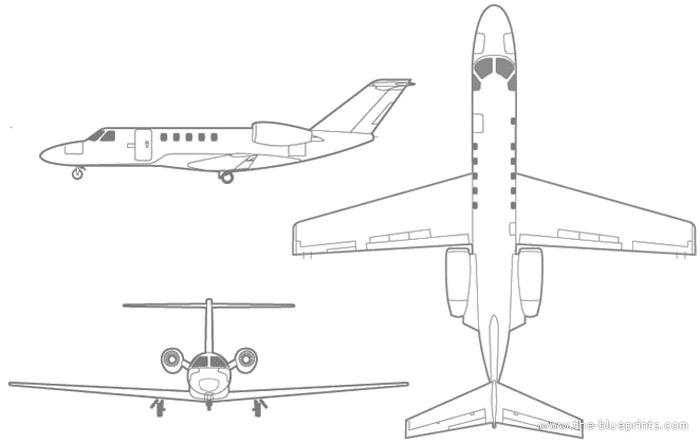
The CJ4 is Cessna’s first narrow-body jet with a swept wing (12.5 degrees at quarter chord) and a wing area of 30.7 m². Its high-speed aerodynamic characteristics are equally impressive, with a maximum operating speed increased to Mach 0.77. While this is slightly less than the Phenom 300’s 0.78M and the Learjet’s 0.81M, the critical speed at which wing aerodynamic drag exponentially increases due to shock waves is significantly higher than the maximum allowed, ensuring efficient operation at high cruise speeds.
All range figures, including 3700 km with fuel reserves, are quoted by the manufacturer based on five passengers and two crew members; reducing speed increases the range by just over 8%. The T-shaped tail empennage is borrowed from the CJ3, with an elongated chord on its fin for improved directional control and an enlarged stabilizer for better longitudinal stability—a practical advantage given the CJ4’s high cruise speeds. Fuselage assembly is done “outside-in,” where the skin is first assembled and held by vacuum jigs, ensuring impeccable streamlining, then the internal framework and components are added. Cessna’s three decades of expertise in using structural adhesives contribute to reduced aerodynamic drag and faster production times. This approach meant the CJ4 ultimately weighed 8 kg less than designers predicted, with an empty equipped weight (including two pilots) of 4646 kg (10,242 pounds).
The aircraft’s nose underwent substantial redesign, adopting a more aerodynamic profile and conical reinforced windshield glazing. Compared to its CJ series predecessors, the CJ4 boasts the most advanced systems, with impressive electrical changes. For narrow-body aircraft in this family, the level of redundancy is unprecedented: all onboard avionics, including the autopilot, have quadruple redundancy. Even in the unlikely event of all four power sources failing, the main battery’s power is sufficient to minimally supply the aircraft with electricity required to complete the flight.
In contrast, rivals like the Phenom 300 and Learjet 40 series only have two power sources. The CJ4’s lithium-ion battery, a joint development by Cessna and A123 Systems, is the first of its kind used on a business jet. It not only performs better than standard (e.g., nickel-cadmium) batteries but also saves over 13 kg of aircraft weight. This alternative approach also allows the CJ4’s engines to be started from the battery at temperatures down to –40°C. The CJ4 also features the new Rockwell Collins Multi-Scan weather radar and Venue CMS cabin management system, features typically found only on higher-category business jets.
Advanced Technology and Flight Experience
The pressurization systems are similar across all three aircraft. At FL450, the CJ4’s pressurization system (0.61 atm) maintains a cabin altitude of 2380m, while the Phenom 300 (0.63 atm) offers 2011m, and the Learjet (0.64 atm) 1960m (with potential for flight up to FL510). Both the CJ4 and Phenom 300 are equipped with a standard evaporative air conditioning system, cooling the cabin air via a ground power source before engine start. For the Learjet, this system is optional, but the Learjet 45XR uniquely includes a Honeywell RE100 APU for autonomous ground operations.
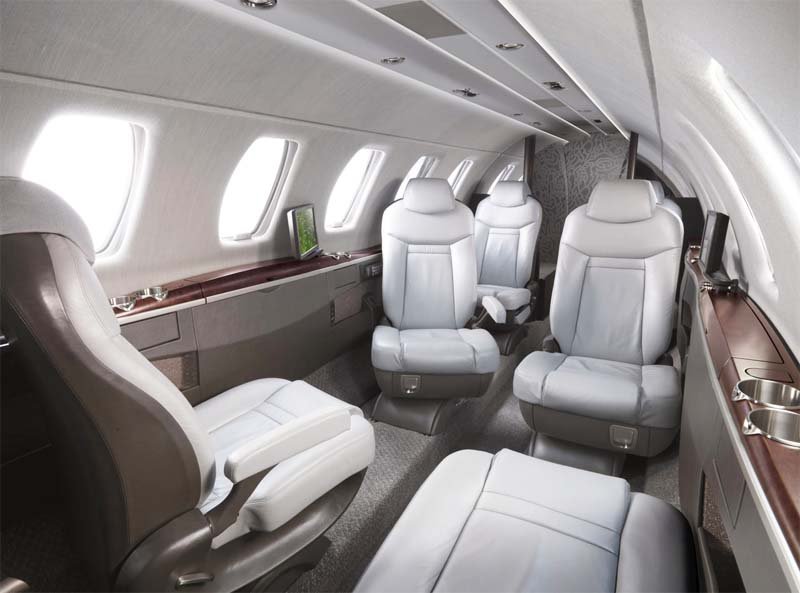
While the CJ4’s cabin volume is smaller than the Phenom 300 or Learjet 40 series, this is only one dimension of passenger comfort. The rear compartment, which is 10 cm longer than the Phenom 300’s equivalent, features a club section of four seats plus two forward-facing seats. The aisle floor is lowered in both the CJ4 and Phenom 300 to increase cabin height. A seventh passenger seat is standard opposite the entry door, which can be swapped for a two-person sofa at no cost, saving 11 kg of empty weight. A ninth passenger can use a fold-down seat over the toilet, though these additional seats are less comfortable than the main six.
The Learjet 45XR’s flat, un-recessed floor allows for more rational use of cabin width. Its 5-meter main compartment accommodates an additional row of seats, comfortably seating eight passengers. Although the CJ4 cabin is over half a meter longer than its predecessor, the CJ3, it has three fewer windows (five on the right, six on the left), affecting natural light compared to the Learjet 40 (14 windows), Learjet 45 (16 windows), and Phenom 300 (four right, five left, plus two in the lavatory, all larger). All three aircraft use long-lasting LED lighting, offer separate temperature control in two cabin zones, and include forward galleys with hot/cold beverage containers and provisions storage.
The CJ4’s entry door is an iteration of early Citation 500-series models: it extends outwards and sideways, with increased dimensions (61 x 122 cm) and a folding airstair. In terms of cabin noise, the CJ4 inherits the achievements of its predecessor, the CJ3, and Learjet engineers have also achieved impressive results. Embraer, however, still needs to work on the Phenom 300 to match its competitors in this regard, given the rather noisy Phenom 100. A new Rockwell Collins Venue CMS (Cabin Management System) is installed to control cabin parameters (lighting, window shades, entertainment), a first for a business jet in this class.
The CMS architecture, inspired by avionics, results in a simpler and more reliable system than previous generations. It uses distributed control with controllers located in each seat, networked via a ring-topology Ethernet, ensuring functionality even if one component fails. Venue CMS boasts extensive self-diagnostic capabilities, simplifying troubleshooting. It includes three 10.6-inch HD monitors, satellite radio, Aircell Axxess II Iridium satellite phone connectivity, numerous ports for MP3 players, two 110V power outlets, and a standard moving map (Airshow). Cessna’s interior options include various finishes, rotating seats, iPod stations, and entertainment upgrades.
External baggage compartments on the CJ4 and Phenom 300 are nearly identical in placement and volume: one in the tail (1.6 m³ for CJ4, 1.9 m³ for Embraer) and a smaller nose compartment (0.42 m³ and 0.14 m³ respectively). The test flight aircraft (prototype N525NG) was loaded with test equipment instead of a standard interior, making its empty weight over 300 kg heavier than production models. With 2.65 tons of fuel and two crew members, the takeoff mass was 7620 kg.
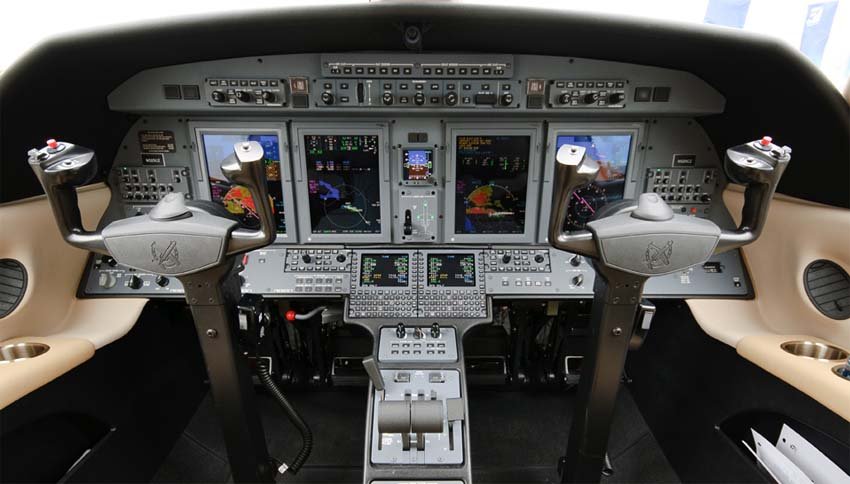
The CJ4’s cockpit was a “clean sheet” design by Cessna, noticeably more ergonomic than all preceding CJ family models. Frequently used instruments and switches are positioned at eye level, with most system switches on a sloped panel below the displays, making them easily accessible. Less frequently used controls, such as trim or external lights, are on the center console. LED indicators provide unambiguous feedback on system status. While Cessna replaced dozens of standalone gauges with MFD displays, engine and system data are still presented as numbers, arrows, and pointers, with a warning system for any abnormal situations.
During takeoff from Wichita, the CJ4 demonstrated impressive ground maneuverability, with tight turns possible within a 10m radius. With nearly 3.3 tons of thrust, its power-to-weight ratio of 2.32:1 is almost sporty, allowing for brisk acceleration and easy rotation. The aircraft’s obedience was evident from the first moments, performing manual flight with ease and precision. The climb to FL450 took 23 minutes, nearly 4 minutes faster than planned, despite some inefficiency above FL300 as the flight management system tried to maintain the recommended Mach 0.64 climb speed.
In horizontal flight, the CJ4 accelerated to 414 knots. Fuel consumption (at an aircraft weight of 7300 kg) stabilized at 463 kg (1020 pounds) per hour, slightly higher than the manufacturer’s claim. Steep 180-degree turns against the wind revealed buffeting only after 52 degrees of bank, when the G-load exceeded 1.8g. During descent to FL310 to test the airbrakes, the aircraft pitched up slightly, but despite significant drag, shaking was barely felt. At ISA –3°C, the maximum speed at this altitude was limited to 453 knots, with fuel consumption at 816 kg (1800 pounds) per hour. At 16,000 feet, 45-degree turns at 250 knots confirmed superb controllability, maintaining speed within six knots and altitude within 40 feet even without trim.
Stall testing, performed only until stick shaker activation per Cessna policy, showed predictable behavior. In a clean wing configuration, the shaker activated at 113 knots indicated airspeed, with buffeting and slight wing rock at 103 knots. Recovery was not instantaneous but fully controllable, with a maximum altitude loss of 140 feet. With gear and flaps deployed, the shaker activated at 98 knots indicated airspeed, with buffeting at 83 knots. Recovery from this condition resulted in a 300-foot altitude loss. These exercises provide valuable lessons for pilots new to the CJ4, highlighting the generous angle of attack margin between shaker activation and full stall.
Landing approaches (ILS and GPS) were stable, with engine response to thrust changes and trim adjustments proving remarkably proportional. Overall, little effort was required to maintain stability. Similar to all CJ family models, the CJ4 exhibits high “floatability” due to its large wing area, leading to a strong ground effect. Even a slight overspeed on landing can cause it to float for an extended period, so meeting the runway threshold at touchdown speed and promptly reducing throttle is recommended. During simulated single-engine failure takeoffs and landings, the ease with which yawing moments could be countered with the rudder was surprising, perhaps even simpler than on other docile aircraft in this renowned family. The final landing with digitally controlled brakes and effective spoilers resulted in a flawless rollout of approximately 760m, without any deviation from the runway centerline.
Conclusions and Market Positioning
The CJ4 is unequivocally the best narrow-body Citation produced to date, unparalleled in handling among its classmates. Its reorganized cockpit significantly reduces crew workload, and its flight characteristics meet or exceed manufacturer specifications. A comparative analysis shows the CJ4 as a structurally efficient, versatile aircraft that has overcome many “hereditary diseases” of the 525 series. It can carry five passengers with two crew on full tanks, or even eight to nine passengers (with a two-seat sofa) and still connect any pair of US cities with one technical stop.
Another competitive advantage of the CJ4 is its superior, class-leading takeoff and landing performance. The combination of a sufficiently large wing and reliable high-altitude performance of the Williams FJ44-4A engines allows for a direct climb to FL410 and above on all routes longer than 370 km. Indeed, climbing directly to FL450 from the runway is the only way to achieve the manufacturer’s advertised maximum range of 3708 km at maximum cruise speed and land with 185 km of fuel reserves per NBAA IFR requirements.
At maximum speed (453 knots at FL310), the aircraft consumes 830 kg (1828 pounds) of fuel per hour, equating to 0.459 km per pound—the least fuel-efficient in its class. However, at FL450, speed drops to 430 knots, and fuel consumption to 444 kg (978 pounds) per hour, achieving 0.81 km per pound of fuel, which is 10% better than the more economical Learjet 45. Other undisputed advantages include its ability to operate from most general aviation airfields, even those with insufficient runway length or in high-altitude/hot conditions. The cockpit ergonomics and avionics, including the unique Rockwell Collins Multi-Scan weather radar and Venue CMS cabin management system, further position the CJ4 as a class leader.
One of Cessna’s main strengths is its world-class operator support, unmatched by any other light business jet manufacturer. Undeniably, the CJ4 is the most capable of the entire narrow-body Citation family. It outperforms the Encore+ in all respects and costs almost $400,000 less. The cancelled Hawker 450 could have provided strong competition. Current test results indicate the CJ4 surpasses its main rival, the Phenom 300, in most flight performance characteristics, though final figures from Embraer are pending. Despite some direct competitors offering more spacious cabins, Cessna provides a hard-to-dispute combination of satisfactory passenger comfort, good flight characteristics, innovative technology, and excellent service. This allows the CJ4 to carve out a special market niche, ensuring its strong marketability, even as Embraer challenges the long-standing duopoly of Cessna, Hawker Beechcraft, and Bombardier Learjet in the light jet market.
Technical Specifications
| Modification | CJ 4 |
| Wingspan, m | 16.26 |
| Aircraft length, m | 15.49 |
| Aircraft height, m | 4.67 |
| Wing area, m2 | 29.50 |
| Empty weight | 4654 |
| Maximum takeoff weight | 7688 |
| Fuel capacity | 2635 |
| Engine type | 2 Williams-Rolls FJ44-4A Turbofan |
| Thrust, kN | 2 x 15.12 |
| Maximum speed, km/h | 806 |
| Cruising speed, km/h | 770 |
| Practical range, km | 3380 |
| Service ceiling, m | 13715 |
| Crew, crew members | 2 |
| Payload | 6-8 passengers |
Image gallery of the Cessna Citation CJ4