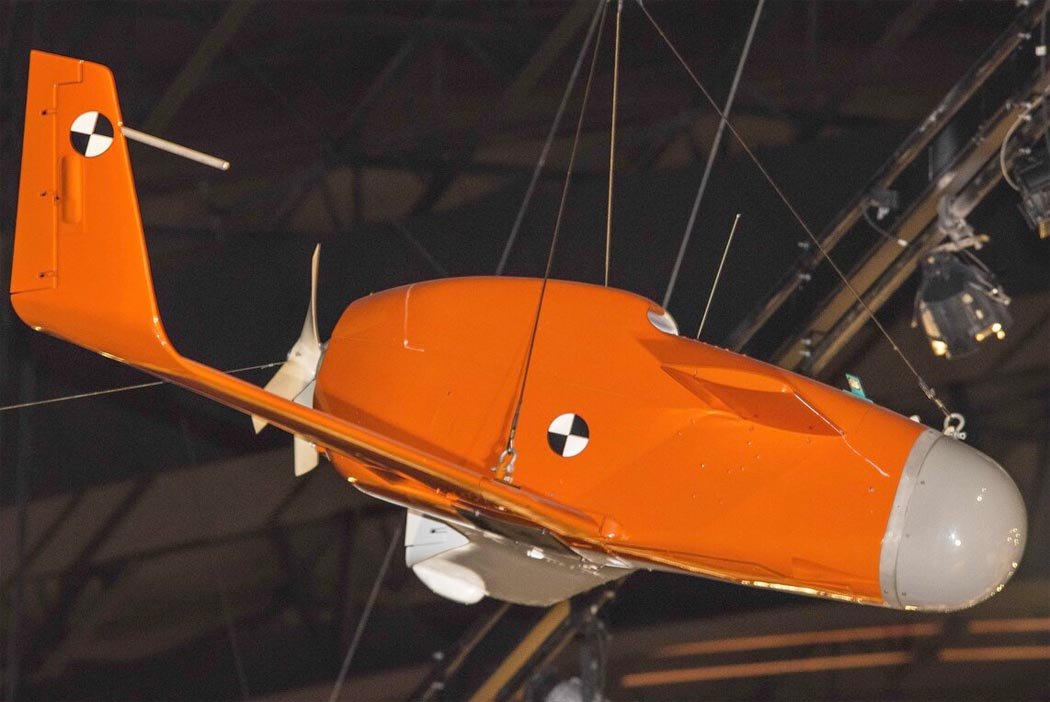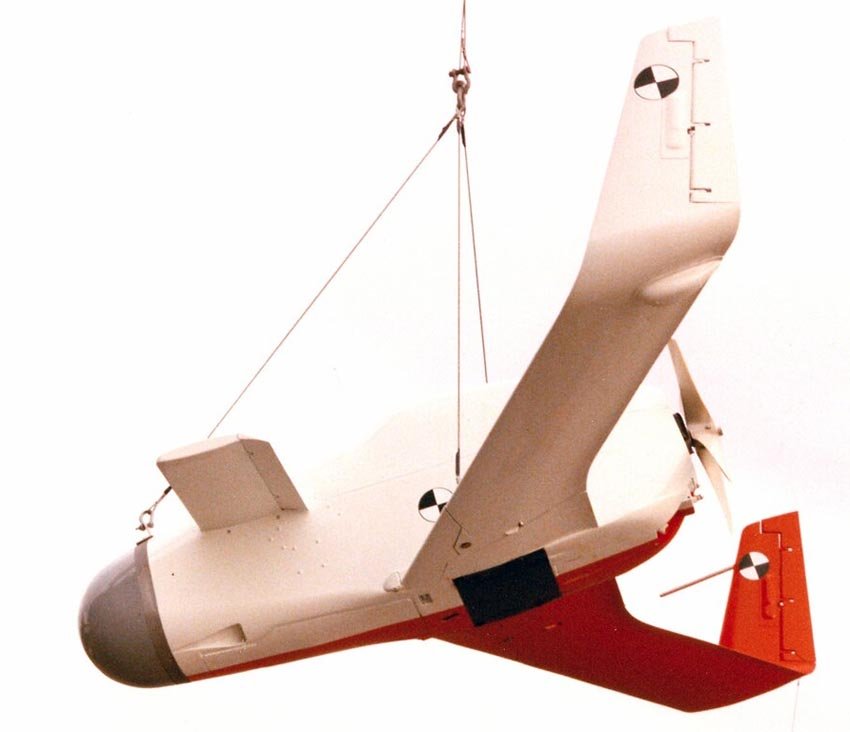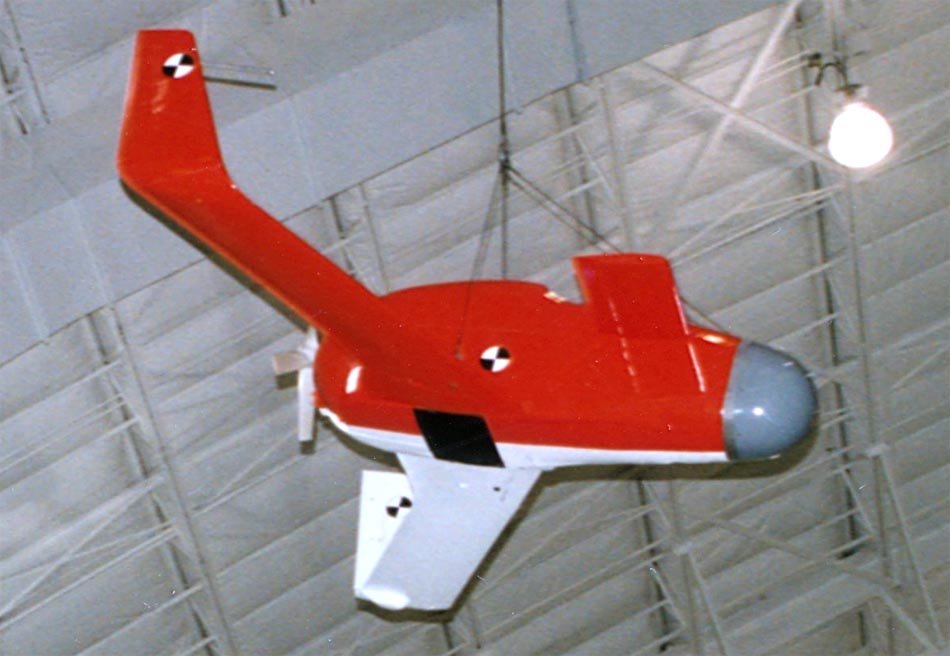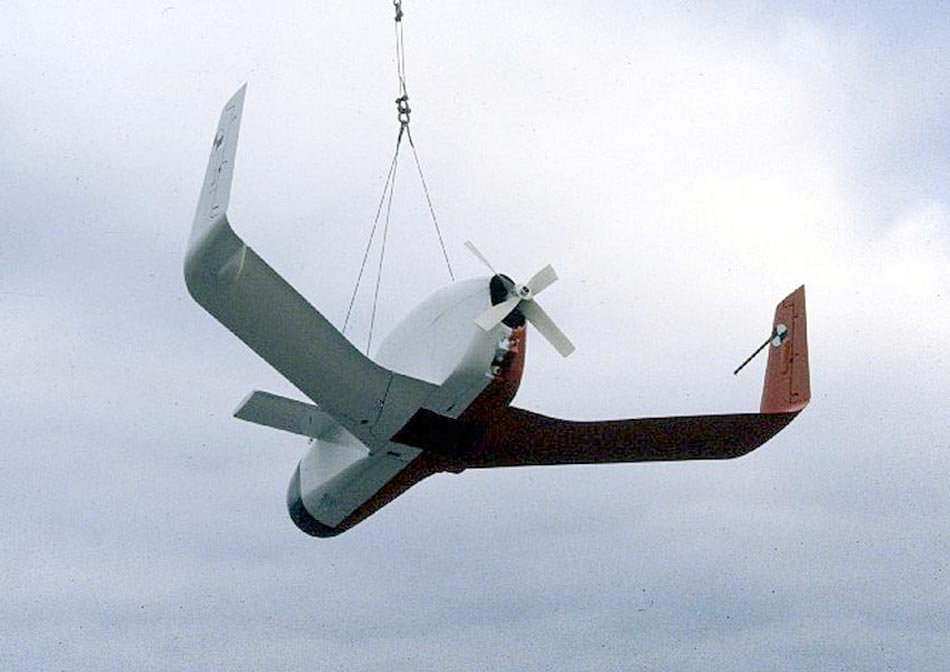
In the late 1980s, the U.S. Air Force Department awarded Boeing Military Airplanes an 18-month, $63 million contract. This agreement covered full-scale development for an anti-radar loitering munition, the YCGM-121B Seek Spinner. Its name, “Seek Spinner,” translates to “Seeker-Spinner” or “Top-Seeker” from English, although “spinner” also means “spindle maker” or “spider.”
The missile received its name, which refers to a toy spinning around its axis (a top), due to its radar seeker head. Inside, a 360-degree surveillance radar with a dish antenna was housed, whose operational principle (continuous rotation around its axis) resembled a spinning top.
Boeing specialists developed the Seek Spinner to meet U.S. Air Force command requirements as a modification of the basic anti-radar drone, the YCQM-121A Pave Tiger. This predecessor was equipped with a compact electronic warfare system.
Origin and Development
The American “kamikaze” drone, first flown in November 1987, had a maximum takeoff weight of approximately 200 kg. It featured a storage and launch system unique for its time.
These devices, ready for almost immediate combat use, were housed 15 at a time in a special block launcher. Since then, this loitering munition launch system has become widely adopted and is now one of the most actively used by developers worldwide, utilizing both multi-round launchers and single launch tubes.
Operational Concept and Challenges
With an estimated cost of $20,000–$25,000 per missile, the adoption of the CGM-121B allowed for massive missile strikes on enemy air defense zones. Even if the hit rate for missiles reaching targets was 1:20 (i.e., 50 out of 1,000 launched missiles), their use was considered expedient, and combat effectiveness was rated high.
According to U.S. experts, including U.S. Air Force Vice Chief of Staff General Lawrence Scantze, the destruction of about fifty Soviet radar stations in the flight paths of American bomber aircraft using Seek Spinner missiles would neutralize the USSR’s air defense system. However, most of these attempts were largely unsuccessful or lacked the reliability and combat effectiveness that military clients expected. This was due to the insufficient development of aviation and weapons technologies of the time, as well as unresolved critical issues in creating highly effective control systems. Consequently, such an “ineffective” weapon did not transition into series production.
As expected, military experts and development engineers quickly concluded that the most effective approach would not be to create a loitering munition as an “option” for reconnaissance drones or, even more so, air-launched cruise missiles. Instead, it was to develop such a weapon initially as a standalone piece of high-precision weaponry. Only then, according to military experts, could two goals be achieved: providing the loitering munition with the necessary combat potential and eliminating the shortcomings inherent in unmanned aerial vehicles of that size.
A preserved sample of the missile was transferred for safekeeping to the National Museum of the United States Air Force in Dayton, Ohio.
Technical Specifications
| Modification | YCGM-121B |
| Wingspan, m | 2.57 |
| Length, m | 2.12 |
| Height, m | 0.61 |
| Maximum takeoff weight | 127 |
| Warhead | 18 (HE) |
| Engine type | 1 Piston engine Cuyuna Eagle |
| Power, hp | 1 x 28 |
| Cruising speed, km/h | 320 |
| Practical range, km | 480-800 |
| Practical ceiling, m | 3000 |
Image gallery of the CGM-121B Seek Spinner