Development and Initial Design
The prototype of the Piasecki PD-22 tandem-rotor helicopter (U.S. Air Force designation: XH-21) made its first flight on April 11, 1952. Eighteen YH-21 helicopters were ordered in 1949 for evaluation trials by the U.S. Air Force, followed by an order for the first 32 serial H-21A machines. The U.S. Army named the helicopter H-21 “Work Horse.”
A distinguishing feature of the production machines from the prototype was the end plates on the stabilizer. The Navy purchased only four aircraft, while the Air Force acquired 214, and the Army 334. In total, 557 machines were built for domestic customers (including five experimental HRP-2s) and 150 for export. The first production machine made its flight in October 1953.
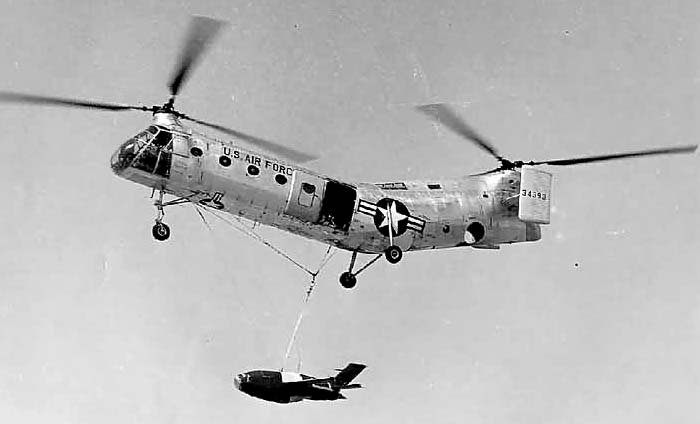
The first production variant of the H-21 was equipped with a single Wright R-1820-75A piston engine delivering 1150 hp. The search and rescue model for the Air Force, the H-21A, was fitted with a Wright R-1820-103 engine, also producing 1150 hp. The Air Force ordered two more variants: the assault transport H-21B and the transport H-21C; both modifications were powered by R-1820-103 engines rated at 1425 hp. The Army variant first flew in 1951, with its serial production commencing in 1952.
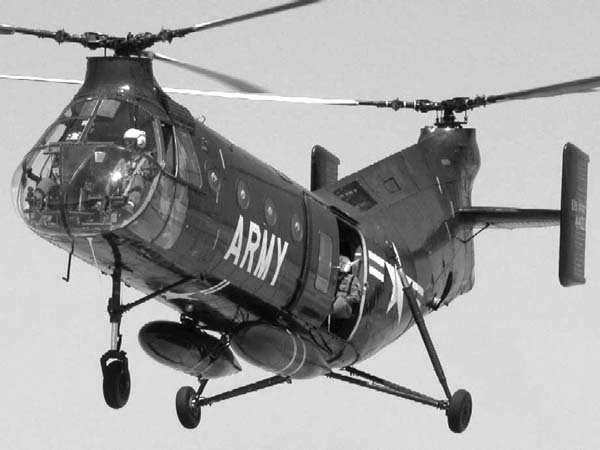
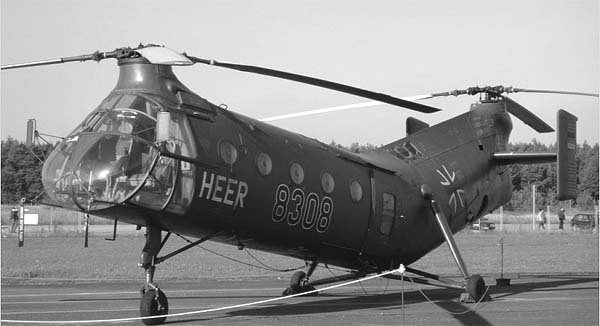
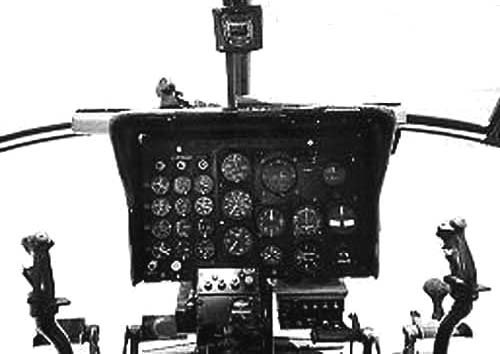
The H-21 helicopter’s fuselage was all-metal, of a semi-monocoque type. The cockpit was separated from the cargo compartment by a bulkhead. The cargo cabin had one door on both the right and left sides. The left-side door was positioned closer to the tail, while the right-side door was closer to the nose. A winch with a lifting capacity of 180 kg was mounted on the front door. Rails laid on the floor facilitated the placement of heavy cargo in the cabin.
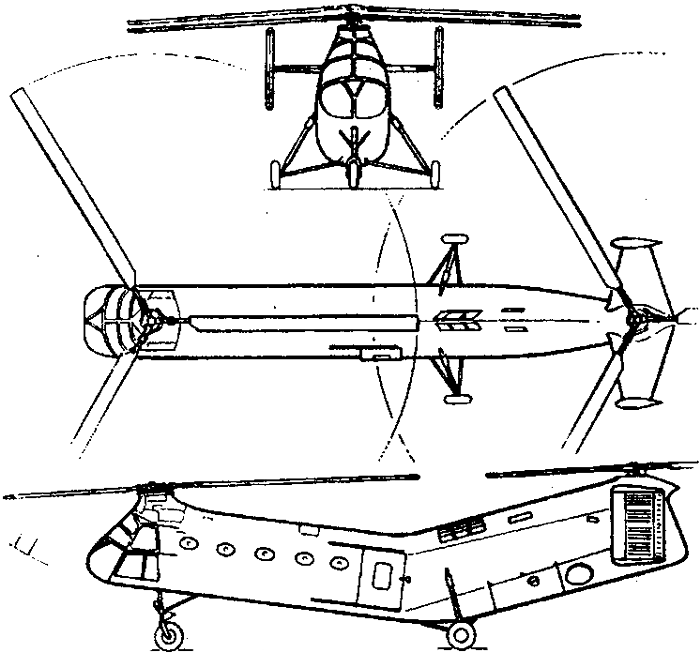
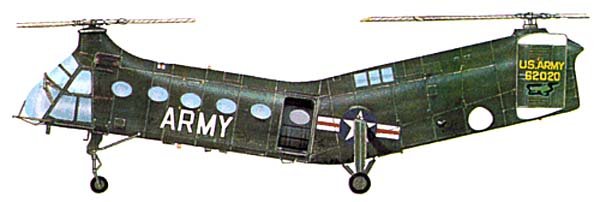
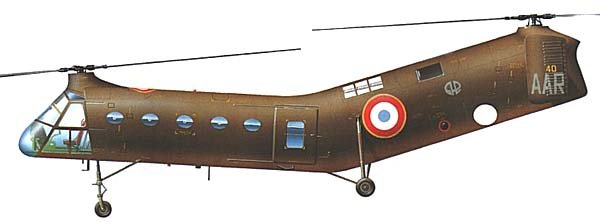
Nine folding seats were installed along the sides (in the assault variant), with two additional seats located on the bulkhead separating the cargo and pilot compartments. Immediately behind the cargo compartment, the fuselage featured a sharp break, giving the helicopter its characteristic appearance, strongly resembling a banana. A pronounced rear rotor pylon was absent. The stabilizer had rectangular end plates.
Behind the cargo compartment was the fuel tank, followed by the engine, which was mounted horizontally. The main rotors were three-bladed. The rectangular-plan blades had a metal frame with plywood skinning. The rotor was equipped with vertical and horizontal hinges. The landing gear was a tricycle type with a nose wheel. Provisions were made for replacing wheels with skis and installing inflatable pontoons.
Operational Challenges and Commercial Use
The operational experience of the “Work Horses” was quite mixed. Designers failed to resolve the issues of rotor blade strength. In 1954, after a series of accidents and disasters caused by blade failures, the U.S. Department of Defense was forced to ban all H-21 helicopter flights. Flights resumed only after replacing the wooden blades with metal ones.
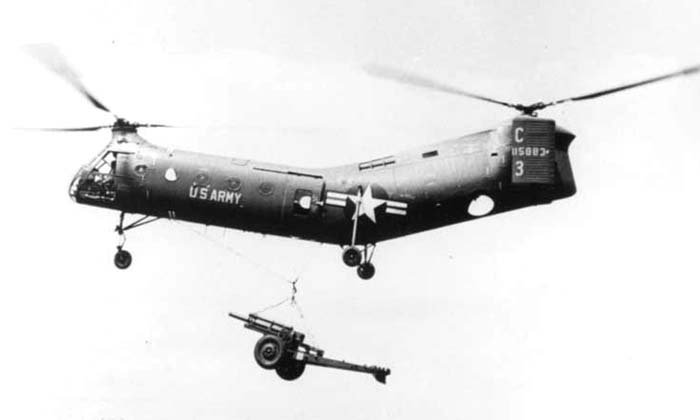
Americans extensively experimented with the H-21, working out various applications for rotary-wing aircraft. A machine gun turret was mounted under the fuselage in the nose section of one aircraft, demonstrating direct air support for ground troops. The “Flying Banana” also tested the possibility of towing various equipment, from boats to tanks.
Commercial operation of the “bananas” holds a special place. In the late 1950s, the Vertol company (in 1955, Piasecki Helicopter split into two—Piasecki Aircraft and Vertol Aircraft. Frank Piasecki focused on creating vertical take-off aircraft and high-speed helicopters with a ducted pusher propeller, while the development of “normal” helicopters remained with Vertol Aircraft) began serial production of the civilian variant of the H-21—the “Vertol-44” helicopter. The design of the civilian H-21 version began in the mid-1950s under the cipher PH-21.
The aircraft was built in three variants: the “Vertol-44A” transport, the “Vertol-44B” passenger, and the “Vertol-44C” enhanced-comfort passenger version. Civilian variants were serially built until 1966. In 1957, the helicopter toured the oil fields of the Gulf of Mexico, demonstrating its ability to deliver people and cargo to offshore drilling platforms.
In 1959, five “Vertol-44Bs” were operated by “New York Airways,” with landing pads on Wall Street and the Hudson serving as home for these aircraft. The French company “Courriers Normands-Transcar” operated several helicopters on the Le Havre-Caen route. Italian company “Elipadana’s” “Vertol-44Bs” flew from Milan to San Remo, Verona, and Turin.
Combat Service and International Legacy
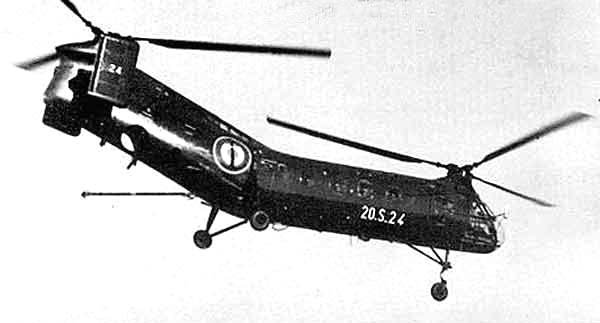
H-21 helicopters not only served in the military but also saw combat. Moreover, the aircraft became one of the main protagonists of the first-ever “helicopter war,” referring to France’s military operations in Algeria. The French first deployed helicopters to Algeria in early summer 1956.
The Army, among others, sent 11 H-21 helicopters to North Africa, while the Navy command dispatched three more of the same type to the combat zone. The helicopters were based in Setif, in the eastern central plateau of Algeria. Together with S-58 transports, Piasecki’s machines were widely used in airmobile operations. The French were the first to develop tactics for using rapid reaction forces.
The spacious helicopters allowed for the rapid delivery of relatively large commando forces to areas where Algerian partisans appeared. Often, troops were dropped directly onto the enemy. Well-trained soldiers could exit the helicopter in just 20 seconds. However, landings were not always unopposed: there was a case where well-aimed machine gun bursts into the cabin of a hovering “banana” killed all ten soldiers.
The scale of longitudinal-scheme helicopter use is illustrated by the following figures: from August 1 to 15, 1956, just four H-21s performed over 250 combat sorties and transported more than 2,000 soldiers. By the end of November, the record flight time for a single helicopter was 646 hours, and all H-21 helicopters collectively transported 70,000 people, accumulating 10,000 hours in combat conditions. Since flights were primarily conducted in the mountains, a helicopter usually carried ten commandos at a time. The French armed several “bananas” with 20-mm automatic cannons. These machines were used for fire support during landings. Lieutenant I. Babot, commander of French Navy Squadron 31F, found a unique use for the auxiliary fuel tank racks. He attached racks for five 250-pound aerial bombs instead of tanks, converting the helicopter into a bomber. The enterprising officer even mounted a bomb sight in the cockpit.
The number of rotary-wing aircraft grew rapidly. In 1956, 11 “Flying Bananas” were based in Setif; a year later, there were already 39. A new helicopter base emerged in the western part of the country—Sidi bel Abbès. In January 1958, seven H-21 helicopters were stationed there, though they were primarily used for training. In 1956, the French Navy had two H-21s in Algeria, and eight a year later. Naval helicopters were subordinate to army command and based in Setif. However, saying helicopters were based in Setif is not entirely accurate. Machines only flew to Setif for maintenance, operating from landing pads located in army garrisons. Due to the extensive deployment of helicopters, reaction time to a threat was reduced to 10 minutes.
In Algeria, Piasecki helicopters directly competed with Sikorsky machines. The Air Force preferred H-34 helicopters, while the Army favored Piasecki’s aircraft. One army officer stated, “The H-21 helicopter is a truck, while the H-34 is a racehorse. We, however, are not participating in races.” An Air Force officer contradicted him: “The H-34 is the best heavy helicopter among those used in Algeria.”
The “trucks” sustained losses. The vulnerability of helicopters to even single bullet hits came as a great surprise to the French. Pilots played a lottery. One H-21 returned to Setif with 18 holes in the rotor blades, fuel tanks, and fuselage, and a partially destroyed drive shaft; another, fully operational, crashed because bullets “found” both pilots. In July 1957, a 12.7 mm bullet lodged in the transmission of a “banana” on a combat sortie; nevertheless, the mission was completed, and the helicopter safely returned to Setif. In September 1957, an H-21’s rear rotor drive shaft was half severed, but the machine stayed airborne for 30 minutes and made it back to base. In autumn 1957, the pilots of another H-21 distinguished themselves. Ground fire severed the collective pitch control cable. The pilots landed the machine in plain sight of the enemy, tied the ends of the broken cable with wire, and then managed to take off and fly for 1 hour and 45 minutes to Setif. By January 1958, four H-21s had been shot down by ground fire. Frontline personnel raised the issue of installing armor and self-sealing fuel tanks on helicopters. Armor installation was deemed impossible due to the reduction in payload, but self-sealing fuel tanks did appear on the “Algerian” H-21s.
From the perspective of helicopter combat application, Algeria became a precursor to Vietnam. American helicopters appeared in Indochina much earlier than the Tonkin Incident. In December 1961, the 8th and 57th Light Helicopter Transport Companies were transferred from the U.S. to Saigon. The aircraft carrier “USNS Core” delivered the rotary-wing equipment to Indochina. On December 22, 30 “bananas” from both units performed their first combat sortie, delivering South Vietnamese infantry. In the landing zone, one CH-21 (by this time the designation had changed to CH-21), serial number 56-2018, was shot down by small arms fire—the first of thousands of combat losses for U.S. armed forces helicopter units over Indochina; the aircraft belonged to the 57th Company. In late January, CH-21s appeared in Da Nang with the arrival of the 93rd Light Helicopter Transport Company. The 93rd Company suffered its first losses on September 30, 1962, when two “bananas” (serial numbers 52-8662 and 564350) were shot down during Operation “Lam Son II.”
Transport helicopters needed an escort of well-armed, more maneuverable “choppers.” UH-1 helicopters began to perform escort tasks for the CH-21. In the initial period of the Indochina War, the “Flying Banana” was the primary transport helicopter. For some time, Americans were only allowed to return fire. The situation changed after the battle for Ap Bac.
On January 5, 1963, up to forty CH-21 helicopters were scheduled to deploy South Vietnamese infantry in four waves. The first wave of helicopters reached the landing zone and offloaded without interference. Falling fog delayed the landing of the remaining three waves for an hour and a half. The helicopters of the second and third waves also deployed troops without incident. Half an hour later, the fourth wave arrived. This time, the helicopters were met with a wall of fire. All helicopters received direct hits from bullets; one made a forced landing. To retrieve the crew of the damaged helicopter, another CH-21 landed nearby. The machine, riddled with bullets upon landing, could no longer take off. The reasons for the heavy losses were discussed in Saigon at a meeting with General Paul Harkins, commander of the group of American military advisors in Vietnam. Admiral Harry Felt, commander of the U.S. Pacific Fleet, presided. Harkins and Felt authorized their men to open fire first. On January 3, 1963, the countdown of U.S. armed forces helicopters shot down over Vietnam began. By the end of 1963, more modern UH-1Bs filled the niche of the “Flying Bananas.” In Vietnam, CH-21 helicopters were armed by their crews with machine guns and HVAR rocket pods. Out of eight CH-21s: two were lost on the battlefield, a third made a landing one kilometer from the landing zone, seven made it back to base, but only two of them were repairable; the rest were written off. Additionally, two days earlier, on January 3, another CH-21 was also shot down in the An Bac area.
In 1955, the Canadian government purchased four H-21A helicopters for search and rescue operations in Arctic conditions. Then, in 1958, they acquired another four H-21Bs and three “Vertol-44As.” All Canadian “bananas” had cockpit heating and rotor blade de-icing systems (similar systems were not installed on all U.S. military H-21s). Canadians widely used H-21 helicopters in the construction of NORAD (North American Air Defense) radar system stations. Military aircraft were actively used for rescuing crews of distressed vessels and evacuating the wounded. There were even instances of externally transporting small aircraft that had made forced landings. For example, in April 1955, a helicopter successfully evacuated a Cessna-180 from a forced landing site.
In 1958, four “Vertol-44” helicopters, specially modified into an ASW (anti-submarine warfare) variant, entered service with the Swedish Navy aviation, where they received the designation HKP-1. The Swedish “choppers” differed from the original variant by having search equipment and the ability to land on water—experiments with the amphibious HUP-2 proved useful. The fleet of Swedish “bananas” was augmented by five helicopters in 1960, and in 1964, the Swedes acquired another five “Vertol-44Bs” from “New York Airways.”
Attempts were made to sharply improve the flight characteristics of the H-21 by installing two General Electric T-58 turboshaft engines, each with 1025 hp; this modification was designated H-21D. Flight tests of two prototypes began in autumn 1957. However, the “turbine” variant did not proceed to serial production.
Technical Specifications
| Modification | H-21V |
| Main rotor diameter, m | 13.41 |
| Length, m | 26.31 |
| Height, m | 4.7 |
| Empty weight | 3629 |
| Maximum takeoff weight | 6668 |
| Engine type | 1 Piston engine Wright R-1820-103 Cyclon |
| Power, kW | 1 x 1063 |
| Maximum speed, km/h | 211 |
| Practical range, km | 644 |
| Practical ceiling, m | 2360 |
| Crew, crew | 2 |
| Payload | 20 soldiers or 2130 kg of cargo in cabin or 1814 kg on sling |
Image gallery of the CH-21 Work Horse (Shawnee)