The creative journey of Soviet weapons designer Vyacheslav Ivanovich Silin began in the 1930s. At the age of 25, he joined Tula’s TSKB No. 14. Lacking sufficient technical knowledge for the work, Silin enrolled in the evening department of the Tula Mechanical Technical School, successfully graduating in 1938.
One of the first projects Vyacheslav Ivanovich worked on seriously was the ShKAS aircraft machine gun.
The Innovative SIBEMAS System
Having established himself as a talented self-taught engineer in 1935, Silin began working on independent projects. In collaboration with M. E. Berezin and P. M. Morozenko, they presented the design for a completely unique 7.62mm aircraft machine gun, the “SIBEMAS.” Its name was an acronym for Silin, Berezin, Morozenko, Aviation, High-Rate, with a revolver-type block of 4 barrels, powered by the energy of gunpowder gases.
At that time, no weapon in the world boasted such a colossal rate of fire, reaching 6,000 rounds per minute! This system was the first in the USSR to use a revolving (drum-type) automatic mechanism, marking a qualitative leap in the quest for high-rate-of-fire aviation weapons.
Unfortunately, the initiative of these talented designers did not receive due recognition. Individual shortcomings, inevitable in any new endeavor, led to the project being discontinued around 1939-1940 after the first difficulties arose. Evidently, the solutions embedded in the “SIBEMAS” system seemed too revolutionary even for the progressive Soviet leadership of that period.
Data on the “SIBEMAS” system is scarce. Currently, no photographs or diagrams of the “Sibemas” machine gun survive, only modest descriptions and contemporaries’ recollections.
V. N. Novikov, former Deputy People’s Commissar of Armaments of the USSR, wrote in his memoirs: “…The machine gun, designed by V. I. Silin, M. E. Berezin, and P. K. Morozenko, had an incredible rate of fire – 6000 rounds per minute. Unfortunately, this aircraft machine gun was underestimated, and work on it was ceased…”
Of course, it cannot be said that the revolving weapon scheme was fundamentally new. As early as the 1860s, the history of automatic weapons began with a similar scheme, developed and patented by American inventor Richard Jordan Gatling. Gatling systems, initially with manual and later electric drive for their barrel block, were quite common weapons in the late 19th and early 20th centuries.
However, Silin, with the “SIBEMAS” machine gun, successfully implemented for the first time in practice the revolving scheme powered by gunpowder gases, which became a hallmark of domestic revolving systems in the post-war years. The prevailing opinion that the Germans, who developed their gas-operated revolving aircraft cannon MG.213 at the end of the war, “borrowed” the idea from the Soviet Union is likely far-fetched. Nevertheless, Silin’s pioneering role in this matter is undeniable.
Developing the TsKVSV-19 Twin Machine Gun
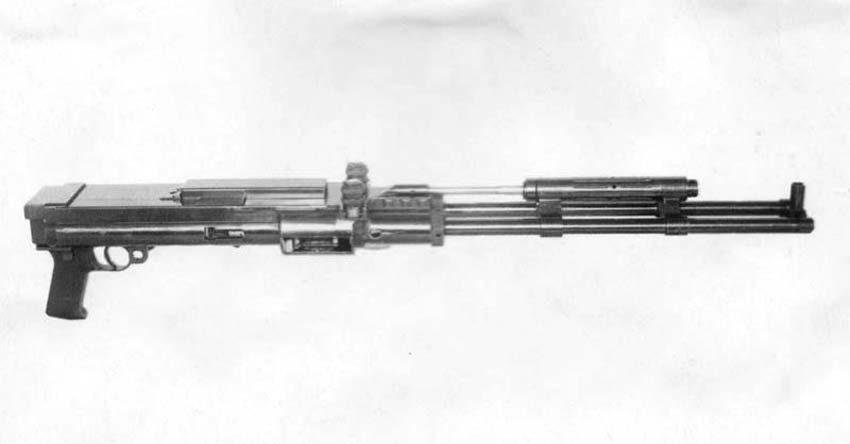
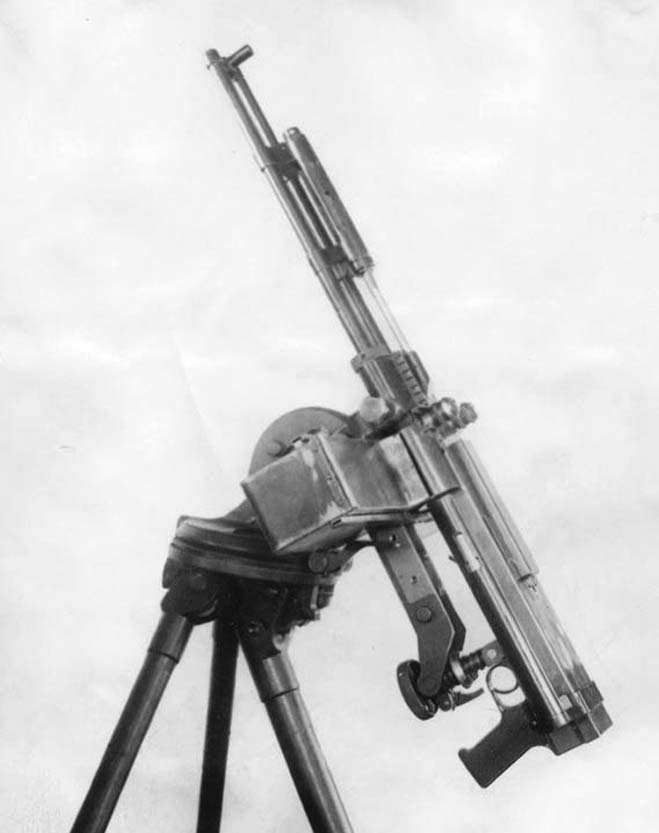
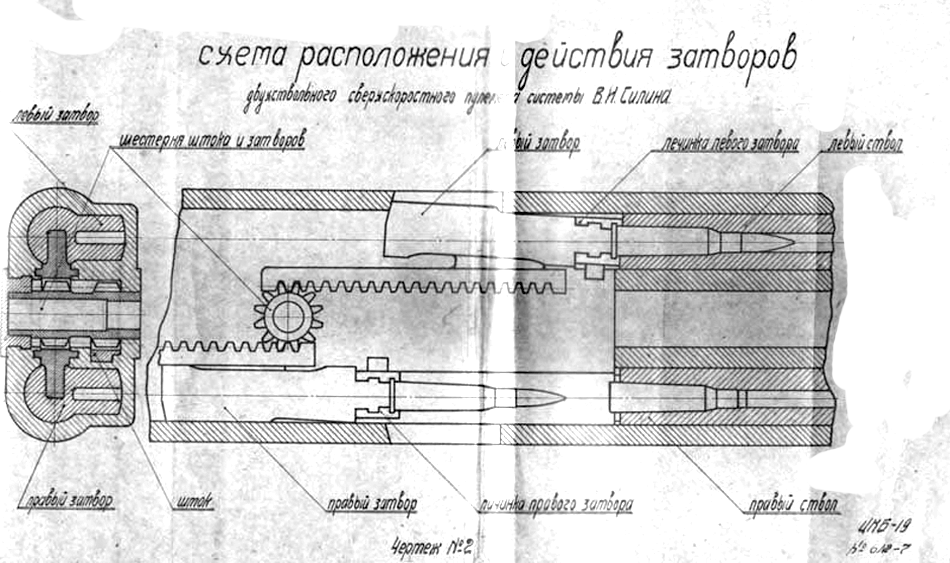
V.I. Silin’s next project was the TsKVSV-19 twin-barreled system, chambered for 7.62mm cartridges. The highlight of Silin’s design was that the TsKVSV-19 machine gun was specifically a twin-barreled system, not merely a paired machine gun with interdependent barrel locking mechanisms. It operated on the gas-operation principle, distinguished by having a common gas chamber for both barrels to impart reciprocating motion to the rod without a return spring. It featured two pistons on a common rod that controlled the machine gun’s mechanisms, ensuring alternating action of gunpowder gases, which were successively vented from the barrels upon firing, moving the rod both backward and forward.
It should be noted that V.I. Silin should not be credited with originating the concept of a twin-barreled system. A similar twin-barreled machine gun system was developed at the end of World War I by German designer Karl Gast. Gast’s twin machine gun achieved a fantastic rate of fire of 1600 rounds/min at that time.
However, V.I. Silin, in his prototype submitted for testing in 1937, managed to achieve 3500 rounds/min. At that time, there were no analogues of the TsKVSV-19 anywhere in the world. Furthermore, it was considered as a kind of universal machine gun, both for aviation use and as a short-range anti-aircraft weapon.
Notably, during the prototype tests, the automatic mechanism worked flawlessly. Nevertheless, the TsKVSV-19 also failed to reach serial production. The outbreak of war buried its development.
In the late 1950s, the topic resurfaced. But by then, the development of a new twin-barreled system was handed over to the design team of Gryazev and Shipunov, colleagues of V.I. Silin at the Tula KBP, but working in a different department. The result was the GSh-23 aircraft cannon, which remains in service to this day. As the saying goes, “not caught, not a thief.” Silin did not accuse his “neighbors” of plagiarism.
Technical Specifications
| Modification | ЦКВСВ-19 |
| Caliber, mm Type of action Rate of fire, rpm Muzzle velocity, m/s Magazine capacity Bullet weight, g Ammunition type | 7.62 Gas-operated with forward barrel recoil 3500 775-825 Belt 9.0 – 10.4 7,62×54R ШКАС |
Image gallery of the TsKVSV-19