One of the calling cards of the British Vickers concern was, not without reason, its eponymous heavy machine guns. Appearing at the beginning of the 20th century as a refinement of Hiram Maxim’s famous machine guns, they followed a glorious path spanning over half a century. In dozens of modifications for various calibers, they successfully fought in two world wars and dozens of local conflicts, serving in the armies of half the world, and were produced under license with various designations. The total number of Vickers machine guns of all types and models produced over half a century is estimated at approximately half a million units.
In Britain, Vickers machine guns were the first to be adapted for use as aircraft armament. The use of belt feeding made the Vickers machine gun very convenient as a fixed offensive weapon. Its short-recoil automatic action and closed-bolt firing allowed for seamless synchronization for firing through the propeller without significant loss of rate of fire. In the early days of aviation, the first Vickers machine guns installed on aircraft were virtually identical to infantry heavy machine guns with water cooling.
During World War I, aviators concluded that water cooling on a machine gun exposed to airflow was simply unnecessary ballast. Consequently, subsequent models of the aviation Vickers Mk.II eliminated the bulky cooling jacket. By the end of the war, a new Mk.III modification appeared, which incorporated muzzle boosters to increase the rate of fire from 550 to 750-950 rounds/min. Post-war Mk.V models featured dual-side belt feeding, and canvas ammunition belts gave way to metallic disintegrating links.
However, by the late 1920s, the basic design of the machine gun no longer satisfied the Royal Air Force. Although reliable and well-established in manufacturing, the machine gun retained “land weapon” atavisms in its basic configuration. Its weight of about 12 kg was still too much for aviation, and a rate of fire considered high in the 1910s no longer seemed so outstanding for the increased aircraft speeds of the late 1920s. Another inconvenience was that the rather bulky, belt-fed machine gun was unsuitable as a defensive, flexible weapon. Therefore, Lewis machine guns with magazine feeding were traditionally used on turrets of British multi-seat aircraft.
Although a turret variant with magazine feeding, designated Vickers Class F, was developed in the mid-1920s based on the standard Vickers Mk.III, this version was not adopted in the UK and was intended only for export sales. Nevertheless, the developments in this area were not in vain.
Development of the Vickers Class J
In 1932, the company began work on a radical modernization of the rapidly aging aircraft machine gun. These efforts aimed to minimize mass-dimensional parameters, increase the rate of fire, and unify the system for use as both offensive and defensive armament.
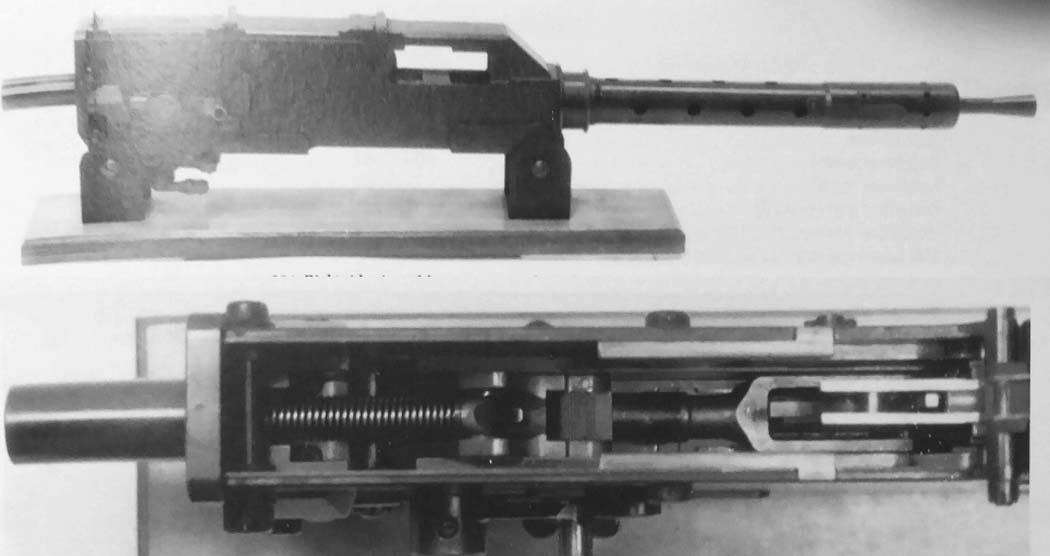
By the summer of 1933, the first prototype machine gun emerged. Kinematically, the weapon replicated the proven scheme developed by Hiram Maxim in the 1860s, specifically a short recoil barrel with a crank-type bolt mechanism. However, the configuration of the design underwent significant changes. The return spring, asymmetrically located on the left side in the basic design, was repositioned along the axis of the machine gun, which allowed for a narrower bolt carrier. This arrangement earned the machine gun the unofficial designation “Vickers central action.” The barrel was shortened by 112 mm, measuring 609.6 mm instead of 721 mm on older Vickers models. The mass of the recoiling parts was reduced by 340 grams, and the recoil stroke was slightly decreased, which shortened the cycle time and consequently increased the rate of fire. Thanks to more efficient muzzle boosters, the rate of fire was raised to 1250 rounds/min. The weight of the machine gun body was reduced to a very acceptable 9.5 kg, compared to 11.5 kg for the Vickers Mk.III.
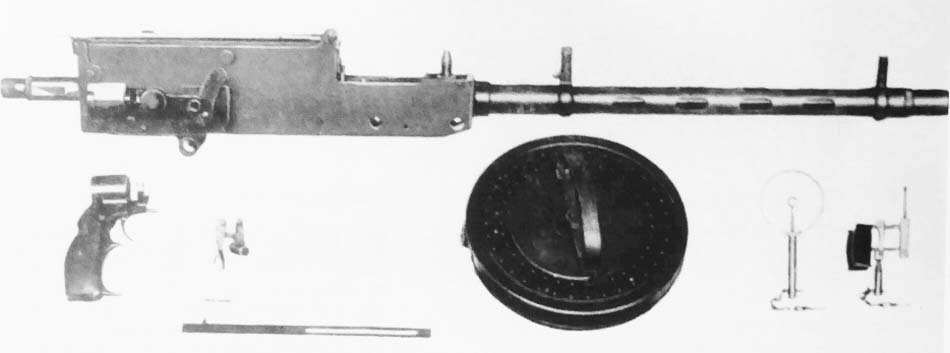
The machine gun was simultaneously developed as a universal weapon for both offensive use with dual-sided belt feeding and defensive flexible use, where the receiver could be easily changed for a 66-round drum magazine. The turret version, however, was slightly heavier due to the need for a pistol grip with a trigger, a ring sight, and the magazine itself, which weighed 3.8 kg when loaded. The total weight of the turret machine gun with a loaded magazine was 13.8 kg, almost identical to the Vickers Class F turret variant. However, the rate of fire of the turret version was deliberately reduced to 1125 rounds/min by increasing the hole in the muzzle booster cup. This seemingly illogical decision was made out of concern for too rapid ammunition consumption by bomber gunners.
Competition and Design Refinements
Naturally, during the refinement period, several drawbacks of the weapon were identified. In the first prototypes, instances of powder gas leakage from an improperly closed bolt, problems with spent casing ejection, and insufficient effectiveness of the rear buffer spring were observed. Nevertheless, the machine gun was generally evaluated positively.
On November 1, 1933, the British War Ministry ordered four specimens of the new “Vickers central action” machine gun for comparative competitive trials to select a promising new-generation aircraft machine gun. At this time, hoping to enter the international market, the machine gun received the traditional export designation Vickers Class J.
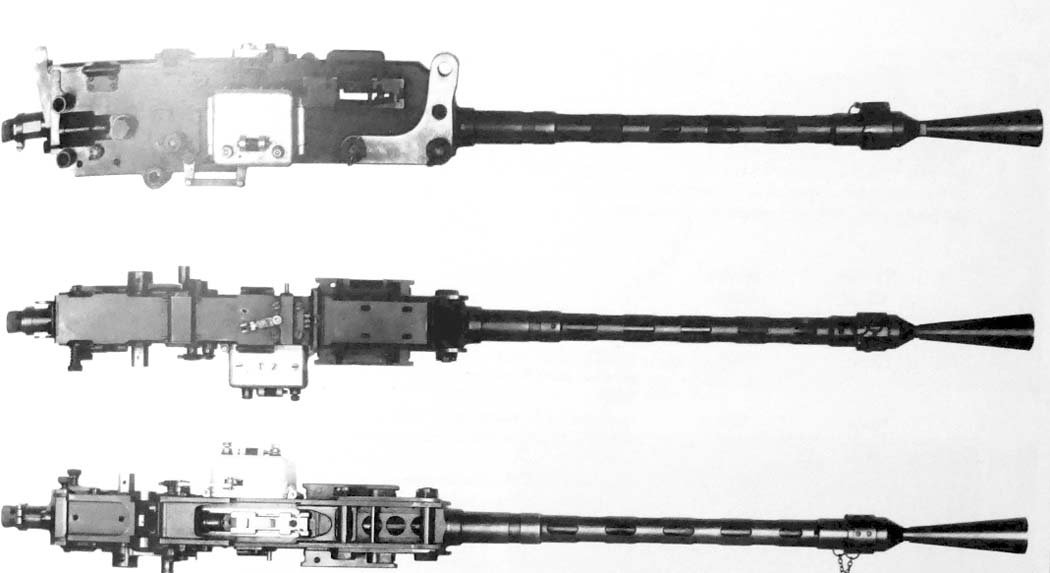
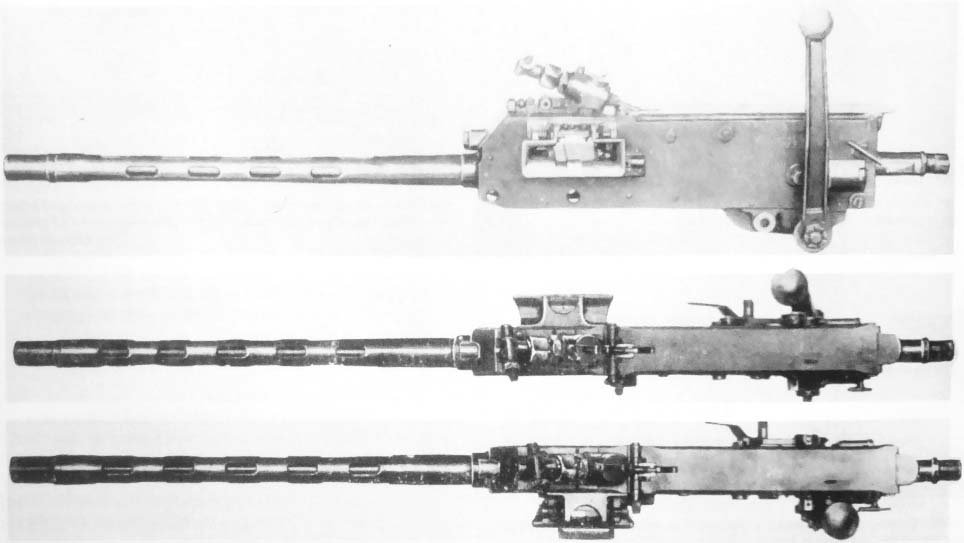
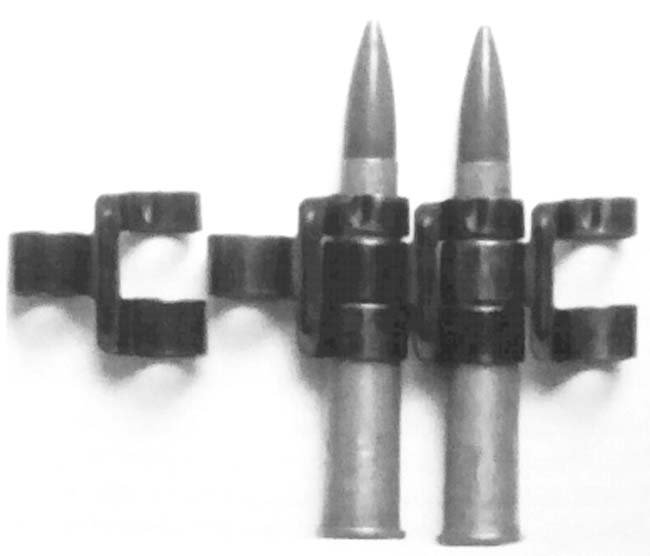
By then, the development team led by Percy Hayson had further refined the machine gun, offering several modifications. The main changes affected the offensive version. Firstly, the cumbersome, archaic charging handle, inherited from older Vickers models, was finally eliminated. Instead, pneumatic or electromechanical reloading mechanisms, which could be mounted on either side of the receiver, were optionally offered. Both mechanical and electromagnetic trigger mechanisms were also permitted. A new belt with lightweight stamped links was also developed.
For export sales, Vickers Class J machine guns were offered not only in the standard British .303” (7.7x56R) caliber but also for the German 7.92x57mm Mauser cartridge.
Thus, by the time of the competition in the summer of 1934, the Vickers Class J represented a fully modern example of aircraft armament. Besides it, Vickers also presented another machine gun, the Vickers Class K turret variant (also known as Vickers Gas Operated or VGO), which, unlike classic “Vickers” systems, featured gas-operated automation based on Berthier’s patents.
Foreign companies also presented their latest developments for the competition. These included the French Darn Model 1933, the Danish Madsen Model 1927, the Hungarian Gebauer (apparently Model 1934.M GKM), the American Browning M1919, and Colt’s latest development based on the same Browning – the rifle-caliber AN-M2 aircraft machine gun.
Among the presented samples, the Vickers Class J machine gun generally looked good. It had a well-known design and was versatile. The Gebauer and Vickers-K only had magazine feeding, and thus potential application only as defensive armament. The Brownings only had belt feeding, which also limited their use to the offensive variant. The Darn and Madsen allowed the use of both magazines and belt feeding, but the former, despite having the highest rate of fire among the contestants, was still, in essence, an underdeveloped sample suffering from teething problems. The Madsen, conversely, had a good reputation but featured complex mechanics and was the most expensive.
Testing of the presented machine guns continued almost until the end of 1934, involving firing on the range and in the air. It is known that regarding the Vickers-J, a pair of synchronized machine guns with a pneumatic charging system of this type were installed on a Bristol Bulldog fighter, showing good reliability.
Legacy and Conclusion
However, unexpectedly, it was precisely the classic, well-known scheme that became the nail in the coffin for this weapon. Despite the combat and operational characteristics of the Vickers-J machine gun being generally on par with competing projects, Air Force representatives rightly concluded that the potential of the ancient Maxim’s kinematic scheme, in this particular embodiment, had reached its ceiling, and there was practically no possibility of further maintaining the machine gun at a global standard. Therefore, the Vickers-J “dropped out of the race” at an early stage of the competition.
Subsequent events showed that this decision was justified.
Ultimately, two machine gun models reached the final: the Vickers-K turret model and the American Browning AN-M2. While the magazine-fed Vickers-K only briefly stayed in aviation – the era of open, compact, manually operated turrets would disappear forever within five years – John Moses Browning’s magnificent creation, re-engineered for the British cartridge and firing from a “not fully closed” bolt, under the designation .303 Browning Mk.II, became the primary armament not only of Britain’s fighter aircraft by the start of the war. Mounted in twin and quadruple installations in mechanized turrets, Brownings served throughout the war as defensive armament for British heavy bombers. The immense potential of the machine gun, laid down by Browning in the 1920s, allowed it to consistently remain relevant. Its initially ordinary rate of fire, around 1150-1200 rounds/min, was eventually increased to 1500 and even 1900 rounds/min.
As for the Vickers “central action” Class J machine gun, it remained merely a historical footnote, the last and most sophisticated attempt to keep the classic design at world standards. Only about two dozen prototypes were manufactured. Foreign customers were also not interested in the development. Only the Japanese, in 1935, purchased several units for study. Already having their licensed version of the Vickers Class E in service, they were interested in keeping it up to modern standards and apparently studied the experience of their “teachers.” But even in the Land of the Rising Sun, the Vickers Class J design did not find further development.
Technical Specifications
| Modification | Class J |
| Caliber, mm | 7.7 |
| Type of automation | short recoil |
| Machine gun body mass, kg | 9.53 (9.92 for turret version) |
| Total mass, kg | 10.89 (13.8 for turret version with loaded magazine) |
| Length, mm | 1138.9 |
| Barrel length, mm | 609.6 |
| Rate of fire, rounds/min | 1250 (1125 for turret version) |
| Muzzle velocity, m/s | 760-840 |
| Magazine capacity | Belt, or 66-round magazine |
| Bullet mass, g | 11 – 13 |
| Cartridge type | 7.7x56R .303 British |
Image gallery of the Vickers Class J Machine Gun