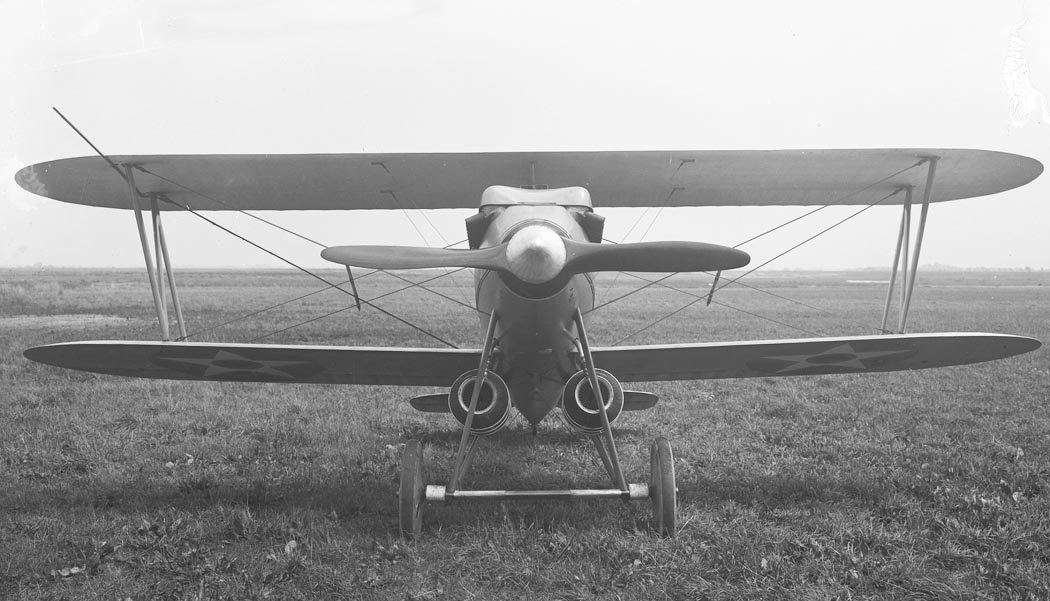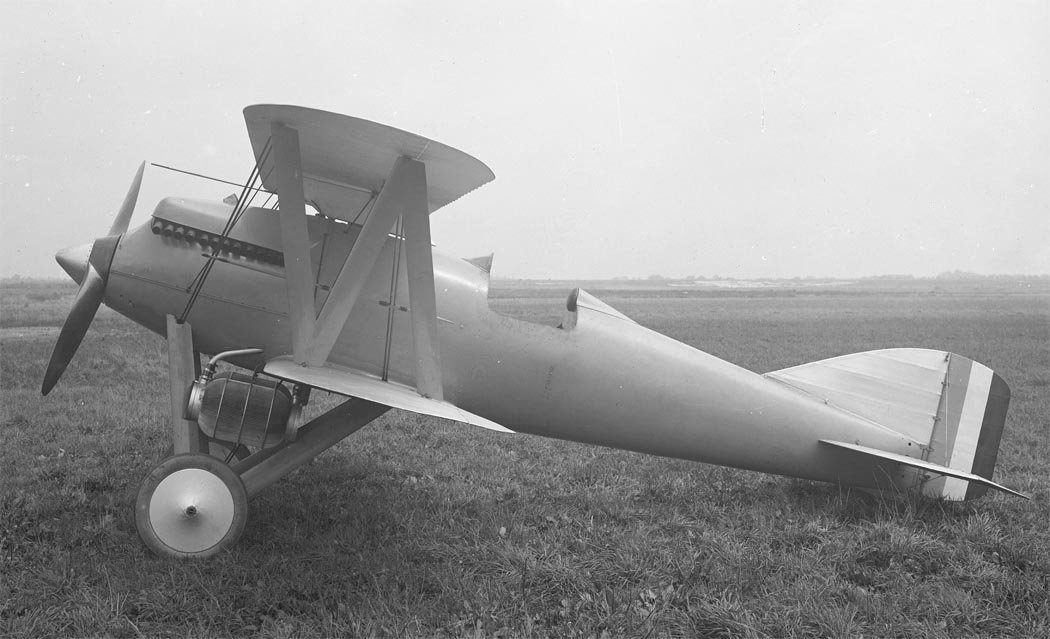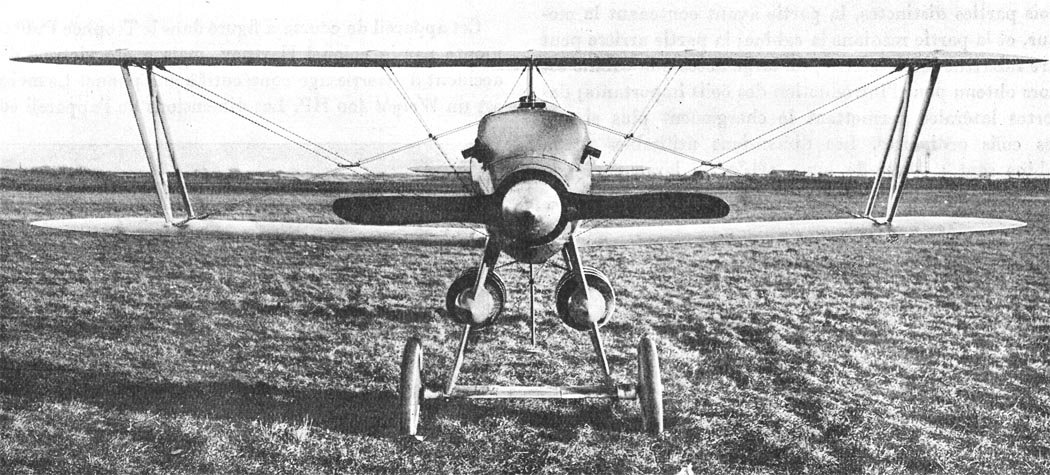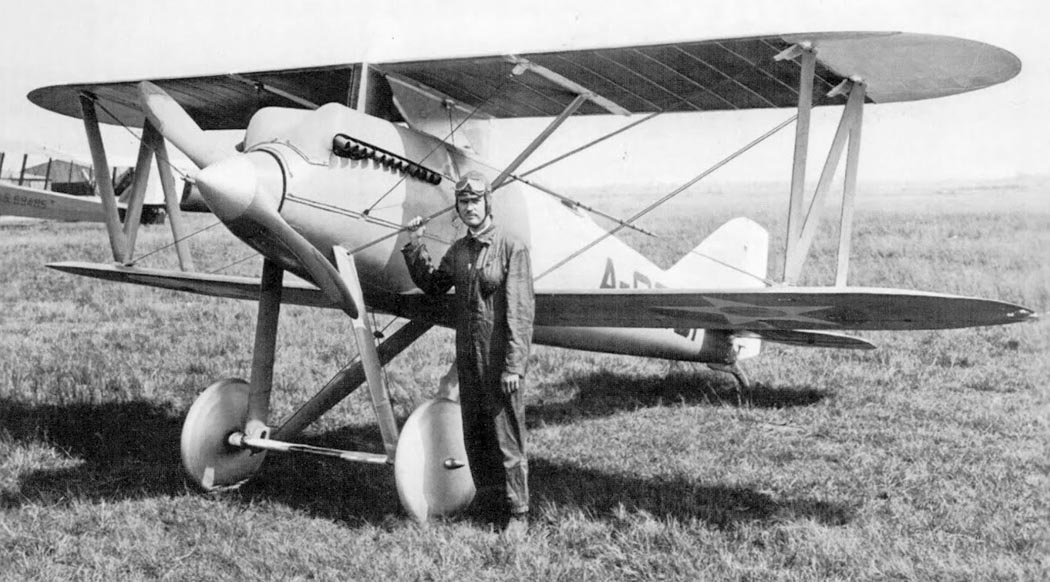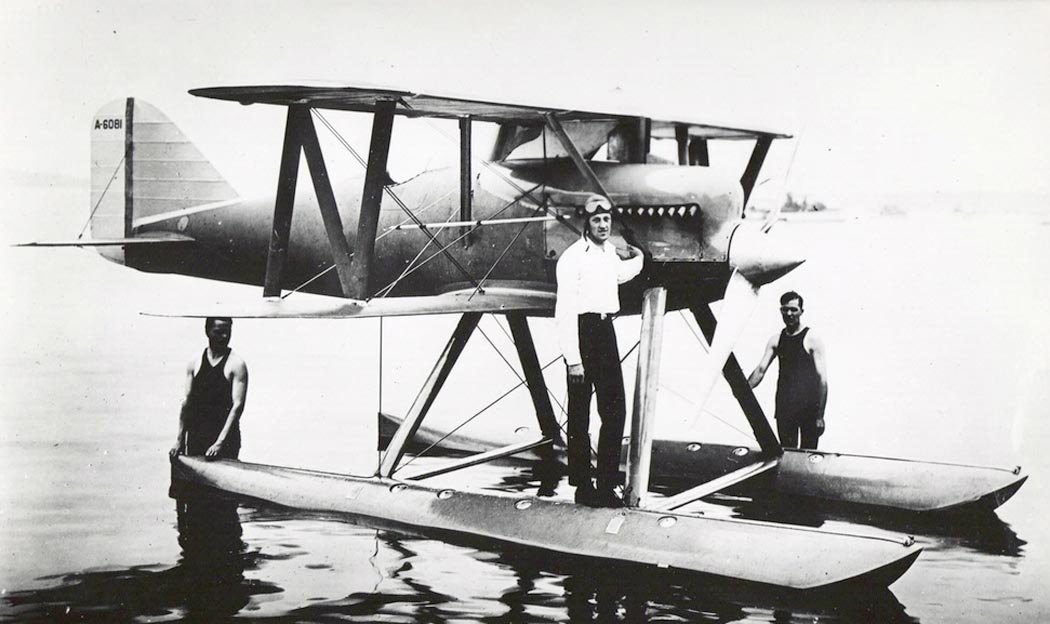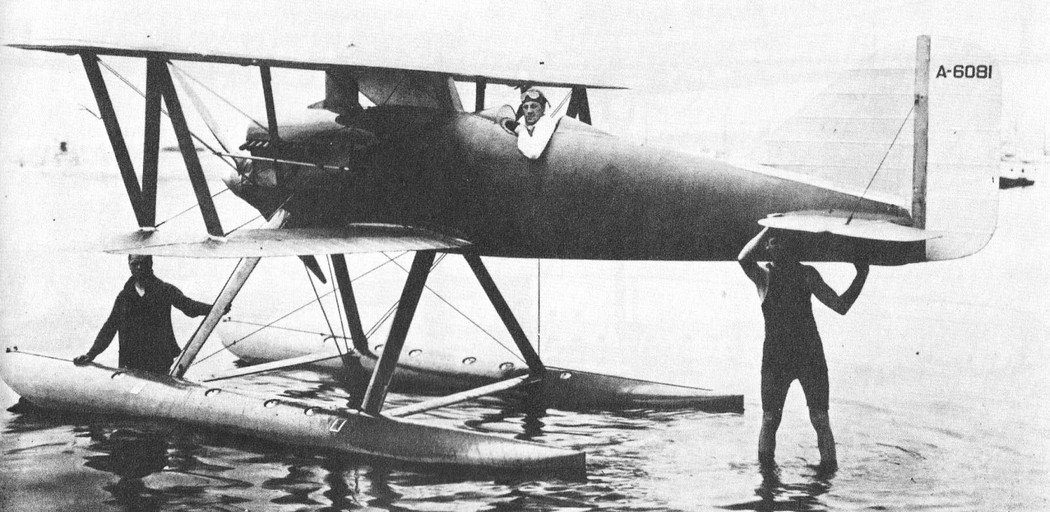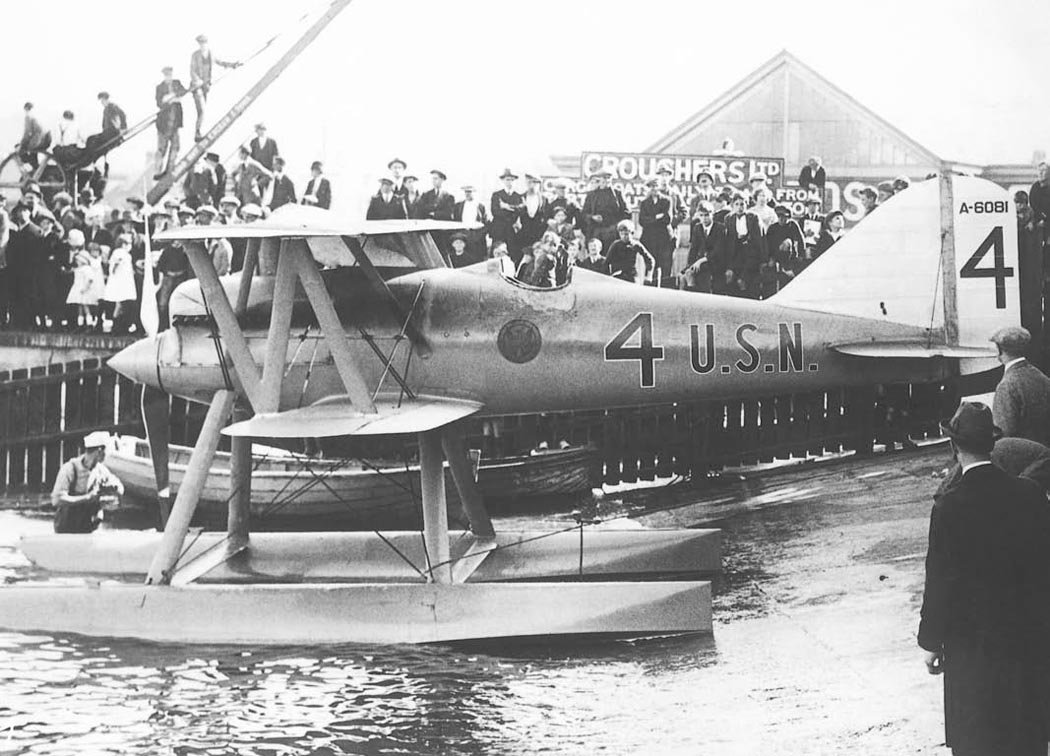
During this period, the Curtiss company focused on the more powerful “Navy Racer” aircraft. It was created in 1921 by designers Boose and Thurston, in parallel with the R6, and received the designation CR-1. The “Navy Racer” was significantly inferior to the “Army-Racer” because it was equipped with the same D-12 engine but had slightly larger dimensions and mass. Lamblin radiators were installed.
An improved variant with wing surface radiators, designated CR-2, was subsequently developed. In 1923, the Curtiss firm increased the engine’s power to 500 hp. These machines were later converted into Curtiss Model 23A seaplanes (modern designation L-17-3) to participate in the 1928 Schneider Trophy competitions held in Great Britain.
Innovation and Competition Performance
Along with a modified landing gear, these aircraft featured new Curtiss D-12 engines with 465 hp and Curtiss-Reed metal propellers. The combination of new engines and propellers allowed two aircraft, under the designation CR-3, to take first and second places in the race. However, development went beyond simply installing a new engine on the CR-2, as the new variant of the “Navy Racer” received the designation R2C1.
The R2C1 featured an elongated nose section, smoothly transitioning into a pointed spinner for the metal propeller. The upper wing was not mounted above the fuselage, as was customary at the time, but was attached directly to it. Moreover, the wing had a new profile, selected after numerous tests in a wind tunnel. The landing gear struts and wheels were completely redesigned based on the “Army-Racer,” with strictly lenticular wheels of minimal cross-section.
As a result of all these changes, the “Navy Racer” biplane achieved a drag coefficient even lower than that of the latest French “Sesquiplane.” The aircraft’s airframe mass was remarkably low. Despite its larger size, the fuselage was lighter than the “Army-Racer,” weighing only 56 kg. Overall, each horsepower of engine power accounted for only 1.42 kg of the aircraft’s mass, a significantly low figure compared to other aircraft of the era.
World Records and Biplane’s Legacy
On October 6, 1923, American naval aviator Williams set a record in the new machine over a 100 km distance: 325.497 km/h. Even a year later, in the new Nieuport-Delage-42 aircraft with a 550 hp engine, Sadi-Lecointe could not fly that distance faster. However, the R2C1, which received a new Curtiss V-1400 engine with 610 hp in 1924, won the Pulitzer Cup again on October 6. The same Williams flew 200 km at a speed of 400.625 km/h.
This speed no longer surprised anyone in 1924, as on November 2 and 4, 1923, at Mitchell Field, pilots Brou and Williams, in identical R2C1 “Navy Racers,” had shown 425 km/h and 417.059 km/h respectively. A new record over a 1 km base was also set then. Williams climbed to 1000 m and then dived almost vertically. Accelerating his machine on the descent to an enormous speed and leveling it into horizontal flight over the measured base, he unexpectedly found himself in a very difficult situation.
Right in front of him, a squadron of bombers was flying a demonstration pass. Williams “dived” under their formation and continued flying at a height of… 3 m! When the chronometers calculated the average speed, it turned out to be 429.025 km/h. This curious record, which held for over a year, became the biplane’s swan song.
The End of the Racing Biplane Era
It was never destined to outperform its “monoplane brother.” And although new biplane fighters with higher flight speeds than the “Navy Racer” appeared in the 1930s (the best of them being the Soviet I-153 “Chaika”), they all lagged behind monoplanes in speed.
The Wright company, like Curtiss, also turned to creating racing biplanes after the failure of 1920. Similar machines with more powerful engines were developed in parallel with the “Army” and “Navy Racers.” However, due to their greater weight and slightly worse aerodynamics, they could not surpass Curtiss’s racing aircraft. The high-speed Wright R-2 aircraft with a 650 hp engine reached a speed of 386 km/h.
At the same time, racing monoplanes of this period could not yet catch up with the “Navy Racer,” although many of them had some potential. For instance, in 1922, the “Simplex Carnier” racing monoplane, created by the Avion Simplex aviation society and designed as a tailless aircraft, crashed before a record flight, killing pilot Madan.
Technical Specifications
| Modification | CR-1 |
| Wingspan, m | 6.91 |
| Aircraft length, m | 6.40 |
| Aircraft height, m | 2.53 |
| Empty weight | 783 |
| Maximum takeoff weight | 978 |
| Engine type | 1 Piston engine Curtiss CD-12 |
| Power, hp | 1 x 450 |
| Maximum speed, km/h | 298 |
| Cruising speed, km/h | 267 |
| Flight duration, h.min | 1.30 |
| Crew, crew members | 1 |
Image gallery of the Curtiss CR Series ‘Navy Racer’