C-119 Flying Boxcar
Development and Design
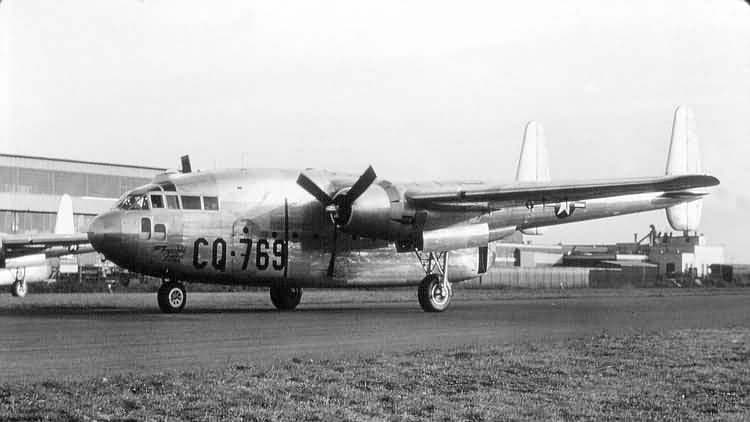
The C-119 Flying Boxcar was a medium military transport aircraft developed by the American firm Fairchild, based on the C-82 Packet transport aircraft. During 1947, Fairchild developed an improved variant of the C-82, the experimental XC-82B, which was a modernized production C-82A. It primarily featured a crew cabin moved to the aircraft’s nose and 28-cylinder Pratt & Whitney R-4360-4 Wasp Major radial engines, each producing 2650 hp.
The aircraft was launched into production under the designation C-119 Flying Boxcar. Production aircraft featured a fuselage widened by 0.36 m, a reinforced structure for handling greater loads, and more powerful R-4360-20 engines. These enhancements allowed it to perform demanding transport missions effectively.
Operational Deployment and Enhancements
Capable of accommodating up to 62 paratroopers and boasting increased cargo capacity, C-119 aircraft proved highly effective during operations in Korea and Vietnam. In 1961, Steward-Davis Inc. developed the Jet-Pak, a C-119 variant. This modification featured a Westinghouse J34-WE-36 turbojet engine with 1542 kgf thrust, installed in a specially designed fairing on the upper surface of the wing’s center section.
At least 26 C-119 aircraft of the Indian Air Force were fitted with a more powerful Orpheus jet engine. This modification ensured operation with an increased payload under “hot and high” conditions, extending their operational capabilities in challenging environments.
Specialized Variants
Modifications included the C-119F, featuring modernized propellers, with 480 units built. A C-119G modification was also developed with upgraded electronic equipment and propellers, further optimizing its performance and operational versatility.
The AC-119G, created in 1968, was a gunship aircraft based on the C-119G. It featured an armored fuselage and a 10-person crew. Its armament included four 7.62 mm GAU-2B/A six-barrel machine guns, housed in SUU-11B/A containers, each with 1500 rounds per gun.
Finally, the AC-119K, an attack aircraft developed in 1969 from the C-119K, incorporated an APQ-133 radar. Its armament was further enhanced with four 7.62 mm GAU-2B/A six-barrel machine guns in SUU-11B/A containers and two 20 mm M61A1 Vulcan six-barrel cannons in SUU-16/A containers, making it a formidable close air support platform.
Technical Specifications
| Modification | C-119 J |
| Wingspan, m | 33.30 |
| Length, m | 26.36 |
| Height, m | 8.03 |
| Wing area, m2 | 130.06 |
| Empty weight | 18136 |
| Maximum takeoff weight | 33748 |
| Internal fuel, l | 9925.3 |
| Engine type | 2 Piston engines Wright R-3350-89W |
| Power, hp | 2 x 3400 |
| Maximum speed, km/h | 476 |
| Cruising speed, km/h | 322 |
| Practical range, km | 3669 |
| Operational range, km | 2848 |
| Service ceiling, m | 7284 |
| Crew | 4-5 crew |
| Payload | 78 soldiers or 62 paratroopers or 9070 kg of cargo |
Image and diagram gallery of the C-119 Flying Boxcar
 C-119 Flying Boxcar |
 C-119 Flying Boxcar |
 C-119 Flying Boxcar |
 C-119 Flying Boxcar |
 C-119 Flying Boxcar |
 C-119 Flying Boxcar |
 C-119 Flying Boxcar |
 C-119 Flying Boxcar |
 C-119 Flying Boxcar |
 C-119 Flying Boxcar |
 C-119 Flying Boxcar |
 C-119 Flying Boxcar |
 C-119 Flying Boxcar |
 C-119 Flying Boxcar |
 C-119 Flying Boxcar |
ArchivoAéreo Editorial Team
A group of aviation researchers and enthusiasts dedicated to documenting and preserving global aeronautical history. All articles are reviewed to ensure historical accuracy.
Sources & Accuracy
The information presented in this technical sheet has been compiled from declassified flight manuals, historical archives, and specialized literature. While we strive for maximum accuracy, some performance data may vary depending on the specific variant or operational conditions.