C-119 Flying Boxcar
Development and Design
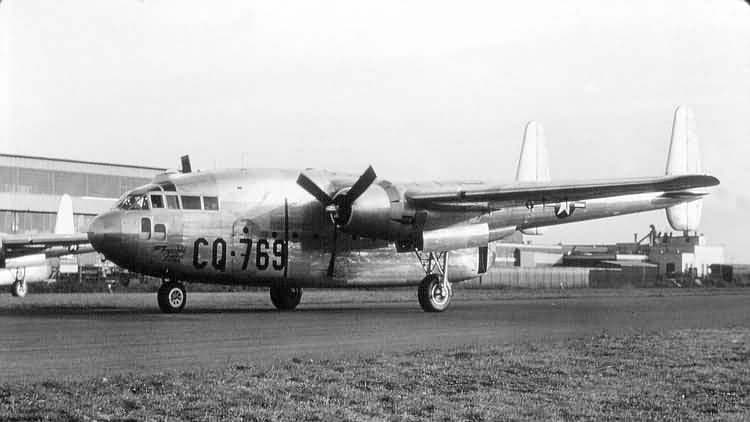
The C-119 Flying Boxcar was a medium military transport aircraft developed by the American firm Fairchild, based on the C-82 Packet transport aircraft. During 1947, Fairchild developed an improved variant of the C-82, the experimental XC-82B, which was a modernized production C-82A. It primarily featured a crew cabin moved to the aircraft’s nose and 28-cylinder Pratt & Whitney R-4360-4 Wasp Major radial engines, each producing 2650 hp.
The aircraft was launched into production under the designation C-119 Flying Boxcar. Production aircraft featured a fuselage widened by 0.36 m, a reinforced structure for handling greater loads, and more powerful R-4360-20 engines. These enhancements allowed it to perform demanding transport missions effectively.
Operational Deployment and Enhancements
Capable of accommodating up to 62 paratroopers and boasting increased cargo capacity, C-119 aircraft proved highly effective during operations in Korea and Vietnam. In 1961, Steward-Davis Inc. developed the Jet-Pak, a C-119 variant. This modification featured a Westinghouse J34-WE-36 turbojet engine with 1542 kgf thrust, installed in a specially designed fairing on the upper surface of the wing’s center section.
At least 26 C-119 aircraft of the Indian Air Force were fitted with a more powerful Orpheus jet engine. This modification ensured operation with an increased payload under “hot and high” conditions, extending their operational capabilities in challenging environments.
Specialized Variants
Modifications included the C-119F, featuring modernized propellers, with 480 units built. A C-119G modification was also developed with upgraded electronic equipment and propellers, further optimizing its performance and operational versatility.
The AC-119G, created in 1968, was a gunship aircraft based on the C-119G. It featured an armored fuselage and a 10-person crew. Its armament included four 7.62 mm GAU-2B/A six-barrel machine guns, housed in SUU-11B/A containers, each with 1500 rounds per gun.
Finally, the AC-119K, an attack aircraft developed in 1969 from the C-119K, incorporated an APQ-133 radar. Its armament was further enhanced with four 7.62 mm GAU-2B/A six-barrel machine guns in SUU-11B/A containers and two 20 mm M61A1 Vulcan six-barrel cannons in SUU-16/A containers, making it a formidable close air support platform.
Technical Specifications
| Modification | C-119 J |
| Wingspan, m | 33.30 |
| Length, m | 26.36 |
| Height, m | 8.03 |
| Wing area, m2 | 130.06 |
| Empty weight | 18136 |
| Maximum takeoff weight | 33748 |
| Internal fuel, l | 9925.3 |
| Engine type | 2 Piston engines Wright R-3350-89W |
| Power, hp | 2 x 3400 |
| Maximum speed, km/h | 476 |
| Cruising speed, km/h | 322 |
| Practical range, km | 3669 |
| Operational range, km | 2848 |
| Service ceiling, m | 7284 |
| Crew | 4-5 crew |
| Payload | 78 soldiers or 62 paratroopers or 9070 kg of cargo |
Image and diagram gallery of the C-119 Flying Boxcar
 C-119 Flying Boxcar |
 C-119 Flying Boxcar |
 C-119 Flying Boxcar |
 C-119 Flying Boxcar |
 C-119 Flying Boxcar |
 C-119 Flying Boxcar |
 C-119 Flying Boxcar |
 C-119 Flying Boxcar |
 C-119 Flying Boxcar |
 C-119 Flying Boxcar |
 C-119 Flying Boxcar |
 C-119 Flying Boxcar |
 C-119 Flying Boxcar |
 C-119 Flying Boxcar |
 C-119 Flying Boxcar |
Equipo Editorial de ArchivoAéreo
Grupo de investigadores y entusiastas de la aviación dedicados a documentar y preservar la historia aeronáutica mundial. Todos los artículos son revisados para garantizar precisión histórica.
Fuentes y Rigurosidad
La información presentada en esta ficha técnica ha sido compilada a partir de manuales de vuelo desclasificados, archivos históricos y bibliografía especializada. Aunque nos esforzamos por mantener la máxima precisión, algunos datos de rendimiento pueden variar según la variante específica o las condiciones operativas.