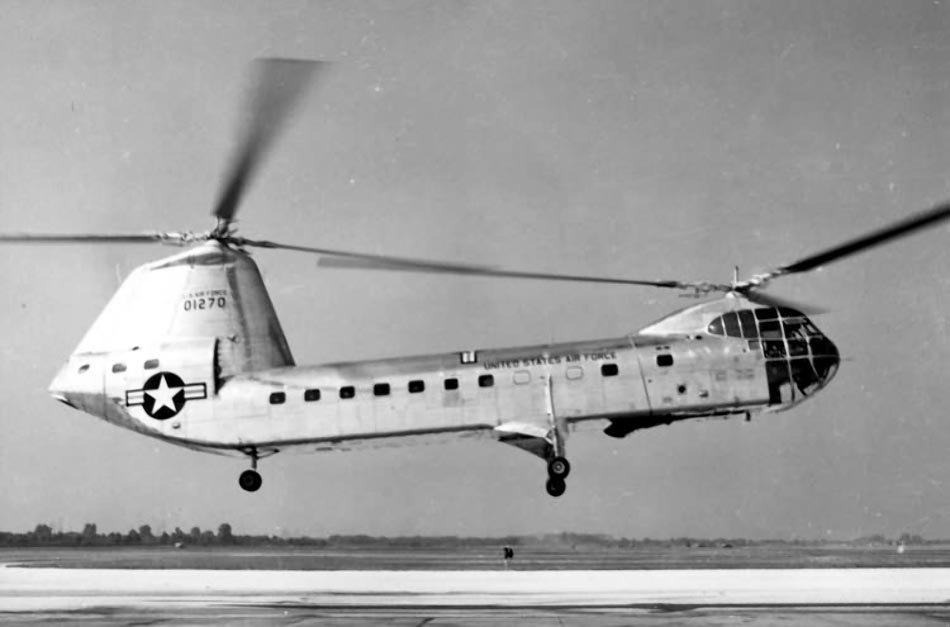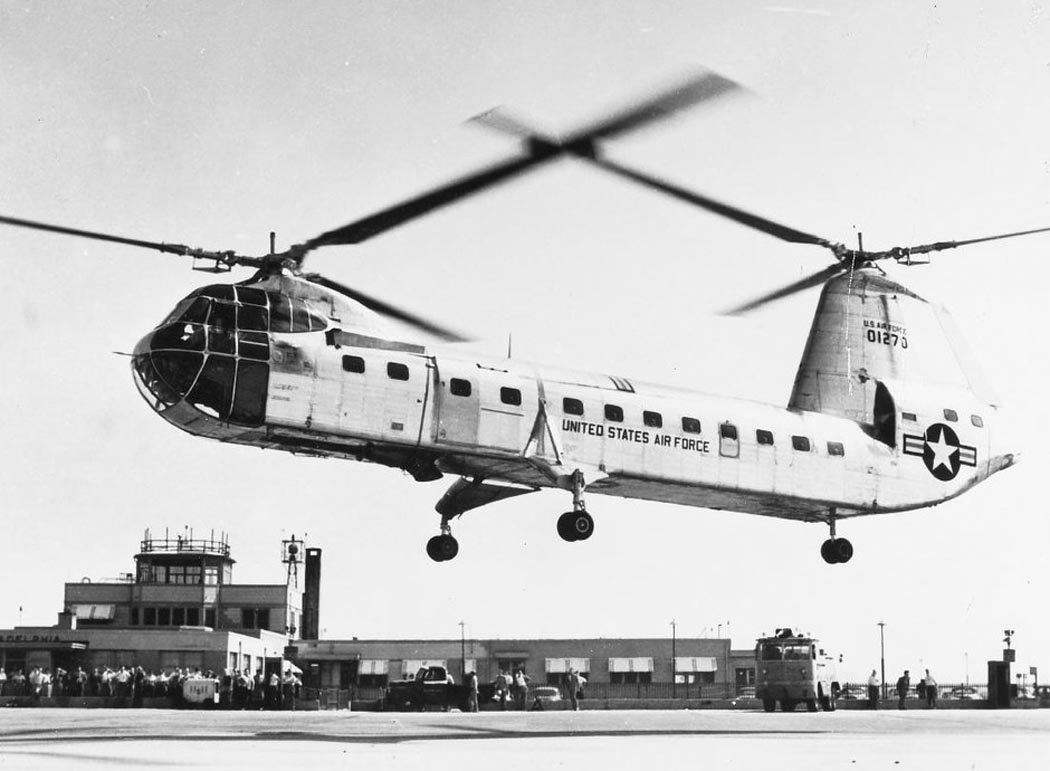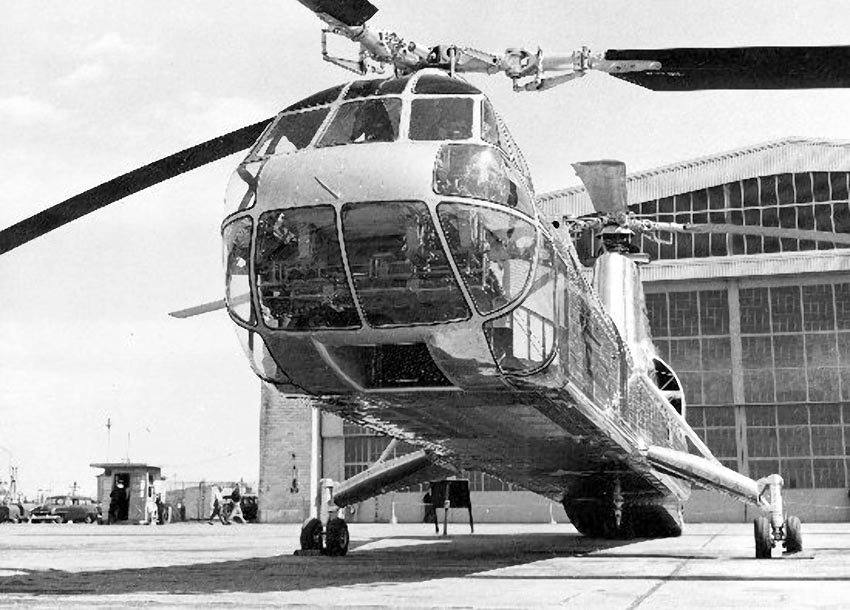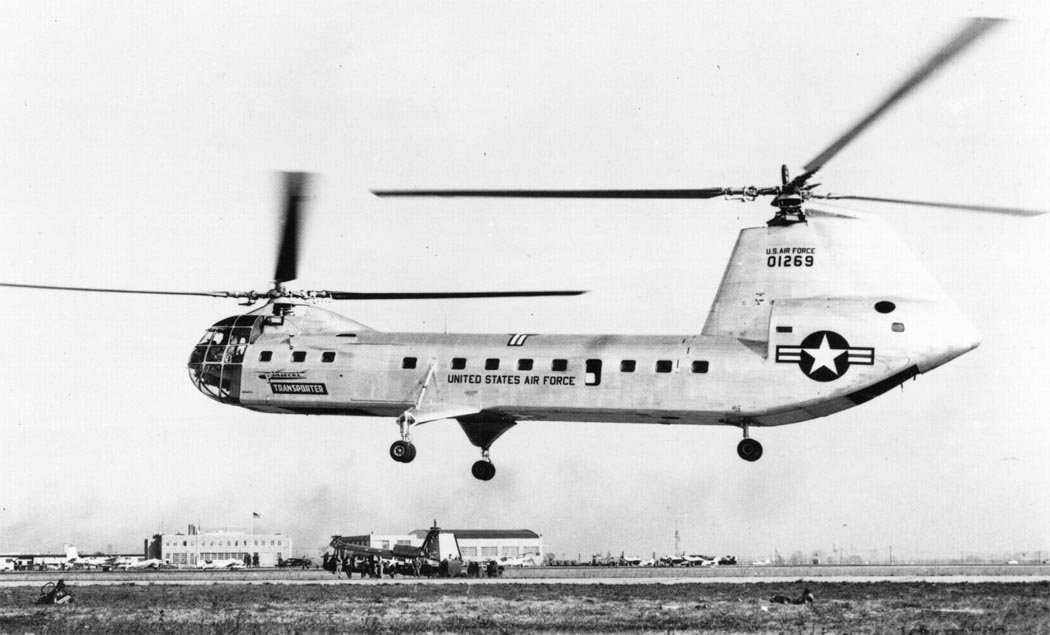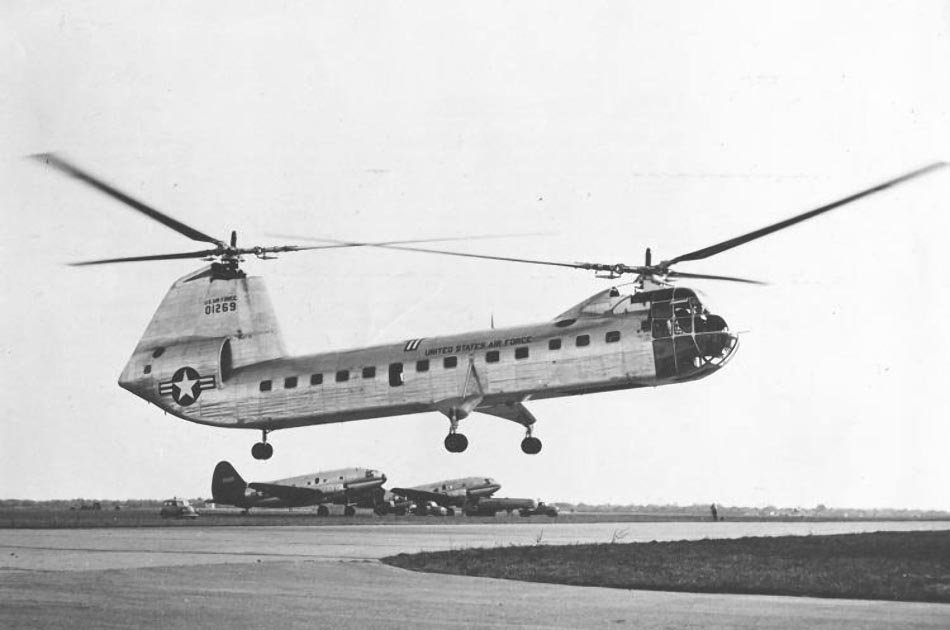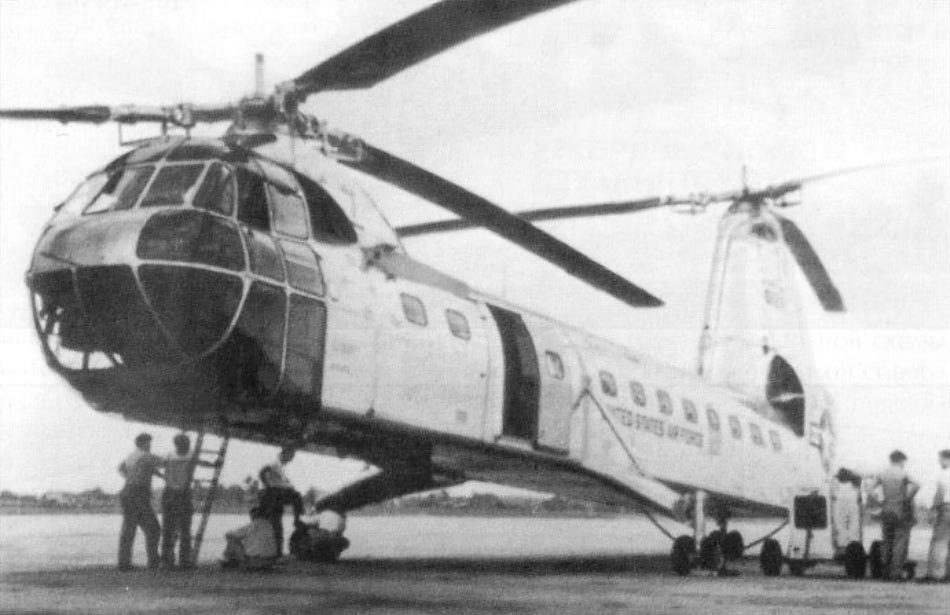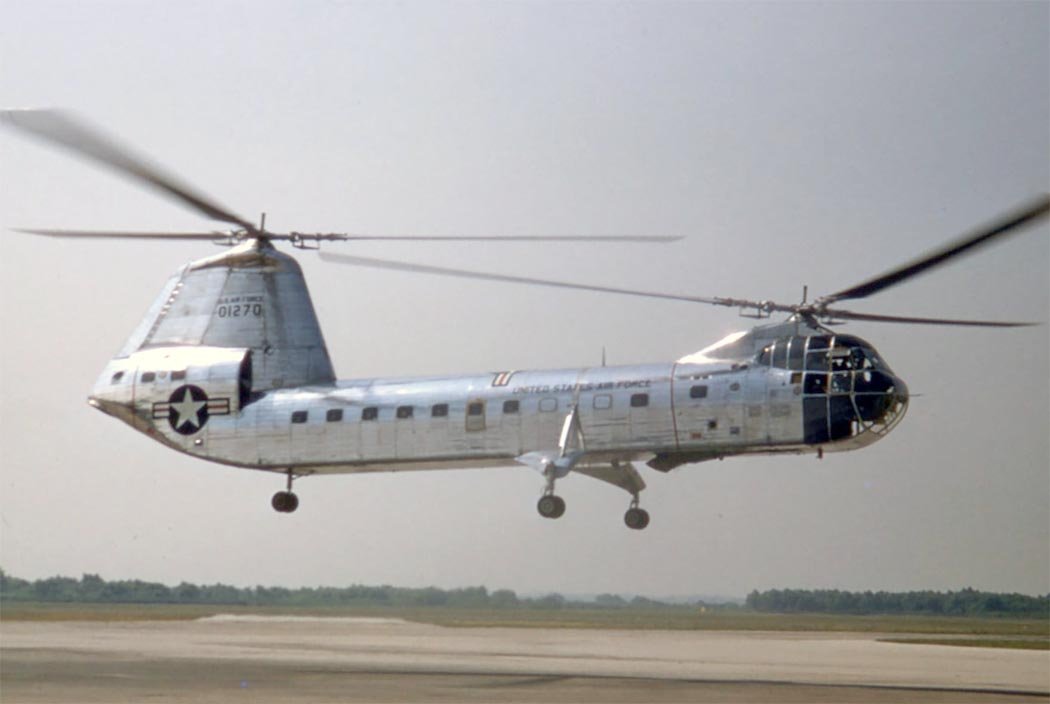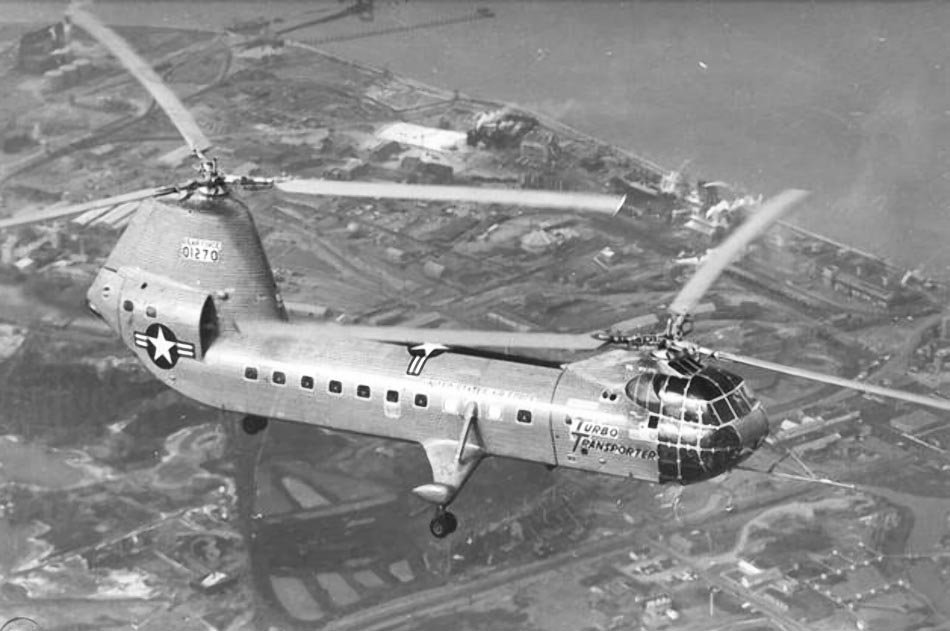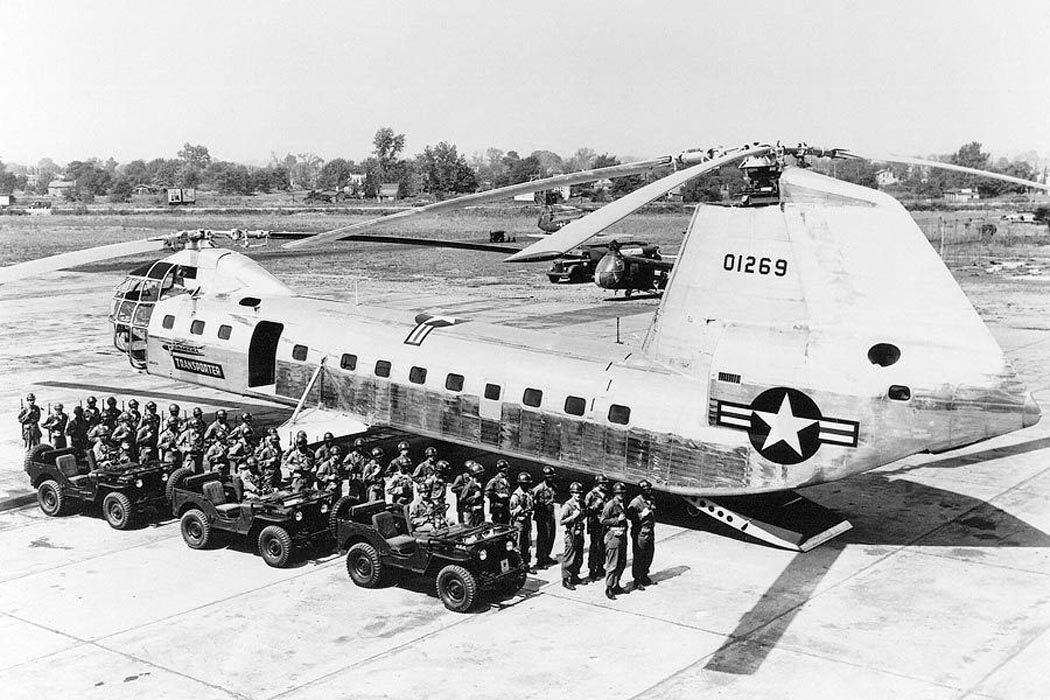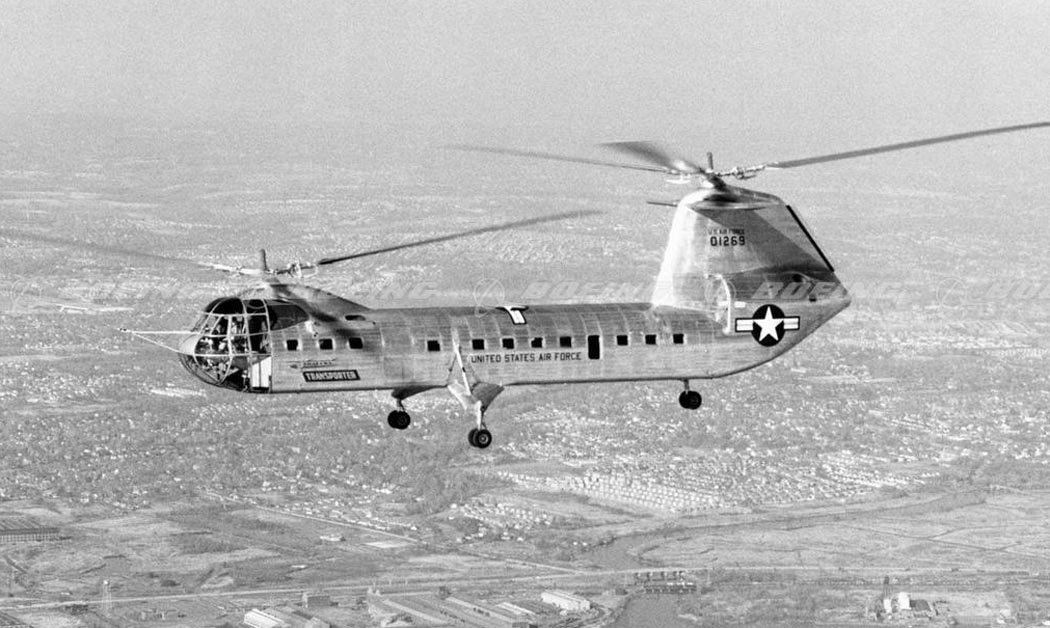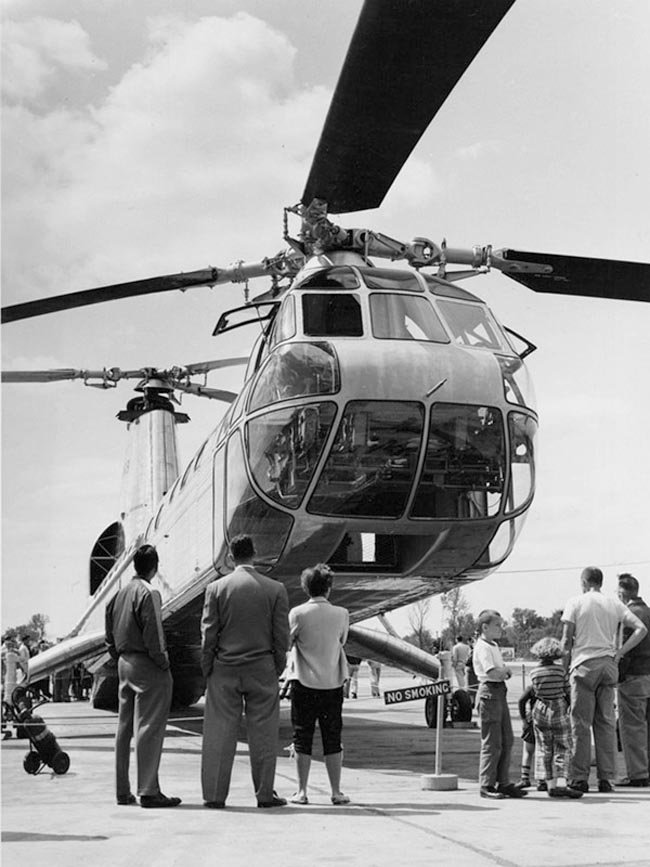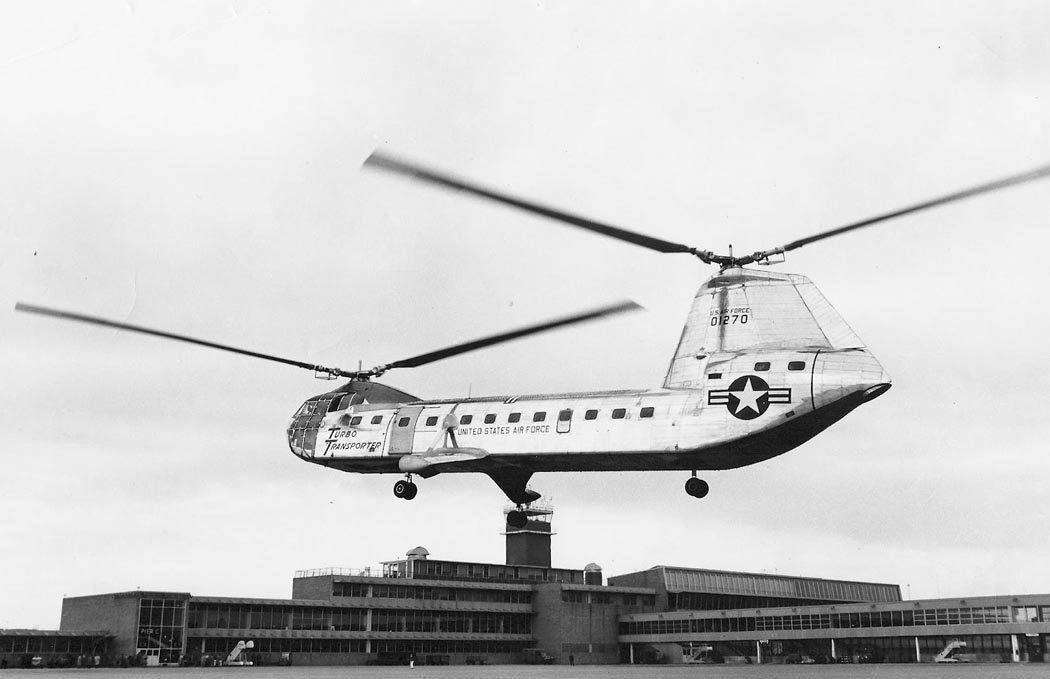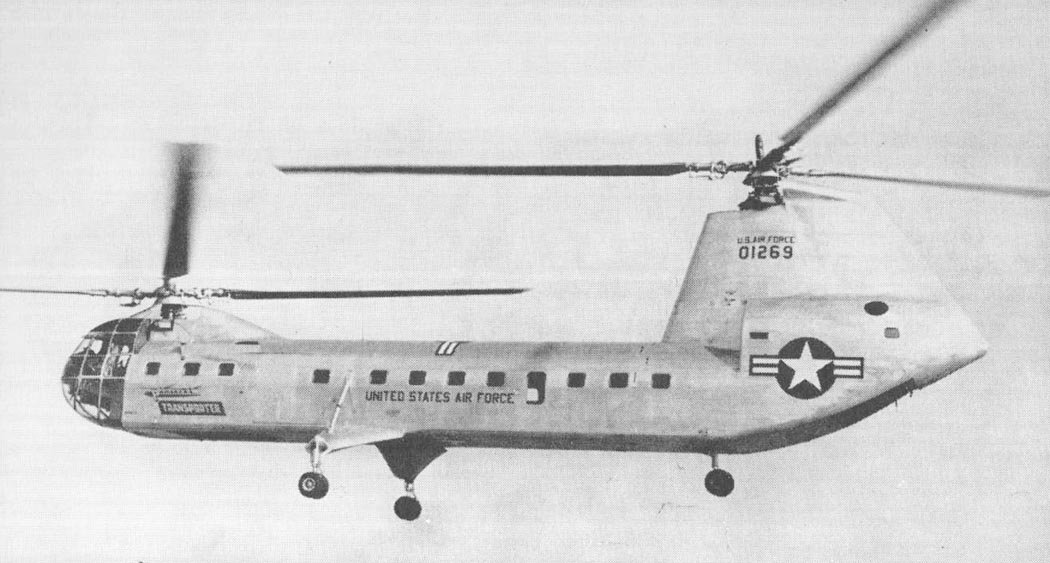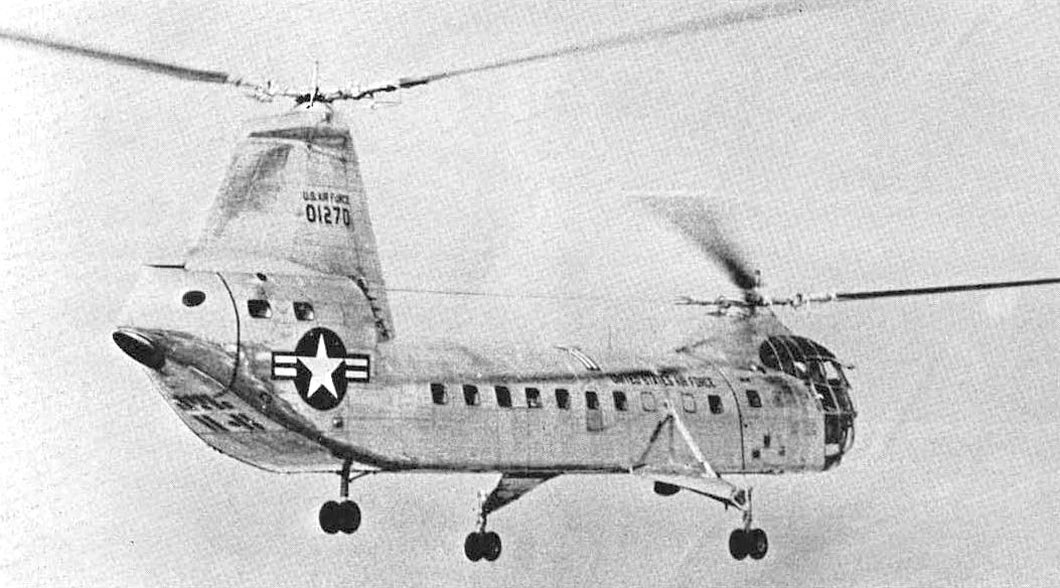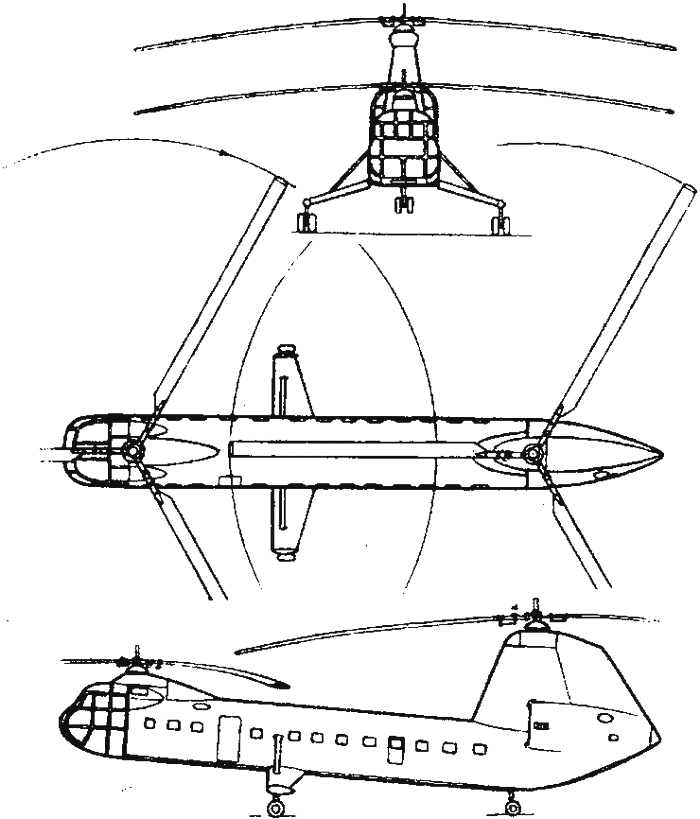
In 1948, Piasecki company began designing a huge tandem-rotor helicopter, intended for transporting 40 paratroopers with full armament (in its commercial modification, up to 50 passengers) and a two-person crew. The machine was designated XH-16 “Transporter”. Photographs of a model of one of the first XH-16 variants are still capable of striking the imagination today: a double-decker helicopter!
The overall layout was traditional, already established by Piasecki engineers. The distinctive feature was its very high landing gear struts. Due to the large ground clearance under the helicopter’s belly, an additional cargo-passenger container was envisioned—a “zero floor” with a retractable pallet. This pallet was interchangeable with the one used by the Fairchild C-120 transport aircraft, thus establishing a unified aircraft-helicopter transport chain.
Great attention was paid to ensuring a wide range of center of gravity locations, as the helicopter was intended for transporting equipment, such as three jeeps at once. During the design process, ambitions were tempered: the “zero floor” was abandoned, and the landing gear struts were shortened. The XH-16 was the first American helicopter to be equipped with two engines.
Each engine rotated “its own” main rotor, and the rotors were linked by a synchronizing shaft. Piston engines were planned for the first prototype, with gas turbine engines for the second. Other layout features included a deployable ramp in the tail section of the fuselage and a developed fin-pylon for the rear rotor. In addition to the ramp, a door was located on the left side, closer to the front of the fuselage.
Funding and Initial Prototype
Initially, design work was funded by the US Air Force, with the Army later joining the program. The Air Force sought a long-range search and rescue helicopter, and subsequently, the H-16 was considered as a replacement for the “Mule” and “Horse,” while retaining its search and rescue capabilities. The development of what was intended to be the world’s largest helicopter proved protracted.
The YH-16 prototype was publicly demonstrated for the first time in September 1953 at Philadelphia Airport. The machine was fitted with Pratt & Whitney R-2180 air-cooled radial piston engines, each rated at 1650 hp. The main rotors were three-bladed.
Early Trials and Challenges
Ground resonance tests were successful. However, they fully demonstrated the imperfection of calculations, or more precisely, insufficient knowledge of the behavior characteristics of tandem-rotor helicopters. Piasecki, not without reason, feared premature spontaneous liftoffs of his creation, so the cabin was loaded with 50,000 pounds of ballast, and metal ingots were tied to the landing gear struts.
The total ballast mass reached 106,000 pounds (48 tons)—three times the normal takeoff weight. Nevertheless, during engine runs, the helicopter occasionally lifted off the ground. Journalists from several publications enthusiastically wrote about the powerful helicopter built by outstanding American engineers. In reality, such machine behavior indicated errors in the main rotor lift calculations.
Flight tests were accompanied by a noisy advertising campaign, and it seemed the machine was a success. Air Force pilots soon joined the flight test program, conducted at Edwards Air Force Base. In February 1954, a blade detached from one of the helicopter’s main rotors during a flight. The aircraft landed safely, but flight testing was suspended for four months.
In an August 1955 flight, one engine failed 25 km from the test center airfield. The helicopter managed to fly back to base and landed successfully again. Problems identified during flight tests concerned high vibration levels and the machine’s instability in forward flight.
The severity of this latter “ailment” can be traced through the evolution of the tail empennage. In the earliest photographs, dated 1953, the tail rotor pylon was clean. In early 1955, a free-standing stabilizer appeared at the top of the pylon. Closer to the autumn of the same year, the YH-16A’s tail was adorned with an ingenious structure, which could well be compared to a peacock’s tail.
Turbine Tests and Cancellation
In December 1955, flight tests began for the “turbine-powered” YH-16A, equipped with two Allison YT-38A-3 turboshaft engines, each producing 2650 hp. In December 1955, during a speed run, the company’s senior test pilot, Harold Peterson, set an unofficial world speed record of 166 mph. Peterson noted that the “Transporter’s” behavior in flight was more akin to that of a transport aircraft than a helicopter.
Major General Hamilton Howze of Army Aviation, riding “as a passenger,” witnessed the record flight. The general described the helicopter’s vibration in hover mode as “greatest,” but deemed the vibration level “acceptable” in forward flight. In January 1956, the YH-16A crashed during a test flight, after which the program was canceled.
Technical Specifications
| Модификация | YН-16A |
| Диаметр несущего винта, м | 25.00 |
| Длина,м | 40. 80 |
| Высота ,м | 7. 62 |
| Пустого | 10208 |
| Максимальная взлетная | 14500 |
| Тип двигателя | 2 ГТД Allison YT38-A-10 |
| Мощность, л.с. | 2 х 2650 |
| Максимальная скорость, км/ч | 235 |
| Крейсерская скорость, км/ч | 215 |
| Практическая дальность, км | 370 |
| Практический потолок, м | 5500 |
| Экипаж, чел | 2 |
| Полезная нагрузка: | 40 содат или 32 носилок |
Image and diagram gallery of the CH-16 Transporter